

A recurring rash can wear you down, especially when it affects somewhere you don’t want to discuss. Ironbark promises an answer as simple as showering.
The soap’s sales page speaks directly to that frustration. Before trusting it with your skin or card details, look past the success stories.
Overview
A Soap Marketed as an Antifungal Treatment
Ironbark is advertised for jock itch, athlete’s foot, ringworm, and other skin concerns. The pitch goes beyond ordinary cleansing or a pleasant shower experience.
The product page says the formula breaks through fungal biofilm in 60 seconds and presents it as an alternative to creams that supposedly fail.
Those are treatment claims. A finished-soap clinical trial supporting that rapid action was not provided in the material inspected.
Monthly Refills Were Already Selected
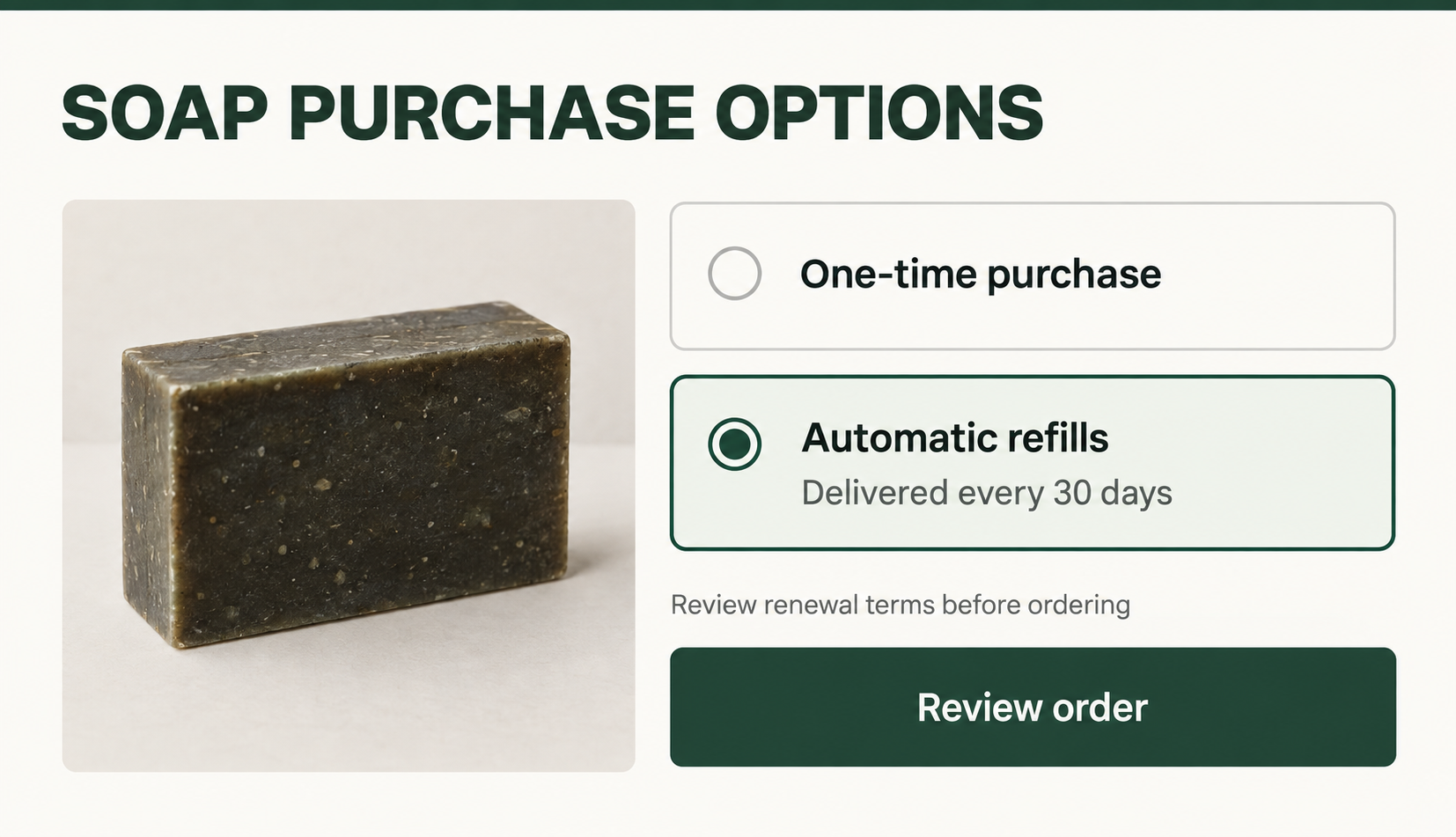
The illustration shows the purchase-choice distinction to watch for. Ironbark’s actual form was checked separately, not inferred from that example screen.
The visible purchase form had automatic refills checked, with a monthly delivery option selected. A shopper thinking about one package needs to notice that choice.
The page also says refills occur every 30 days. Recurring delivery is therefore a documented feature, not speculation based on the product category.
The product wasn’t purchased. Final checkout consent, later charges, and the practical success of cancellation were not tested.
The Refund Promises Don’t Agree
A prominent section promises a refund after a 60-day trial. A later FAQ describes 90 days. The formal return policy instead gives 30 days.
That policy also requires unused condition and excludes personal-care goods and sale items. Those restrictions sit awkwardly beside a soap sold through a discounted trial pitch.
The main concerns are:
- Strong infection-treatment promises without a demonstrated finished-product trial.
- A selected monthly refill option before purchase.
- Three different refund timelines across the same seller’s material.
- Return exclusions that could affect the very product being promoted.
- Medical reassurance that risks encouraging delayed diagnosis.
The Problem With the Claim That Creams Fail
The page frames conventional creams as surface treatments that miss a hidden fungal colony. Ironbark, by contrast, supposedly reaches the cause in a brief shower.
For someone who has already tried several products, that story can feel convincing. It gives a reason for disappointment and a new product to believe in.
But not every itchy patch is the same condition. A rash can be misidentified, aggravated by irritation, or treated for too short a time.
The CDC’s ringworm guidance describes antifungal medicines as treatment, with the choice depending on location and severity.
It specifically warns against steroid creams for a rash that may be ringworm. A seller’s criticism of creams shouldn’t obscure that important distinction.
Antifungal creams and steroid creams are not interchangeable. Nor does a failure with one preparation prove a branded soap will work better.
A Plausible Ingredient Is Not Proof of This Soap
Ironbark highlights tea tree oil, sulfur spring extract, witch hazel, and ceramide. Its FAQ adds other components and says the full list appears on packaging.
The National Center for Complementary and Integrative Health reports limited evidence for topical tea tree oil in some conditions.
That cautious background is not proof that this bar clears several infections, penetrates biofilm in one minute, or outperforms a prescription.
Concentration, contact time, formulation, and the condition being treated matter. A wash-off soap isn’t automatically equivalent to an ingredient preparation used in a study.
The site doesn’t provide enough clinical detail to bridge that gap. Don’t use a familiar plant name as a shortcut around the missing product evidence.
The promotional ingredient descriptions don’t state the tea tree oil concentration for the fast-action promise. That prevents matching its brief contact time with a tested preparation.
A label should also distinguish cleansing directions from medical treatment instructions. Ask whether the claimed use was tested on the same finished bar being sold.
How the Ironbark Purchase Funnel Works
Step 1: Embarrassment Makes a Private Fix Attractive
The testimonials describe relationship difficulties, uncomfortable workouts, and years of unsuccessful treatment. They make the purchase feel like a way to regain normal life.
That emotional framing is powerful because shoppers may want to avoid another uncomfortable conversation. The easier option is to order quietly.
The page’s stories remain seller-presented testimonials, not independently authenticated medical histories. They cannot diagnose your rash or predict your response.
You deserve practical help without shame. A clinician or pharmacist has seen these problems before and can help identify what treatment actually fits.
Step 2: A Rapid Mechanism Replaces Clinical Detail
Biofilm language makes the pitch sound technical. The 60-second breakthrough claim then makes the treatment sound exceptionally quick and straightforward.
The missing details are more useful than the impressive term: what organisms were tested, which formula was used, and whether the result occurred in people.
A laboratory observation would not, by itself, establish clearance of jock itch in a customer. A finished-product trial needs a relevant clinical outcome.
The page also presents customer-survey percentages. A post-purchase survey isn’t a controlled comparison with approved antifungal treatment.
Testimonials saying a soap beat prescriptions don’t supply that comparison either. They are part of the promotion, not a basis for stopping prescribed care.
Step 3: Bundle Discounts Complicate the Actual Price
The offer presents a two-soap package and a larger five-soap package, using free-item language and prominent per-soap figures.
One observed version showed $25.99 for the smaller package alongside $9.99 per soap. Those figures do not describe the same simple division.
The larger displayed total was $51.98, accompanied by a lower unit-price claim. The shopper needs the final quantity and charge, not the advertising arithmetic.
Prices localized when the page settled in the browser. Currency and totals can therefore differ between visits, countries, or versions of the offer.
Read the cart before paying. A headline about buying one and receiving another does not explain every component of a package or its recurring cost.
Step 4: Automatic Delivery Is Selected Alongside the Bundle
The refill checkbox was checked on the visible form. Its accompanying dropdown indicated one month, while nearby text described a 30-day refill cycle.
That is the point where an initial soap purchase can become an ongoing commitment. If you want one delivery, don’t leave the selection unexplained.
Check whether changing the purchase choice changes price, quantity, or eligibility for the deal. Then read the resulting order summary again.
The precise renewal amount was not established through a paid transaction. Don’t assume the first promotional total necessarily remains the future charge.
A subscription can be disclosed and still be unsuitable for you. The practical issue is whether you knowingly agreed to the exact future shipments.
Step 5: The Trial Promise Encourages You to Keep Using It
The 60-day guarantee section invites consistent use before deciding whether visible improvement occurred. Another FAQ extends the impression to 90 days.
Following that advice could take a buyer past the formal policy’s 30-day request window. Opening and using the soap creates another eligibility question.
The refund policy asks for unused condition and original packaging, and lists personal-care and sale exclusions.
A generic policy copied across products is not a satisfactory answer. The seller needs to explain which written promise covers this discounted soap.
Resolve it before ordering. If you already paid, request a refund decision while preserving evidence of the longer guarantee you were shown.
The Ironbark Company, Contacts, and Product Trail
A Named Estonian Business Is Disclosed
The contact-information page identifies Nawrocki&Dulanto OÜ and registry number 16790990. The Estonian business register contains a matching entity and address.
That is meaningful identification, not a fake-company finding. An incorporated business can still publish questionable treatment claims or inconsistent refund terms.
The register record also displayed a deletion notice while showing the business entered in the register. A notice is not completed dissolution.
Current company status matters when seeking a remedy. Use the exact legal name and registry code rather than treating the Ironbark brand as the company.
The Registered Address Is Not a Verified Soap Factory
The disclosed address is Pärnu mnt 105, Tallinn, Estonia. It matches the register, but that match does not identify where the bar is manufactured.
The return policy doesn’t publish a fixed return destination. It tells customers to request instructions and wait for acceptance.
Don’t send a parcel to Tallinn just because it is the business address. Obtain the authorized return location and shipping arrangements for your order.
Published Support Is Not a Tested Refund Service
The site lists hello@tryironbark.com. Its refund wording also includes a Gmail contact in parentheses. The relationship between those routes should be clarified.
No email or telephone test was performed. Listing contact details is different from demonstrating that a cancellation or refund will be processed.
Send an order-specific request through the seller’s published support. Ask separately about canceling future refills and resolving the package you already bought.
The Packaging Needs to Support Safe Use
The page’s ingredient descriptions aren’t a complete assessment of the delivered bar. Inspect the label for the full list, responsible business, batch, and warnings.
Product imagery includes NAIA and Ironbark branding. Ask the seller to explain any difference between the advertised bar and the package received.
No manufacturing-country verification or laboratory testing established the contents. Chinese origin, contamination, and AI-generated customer photos should not be assumed from appearance.
Don’t Let a Soap Trial Become a Medical Delay
Seek professional help for a persistent, spreading, painful, or recurrent rash, particularly if you have diabetes or another condition affecting healing.
A promise that a damaged barrier explains every recurrence is too simple to guide treatment. The right next step may be testing or a different diagnosis.
Tea tree products can irritate some people. New burning, redness, or worsening symptoms are not proof that the soap is working through an infection.
Stop using an irritating product and ask a clinician for advice. Don’t continue solely because a sales page says results require several more weeks.
Keep the label available when discussing the reaction. A list of key ingredients copied from an advertisement may omit something relevant.
There is no need to install security software merely because you visited this store. The documented issues concern treatment claims, purchasing, and refund terms.
What to Do If You Ordered Ironbark
-
Look at the purchase type first. Review your receipt and account for monthly refills. Write down the next shipment and billing date.
If recurring delivery wasn’t intended, request cancellation now. Save a screenshot of the cancellation state and ask support for confirmation that future charges are stopped.
-
Separate cancellation from a refund. A canceled refill arrangement does not necessarily reverse the initial charge or a shipment already processed.
State both requests explicitly if you want both outcomes. Include the order number and identify which package or charge is disputed.
-
Preserve the conflicting guarantees. Save the 60-day section, 90-day FAQ, and 30-day policy. Keep any email making a different promise.
Ask which guarantee the seller applies to your used or unopened soap. Don’t wait out the longest advertised period before raising the mismatch.
-
Get written return authorization. Request the complete return address, eligible condition, postage responsibility, and refund amount before sending the parcel.
Keep tracking and proof of delivery. Photograph the item and package so a later dispute doesn’t depend on your memory.
-
Take care of the skin problem. Stop the product if it causes irritation. Consult a pharmacist or clinician about persistent symptoms and bring the label.
Do not replace prescribed antifungal care with testimonial advice. Ask about the diagnosis and appropriate treatment duration.
-
Contact the payment provider if needed. Explain an unauthorized renewal, non-delivery, or refused promised refund accurately. Supply the relevant receipt and correspondence.
Ask about deadlines early. Don’t assume repeated messages to the merchant extend the time available to dispute a card transaction.
Frequently Asked Questions
Is Ironbark a Proven Antifungal Treatment?
The inspected promotion did not establish a finished-soap clinical trial supporting its rapid treatment claims. Ingredient research cannot substitute for that product-specific evidence.
Does Ironbark Have Automatic Refills?
Yes, the visible offer included checked monthly refills. That establishes the selected form state, not proof that every buyer accepted recurring billing.
Is the Refund Period 30, 60, or 90 Days?
The seller’s pages give all three timelines. Ask for written confirmation covering your exact purchase and preserve the guarantee that influenced your order.
Is the Company Behind Ironbark Real?
A matching Estonian register entry exists for the disclosed business. Registration does not validate the soap’s clinical claims or resolve its return-policy conflicts.
Should I Stop Using Antifungal Creams?
Not because of this sales page. Ask a healthcare professional about ineffective treatment, diagnosis, and duration rather than switching based on the soap’s testimonials.
What Should I Do About Another Ironbark Charge?
Check the renewal schedule and authorization, cancel unwanted future shipments, and request a remedy for the current charge. Escalate unresolved billing through your payment provider.
The Bottom Line
Do not buy Ironbark as a replacement for proven antifungal care. Its treatment pitch is too strong for the evidence presented, and its refund promises conflict.
If you’ve ordered, check the monthly refill setting immediately, preserve the guarantee, and seek written cancellation or return instructions. Persistent skin symptoms need proper assessment.








