

When a problem keeps coming back, you start looking for anything that sounds simple.
Jock itch, athlete’s foot, and stubborn skin irritation can turn into a cycle that wears people down. You try a cream, it improves, then it returns. You switch products, you change routines, you wash more, you still feel like you are chasing it.
That is exactly why Veloma Andrew’s Antifungal Soap is such an effective pitch.
It promises the one thing people want most: a clean, easy fix that finally works at the root.
But the closer you look at how the offer is built, the more it resembles a high-pressure dropshipping funnel selling a very cheap commodity product at a steep markup, with bold claims, heavy persuasion, and a return path that can feel impossible when something goes wrong.
This review breaks down what Veloma Andrew’s Antifungal Soap is, how the sales operation works, why the red flags matter, and what to do if you already ordered.
Overview
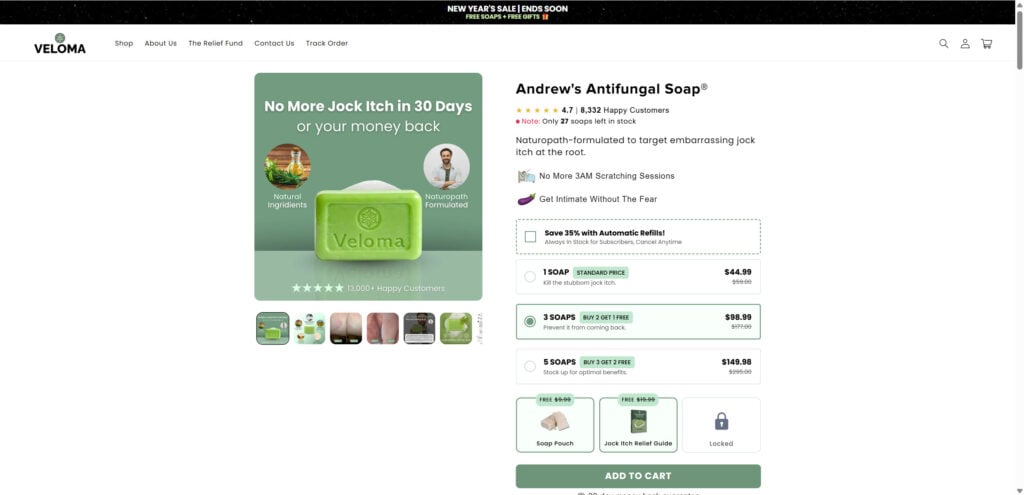
Veloma Andrew’s Antifungal Soap is marketed as a premium, naturopath-formulated tea tree oil antifungal soap that “works fast” and targets fungal issues like jock itch and athlete’s foot. The product is presented as the solution for people who feel stuck after trying “the usual” creams, powders, and routines.
The messaging is not subtle.
It leans hard into urgency, fear, and certainty. It suggests that if you do not use this specific soap, the problem will not end. It also implies that most other approaches fail because they do not address a hidden mechanism.
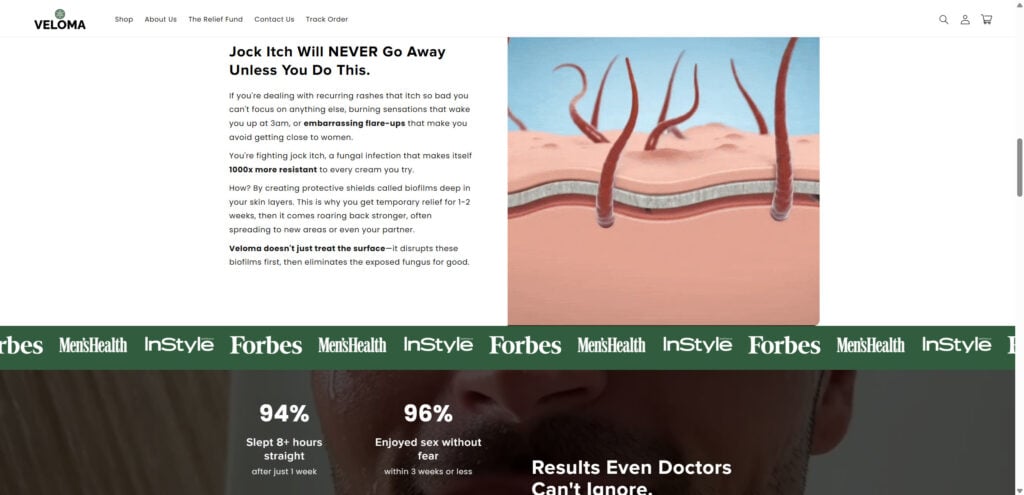
That mechanism is described using “biofilm” language, with statements that suggest fungus protects itself behind shields deep in the skin, making it far more resistant to typical treatments.
The story being sold is stronger than the product
This is the first thing to understand.
Veloma is not simply selling a soap bar. It is selling a storyline designed to feel like an answer.
The storyline usually looks like this:
A founder spends years studying the problem. Traditional options do not work. Doctors keep offering the same routines. Then a breakthrough happens. A simple product finally disrupts the real cause. Now relief is easy, fast, and lasting.
That narrative is emotionally powerful because it mirrors what people already feel.
They feel ignored. They feel frustrated. They feel like they have tried everything. So when a page confidently says, “Here is why it keeps happening and here is the fix,” it can feel like a breakthrough.
But emotional resonance is not proof.
The claims are unusually aggressive for a cosmetic product
A soap can clean skin. It can remove sweat and oils. It can help reduce odor. Some soaps contain ingredients that may be irritating to microbes in lab settings.
That is the reasonable end of the spectrum.
Veloma’s marketing pushes beyond that.
It uses language like:
- “Kills the fungus for good”
- “No more jock itch in 30 days or your money back”
- “Keep fungus away forever”
- “Jock itch will never go away unless you do this”
- “Breaks biofilm and kills fungus in one shot”
- “1000x more resistant” style comparisons to imply normal solutions are hopeless
Those are not ordinary soap claims. They are cure-style promises.
When a product is advertised with that level of certainty, the burden of proof should go up, not down.
A trustworthy health-adjacent brand typically provides more clarity, not more hype.
The credibility cues are designed to disarm skepticism
Veloma stacks multiple trust signals throughout the offer. These signals are meant to make the product feel established and widely validated.
Common cues in this kind of funnel include:
- A founder identity and signature
- Claims of years of research
- Large customer numbers and star ratings
- A “money back” guarantee
- Publication logos displayed as authority signals
- A polished catalog page that makes the brand look bigger than one product
None of these cues are automatically fake. The issue is how they are used.
When credibility is presented as visuals and slogans, rather than verifiable information, it functions as persuasion instead of evidence.
The price point is the loudest red flag
Veloma’s pricing places this in a premium bracket.
A single bar is priced around $44.99, with multi-bar bundles priced near $98.99 and $149.98. There is also a subscription option offering a discount, framed as “automatic refills,” with “cancel anytime” language.
For a soap bar, $44.99 is not a normal price.
To justify that, a brand would usually need to provide:
- A full ingredient list with concentrations
- Manufacturing standards and testing details
- Clear labeling and batch traceability
- Independent reviews across multiple platforms
- Transparent shipping and returns, including realistic logistics
When a soap is priced like a specialty treatment, but sold like a high-pressure funnel, you should pause.
The cheap OEM product pattern
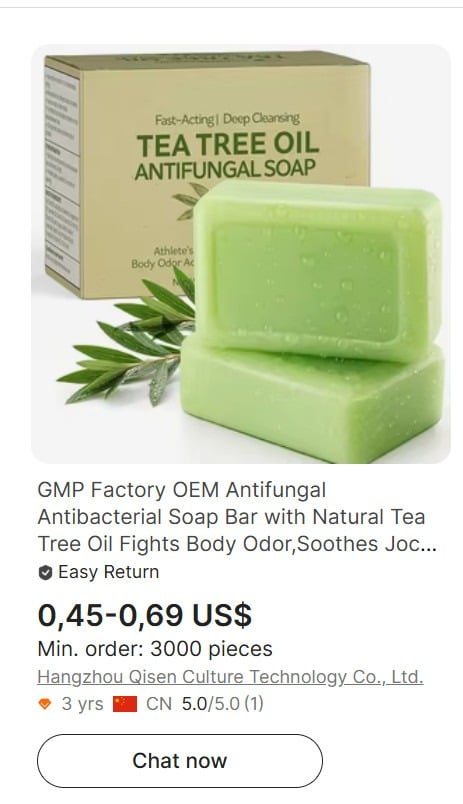
A major concern with Veloma is that this type of “tea tree oil antifungal soap” is widely available as a generic OEM product made in China for well under $1 per bar at scale.
That matters because it fits a very common business model:
- A factory produces an inexpensive generic soap in bulk.
- A reseller buys it, adds branding and packaging.
- The product is marketed as a breakthrough solution.
- The price is increased massively.
- The funnel is built to push bundles and subscriptions.
OEM manufacturing itself is not inherently bad. Many legitimate brands use contract manufacturers.
The red flag is when the marketing implies a unique discovery and premium formulation, while the product category is a widely duplicated commodity item.
When the underlying product is common, the page must rely on persuasion and urgency to create perceived exclusivity.
The bundle structure is built to increase spend fast
Veloma pushes multi-unit orders in a way that feels like “responsible treatment,” not upselling.
You are not encouraged to try one bar and see if it helps. You are encouraged to stock up to prevent recurrence.
That framing matters because it shifts the purchase from:
“Let me test a product.”
to:
“If I do not buy enough, it may come back.”
This is a classic funnel move. It increases average order value and reduces the chance a buyer will seek a refund quickly.
The “automatic refills” option raises billing risk
Subscription offers are not automatically scams. Plenty of legitimate brands offer subscriptions.
The problem is how subscriptions are presented and implemented.
If buyers are reporting being charged for multiple units even when they thought they ordered one, there are a few common ways that can happen in funnels like this:
- A subscription box is pre-selected or visually blended into the offer
- The default option is a bundle, not a single unit
- A one-click post-purchase offer adds extra units
- The order confirmation is confusing, so the buyer notices too late
- The billing descriptor on the card statement looks unfamiliar, so it is harder to identify quickly
If multiple-charge complaints exist, they deserve to be taken seriously.
Unexpected billing is one of the strongest signals that a storefront is optimized for extraction, not customer satisfaction.
Returns that are “technically possible” but practically painful
You also flagged a major issue: returns are effectively impossible.
This is extremely common in dropshipping-style operations, especially when fulfillment is overseas or routed through third-party logistics.
Here is what “impossible returns” often looks like in real life:
- Support replies slowly or stops replying
- You are asked to provide extra steps repeatedly
- You are offered a partial refund instead of a return
- The return address is overseas
- Return shipping is paid by the buyer
- Return shipping costs are close to the order value
- Refunds are delayed until the product is “received,” which may take weeks
A guarantee sounds comforting on the page. The real test is how easy it is to use it.
Health reality check
It is important to keep this grounded.
Many people who think they have a fungal issue do not.
Many conditions that mimic fungus include:
- Contact dermatitis from detergents or soaps
- Intertrigo from moisture and friction
- Eczema or psoriasis
- Bacterial irritation
- Allergic reactions
- Heat rash
Even when it is fungal, the most effective treatments are not always cosmetic products. Sometimes they are over-the-counter antifungal medications. Sometimes a clinician needs to confirm what it is.
So if a product promises to fix everything with a bar of soap, that promise should be treated carefully.
Should you buy Veloma Andrew’s Antifungal Soap?
If your goal is a trustworthy, transparent, fairly priced product with realistic claims and a practical return process, this offer is not a safe bet.
The overall presentation fits a familiar pattern:
- Commodity product category with cheap OEM equivalents
- Aggressive cure-style claims and fear-based hooks
- High markup pricing anchored to embarrassment and urgency
- Bundling and subscription mechanics that can lead to unexpected charges
- Reports of multi-unit billing issues
- Returns that can be difficult or financially pointless
That does not mean every buyer will have a terrible experience.
It does mean the risk profile is higher than it should be for a basic hygiene product.
If you want a safer path, buy from sources that provide clear labeling, consistent customer service, and easy returns.
If you already bought it, there are smart steps you can take right now to protect your money and your health.
How The Operation Works
To understand why this product triggers so many concerns, you need to look at the system around it, not just the soap.
There are two operations happening at the same time:
- The marketing operation that drives impulse purchases
- The fulfillment and billing operation that creates friction when buyers push back
Step 1: Target a problem people feel embarrassed to talk about
Fungal irritation is a perfect niche for aggressive marketing.
People often feel:
- Self-conscious
- Frustrated
- Tired of trial and error
- Quietly desperate for something that works
That emotional state makes buyers more vulnerable to confident promises.
If a page says, “Stop scratching at 3 AM,” it is not just a feature. It is a personal pain point.
Step 2: Reframe the condition as “stubborn because of a hidden enemy”
Veloma heavily promotes the idea of protective “biofilms” deep in skin layers.
The goal is not education. The goal is positioning.
It suggests that normal treatments fail because they only treat the surface, while this soap disrupts the shield first and then eliminates the fungus.
This is persuasive because it gives the buyer a simple explanation for why they have struggled.
But it also creates a trap.
If the product does not work, the buyer is more likely to blame themselves or assume they “need more time,” rather than questioning the product.
That is why funnels love mechanisms like this. They reduce refunds by extending hope.
Step 3: Build authority with a founder narrative
The founder story adds emotional trust.
A person appears. A signature appears. A personal “I solved this” story appears. A timeline of years and obsession appears.
This is a conversion strategy.
It helps the buyer feel like the product is not a random commodity item. It feels handcrafted, researched, and mission-driven.
In reality, a founder story can be real, exaggerated, or fully manufactured.
Even when it is real, it does not validate the claims.
Step 4: Add big social proof numbers that are hard to verify
The page presents large customer counts and high star ratings.
This pushes a subconscious conclusion:
“Thousands of people bought it and loved it, so it must be safe.”
But social proof is only meaningful when it is transparent and independently visible across multiple places.
When praise exists mainly inside the seller’s own environment, it is controlled.
Controlled proof should not carry the same weight as third-party proof.
Step 5: Use publication logos as borrowed credibility
Another common tactic is displaying major publication logos as if they imply endorsement or coverage.
Even when a brand has been mentioned somewhere, logos can be used in misleading ways.
It creates the feeling of legitimacy without requiring evidence.
For buyers, the effect is simple: skepticism drops, urgency rises.
Step 6: Use urgency and scarcity to speed the decision
Scarcity cues like “only X left” or time-limited sales are designed to reduce comparison shopping.
If you feel like the product might sell out, you stop researching.
This is critical for dropshipping funnels, because the biggest threat is the buyer taking 15 minutes to search for alternatives and price comparisons.
Step 7: Push bundles as “the correct protocol”
The pricing layout is intentionally designed to make single-unit ordering feel like the wrong choice.
The multi-unit options are framed as the smarter way to “prevent it from coming back.”
That nudges the buyer into spending $98.99 or $149.98 instead of $44.99.
The psychological logic is:
“If this is finally the answer, I should do it properly.”
That is how a cheap product becomes a high-ticket order.
Step 8: Introduce subscriptions as “savings” and “peace of mind”
Subscriptions create recurring revenue and improve cash flow.
They also create a new risk for buyers: recurring charges they did not fully notice or understand.
Even when “cancel anytime” is displayed, cancellation can be slow, hidden behind support tickets, or buried inside an account portal that buyers never created.
If people report unexpected charges or extra units, subscriptions and post-purchase add-ons are the first mechanisms to examine.
Step 9: Add post-purchase offers that can create extra charges
Many funnels use one-click add-ons after checkout.
A buyer thinks:
“I am just confirming my order.”
But the page is actually offering:
“Add two more for a discount.”
A single click can create a second charge, sometimes processed as a separate transaction.
If the buyer does not notice immediately, the package arrives with multiple units and the customer feels tricked.
Step 10: Outsource fulfillment to keep costs low
Dropshipping-style operations typically do not hold local inventory.
Orders are routed to a supplier or third-party warehouse, often overseas.
The result can include:
- Slower shipping than expected
- Tracking delays
- Generic packaging
- Minimal instructions
- Limited support power when something goes wrong
This is not always malicious, but it shifts risk onto the buyer.
Step 11: Make returns hard enough that many buyers give up
This is where the operation becomes most damaging.
A product can be overpriced and still refundable, which allows a buyer to correct the mistake.
When returns become difficult, the buyer is trapped.
Common friction points include:
- Support delays that push you past the return window
- Requests for repeated documentation
- Partial refund offers that require you to keep the item
- Return shipping to an overseas address
- High shipping costs with no reimbursement
- Refunds that are delayed until the product is received, which can take weeks
This is exactly why “money back” guarantees are not comforting by default.
The process matters more than the promise.
Step 12: The buyer experience becomes predictable
When this kind of funnel goes wrong, complaints tend to cluster around the same themes:
- “The claims were exaggerated.”
- “I was billed for more than expected.”
- “I tried to contact support and got slow replies.”
- “They offered partial refunds but made returns hard.”
- “Shipping took longer than expected.”
- “I could have bought a similar product far cheaper elsewhere.”
This is why Veloma Andrew’s Antifungal Soap should be evaluated less as a soap and more as a high-risk purchase funnel.
What To Do If You Bought This
If you already ordered Veloma Andrew’s Antifungal Soap, focus on two goals:
- Protect your money
- Protect your health and safety
Here is a practical plan that works in the real world.
- Find your order confirmation and save it
Save the confirmation email, order number, and the total charge. If there are multiple charges, save those too. - Check your card statement carefully for extra charges
Look for:- More than one charge
- A second charge days later
- A subscription-style recurring charge
- Look for subscription enrollment and cancel it right away
If the order included “automatic refills,” log into your account if possible and cancel. If you cannot find an account portal, email support and clearly state:
“Cancel any subscription or automatic refills associated with my order.” - Email support with a clear, firm message
Keep it short and specific:- Your order number
- The issue (unexpected charges, wrong quantity, cancellation request, refund request)
- What you want (refund, cancellation, no further shipments)
- A deadline for response
- If you were charged for multiple units, state that clearly
Use plain language:
“I ordered 1 unit. I was charged for 3. I did not authorize this. I want a full refund for the unauthorized portion.” - Do not rely on promises made only in chat
If support offers a partial refund, ask them to put the full resolution in writing. Partial refunds are often used to reduce chargebacks while leaving the buyer stuck. - Document everything
Save:- Emails
- Order page details you relied on
- Shipping confirmations
- Tracking updates
- Any refusal to provide a practical return solution
- If the item has not shipped, request cancellation immediately
Many sellers will say, “We cannot cancel after processing,” even when it has not shipped. Ask for written confirmation of shipping status. - If it arrives and you plan to seek a refund, avoid opening and using it
Many return policies require “unused” condition. If you want the highest chance of a refund, keep it unused and document condition on arrival. - If returns require overseas shipping at your expense, weigh the economics
If return shipping costs are close to the product price, a dispute may be the more realistic path. - Use your payment protections if support stalls
If you paid by credit card or PayPal, you may have buyer protection options. File a dispute if:
- You were billed for more than you authorized
- The seller refuses a refund despite misleading claims
- You cannot reach support
- The return process is unreasonable
Provide clear evidence and keep your timeline tight.
- Watch for future charges for at least 60 days
If subscriptions were involved, monitor your statement. If a new charge appears, dispute it quickly. - Take a health-first approach if symptoms persist
If you are dealing with ongoing rash, pain, cracking skin, swelling, spreading irritation, or symptoms that do not improve, consider consulting a pharmacist or clinician. Many issues that look fungal are not fungal, and the right treatment depends on the correct diagnosis. - Avoid harsh routines that can worsen irritation
Over-washing, harsh soaps, and aggressive scrubbing can damage skin and make symptoms worse. Keep routines gentle and focus on reducing moisture and friction while you seek appropriate care.
The Bottom Line
Veloma Andrew’s Antifungal Soap is marketed as a fast, decisive fix for jock itch and fungal problems, with “root cause” messaging, biofilm claims, and a guarantee designed to feel risk-free.
But the overall structure strongly resembles a dropshipping funnel: steep markups on a commodity-style tea tree soap, cure-like promises that are difficult to verify, heavy pressure to buy bundles, subscription mechanics that can lead to unexpected billing, and a return experience that can be financially or practically unworkable.
If you want a safer purchase, choose products from reputable retailers with transparent labeling and reliable support.
If you already bought Veloma, focus on protecting yourself: check for extra charges, cancel any refills, document everything, push for a written resolution, and use your payment protections quickly if the seller stalls.








