

A recruiter says your experience fits an unlisted role. The company name is familiar, the salary sounds appealing, and the conversation starts like a genuine opportunity.
Then your resume supposedly needs fixing. The Korn Ferry recruiter scam uses that small setback to change what you are being asked to trust.
Overview
The scam borrows Korn Ferry’s identity to create a paid hurdle
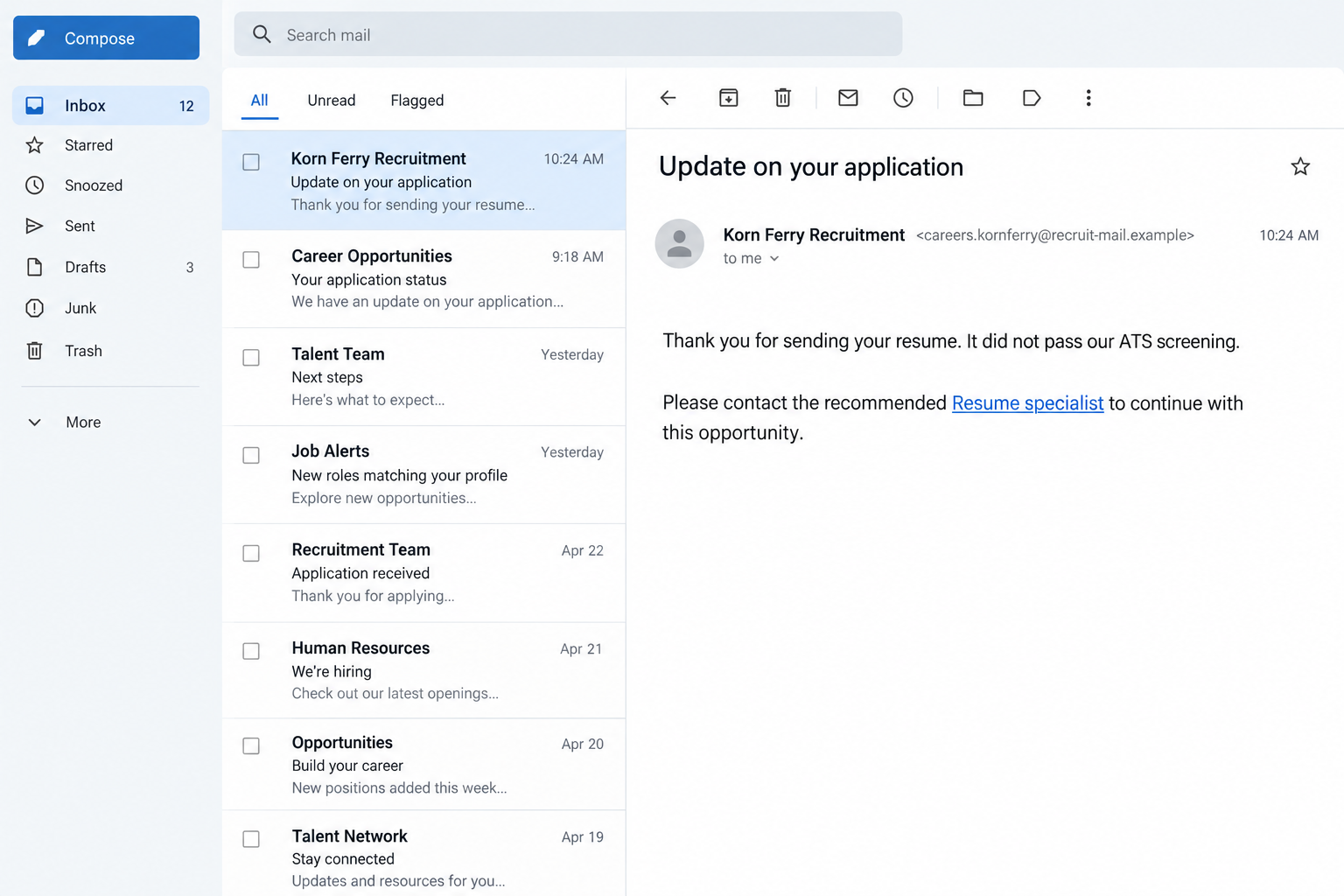
This is a recruitment impersonation scam. A person claiming to represent Korn Ferry says your resume failed screening, then directs you to a paid resume specialist.
The legitimate firm is not the scam. Korn Ferry has published an official recruitment-fraud warning and says it never requests payment from candidates.
In the reported case, the sender’s address was a consumer email account containing the company name. It was not an independently authenticated contact at the firm.
Do not pay the referral fee or send more information to preserve the opportunity. Verify the recruiter through the real company’s contact channels first.
A fake ATS problem makes the fee sound like a repair
ATS stands for applicant tracking system. Employers can use recruitment software to manage applications, but the term does not authenticate a particular rejection or recruiter.
The alleged problem arrives after you have already discussed the job and supplied a resume. Paying for an update can feel like finishing the application.
The referral introduces another person presented as capable of solving the problem. That person’s fee schedule becomes attached to the opportunity you were encouraged to want.
- A recruiter uses a recognized company’s name or an employee’s identity.
- The role is described as unlisted, exclusive, or handled privately.
- Your resume supposedly fails an ATS check after a short exchange.
- A specific writer is offered as the route back into the process.
- Payment appears before the recruiter or vacancy has been independently verified.
- The actual sender address does not match the identity being claimed.
Paid resume writing and fake recruitment are different things
Some resume writers provide legitimate paid services. Choosing to hire one independently is not the same as paying an impostor’s referral to continue a fabricated hiring process.
The accusation here rests on the borrowed identity and deceptive recruitment condition. It is not a claim that every writer charges unfairly or every ATS problem is invented.
The reported writer’s lack of an online presence adds a verification gap. It does not, by itself, prove what every service would deliver.
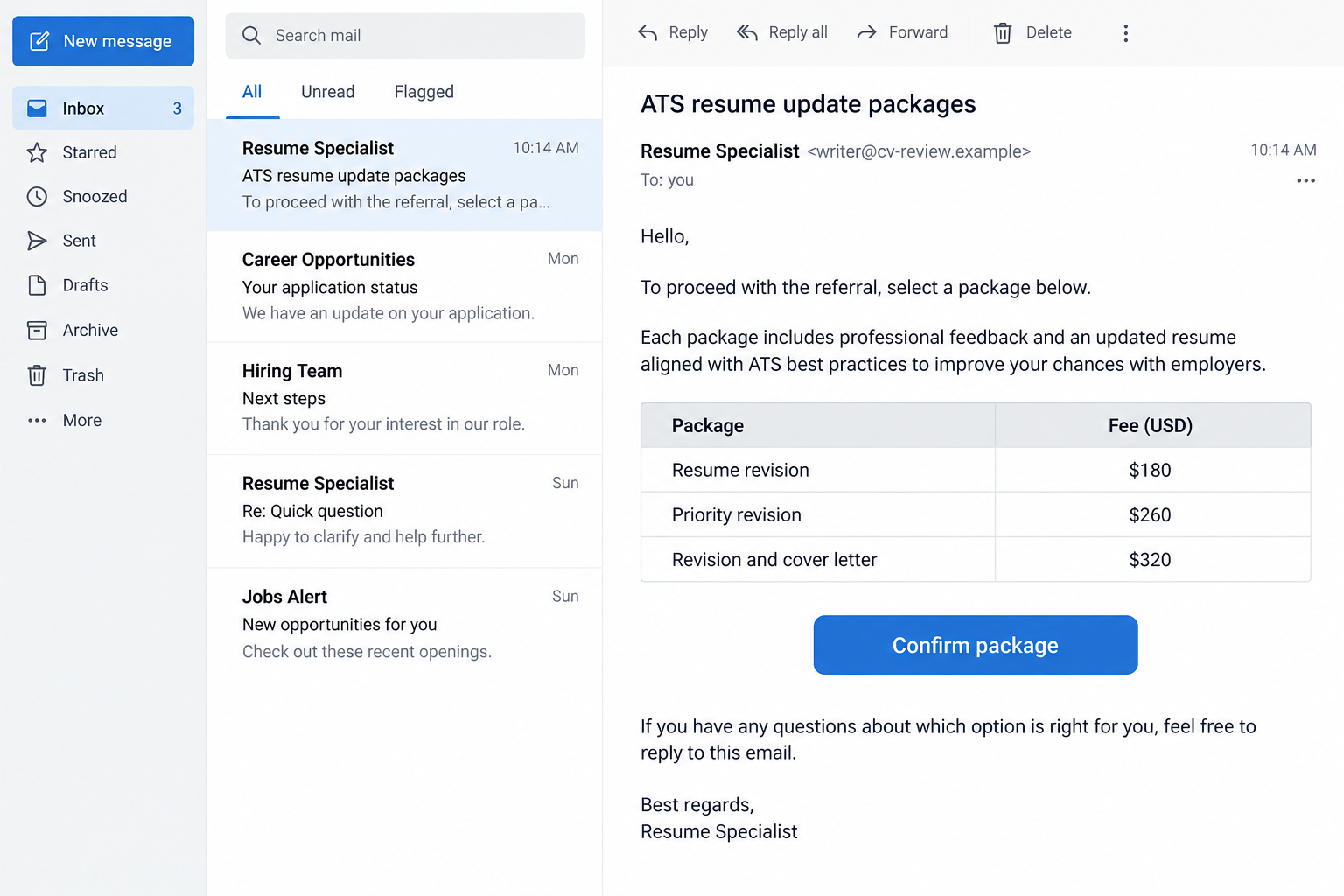
Our reconstructed emails use fictional senders and example prices. They show the referral sequence, not an actual Korn Ferry invoice or a verified resume-service package.
Why a Rejection Can Make the Offer More Convincing
A scam that instantly hires everyone can feel suspicious. A supposed rejection introduces friction that resembles a real recruitment process.
You have not been promised a job without effort. Instead, you are told there is one fixable problem between your experience and the next stage.
That makes the payment feel practical rather than extravagant. You are not buying a job, the sender suggests; you are correcting a document.
The distinction is false when the recruiter and opportunity are fabricated. A modest professional-sounding service can still be the way a fake job extracts money.
The alleged software decision also makes the obstacle harder to question. You cannot inspect an employer’s internal screening result through the stranger’s word alone.
When a writer is recommended, the conversation suddenly has a solution. The same process that created the problem supplies the person who can supposedly solve it.
That circular arrangement deserves scrutiny. A referral is not independent validation when it comes entirely from the unverified recruiter.
A real employee’s name can make the sender seem established. Finding that person online proves they exist, not that they wrote the email in your inbox.
Likewise, an appealing job description may be copied from a real posting. It does not establish that the sender has authority to represent the employer.
How the Korn Ferry Recruiter Scam Works
Step 1: The impostor approaches you with a plausible career match
The message refers to your professional background or profile and suggests you would fit a role. A known recruiting brand gives the contact immediate credibility.
The vacancy may be described as unlisted and handled through recruiters. That explanation can discourage you from checking whether a public posting exists.
Confidential recruiting can be legitimate. The claim becomes risky when it is used to replace verification of the person, employer, and process.
Do not treat the absence of a public advert as proof either way. Establish the recruiter’s authority through the genuine firm before sharing sensitive records.
Step 2: An ordinary exchange encourages you to send a resume
A brief discussion about experience or salary can make the contact feel less like a mass message. You begin investing attention in the possibility.
Sending a resume is common during hiring, which makes the request less obviously alarming than a demand for banking credentials.
Still, the document can expose personal contact details and work history. Give it to verified recipients, not simply anyone using a recruiting firm’s name.
The reported applicant shared a resume before noticing the sender-address mismatch. That sequence illustrates why identity checks should happen before the conversation feels established.
Step 3: The sender claims your resume failed ATS screening
The next message introduces a technical-sounding rejection. Your qualifications may still be praised, while the document is blamed for blocking progress.
This keeps you interested in the role. The problem appears correctable without changing your experience, availability, or suitability.
Do not accept a supposed ATS score or result as independent evidence. The person presenting it has not necessarily demonstrated access to the employer’s recruitment system.
Ask the authenticated company whether the recruiter, vacancy, and instruction are genuine. A screenshot from the same sender cannot answer all three questions.
Step 4: A recommended specialist turns the obstacle into a purchase
The recruiter directs you to a particular writer for an update that supposedly addresses the screening issue. The writer then supplies a fee structure.
Now the opportunity has a payment route. The cost may be explained as a normal professional service rather than a recruiting fee.
That wording does not resolve the impersonation. Paying a separate person can still be part of a deceptive hiring story.
You do not need to prove a financial relationship between the accounts before declining. The recruiter must be verified independently before their referral carries any weight.
The example packages shown here are illustrative. The reported case establishes a paid referral, not these particular amounts, turnaround times, or promised deliverables.
Step 5: The sender’s actual identity fails the independent check
In the reported example, closer inspection revealed a consumer email address containing the company name, rather than an authenticated Korn Ferry corporate contact.
A company word inside an address is not ownership of that company’s domain. The text before the at sign can be chosen by an account creator.
That explains how a name can look familiar while the mailbox belongs elsewhere. Read the entire address rather than stopping at the recognizable part.
A free email account alone does not make every independent professional fraudulent. Here, it conflicts with the claimed identity of a representative at the named firm.
Korn Ferry’s own warning provides the important boundary: candidate payments and requests for personal financial information are not its recruitment process.
Verify the Recruiter Before You Evaluate the Writer
Use the real firm’s contact route
Find the company’s official website independently. Contact an office or an already authenticated recruiter to check who approached you and what they requested.
Do not use a telephone number added by the suspicious sender as the verification channel. That would let the impostor supply their own confirmation.
Send a concise description of the offer and alleged ATS issue. Avoid attaching identity documents or financial details merely to ask whether the contact is genuine.
Separate a real employee from an email using their name
A professional profile may have been copied. Compare the contact route with information obtained from the actual company, rather than trusting a signature block.
A photo, job title, and familiar name are not sufficient proof. The person sending the email may have borrowed all three.
If you receive a follow-up on social media, verify that account too. A second channel controlled by the same stranger does not become independent evidence.
Ask what the alleged fee is supposed to change
Is the writer an optional service you choose, or a condition imposed by the unverified recruiter? That distinction matters more than whether the package looks professional.
A document revision cannot prove the job exists. A receipt for writing work cannot authenticate the person who introduced you to the vacancy.
If payment is required before anyone can confirm the recruiter or position, stop. You are being asked to spend money before establishing the basic premise.
What Makes This Different From Other Fake Job Offers?
Some recruitment scams demand equipment purchases or crypto-funded training. This version narrows the request to your resume, making the payment sound relevant to a genuine hiring obstacle.
We have previously covered fake Korn Ferry job offers involving online training. The ATS referral is a different payment story using the same borrowed authority.
You do not need to classify every fake job before responding. The common boundary is that an unverified opportunity should not make you pay a stranger.
Career anxiety can make a small fix feel worth the cost. You may think declining means losing a rare opportunity when your job search has been difficult.
The impostor depends on that pressure. A job that disappears when you request independent verification was not a reliable opportunity to begin with.
Do not turn this experience into distrust of all recruiters. Keep working with people whose identity and process you can establish through real organizational channels.
Nor should an unexpected rejection make you assume your resume is defective. Consider ordinary career advice separately, after checking who made the allegation.
What to Do if You Have Fallen Victim to This Scam
-
Stop the referral and any pending payment. Do not buy a higher package, rush service, or second revision because the recruiter says the opportunity will close.
Pause the exchange before submitting more information. You can verify a contact without continuing their paid process.
-
Save the full recruitment conversation. Preserve sender addresses, subject lines, the alleged ATS rejection, writer referral, package terms, and any payment instructions.
Keep the records private. Do not publish the real employee’s personal details merely because an impersonator borrowed their name.
-
Inform Korn Ferry through its genuine office contacts. Explain that someone used the firm’s identity and asked for a paid resume referral.
Ask whether the individual and vacancy can be authenticated. Do not contact the suspicious sender again to request proof the real firm has already questioned.
-
Contact your payment provider if money was sent. Describe the identity impersonation and the claim that payment was needed to continue recruitment.
Provide receipts and the exact service terms. If work was delivered, say so accurately; the deceptive job claim remains separate from what a writer supplied.
-
Assess what information was exposed. A resume can reveal contact details and employment history, but sharing it does not automatically give someone control of your accounts.
If you also sent identification, banking information, or tax details, contact relevant institutions about protection. Match the response to the actual data shared.
-
Secure any credentials entered through their links. Replace exposed or reused passwords on the genuine services, using a device you trust.
Check account alerts, sessions, and recovery information. An unsolicited verification code should not be forwarded to the alleged recruiter or resume specialist.
-
Check unexpected files or installation requests. Malwarebytes may help inspect a supported computer after opening an untrusted download or running software supplied during the conversation.
AdGuard can provide an additional barrier against known malicious web destinations. It cannot authenticate a recruiter or recover a writing fee.
If you only sent a document and installed nothing, do not assume your computer was infected. Explain the real exposure when seeking help.
-
Report the impersonation on the original platform. Use the email provider, networking service, or job site’s reporting tools and include evidence of the claimed company identity.
In the United States, report the fraudulent offer through the FTC’s official channel. Use your local fraud-reporting service if you are elsewhere.
-
Expect a more personalized follow-up. Someone may reuse your work history or mention the exact resume issue to make another opportunity sound credible.
Verify every new contact independently. A promise to refund the fee should not require a fresh payment, remote access, or additional confidential documents.
Frequently Asked Questions
Is Korn Ferry itself running this resume-payment scam?
No. This article concerns impostors borrowing the firm’s identity. Korn Ferry has warned about recruitment fraud and says it never requests candidate payments.
Is an ATS rejection always fake?
No. Recruitment software is real, and applications can be rejected. The problem is an unverified recruiter using that claim to steer you into a paid referral.
Can a company name inside an email address be misleading?
Yes. An account creator can include company words before the at sign. Read the full address and verify the sender through the real organization.
Are paid resume writers legitimate?
Some are. An independently chosen writing service is different from a purchase imposed by someone impersonating a recruiter. Verify the job claim before considering the referral.
What if I already sent my resume but did not pay?
Stop the conversation and review what personal details were included. Watch for tailored follow-ups, but do not assume a resume alone gives access to your banking or email.
Should I pay a small amount to keep the role available?
No. A small fee does not verify a vacancy or recruiter. Check through Korn Ferry’s official contact route before sending any money or additional information.
The Bottom Line
The Korn Ferry recruiter scam turns an alleged ATS rejection into a paid resume referral. The borrowed company identity is what makes that request deceptive.
Verify the recruiter independently and decline the payment hurdle. Genuine career advice can wait until you know who actually contacted you and whether the opportunity exists.








