

Finding affordable weight-loss care online can feel like relief after weeks of comparing prices. LeanMeds promises a simpler route, with medication and support presented together.
Before paying, give the purchase conditions the same attention as the treatment options. A comfortable-looking appointment process does not tell you everything about the commitment.

Overview
LeanMeds is a telehealth offer, not a gummy supplement
LeanMeds markets online weight-loss care involving prescription options, clinical assessment, and support. The homepage advertises plans starting at $49 monthly.
This is not the same purchase as ordering an over-the-counter supplement. Medical eligibility, a clinician’s decisions, and a dispensing pharmacy can all affect what happens next.
The central concern in this investigation is the financial arrangement around that process. It should be understandable before a patient commits money.
The homepage reassurance and subscription policy do not align neatly
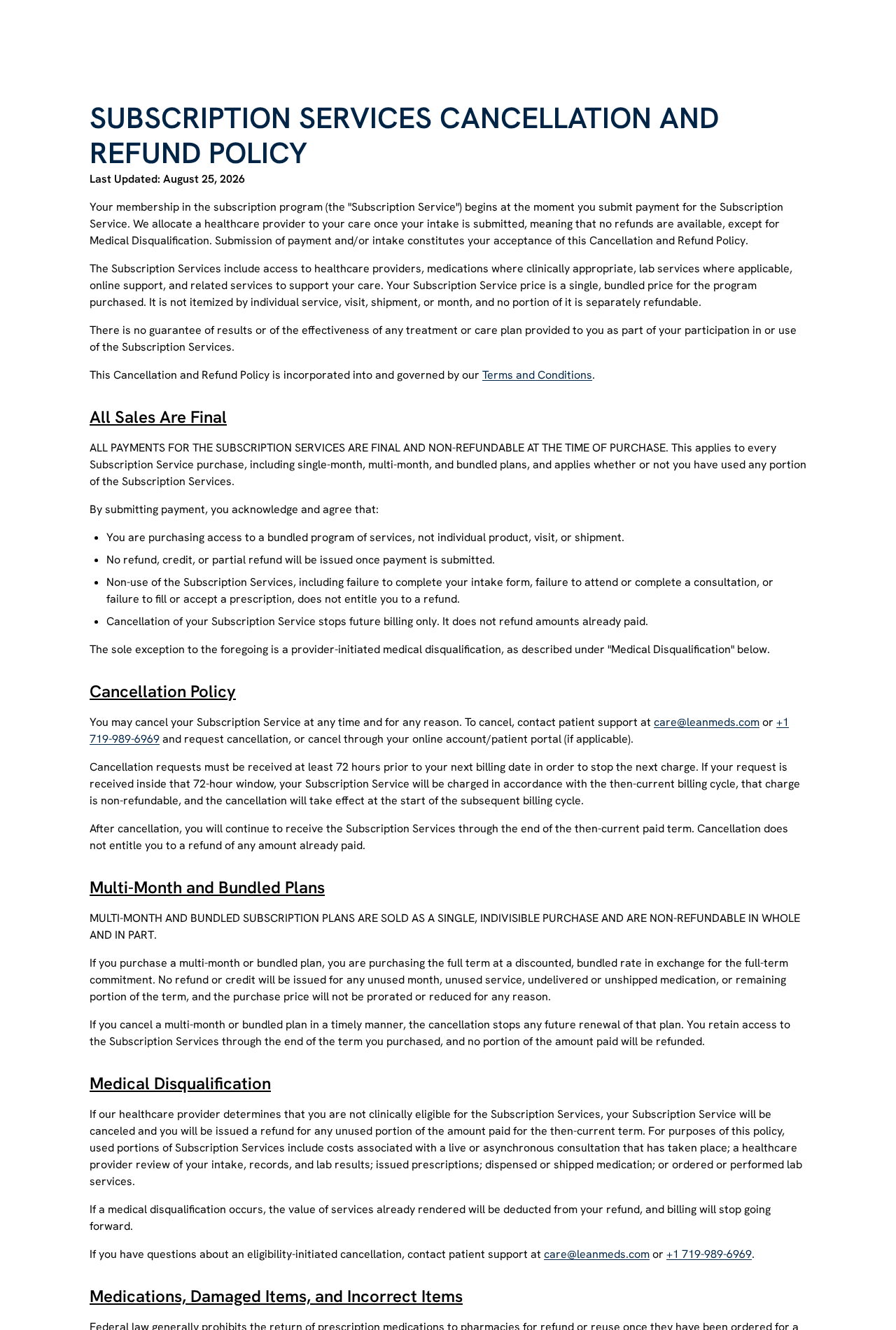
The homepage says there is no automatic rebilling. Its separate subscription policy describes future billing and an advance cancellation requirement.
Under that policy, a cancellation must be received at least 72 hours before the next billing date to stop the upcoming charge.
This discrepancy needs a plan-specific explanation. It is not proof that every purchase automatically renews, but it is a reason not to rely on the slogan alone.
The refund restrictions are a substantial purchasing risk
The subscription policy broadly treats payments as final from purchase, including when someone does not use the service. It provides a limited medical-disqualification exception.
A buyer expecting to pay only for medication received may misunderstand that arrangement. The terms describe a bundle, not a refundable payment for each completed task.
- Confirm whether your particular plan renews automatically.
- Get the total upfront charge, not just a monthly equivalent.
- Find out what happens if you never complete the intake.
- Identify the clinician and dispensing pharmacy separately from the marketing brand.
- Keep the cancellation deadline and effective date in writing.
How the Enrollment and Billing Risk Develop
Step 1: An approachable monthly price draws you into the care offer
The page presents treatment as a convenient package rather than several separate expenses. That can be helpful when medication, appointments, and support are otherwise difficult to compare.
However, a starting monthly figure is not necessarily the amount due today. It may represent one option, a particular term, or a rate expressed across multiple months.
Before moving forward, ask for the total transaction amount and what it includes. Do not infer that every medication or dose costs the advertised starting figure.
Also establish whether the price remains the same for your prescribed treatment. A general pricing promise should be translated into an actual written order.
Step 2: Payment and clinical eligibility can occur at different points
An online health questionnaire does not guarantee a prescription. A licensed clinician must decide whether a particular treatment is appropriate for the patient.
The subscription policy says membership begins when payment is submitted. This makes the sequence of events financially important.
Ask whether you are being charged before assessment, after approval, or after a prescription is accepted. Those arrangements expose you to different risks.
If the answer is unclear, do not submit payment merely to discover it. A medical enrollment process should explain the financial terms without requiring a commitment first.
Step 3: The bundle may be treated as purchased even when unused
The policy states that non-use does not ordinarily create a refund entitlement. That includes failing to complete intake, attend a consultation, or fill a prescription.
Imagine paying, then realizing the care arrangement is unsuitable before completing the questionnaire. Under the stated policy, that change of mind may still leave the payment committed.
That example describes the policy’s effect, not a reported patient case. It shows why understanding the bundle matters before purchasing it.
Ask which services are considered delivered immediately and how their value is calculated. A general reference to access should not replace an understandable financial explanation.
Step 4: Canceling at the last minute may not stop the next charge
The published cancellation rule requires 72 hours of notice before the next billing date. A request inside that window is described as taking effect afterward.
That is more specific than a broad promise that you can cancel whenever you like. The ability to submit a cancellation is different from stopping today’s scheduled payment.
Calendar the actual deadline, including time zone where relevant. Do not wait until a renewal appears on your card statement to ask how the plan works.
Require confirmation that the request was received and when it becomes effective. A sent email proves submission, but the policy’s wording makes receipt significant.
Step 5: A larger package can leave more money tied up
The policy describes multi-month plans as indivisible purchases. It excludes ordinary prorated refunds for unused months, services, or unshipped medication within that paid term.
A lower monthly equivalent can therefore mean a larger upfront exposure. Compare the total amount you could lose if the arrangement stops fitting your needs.
For instance, three months priced as a package is not necessarily three separately refundable monthly purchases. Cancellation may stop another term without refunding the remaining current one.
Do not select a longer package solely for its headline discount. Resolve treatment suitability and billing expectations before committing more money.
Questions the Financial Terms Should Answer
Which plan does the no-rebilling message describe?
A homepage can contain a general reassurance while a policy covers several arrangements. That possibility does not resolve the contradiction for an individual buyer.
Ask whether the no-rebilling message applies to the option you are considering. Require a clear yes or no and the applicable checkout provision.
If a representative says you must manually approve each renewal, keep that answer. If a subscription renews unless canceled, keep the schedule instead.
Both arrangements can exist in a business, but the customer should not have to guess which one they are buying.
What counts as medical disqualification?
The policy provides an exception when a provider determines that a patient is clinically ineligible. It describes refunding the unused portion after deducting services already rendered.
That is narrower than an unrestricted satisfaction guarantee. Deciding you dislike the arrangement is not necessarily the same as a clinician finding you unsuitable.
Ask how eligibility is determined and what charges may be deducted. Retain the provider’s decision if the exception applies to you.
Do not distort your medical information to obtain a financial outcome. Accurate health information is necessary for safe care and an honest eligibility review.
Is an unused service being confused with returned medicine?
Prescription products have handling and dispensing restrictions. However, a question about money charged before treatment is not automatically a request to return medication.
Keep your complaint precise. An intake never completed, an appointment never provided, and a damaged shipment are different issues requiring different explanations.
We are describing the merchant’s stated policy, not deciding whether every restriction is legally enforceable. Your rights can depend on location and the circumstances.
If a dispute remains unresolved, ask a consumer protection agency or qualified adviser about the particular transaction rather than accepting a blanket legal assertion.
LeanMeds Platform, Clinicians, and Pharmacy Responsibilities
The marketing brand and clinical platform have different roles
The terms of service distinguish LeanMeds’ non-clinical functions from OpenLoop’s platform and independent healthcare professionals.
They state that LeanMeds does not itself practice medicine or dispense medication. That distinction should be clear when you seek treatment or report a problem.
Ask which organization handles billing and which organization is responsible for the clinical service. Keep both names rather than treating the logo as the entire care team.
A named clinician should be verifiable
Before relying on a treatment plan, identify the clinician responsible for it. Verify their professional license through the relevant state’s licensing board.
A generic assurance about licensed providers does not identify your individual prescriber. State-specific authority matters when care is provided remotely.
Make sure you know how to contact the clinical team with side effects, dosage questions, or changing symptoms. Billing support is not a substitute for clinical advice.
The dispensing pharmacy is a separate checkpoint
The site lists pharmacy relationships, but a listed name alone does not confirm who will dispense your prescription. Ask for the pharmacy assigned to your actual order.
Check its license using the appropriate pharmacy board. Confirm the prescription label, pharmacy contact information, and instructions when the medication arrives.
A pharmacy address should help identify the dispensing facility. It should not be used as automatic proof that the marketing company owns or manufactures the medicine.
Support should confirm billing actions clearly
The cancellation policy publishes care@leanmeds.com and +1 719-989-6969, and refers to cancellation through a patient portal where available.
We have not tested a support call or patient enrollment. These are published routes, not a guarantee that a particular request will be answered promptly.
For a cancellation, insist on the effective date and future-billing status. For clinical concerns, ask to be connected to the responsible provider instead.
Compounded Medication Requires Its Own Safety Check
Medication quality is a separate issue from subscription pricing. A transparent bill does not establish that a treatment is appropriate, and a prescription does not explain the bill.
The FDA warns about unapproved GLP-1 products, including concerns involving compounded semaglutide and tirzepatide.
Compounded drugs are not FDA-approved. They are not reviewed by the agency for safety, effectiveness, and quality in the same way as approved medicines.
This background does not establish that a particular LeanMeds shipment is counterfeit or harmful. It explains why patients need the exact prescribed product and dispensing details.
Ask your clinician whether the proposed medication is approved or compounded and why that option is appropriate. Do not assume all similarly named injections are interchangeable.
Never change a dose, replace medication, or alter a prescribed treatment based on a sales page or this billing investigation. Take those questions to the prescriber.
What to Do if You Paid or Need to Cancel
- Collect the complete transaction record.
Save the receipt, plan duration, enrollment terms, and advertised price. Include the homepage reassurance if it influenced your decision about recurring billing.
Write down what care you actually received: assessment, appointment, prescription, shipment, or support. This helps distinguish a financial complaint from a medical question.
- Request cancellation before the advance-notice deadline.
Use the published support channel or patient portal. State that you want future renewal stopped and request the effective date.
Allow for the policy’s 72-hour window. If you are already inside it, submit the request immediately anyway and ask whether the imminent charge can be stopped.
- Ask for a plan-specific billing explanation.
If you expected manual renewal, quote the no-rebilling representation and ask why a further charge was scheduled. Request the authorization applicable to your plan.
Do not settle for a generic description of subscriptions. The question is which terms you actually accepted and how they relate to the advertisement.
- Document any provider-initiated disqualification.
If the clinician says you are ineligible, ask support to apply the stated exception. Request a breakdown of any services deducted from the refund.
Keep clinical records securely. Share only the information necessary for the particular billing inquiry, not your entire medical history with an unrelated party.
- Address medication concerns with the clinical team.
For a damaged or incorrect shipment, retain the packaging and prescription label, then contact the pharmacy and prescriber for instructions before using it.
Seek urgent medical help for serious symptoms. Do not wait for a billing ticket to be answered if the concern is your immediate health.
- Escalate an unresolved charge with accurate evidence.
Ask your payment provider about dispute options and time limits. Include the order terms, cancellation record, and the merchant’s explanation of any remaining charge.
Distinguish an unauthorized renewal from an authorized purchase you regret. A precise description gives the reviewer a much clearer issue to assess.
Frequently Asked Questions
Is LeanMeds a confirmed scam?
The evidence supports a warning about unclear billing expectations and restrictive purchase conditions. It does not establish blanket fraud or counterfeit medication.
The practical recommendation is firm: do not pay until the renewal arrangement and financial consequences of non-use are explained for your exact plan.
Does the no-auto-rebill claim guarantee there are no renewals?
Do not assume that. The subscription policy discusses future billing, so ask which arrangement applies to the option you are choosing.
Keep the answer with the checkout terms and confirmation. A homepage phrase alone is not enough to resolve a plan-specific contradiction.
Can I cancel on the billing date?
You can request cancellation, but the policy requires receipt at least 72 hours earlier to stop the next charge. Late requests may take effect afterward.
Ask support to confirm the actual deadline and effective date instead of relying on a general promise that cancellation is available anytime.
Will I get a refund if I never complete the intake?
The stated policy ordinarily excludes a refund for non-use, including an incomplete intake. Its provider-initiated medical-disqualification exception is a different circumstance.
Review the conditions before paying, especially when purchasing a longer bundle that may not be prorated.
Does a listed pharmacy prove my medication is FDA-approved?
No. The pharmacy’s identity, its license, and the exact medicine’s approval status are separate questions. Confirm the product with your prescribing clinician.
A compounded preparation should not be assumed equivalent to an FDA-approved product simply because similar ingredient names appear.
What should I do before making the first payment?
Get the full charge, renewal schedule, cancellation deadline, eligibility process, and responsible clinical organizations in writing. Choose only after those answers make sense.
If the billing explanation remains contradictory, look elsewhere for care rather than using payment as a way to test the promise.
The Bottom Line
LeanMeds’ simple homepage message does not adequately explain the subscription policy’s cancellation and refund exposure. Resolve those terms before paying, particularly for a multi-month package.
Keep treatment decisions with a qualified clinician. If you already paid, confirm the next billing date and submit any cancellation before the 72-hour deadline.








