

Luxe Korean Under Eye Balm is being promoted across social media as a fast fix for under-eye bags, fine lines, puffiness, dark circles, and tired-looking skin.
The ads make it look like a breakthrough Korean skincare product. But when you look past the viral videos, emotional testimonials, and “Buy 1, Get 1 Free” offers, the whole operation starts to look much less trustworthy.
This is not necessarily a fake product. You may receive an under-eye balm.
The problem is that the marketing appears heavily exaggerated and built around claims that go far beyond what a simple skincare stick can realistically do.
Scam Overview
Luxe Korean Under Eye Balm appears to follow the same playbook used by many viral beauty dropshipping products.
The basic formula
The operation usually works like this:
- Take a cheap under-eye balm or skincare stick
- Brand it as “Korean beauty” or “Korean lab science”
- Use dramatic before-and-after content
- Push emotional social media ads
- Add fake urgency, discounts, and bundle deals
- Sell the product at a large markup
The result is a product that may physically exist, but is marketed as if it can deliver medical-grade or cosmetic-procedure-level results.
That is where the red flags begin.
What the Ads Want You to Believe
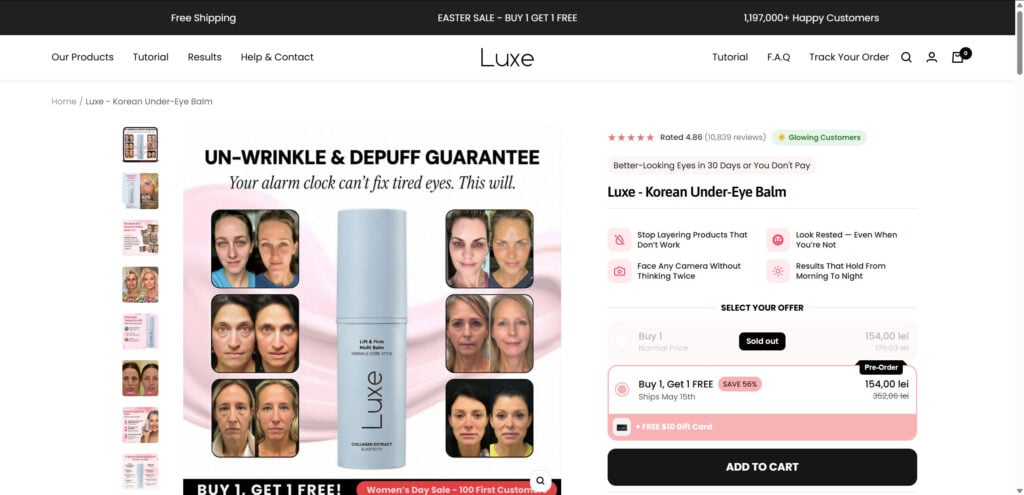
The ads usually suggest that the balm can:
- Smooth under-eye wrinkles quickly
- Tighten loose skin
- Reduce puffiness
- Minimize dark circles
- Make mature skin look younger
- Replace expensive eye creams
- Deliver visible results almost instantly
Some ads frame it as if beauty professionals, skincare insiders, or “Korean lab” technology have uncovered something ordinary consumers do not know about.
That kind of positioning is designed to create trust fast.
But trust is not proof.
What the Product Most Likely Is
A realistic under-eye balm can do a few basic things:
- Moisturize the skin
- Add a temporary smoothing effect
- Create a slightly dewy or reflective finish
- Reduce the appearance of dryness lines
- Make the area feel softer for a short time
That is normal skincare.
What it cannot realistically do:
- Permanently remove eye bags
- Reverse deep wrinkles
- rebuild collagen overnight
- replace filler, Botox, laser treatments, or surgery
- permanently tighten loose under-eye skin
- eliminate genetic dark circles
If the ads imply those results, the marketing is misleading.
Major Red Flags
1. Claims That Go Beyond What Skincare Can Do
The biggest issue with Luxe Korean Under Eye Balm is not that an eye balm exists. It is that the claims appear too strong for the product category.
Under-eye aging can be caused by several things:
- skin thinning
- genetics
- pigmentation
- fluid retention
- fat pad changes
- volume loss
- sleep, allergies, or lifestyle factors
A balm cannot fix all of that.
At most, it may temporarily improve the look of dryness, texture, or dullness. It may make the skin look smoother for a short period. But if the product is being promoted as a dramatic anti-aging fix, that is a serious warning sign.
2. “Korean Lab Science” With No Real Proof
The phrase “Korean skincare” is powerful in beauty marketing because many consumers associate it with innovation, gentle formulas, and high-quality cosmetic development.
But many dropshipping stores abuse that trust.
They use phrases like:
- “Korean lab science”
- “K-beauty technology”
- “dermatologist-inspired”
- “advanced under-eye repair”
- “clinical Korean formula”
The problem is simple:
Where is the proof?
A legitimate brand should provide:
- full ingredient list
- manufacturer details
- clinical test results
- safety testing information
- real company background
- clear return policy
- verified customer reviews
If the product only uses “Korean” as a marketing label without evidence, that is branding, not science.
3. Viral Testimonials That Feel Too Perfect
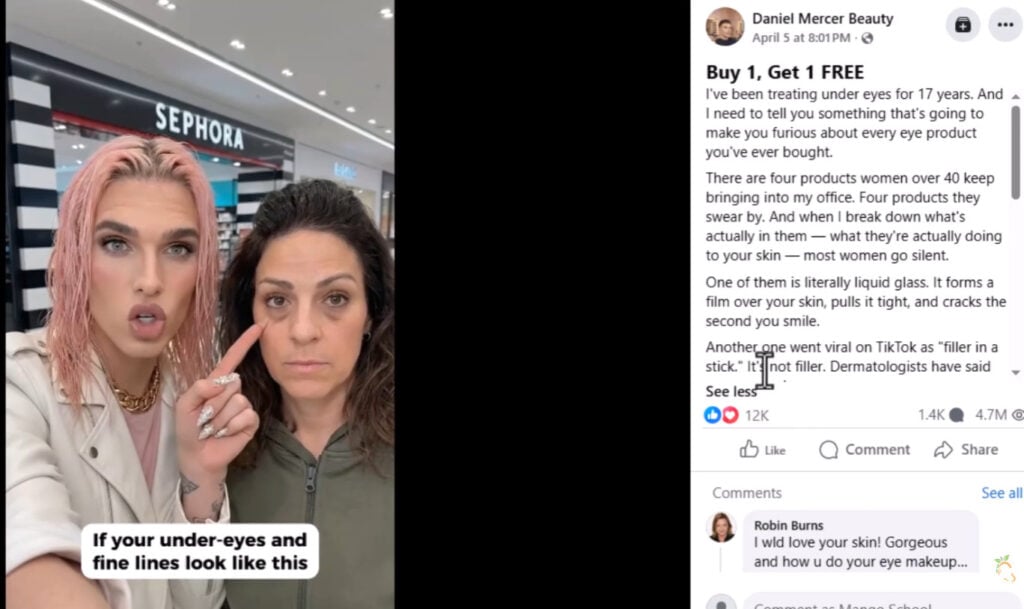
The ads often rely on testimonial-style videos.
These usually show someone saying the product:
- worked instantly
- replaced other eye creams
- shocked them with the results
- made them regret previous purchases
- is a “secret” product women over 40 need to know about
This is classic social media conversion copy.
The problem is that these videos are often scripted, staged, edited, or reused across different products. Some may use paid actors, AI-generated voiceovers, stock clips, or unrelated footage.
If the testimonial sounds like a dramatic sales script instead of a normal customer review, treat it with caution.
4. Before-and-After Images May Be Edited
Before-and-after images are one of the strongest tools in beauty advertising.
They can also be one of the most misleading.
Common tricks include:
- different lighting
- different facial expressions
- different camera angles
- filters
- skin smoothing
- AI enhancement
- makeup added after application
- pulling the skin tighter in the “after” image
With under-eye products, even a small lighting change can make lines, shadows, and puffiness look completely different.
If the results look too dramatic for a simple balm, they probably are.
5. The Product Is Sold on Multiple Sites
Another major red flag is that the same type of product is often sold across multiple websites under different names.
This usually means:
- the product is not exclusive
- the seller may not be the manufacturer
- the formula may be generic
- branding changes depending on the ad campaign
- customer service may be hard to trace
This is common in dropshipping.
One site sells it as a Korean eye balm. Another may sell the same product as an anti-aging stick, wrinkle eraser, instant eye repair balm, or collagen tightening balm.
Different name. Same product. Same playbook.
6. Cheap Formula, Premium Price
Many viral beauty products like this are inexpensive to source.
The seller then adds:
- polished branding
- dramatic ad videos
- fake urgency
- bundle discounts
- “Korean beauty” positioning
That turns a low-cost balm into a premium-priced “solution.”
The issue is not that a company makes a profit. The issue is when a basic product is marketed as if it has rare, advanced, clinically proven powers.
You may be paying mostly for the ad campaign, not the formula.
7. Countdown Timers and Bundle Deals
These stores often use pressure tactics such as:
- “Buy 1, Get 1 Free”
- “Today only”
- “Limited stock”
- countdown timers
- “sale ends at midnight”
- bundle discounts
- free shipping thresholds
These are designed to stop you from researching.
The goal is simple: get the purchase before you compare prices, check reviews, or realize the same product may be available elsewhere for much less.
8. Fake Authority Positioning
Some ads try to make the product seem endorsed by experts.
They may use:
- beauty professional language
- clinic-style settings
- Sephora-style backgrounds
- “dermatologist said” claims
- “as seen on” logos
- anonymous expert opinions
But if there is no verifiable expert, no real endorsement, and no direct evidence, this is authority theater.
It creates the feeling of credibility without providing actual proof.
How the Operation Works
Step 1: The ad targets insecurity
The ad focuses on under-eye bags, wrinkles, aging, tired skin, or women over 40.
It makes the viewer feel like they have been wasting money on the wrong products.
Step 2: The product is framed as a secret
The pitch often suggests that this balm is something beauty insiders know but big brands do not want you to discover.
That makes the product feel special and urgent.
Step 3: The results look instant
The ad shows fast visual changes.
This is where editing, lighting, filters, and staged demonstrations may come in.
Step 4: The offer pushes fast checkout
The buyer is shown:
- buy-one-get-one deals
- limited stock
- countdown timers
- bundle savings
The page is designed to reduce hesitation.
Step 5: The customer receives a basic product
If the order arrives, it may be a standard under-eye balm, not a miracle treatment.
The customer may notice:
- light moisturizing
- temporary shine
- mild smoothing
- no major change
Step 6: Returns become difficult
Many dropshipping beauty stores make refunds difficult by using:
- strict return windows
- unopened-only policies
- international return addresses
- slow support
- partial refund offers
By the time the customer realizes the product does not match the claims, getting money back may be frustrating.
Is Luxe Korean Under Eye Balm a Scam?
Not necessarily a fake product scam
The product may exist. Customers may receive a balm.
That alone does not make the offer legitimate.
The bigger issue is misleading marketing
Luxe Korean Under Eye Balm appears to be high-risk because of:
- exaggerated skincare claims
- vague “Korean lab” positioning
- suspicious testimonials
- possibly edited before-and-after images
- generic product sourcing
- pressure-based sales tactics
- unclear brand accountability
The safest classification is:
A real product sold through misleading beauty marketing.
What You Should Expect If You Buy It
If the balm arrives, expect something closer to:
- a basic moisturizing eye stick
- temporary skin softening
- a slight cosmetic smoothing effect
- no dramatic long-term transformation
Do not expect:
- permanent wrinkle removal
- under-eye bag elimination
- filler-like results
- collagen rebuilding from one product
- medical-grade tightening
A balm can improve the look of dryness. It cannot remodel your under-eye area.
Should You Buy It?
For most people, the answer is no.
Reasons to avoid it
- claims appear exaggerated
- product may be generic
- results are likely temporary
- ads may use edited or AI-generated visuals
- similar products may be cheaper elsewhere
- returns may be difficult
When it might be acceptable
Only if you understand that you are buying a basic cosmetic balm, not a real under-eye treatment.
If you want a light moisturizing stick and the price is low enough, that is one thing.
But buying it because the ads promise dramatic anti-aging results is risky.
What To Do If You Already Bought It
1. Save the ads and product page
Take screenshots of:
- before-and-after claims
- “Korean lab science” statements
- money-back guarantee
- bundle offer
- checkout total
- order confirmation
This matters if the product does not match the advertising.
2. Check for unexpected charges
Some viral product sites use confusing upsells.
Review your payment statement for:
- duplicate charges
- bundle upgrades you did not intend to buy
- hidden shipping fees
- subscription-style charges
3. Inspect the product immediately
When it arrives, check:
- packaging quality
- ingredient list
- country of origin
- expiration date
- whether it matches the advertised product
- whether instructions and warnings are included
If anything looks suspicious, do not use it around your eyes.
4. Patch test before applying near your eyes
The under-eye area is sensitive.
Before using it, test a small amount on another area of skin first.
Stop using it if you notice:
- burning
- redness
- itching
- swelling
- watery eyes
- rash
- irritation
5. Request a refund quickly
If you are dissatisfied, contact support immediately.
Do not wait until the refund window is almost over.
Keep the message simple:
I am requesting a refund for order #[number]. The product does not match the results and claims advertised. Please provide return instructions and confirm the refund timeline.
6. File a chargeback if needed
If the seller ignores you, refuses a reasonable refund, or the product was materially different from what was advertised, contact your bank or payment provider.
Use documentation showing:
- what was promised
- what arrived
- how the seller responded
The Bottom Line
Luxe Korean Under Eye Balm is not a proven under-eye miracle.
It appears to be a viral beauty product sold through exaggerated claims, emotional social media ads, questionable testimonials, and pressure-based checkout tactics.
The product may arrive. It may even moisturize.
But that is very different from delivering the dramatic anti-aging results implied in the ads.
The safest conclusion is simple:
Luxe Korean Under Eye Balm looks like a generic skincare stick wrapped in premium “Korean beauty” marketing and sold with claims that go far beyond what the product can realistically achieve.








