

A bank-style email says your winning funds are ready for transfer. There is a remittance department, a reference number, and one account requirement left to resolve.
The Nationwide Bank PLC scam makes that last piece sound like ordinary banking. Before discussing the transfer, check who is asking you to open anything.
Overview
An unexpected prize becomes a bank-account setup demand
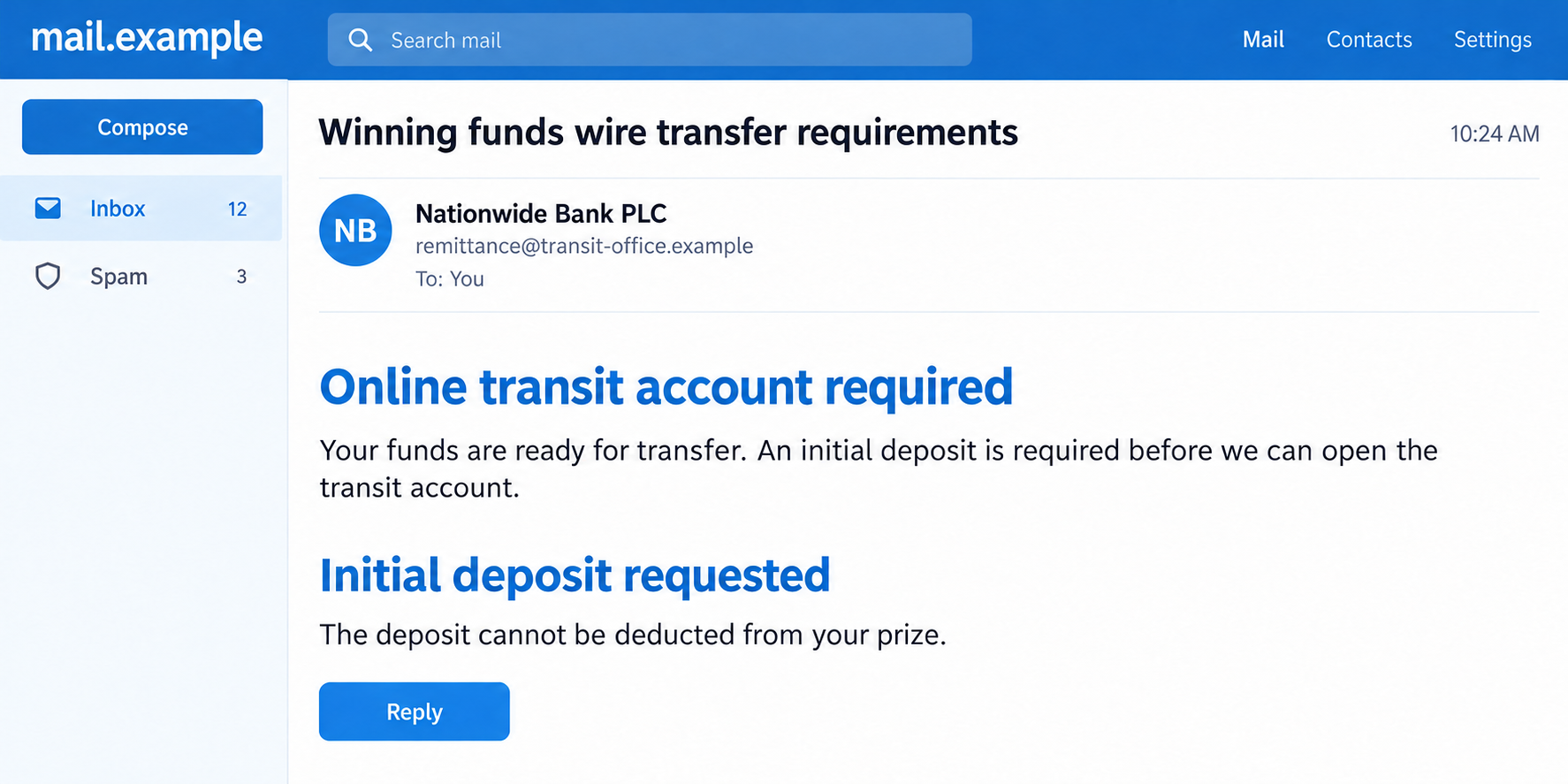
The fraudulent email claims winning funds have cleared and can be sent to your bank after an Online Transit Account is established.
It demands an initial deposit before opening that account. An insurance explanation supposedly prevents deducting the expense from the prize.
This is an advance-fee approach: the recipient pays real money to release a promised windfall. The invented account requirement keeps the money just out of reach.
Nationwide’s warning about advance payments describes unexpected prize or money offers that require fees and deliver nothing in return.
The sender’s banking title is part of the claim
The message uses the name Nationwide Bank PLC and official-sounding remittance roles. It does not become a bank communication simply by adopting those labels.
Do not confuse that claimed organization with the genuine U.K. Nationwide Building Society. Check any alleged institutional connection independently.
A postal address, reference code, direct line, or signature can be copied into an email. The requested payment needs confirmation from a real institution you contacted yourself.
A deposit should not be the price of verifying a surprise windfall
The pressure points in the approach include:
- Funds you were not expecting are declared ready for immediate transfer.
- A special transit account must be opened before you receive anything.
- The opening deposit must come from you, not from the alleged prize.
- An insurance or legal explanation blocks the obvious deduction question.
- A deadline threatens forfeiture if the setup requirement is not met.
- Online banking credentials are promised only after the money is sent.
The lead image is a fictional email illustration. It does not authenticate a bank, identify a current operator, or show an actual account balance.
Why the Transit Account Story Sounds Like Progress
The email begins after the supposed verification is finished
The message says clearance and remittance work have already been completed. That makes the account setup appear like a final administrative step rather than another uncertain claim.
You are invited to focus on completing the transfer, not proving that the underlying prize exists. The email supplies its own answer to that earlier question.
A recipient who has already heard a prize story may find this banking stage reassuring. A second claimed organization can still belong to the same deceptive conversation.
Keep the earlier prize message if one exists. Who introduced the remittance contact, and through which channel, can help explain how the banking story reached you.
Banking language makes a fee sound like a deposit
A deposit sounds different from paying a stranger to release a prize. It suggests money remains yours inside an account rather than being lost to a fee.
But the label does not establish where the payment goes. Until the institution and account are independently verified, the proposed destination remains an untrusted request.
Ask what account is being opened, whose name it will hold, and how the real institution confirms it. Do not pay first to obtain those answers.
The insurance explanation discourages a simple question
The message anticipates asking why the expense cannot be deducted from the funds. Its answer is a supposed restriction imposed by insurance or donors.
That explanation preserves the important condition: your money must move before theirs supposedly can. It does not supply independently confirmed funds or an approved banking procedure.
Another certificate from the same sender would leave that condition unchanged. The claim needs checking outside the agent’s documents and contact details.
How the Nationwide Bank PLC Transit Account Scam Works
Step 1: A remittance email declares the funds ready
The recipient receives a formal-looking message about winning funds. It presents a department, senior title, and transfer reference as though the payment is already being processed.
The message may appear as a continuation of earlier contact or arrive unexpectedly. Either way, the claimed prize needs a legitimate source and recognizable entry.
Do not treat a banking letter as independent confirmation when it was introduced by the person promoting the prize.
If you know nothing about the supposed award, stop. A stranger’s explanation about how your details were selected is not a reason to send personal information.
Step 2: The agent introduces an Online Transit Account
The email says a special account must be established before the remittance can proceed. That changes the recipient’s task from receiving money to funding account setup.
The term sounds technical enough that someone unfamiliar with international payments may assume it is standard procedure.
Do not accept unfamiliar banking terminology on confidence alone. Ask a genuinely contacted bank whether the stated product and requirement belong to its normal services.
A private agent should not control the only route for checking the account. If the product exists, the real institution should be able to explain it independently.
Step 3: An upfront deposit is protected from deduction
The agent demands an initial payment and explains why it cannot be removed from the alleged winnings. A time limit may threaten cancellation or forfeiture.
Versions of the email impose a three-business-day deadline. That turns an unverified deposit into something resembling a scheduled banking requirement, even though the sender supplied the deadline.
This forces the recipient to risk their own funds while the promised money remains unconfirmed. The amount can seem small beside the imaginary prize.
Do not judge the demand only by that comparison. The meaningful question is whether the prize, institution, account, and payment recipient were verified before sending anything.
Real account deposits and charges can exist. They belong to a genuine banking relationship, not an unexplained prerequisite for collecting an unsolicited windfall.
Refusing this demand does not mean abandoning a verified prize. It means declining to fund a claim the sender has not established independently.
Step 4: Banking credentials are promised after payment
The email says online login details will arrive once the deposit is received. Then the recipient will supposedly see a statement and transfer the funds themselves.
That delays the most convincing-looking evidence until after money has already been sent. The promise of a future portal cannot justify the present payment.
If the operator later supplies a website, its displayed balance still needs independent validation. A page controlled by the claimant can show any number it chooses.
Do not reuse an existing banking or email password to open an unfamiliar portal. That would create a separate credential risk alongside the payment demand.
Do not accept an agent’s balance screenshot instead of confirmation from your own bank. A picture of available funds is not an incoming payment.
Step 5: The unresolved transfer can produce another payment request
Advance-fee operations can introduce additional release, clearance, or administrative expenses. Each new requirement explains why the promised money still has not arrived.
A prior payment can make stopping difficult. The recipient may feel one more amount is necessary to avoid losing everything already committed.
That pressure does not create real funds. Stop further payments and ask the actual payment provider about intervention or a dispute.
Also be cautious about a new caller offering to recover the deposit. An unsolicited recovery demand can continue the loss under a different name.
Verify the Institution Before Discussing a Transfer
Use contact information outside the prize conversation
Find the bank or building society through a known official route. Do not use the direct telephone line, reply address, or web page supplied by the claimant.
Give verified support the claimed department, product, and reference. Ask whether the message and proposed account belong to the institution.
Nationwide’s scam guidance offers an independent starting point for checking approaches that misuse its name.
Match the legal name, product and payment recipient
A recognizable word in a company name is not enough. Check the exact organization and banking product rather than assuming every similar name is connected.
If payment instructions name an individual or another company, request an explanation from the real institution. Do not rely on the agent’s explanation of an intermediary.
A certificate, seal, or address needs verification of its own. A genuine address can be copied into a document without permission from its occupant.
The same caution applies to a company registration number. Even a real registered organization can be impersonated, so match the contact and banking service independently.
Keep ordinary transfers separate from surprise-prize deposits
International payments can involve actual charges, identity checks, and account requirements. That does not validate every email borrowing those concepts.
For a transfer you genuinely expect, speak with your existing bank and the known sender through established contacts. Confirm the payment purpose and normal process.
The unsafe feature here is paying an unverified intermediary to unlock unexpected winnings. Do not turn a general fact about banking fees into permission for that demand.
What to Do if You Have Fallen Victim to This Scam
-
Stop sending deposits or release payments.
Tell the claimant nothing further about your accounts. Preserve the messages already received, then block the unverified contact.
A new deadline or supposed insurance complication should not restart the conversation. Discuss the situation with a trusted person if earlier payments make stopping difficult.
-
Contact the provider that handled the payment urgently.
Give the actual recipient, destination account, date, amount, and transfer reference. Explain that a fake banking account setup was used to obtain the money.
Use the recipient shown on your actual payment record, not just the organization named in the email. Those names may point to different parties.
Ask about a recall, recipient-account alert, or available dispute process. Recovery is not assured, but delaying while negotiating with the agent can reduce options.
-
Notify your bank about any financial information shared.
Specify whether the disclosure involved an account number, card, password, PIN, login link, or authorization. Different details require different protective measures.
An account number alone should not be described as confirmed full account takeover. Let the bank assess the exposure and look for relevant activity.
-
Secure credentials used on an unfamiliar portal.
If you created a login with a reused password, replace it on the genuine services where it was used. Prioritize email and financial accounts.
Check recovery settings and unfamiliar sessions through those real services. Do not use a password-reset link supplied by the supposed remittance department.
-
Keep a payment-and-promise timeline.
Save the original remittance email, full headers when available, claimed account references, certificates, bank details supplied by the sender, and receipts.
Separate what the agent promised from what you actually received. A fabricated statement should be identified as the agent’s document, not an authenticated bank record.
Record each additional deposit request separately, including its stated purpose. That keeps the changing explanation visible rather than combining several payments into one vague loss.
-
Report the misuse of the Nationwide name.
Nationwide lists phishing@nationwide.co.uk for suspicious messages referring to it. Use its official instructions rather than replying to the agent.
Its online-banking fraud guidance explains independently checking contact. Send only evidence relevant to the report, not passwords or active security codes.
-
Report the loss through the appropriate official channel.
GOV.UK explains fraud reporting for U.K. victims. Elsewhere, use your local police or national fraud-reporting service.
Retain the report number and your payment provider’s case reference. Reporting an email alone does not automatically open or decide a financial dispute.
-
Refuse recovery help introduced by a stranger.
A later person may claim to represent investigators, a bank, or an account-recovery department. Verify that contact through independently obtained official information.
Do not pay another advance charge for the refund or transfer. Continue with the bank and reporting cases you initiated yourself.
Frequently Asked Questions
Is Nationwide itself responsible for this email?
No connection to the genuine U.K. Nationwide Building Society is established by the sender’s claimed banking title. The warning concerns the impersonating remittance and deposit demand.
Is an Online Transit Account necessarily a legitimate product?
The phrase in this email is a claim made by its sender. Confirm any banking product with the actual institution before sharing information or paying to establish it.
Do real bank accounts ever require deposits?
Yes, genuine products can have deposit requirements or charges. That differs from funding an unverified account to release an unexpected prize. Check the institution and contract independently.
Why does the agent say the deposit cannot come from the winnings?
The explanation keeps your upfront payment necessary. An insurance or donor story supplied by the claimant does not authenticate funds or make the payment safe.
Would seeing the prize inside a website prove it exists?
No. A claimant-controlled page can display a fabricated balance. Verify funds through a genuine institution rather than paying for access to the sender’s dashboard.
What is the first step after sending a deposit?
Stop further payments and contact the payment provider with the real transaction details. Ask about intervention promptly, then preserve evidence and report the fraudulent approach.
The Bottom Line
Do not send a deposit to open a supposed transit account for unexpected winnings. The Nationwide Bank PLC scam makes your payment the condition for an unverified prize.
Check the institution independently. If money has already moved, contact the payment provider immediately and refuse additional release or recovery charges.








