

The Neo Socket Fuel Saver is marketed as a simple way to reduce fuel costs and improve driving efficiency. With rising gas prices, that kind of promise is easy to notice and even easier to consider.
The product is presented as a small plug-in device that supposedly helps your vehicle perform better while saving money over time. At first glance, it appears convenient, modern, and low risk.
But before trusting the claims, it is worth taking a closer look at how this product is being sold and what buyers should know.
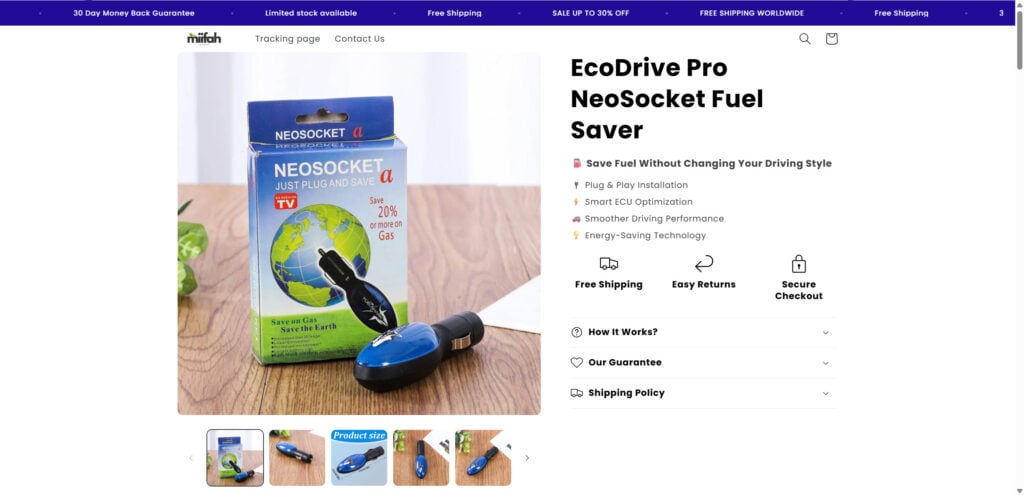
Scam Overview
What the Neo Socket Fuel Saver claims
The Neo Socket Fuel Saver is usually advertised as a plug-and-play gadget that can supposedly:
- save 10% to 30% on fuel
- improve engine efficiency
- smooth out performance
- optimize your vehicle’s electrical system
- work automatically in the background
- deliver savings without changing your driving habits
The wording is always designed to sound technical and reassuring.
You will often see phrases like:
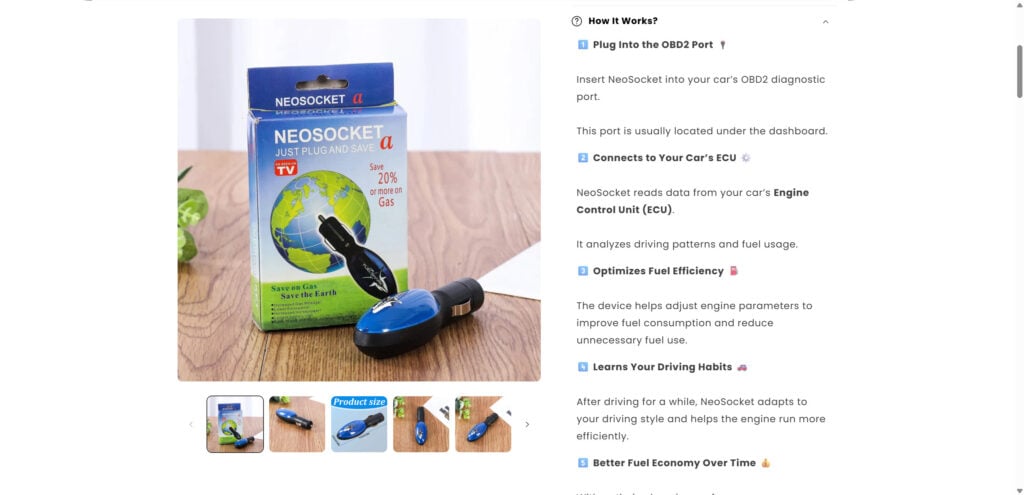
- smart ECU optimization
- voltage stabilization
- better fuel economy over time
- adaptive driving technology
- plug and play installation
To the average buyer, that sounds believable enough. Modern cars are full of electronics, so people may assume a small device could somehow improve fuel efficiency.
That is exactly why these offers keep working.
Why the claims do not hold up
The main problem is simple.
A tiny plug-in gadget like this is not a credible way to cut fuel use by 10% to 30%.
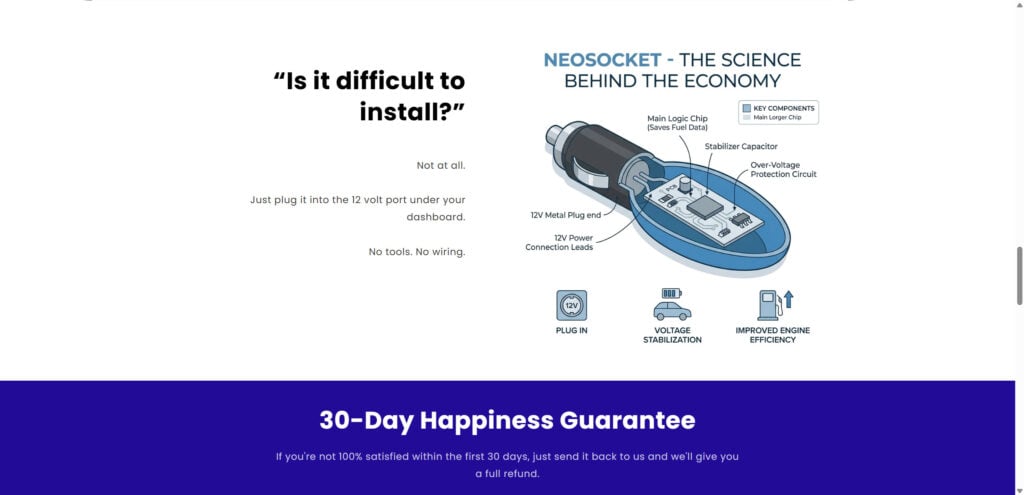
Even if the device contains a small capacitor, an LED, and a few basic components, that does not make the big promises real. A little light turning on does not prove the product is improving engine performance. It only proves the device is getting power.
That is a huge difference.
Products like this often rely on the appearance of electronics, not real engineering. The shell looks polished. The packaging looks official. The inside may contain just enough parts to seem technical. But the actual performance claims are far bigger than what the device could realistically support.
The product looks more advanced than it is
One reason this scam keeps fooling people is that the product itself looks more convincing than many junk gadgets.
The Neo Socket has a custom-looking case, a glossy top, and packaging that makes it appear like a real automotive accessory. That polished look gives buyers confidence.
But appearance is not proof.
A fake product can still have:
- a nice outer shell
- branded packaging
- a glowing light
- a simple circuit board
- a technical-sounding sales page
That does not make it legitimate.
It has been sold for years under different names
This is another major red flag.
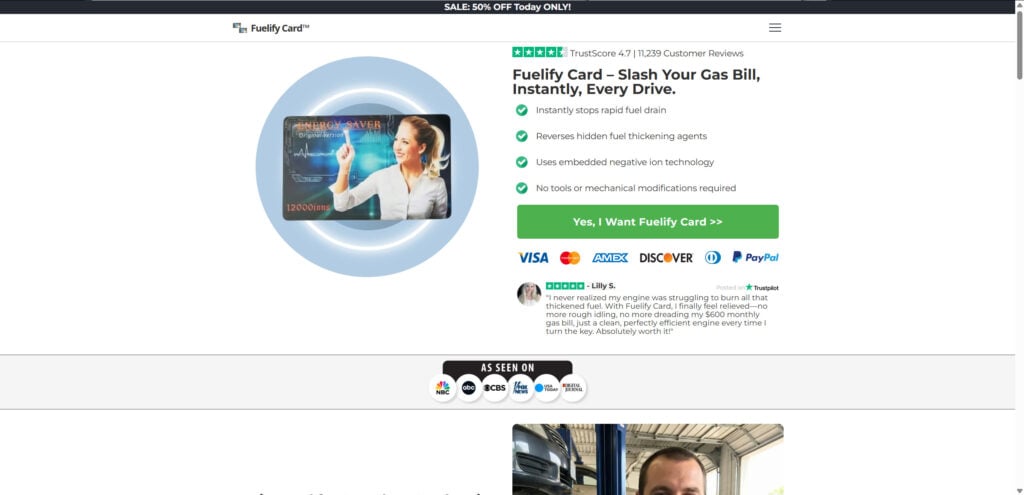
The Neo Socket Fuel Saver does not look like a new invention. It looks like another rebranded version of the same old fake fuel saver gimmick that has been circulating online for years.
These devices are often marketed under different names such as:
- fuel saver chip
- eco fuel saver
- gas saver plug
- voltage stabilizer
- fuel shark style device
The name changes. The scam stays the same.
That is how these products survive. Once one name gets a bad reputation, the sellers move to another site, another store, or another brand name.
Why this should be treated as a scam
Taken together, the red flags are hard to ignore.
The Neo Socket Fuel Saver appears suspicious because:
- it makes big savings claims without solid proof
- it uses vague technical language
- it relies heavily on visual presentation
- it seems to be a recycled product sold under multiple names
- similar versions appear to be extremely cheap wholesale gadgets
- many of these sellers use aggressive advertising and weak customer service
This is not how a real automotive innovation is usually sold.
It looks much more like a high-markup gimmick built to exploit drivers who want relief from high fuel prices.
How the Scam Works
Step 1: Scammers run ads that target frustrated drivers
The scam usually starts with ads.
These ads are often built around a simple emotional message:
- gas prices are rising
- driving is getting expensive
- you need a smarter way to save money
The ad then presents the Neo Socket Fuel Saver as an easy solution. No mechanic. No tools. No special knowledge. Just plug it in and start saving.
That message is powerful because it targets a real problem people already care about.
Step 2: They make the product sound high-tech
Once people click the ad, they land on a sales page filled with technical-sounding claims.
The sellers often use phrases like:
- ECU optimization
- voltage regulation
- fuel-saving technology
- driving pattern learning
- engine efficiency enhancement
Most buyers are not automotive engineers, so the wording can sound convincing at first glance.
But the language is usually vague on purpose. It sounds advanced without clearly explaining how the device could actually deliver those savings.
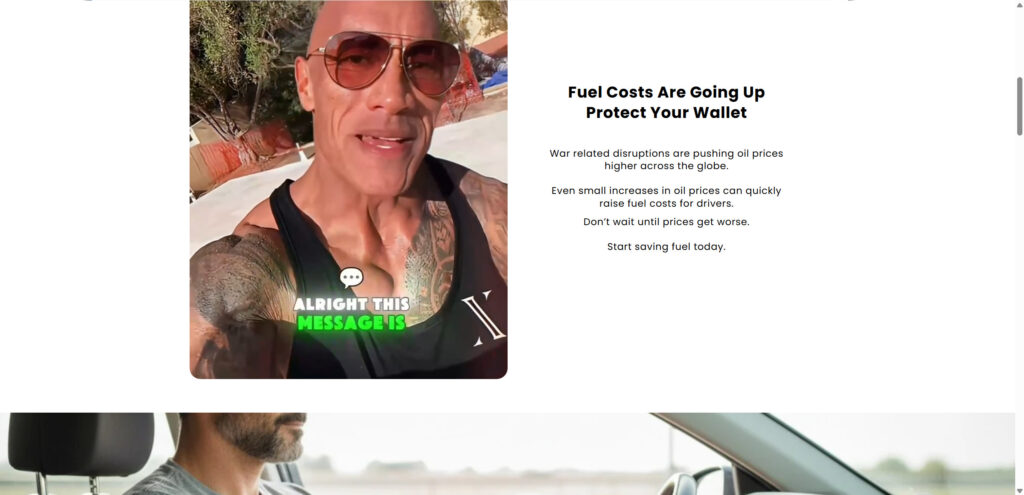
Step 3: They sell it on many different websites
This is not usually a one-site scam.
Products like the Neo Socket Fuel Saver are often sold across many websites under slightly different names, product titles, and designs. One store disappears, another shows up. One listing gets complaints, another version appears.
That makes the scam harder for regular buyers to track.
A shopper may think they found a new product when they are really looking at the same old gimmick being recycled again and again.
Step 4: They pressure people into buying quickly
The product pages are usually built to push fast purchases.
Common pressure tactics include:
- limited stock messages
- sale countdowns
- free shipping offers
- “buy now” discounts
- money-back guarantees
- claims that thousands of drivers already use it
All of this is designed to stop people from slowing down and thinking carefully.
The goal is impulse buying.
Step 5: They trick buyers into ordering more than they intended
This is where things often get worse.
In many cases, buyers think they are ordering one unit, but the checkout flow is designed to push bundles, upsells, extra quantities, or confusing order selections. Some people only realize later that they were charged for multiple units.
That can happen through:
- preselected bundle offers
- confusing checkout pages
- one-click upsells after payment
- misleading quantity layouts
- extra add-ons slipped into the order flow
So instead of receiving one cheap gadget, the customer may end up paying for several.
Step 6: They ship multiple units, even if the buyer only wanted one
This is a common complaint pattern with scam-style product stores.
A buyer may believe they ordered one Neo Socket Fuel Saver, but the seller ships multiple units and charges accordingly, or claims the larger order was selected during checkout.
That creates a second layer of frustration.
Now the buyer is not only dealing with a useless product. They may also be dealing with an inflated order they never clearly intended to place.
Step 7: The product arrives and does little or nothing
When the package shows up, the device often appears “real” enough to avoid instant suspicion.
It may:
- look polished
- plug in
- light up
- contain simple electronics
- resemble the photos on the site
But that does not mean it works.
For many buyers, the product’s only obvious function is that it lights up. The promised fuel savings, smoother driving, and ECU magic never become meaningfully visible.
That is one reason this scam keeps going. The product is not always obviously broken. It is just useless.
Step 8: Buyers struggle to prove it does not work
This is one of the smartest parts of the scam.
Fuel savings are hard for the average person to measure precisely. Mileage changes for all kinds of reasons, including:
- traffic
- weather
- driving habits
- tire pressure
- route changes
- vehicle condition
Because of that, scammers benefit from uncertainty.
A buyer may wonder:
- Maybe it needs more time
- Maybe I need to drive more
- Maybe the results are gradual
- Maybe I just cannot measure it easily
That delay gives the seller cover.
Step 9: The seller refuses to refund or makes it very difficult
Once buyers try to get their money back, the real scam becomes obvious.
A common pattern is that the seller:
- ignores refund requests
- replies slowly
- blames the buyer
- points to confusing order terms
- demands return shipping
- offers only a partial refund
- refuses to acknowledge that multiple units were not clearly ordered
This is where many customers realize they were not dealing with a serious business at all.
The “guarantee” on the product page often looks much better than the actual customer service experience.
Step 10: The scam repeats under another name
Even after complaints build up, the scam does not necessarily end.
The same style of product can simply reappear:
- on a different website
- under a different brand name
- with slightly different packaging
- with the same fake promises
That is why this is best understood as a broader scam pattern, not just one bad product listing.
This is a big scam model built around cheap gadgets, aggressive ads, misleading checkout flows, and poor refund practices.
What To Do If You Have Fallen Victim to This Scam
1. Save all proof of the order
Before anything else, collect your evidence.
Save or screenshot:
- the product page
- the order confirmation
- the amount charged
- the quantity shown
- shipping emails
- refund policy wording
- any upsell or checkout pages
This matters because scammy websites often change their pages later.
2. Check whether you were charged for more than one unit
Look carefully at your receipt and payment record.
Make sure you confirm:
- how many units you meant to buy
- how many units you were charged for
- whether upsells were added
- whether shipping or extra fees were included
If multiple units were billed unexpectedly, that should be part of your complaint.
3. Contact the seller in writing
Send a clear refund request by email or contact form.
Keep it short and direct. Include:
- your order number
- the quantity issue, if applicable
- a statement that the product does not perform as advertised
- a request for a full refund
Ask for a reply within a specific number of business days.
4. Dispute the charge if the seller refuses
If the seller stalls or refuses to help, go to your payment provider.
Depending on how you paid, that may include:
- your credit card company
- PayPal
- your debit card issuer
- your bank
Explain that:
- the product appears misleading
- the claims were unsupported
- the order quantity may have been deceptive
- the seller is refusing to refund
5. Stop using the device
Do not keep using a questionable gadget in your vehicle just because it lights up.
Remove it.
At best, it is doing nothing useful. At worst, it is a low-quality electronic device you do not need plugged into your car.
6. Warn other buyers
If you can, leave a review or post a complaint describing what happened.
Be specific. Mention:
- where you bought it
- what was promised
- whether multiple units were sent
- how the refund request was handled
That can help other people avoid the same trap.
The Bottom Line
Why Neo Socket Fuel Saver looks like a scam
The Neo Socket Fuel Saver appears to be part of a long-running fake fuel saver scam built around aggressive advertising, recycled product branding, weak technical claims, and bad post-purchase support.
The pattern is clear:
- scammers run ads
- they make the gadget sound advanced
- they sell it across many sites
- they push buyers into bigger orders
- they sometimes send multiple units
- they refuse or delay refunds
- they move on and repeat
That is not a legitimate automotive product strategy.
That is scam behavior.
Final takeaway
If you are thinking about buying the Neo Socket Fuel Saver, avoid it.
If you already bought it, especially if you were charged for more than one unit, save your records and dispute the transaction if the seller does not cooperate.
This looks like a big scam built to turn a cheap gadget into an expensive mistake.

Join the discussion
0 commentsShare your experience or ask a question about this article.
Discussion
Start the conversation
Have a question or something useful to share? Add the first comment.