

A polished smart ring promising sleep, stress, cycle, and recovery insights can feel like an affordable shortcut to understanding your body.
Noomay wraps that promise in elegant design, bold popularity figures, and unusually reassuring guarantees. The important details deserve a closer look before checkout.
Overview
What Noomay Says the Ring Can Do
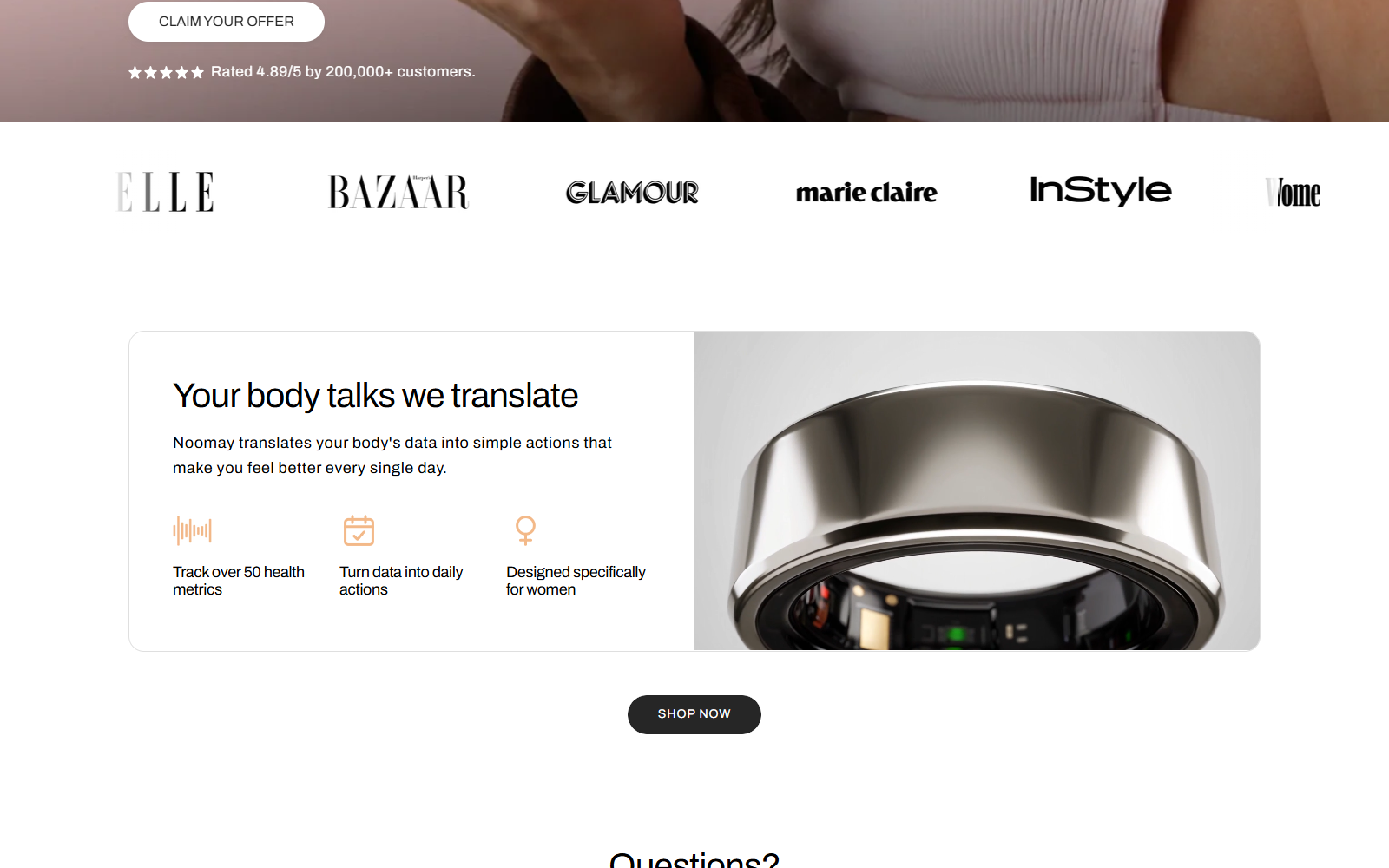
Noomay markets a wearable ring designed for women and says it tracks more than 50 health and wellness metrics.
The advertised measurements include heart rate, heart-rate variability, blood oxygen, skin temperature, movement, sleep stages, stress, readiness, calories, and menstrual-cycle patterns.
The seller says a free iOS and Android app converts those readings into daily recommendations. It also promises no recurring app subscription.
Other highlighted promises include up to seven days of battery life, free worldwide shipping, and delivery within five to eight business days.
Why the Presentation Raises Questions
The homepage says Noomay is rated 4.89 out of 5 by more than 200,000 customers. It also describes a community of 200,000 women.
Those figures are extraordinary for a domain created only on August 9, 2026, according to the domain registration record reviewed for this investigation.
A young store can sell a real product. Age alone does not prove fraud, but it makes enormous historical sales claims harder to reconcile.
The site displays publication logos and extensive testimonials. Shoppers should ask whether those logos represent editorial coverage, paid placements, or simply decorative trust signals.
Our Evidence-Based Assessment
Noomay is not being labeled a confirmed scam in this article. Its written return and warranty terms are stronger than many short-lived gadget stores.
The concerns involve verification. The ring’s hardware lineage, independent accuracy testing, app-store presence, enormous customer count, and long-term software support are not clearly demonstrated.
Before ordering, a buyer should independently confirm these points:
- Direct App Store and Google Play links for the promised Noomay application
- Independent sensor-accuracy testing against established wearable devices
- The exact ring model, manufacturer, certifications, and country of origin
- How health data is stored, encrypted, exported, and deleted
- Whether the 100-day return label is available in the buyer’s country
- Which entity handles warranty claims after the website changes or closes
The Popularity Claims Need Independent Context
A claimed customer base of 200,000 would normally leave a broad independent footprint across app stores, support forums, retailer pages, and long-running customer discussions.
At the time of review, the independent review profile we located contained only a tiny number of public reviews compared with the homepage figure.
That mismatch does not establish that every testimonial is fabricated. It does mean the site’s own numbers should not be treated as independent proof.
On-site reviews are selected, hosted, and presented by the seller. Independent reviews provide stronger evidence because the seller controls them less directly.
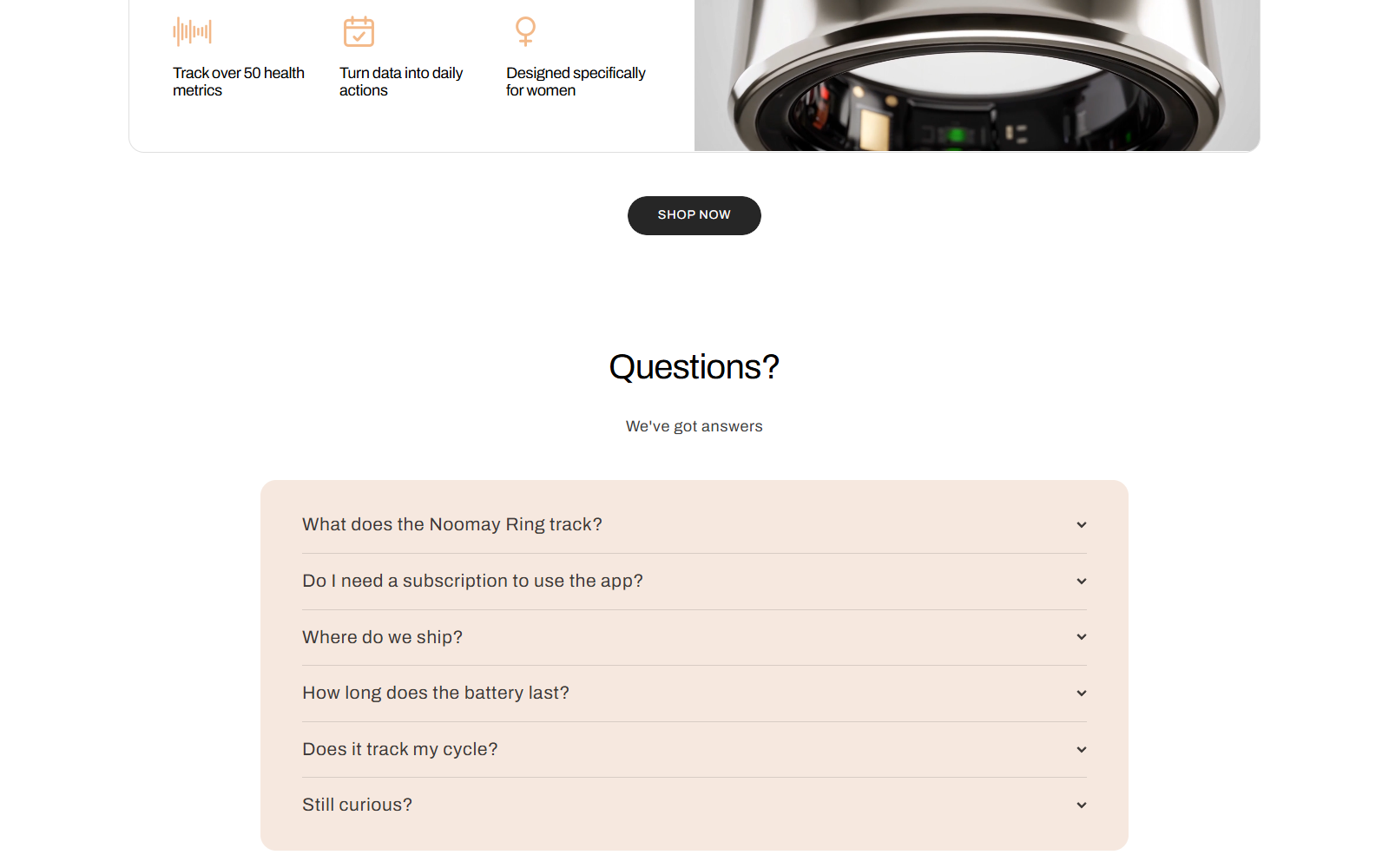
Noomay’s FAQ promises that its app is free for life and available on iOS and Android in every language.
We could not independently locate a clearly branded Noomay app listing through ordinary App Store and Google Play searches during this review.
Search results can be incomplete, and an application may appear under a developer’s different name. Buyers should request direct official store links before paying.
This matters because a smart ring is only half a product. Without functioning software, its sensors cannot deliver the reports promoted by the storefront.
Health Metrics Are Not Medical Answers
Noomay itself states that the ring and app provide wellness insights, are not medical devices, and cannot replace advice from a qualified professional.
That disclaimer is important. Consumer wearables can show trends, but sleep staging, oxygen readings, stress scores, and cycle estimates may contain errors.
A low or high reading should not be used to diagnose a condition, change medication, or postpone medical attention.
Fit, skin tone, motion, circulation, temperature, sensor contact, and software algorithms can all influence optical wearable measurements.
Ask for validation involving the exact Noomay model. General research about smart rings does not automatically validate this particular hardware and algorithm.
How the Noomay Smart Ring Offer Works
Step 1: The Ad Sells Relief From Uncertainty
The pitch begins with familiar problems: poor sleep, unexplained fatigue, stress, cycle changes, and difficulty understanding daily energy.
A ring appears easier than keeping a journal, arranging tests, or comparing multiple health applications.
That emotional promise encourages shoppers to focus on the imagined insight before examining who built the device.
Step 2: Design and Publication Logos Create Authority
The page uses clean typography, premium photography, large media logos, star ratings, and confident statements about translating the body’s signals.
These elements create the visual language of an established wearable company, even though appearance alone says nothing about technical validation.
A logo row should never be interpreted automatically as an endorsement. Look for a specific article, review, or award on the publication’s own website.
Step 3: Big Numbers Reduce Buyer Hesitation
Statements about 200,000 customers and a 4.89 rating suggest that a large community has already tested the product.
Social proof is persuasive because it makes uncertainty feel settled. Yet the site does not clearly show a verifiable dataset behind those totals.
A careful buyer should compare the claimed scale with independent review volume, app downloads, corporate history, and archived versions of the store.
Step 4: The Ring and App Are Sold as One System
The physical ring gathers sensor readings, while the promised application interprets them and displays scores.
Before ordering, confirm phone compatibility, required permissions, export options, account deletion, update support, and whether all advertised features already exist.
Do not rely on a generic statement that an app works on every language and platform. Request direct listings and current compatibility requirements.
Step 5: A Large Discount Adds Urgency
The storefront advertises 53% off and says a limited-time offer is ending soon.
Countdown language can shorten comparison shopping. Record the price, shipping promise, taxes, bundle quantity, warranty selection, and total before submitting payment.
If the same promotion returns after its timer expires, treat the urgency as a sales device rather than an actual deadline.
Step 6: Strong Guarantees Close the Sale
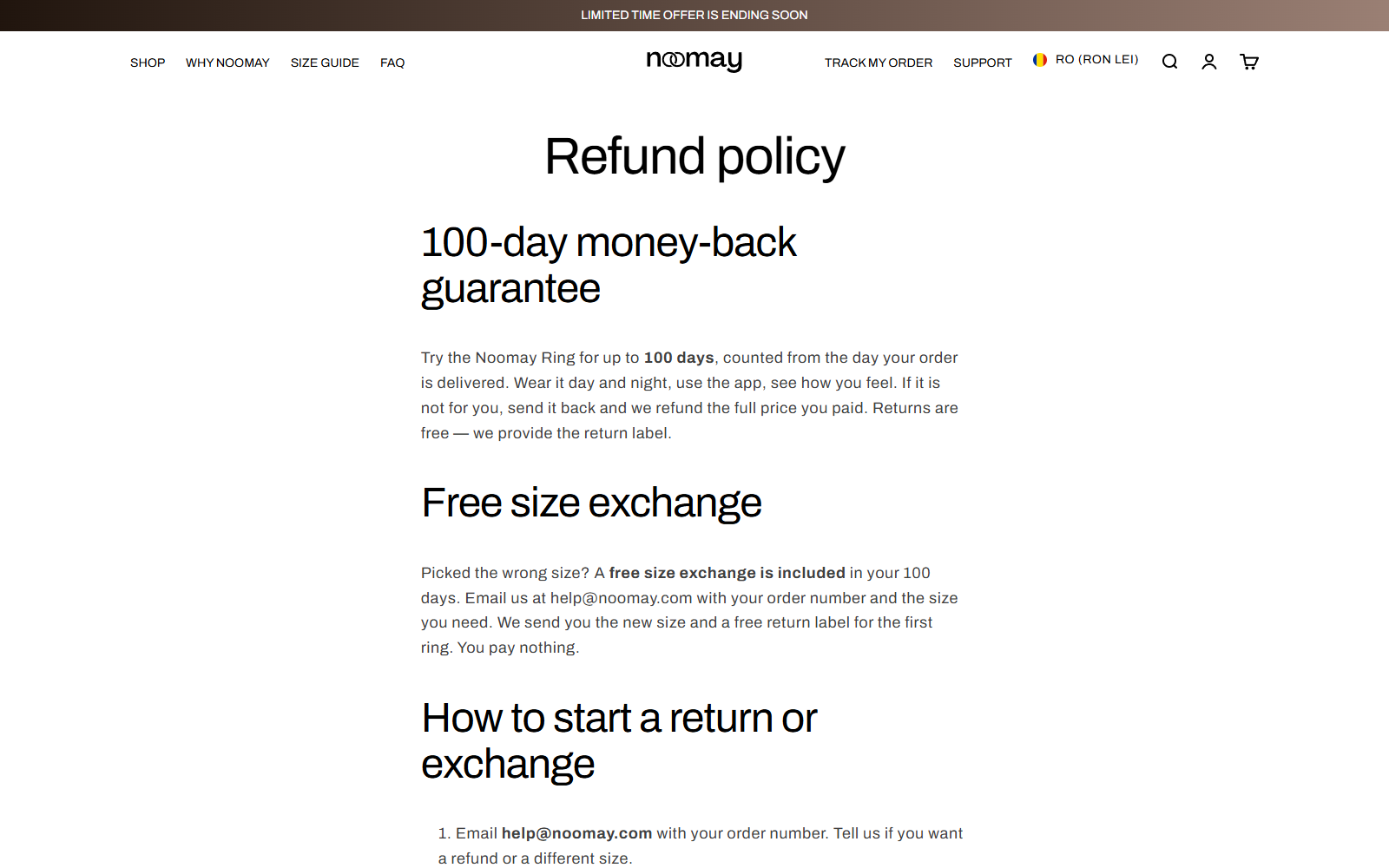
The published refund policy offers 100 days, normal wear acceptance, a provided return label, and a full-price refund.
The seller also states that every ring includes a two-year replacement warranty, with a paid lifetime-warranty upgrade available during checkout.
These are meaningful written promises. Save them before ordering because policies can change, and enforcement depends on support remaining responsive.
Company, Address, and Fulfillment Checks
The Legal Operator Is Named, but the Brand Is New
Noomay’s terms identify Adonis Group LLC as the operator. Wyoming records list that company with a December 23, 2024 filing date.
The same legal entity also operates another consumer brand, BLINQON. That connection is not wrongdoing, but it shows the company manages multiple direct-to-consumer offers.
Compare the legal name on the receipt and card statement with Adonis Group LLC. Challenge an unfamiliar merchant name quickly.
The Cheyenne Address Does Not Identify a Lab
The listed address is 1507 Lampman Court, Cheyenne, Wyoming. Public records show it is used for business registration purposes.
The address does not, by itself, establish where rings are engineered, manufactured, tested, stocked, repaired, or returned.
Ask for the actual return destination and manufacturing country before ordering. A registered business address is not a factory or quality laboratory.
Support Is Primarily an Email Relationship
The published contact method is help@noomay.com. We did not find a prominently displayed dedicated Noomay telephone support line.
Email support can work well, but buyers should send a pre-sale question and evaluate whether the answer is specific, timely, and signed by an identifiable team.
Keep every response. A saved conversation can support a card dispute if the delivered ring, app, or warranty differs from the written promise.
The Hardware Supply Chain Remains Unclear
The reviewed pages do not clearly name the original equipment manufacturer, sensor supplier, independent testing laboratory, or exact compliance certificates.
That missing traceability matters more for a health-data wearable than for an ordinary fashion accessory.
Request model numbers and certificate documents that can be verified with the issuing body. A logo or generic compliance statement is not enough.
The Return Policy Is Better Than the Marketing Evidence
Noomay’s written return policy is unusually clear. It allows the ring to be worn and tested, accepts normal signs of wear, and promises free return shipping.
It also says refunds are processed within 14 days after the return arrives. Damaged or incorrect deliveries should be replaced or refunded without cost.
Those terms reduce purchase risk only if the seller follows them. Save screenshots showing the policy date, order number, delivery date, and support instructions.
Do not mail the ring without approval. The policy warns that unauthorized returns may not be matched to an order.
Use tracked shipping and preserve the carrier receipt, package weight, serial number, and photographs of everything returned.
How to Evaluate the Ring Before Keeping It
Use the return window as a structured test period, not as permission to trust every chart.
- Confirm the app developer, privacy policy, permissions, and update history before creating an account.
- Compare resting heart-rate trends with a known device under the same conditions.
- Check whether readings disappear during movement, loose contact, or overnight wear.
- Test battery life with all advertised features enabled.
- Export your data and confirm the promised machine-readable format works.
- Request deletion and verify what remains in backups or customer-service systems.
- Do not use the ring to make treatment decisions.
If advertised functions are missing, document the screen and contact support within the return period.
A precise written complaint is stronger than saying the product feels disappointing. Identify the feature, phone model, app version, and steps already tried.
The App Matters as Much as the Ring
A smart ring is only one part of the purchase. Its app interprets readings, stores history, installs updates, and turns sensor signals into advice.
If the app disappears, stops receiving updates, or loses phone compatibility, an otherwise functioning ring can become far less useful.
Ask which company publishes the app, where it is officially distributed, and how long software support is promised.
Search the Apple App Store and Google Play directly. Read recent complaints about pairing, synchronization, battery drain, and account access.
Permission requests also matter. A wellness app should explain why it needs location, contacts, advertising identifiers, or access to other health records.
Do not reuse a banking or email password when creating the account. Use a unique password and stronger sign-in protection when available.
Privacy Questions Buyers Should Ask
Sleep, temperature, cycle, stress, and activity records can reveal intimate routines. That makes the privacy policy part of the product, not background paperwork.
Check whether data is shared with analytics companies, advertisers, affiliates, insurers, employers, or parties involved in a future business sale.
Look for a clear deletion process. Removing the app from a phone does not necessarily erase an account or measurements stored remotely.
Before returning the ring, unpair it, request account deletion, and preserve confirmation. A factory reset may not remove cloud-held information.
What to Do if You Have Fallen Victim to This Scam
- Save the complete transaction record. Keep the advertisement, product page, checkout total, order confirmation, refund terms, warranty wording, emails, tracking history, packaging, and ring serial number.
- Write to the seller immediately. State whether you want cancellation, refund, replacement, data deletion, or warranty service. Include the order number and a clear deadline.
- Follow the return instructions exactly. Wait for authorization, use the provided label when promised, photograph the contents, and retain tracking until the refund posts.
- Contact the card issuer if promises are not honored. Explain whether the dispute involves non-delivery, missing features, misrepresentation, duplicate charges, or an unprocessed return.
- Secure the connected account. Change reused passwords, revoke unnecessary permissions, and request deletion of health and account data if you stop using the service.
- Check the device that opened the advertisement. Malwarebytes can scan for unwanted programs or malicious downloads. AdGuard can block many deceptive ads and known scam destinations.
- Do not pay a recovery agent. Anyone demanding an upfront fee to obtain a guaranteed refund may be launching a second scam.
- Report serious misrepresentation. Send evidence to your consumer-protection authority, advertising regulator, marketplace, social network, and payment provider.
Frequently Asked Questions
Is Noomay Smart Ring definitely a scam?
No. We found a real legal operator and consumer-friendly written terms. The unresolved concerns involve very large popularity claims, app verification, and hardware transparency.
Does Noomay require a monthly subscription?
The reviewed website says the app is free for life with no subscription. Save that promise and confirm the checkout contains no recurring service.
Can the ring diagnose a health condition?
No. Noomay describes it as a wellness product, not a medical device. Concerning symptoms or readings require advice from a qualified clinician.
Is the 100-day guarantee real?
It is clearly published and includes normal wear plus a free return label. Whether it is honored consistently can only be judged through documented customer outcomes.
Why does the 200,000-customer claim matter?
It signals experience and trust, yet the young domain and limited independent footprint make that number important to verify before relying on it.
What should I ask before ordering?
Request direct app-store links, the hardware manufacturer, accuracy validation, return-label availability, privacy details, and the exact merchant name that will appear on your statement.
The Bottom Line
Noomay presents a polished smart ring offer with ambitious health tracking and unusually generous written protection. Those strengths do not independently validate its performance or popularity.
Treat the ring as an unverified wellness gadget until the app, hardware, testing, and support history can be confirmed. Pay by a dispute-friendly method and save every promise.

Join the discussion
0 commentsShare your experience or ask a question about this article.
Discussion
Start the conversation
Have a question or something useful to share? Add the first comment.