


An email about your Norwegian Cruise Line reservation lands in your inbox. It mentions the ship you’re sailing on and asks you to finish a payment check.
The trip is real, and the details look familiar. With a cancellation warning attached, the message can feel like something you need to handle before packing.
Overview
The email borrows details from a genuine cruise
The Norwegian Cruise Line email scam uses a supposed payment verification to lure passengers into disclosing card information. Some reported messages include accurate reservation details.
A name, ship or sailing date can make the request sound informed. None of those details establishes that Norwegian sent the message or requires the proposed payment check.
The scammer wants you to treat information about your vacation as permission to follow their instructions. Those are two very different things.
Norwegian has issued its own warning
An Important Guest Advisory on Norwegian’s website says the company is investigating reports of fraudulent emails claiming to come from the cruise line.
The advisory tells guests to avoid replying, opening the messages’ links or providing personal and payment information. It directs reservation questions to genuine support or a travel advisor.
This is a confirmed impersonation campaign. The warning does not identify how each sender obtained booking details or establish that every passenger’s account was compromised.
The safest response starts outside the email
- Check the reservation through your established booking account.
- Ask your travel advisor about any genuine balance.
- Find Norwegian’s contact details through its official website.
- Keep the original message for a fraud report.
- Call your card issuer if you disclosed payment information.
Don’t enter card details through the warning’s link to prevent a cancellation. Confirm the actual reservation status through a channel you already trust.
Why This Message Can Feel Like Part of Your Travel Plans
Cruise preparations involve several legitimate tasks. You may be checking documents, arranging transfers or waiting for information about the booking, so another email doesn’t necessarily look unusual.
A payment problem also sounds plausible before travel. The scammer relies on the gap between recognizing your reservation and checking who is asking you to act.
Passengers reported card-verification emails that referred to their cruises. Other accounts in the discussion described messages containing names, reservation numbers, ships and departure dates.
Those are passenger reports, not an independent audit of Norwegian’s systems. The company’s own advisory separately confirms that fraudulent emails are being reported.
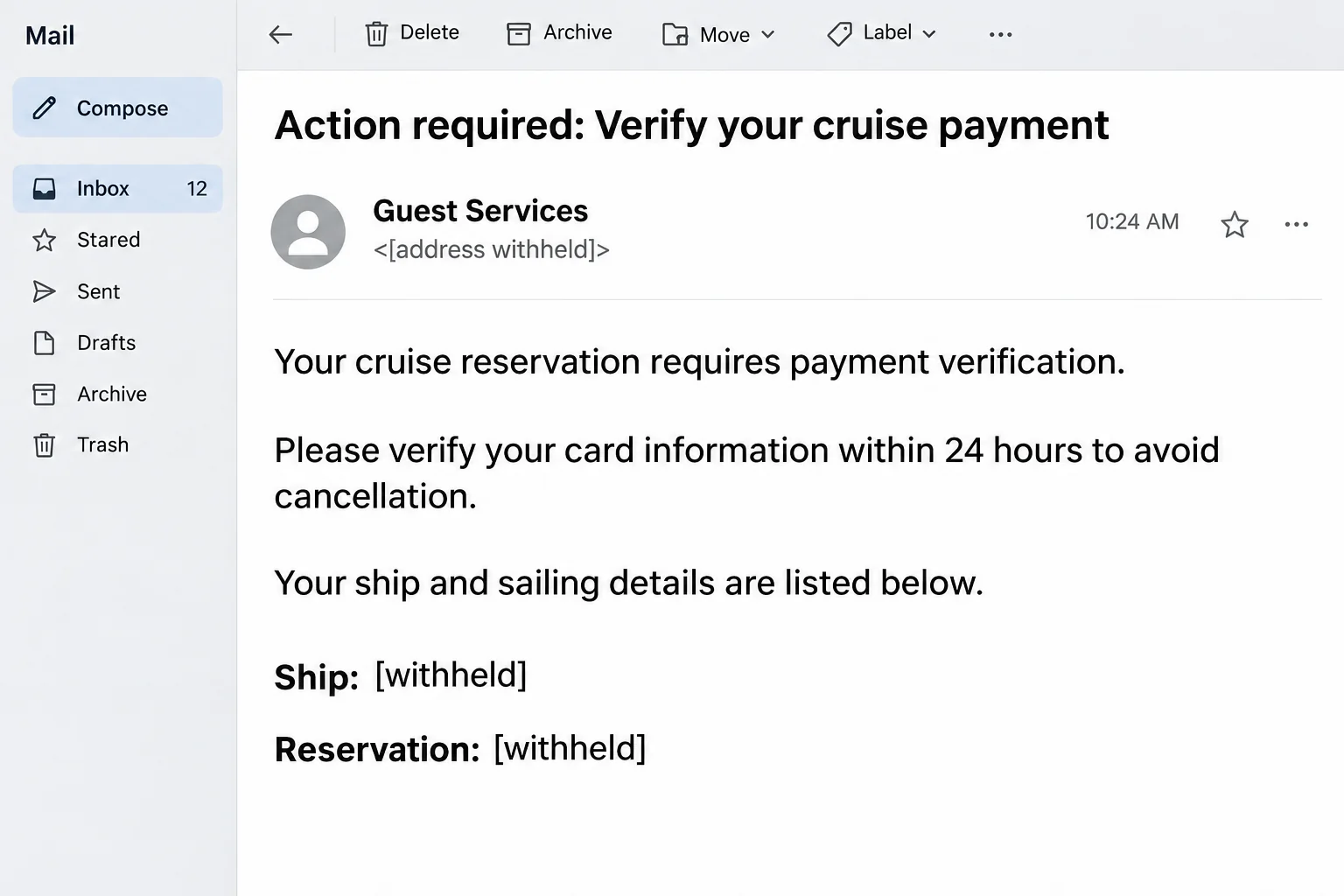
The reconstructed email illustrates the cancellation pressure without reproducing a passenger’s name or booking number. Its wording is fictional, rather than a copy of one traveler’s message.
If you’ve seen a similar demand, the useful next step is to check the booking. You don’t need to determine the entire campaign’s origin first.
How the Norwegian Cruise Line Email Scam Works
Step 1: A reservation message reaches you at a believable moment
The email presents itself as an administrative follow-up. You’re not being asked to buy an unfamiliar trip; you’re being told to protect a vacation you’ve already arranged.
That framing gives the sender an advantage. People who would ignore an unexpected prize may pay attention to a notice that appears to concern their cabin.
Look at what the message asks you to do, rather than judging only whether travel correspondence was expected. An expected subject can still carry an unauthorized request.
If you booked through an advisor, include them in the verification. They can help check the existing booking without relying on the sender’s payment instructions.
Step 2: Familiar information makes the stranger appear authorized
The sender includes enough recognizable information to seem connected to the reservation. A correct ship name or departure date can overshadow doubts about the email address.
Passengers also reported receiving messages after booking through different routes. Those accounts don’t establish a single source of the information or justify blaming a particular travel advisor.
A matching reservation number isn’t a secret handshake that authenticates an email. It is information about the booking, not evidence of the sender’s authority to handle it.
Avoid supplying additional booking details in your reply to test the sender. Instead, ask Norwegian or your advisor through contact information you obtain independently.
Step 3: A cancellation threat makes verification feel urgent
The message says you must verify payment to keep the reservation. That turns a financial request into a fear of losing the trip.
The pressure can make you focus on the cost of ignoring the email, while overlooking the risk of entering your card details where it directs you.
A deadline in an email isn’t confirmation that a booking deadline exists. Check any genuine outstanding balance and its due date against the reservation record.
If support confirms a payment is required, complete it through the verified booking process. You don’t have to use the suspicious email to meet a legitimate obligation.
Step 4: The supposed security check asks for payment information
The fraudulent message routes the passenger toward a request for card details. The verification language makes disclosure sound like a protective measure rather than a new risk.
Norwegian’s advisory explicitly tells guests not to provide personal or payment information in response to the fraudulent emails. A familiar logo doesn’t override that warning.
Don’t assume a page is genuine because it uses encryption or reproduces the cruise line’s appearance. Check how you reached it before typing anything.
If you already supplied details, contact your issuer instead of returning to the page to undo the action. The page’s own cancellation or support instructions aren’t trustworthy.
Step 5: Further messages can keep the pressure going
Several passengers described receiving repeated emails. More copies can make the issue feel persistent, but repetition doesn’t authenticate the request.
A follow-up may simply repeat the need to act. Don’t interpret increasingly urgent wording as evidence that Norwegian has actually changed your reservation.
Keep one complete original and note whether subsequent messages contain different sender details or links. That can help support understand what you’ve received.
Once the reservation has been checked through genuine support, follow that verified answer. Don’t reopen the same financial decision each time another warning arrives.
What Norwegian’s Domain List Helps You Check
The company’s advisory identifies these email domains for Norwegian communications: @ncl.com, @e.ncl.com and @nclcorp.com. Read the complete sender address, not only its display name.
A name such as Guest Services doesn’t tell you which domain sent the message. Expand the sender details in your mail app to see what it actually shows.
A lookalike address can include a familiar name inside a longer, unrelated domain. Don’t stop reading as soon as you notice the letters NCL.
Equally, a displayed address alone isn’t conclusive authentication. An unexpected demand for card information still needs to be checked independently, even if the message appears polished.
Be careful with arguments based only on branding. Norwegian itself uses NCL in its website address, so that abbreviation doesn’t independently prove an email is fraudulent.
Use the advisory as a reason to pause and verify. Don’t turn one visual detail into a guarantee that every other message is safe.
Do Real Booking Details Prove a Data Breach?
Accurate personal information makes this campaign more concerning, but it doesn’t identify how the information was obtained. That question requires evidence beyond the email’s contents.
Norwegian’s advisory says it is investigating fraudulent emails. It doesn’t explain a confirmed technical cause or say which individual accounts, if any, were accessed.
Don’t assume that everyone traveling on the same ship has been affected. Likewise, receiving no message doesn’t establish that an account has never been exposed.
Concentrate on findings you can check: unfamiliar account changes, unrecognized card activity and the actual status of your reservation. Report those details without adding guesses.
Never post an unredacted booking confirmation publicly to demonstrate that the scammer knew your details. That can expose the same information to additional strangers.
What to Do if You Have Fallen Victim to This Scam
-
Leave the verification page and stop replying. Don’t complete another form to cancel the first one. Save the message before reporting or blocking its sender.
If a new email offers to help fix the situation, treat that request separately. A second sender doesn’t gain your trust merely by acknowledging the first scam.
-
Tell your card issuer exactly what you shared. Explain whether you entered card details, approved a transaction or disclosed a one-time verification code.
Ask about blocking further use, replacing the card and reporting unfamiliar charges. A charge that hasn’t appeared yet doesn’t mean the disclosed information is safe.
-
Verify the cruise through Norwegian or your travel advisor. Open your established account or find the contact route on Norwegian’s official contact page.
Ask whether the reservation remains active and whether anything legitimate is due. Tell the representative about the fraudulent message, rather than treating its cancellation threat as fact.
-
Keep genuine booking payments separate from fraudulent charges. Save the original invoice and any payment records you already held before the suspicious email arrived.
When discussing a dispute, identify the specific transaction that concerns you. Don’t confuse an authorized cruise payment with a different merchant charge following the disclosure.
-
Review any account whose password you entered. Use the real service to replace disclosed credentials, then check its available sign-in and recovery settings.
Change a reused password on other affected accounts too. A card-verification message doesn’t automatically mean your email account was accessed, so explain your actual exposure to support.
-
Preserve the evidence without circulating personal details. Keep the full sender address, original email, suspicious destination and the date you interacted with it.
Provide reservation information privately to genuine support when requested. If you seek public advice, obscure passenger details, reservation identifiers and payment information in any images.
-
Report the message through your email service. Its phishing-report control can help flag similar attempts. Preserve your own copy first if you need it for follow-up.
For internet-enabled fraud in the United States, you can also report through IC3. Keep any acknowledgment with the bank and booking-provider correspondence.
Keep Your Travel Arrangements Working While You Resolve It
If a card needs replacement, ask the real booking provider whether a future payment uses that card. Update the method only through an independently confirmed route.
Check that you can still access your genuine account after security changes. Keep verified contact information available so an approaching travel date doesn’t push you back toward the email.
Make sure other passengers understand what happened. Someone else on the reservation might otherwise answer the same request because they think the group has overlooked a task.
If you used a travel advisor, agree who will handle legitimate payment questions. A clear contact reduces the chance that different travelers act on conflicting messages.
For a group booking, identify the person who actually made the original payment. They may hold the invoice or card record needed to clarify a disputed charge.
Don’t send another passenger’s card details to the email contact while trying to help. An instruction involving someone else’s payment method still needs independent confirmation.
If you’re outside the United States, choose the relevant contact information from Norwegian’s official page. A regional support route is preferable to a number inserted in the warning.
Keep a short record of your verified support conversation, including the date and reference if supplied. That makes a later follow-up easier if more messages arrive.
Before paying a genuine balance, compare its amount and recipient with the original booking documents. Ask the real representative to resolve any mismatch you don’t understand.
Don’t let an unfamiliar email deadline replace the due date on those documents. If the two conflict, explain that conflict through your established booking contact.
The goal is to protect both the payment method and the trip. You can challenge a fraudulent request without abandoning an otherwise valid reservation.
Frequently Asked Questions
Has Norwegian confirmed that fraudulent emails are circulating?
Its website carries an advisory about reports of fraudulent emails claiming to come from the cruise line. Guests are told not to respond or disclose payment information.
What if the reservation number and sailing date match?
Those details make a message convincing but don’t authenticate its sender. Check the reservation through Norwegian or the advisor you actually used.
Will ignoring the email cancel my cruise?
The scammer’s threat doesn’t establish your booking status. Confirm any legitimate balance or deadline through the real booking channel rather than the email’s link.
Is an email fake simply because it says NCL?
That abbreviation alone proves nothing about authenticity. Read the sender details, assess the request and independently verify any instruction involving card or account information.
Should I assume Norwegian has been hacked?
The advisory doesn’t establish the source of every exposed booking detail. Report suspicious activity you can document without turning speculation into a conclusion about the systems involved.
What if I opened the email but entered nothing?
Opening a message isn’t the same as disclosing card details or account credentials. Stop following its instructions, report it and check the booking independently.
The Bottom Line
Don’t verify your card through a cancellation warning that claims to be from Norwegian Cruise Line. Use the genuine reservation account, official support or your established advisor.
If you already entered payment information, contact the issuer promptly. Confirm the cruise separately and keep the original email for your reports.

Join the discussion
0 commentsShare your experience or ask a question about this article.
Community experiences
Did this happen to you?
Your experience could help someone recognize the same scam. Submit a private report for our team to review.
I experienced this tooReports are reviewed before publication. Sharing publicly is always your choice.
Discussion
Start the conversation
Have a question or something useful to share? Add the first comment.