

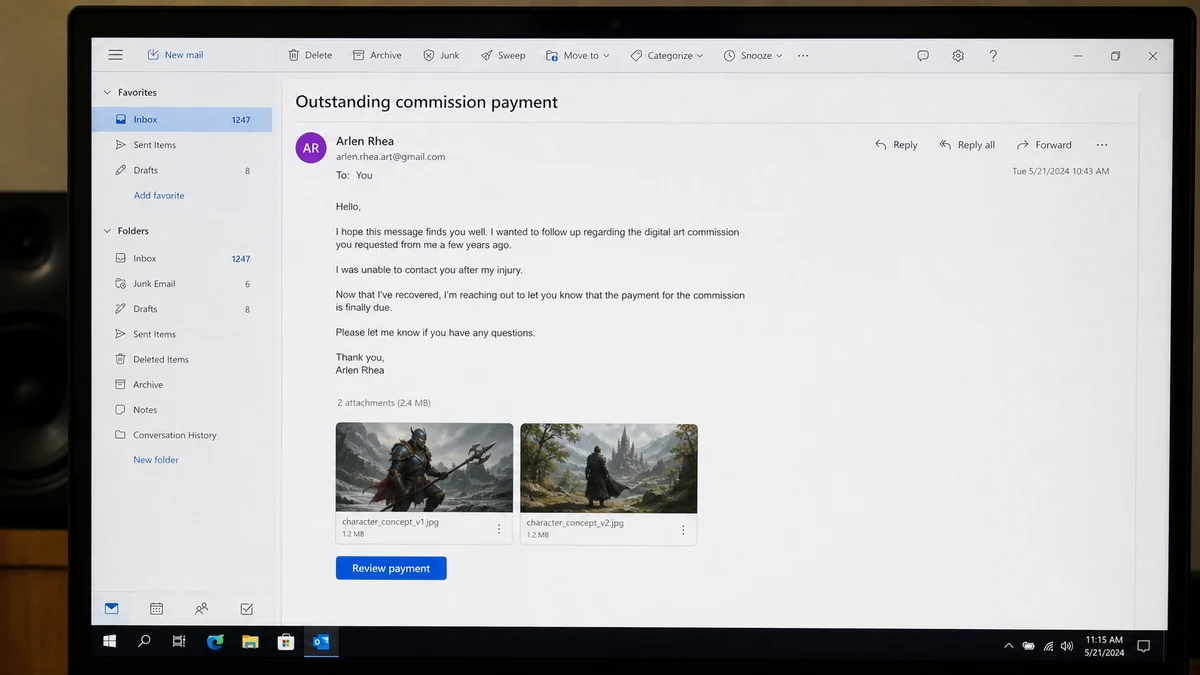
An artist appears after years of silence with an emotional explanation and a bill for work you supposedly ordered long ago. The attached images look original, and the dates overlap a period when you really bought commissions.
That uncertainty is the hook. Paying may feel kinder than challenging someone who claims to have suffered, even when no order record connects the sender to you.
Overview
The message combines memory gaps with emotional pressure
A recent consumer report described an email from someone claiming an injury had prevented contact about an outstanding digital art commission.
The recipient had genuinely commissioned art during the period mentioned and had met artists through social media. That real history made it difficult to dismiss the claim immediately.
The sender reportedly offered artwork and said the images could be redrawn. An attachment that appears handmade can make the debt story feel specific, but it does not establish who created the image or who ordered it.
The timing can be researched or simply guessed
Artists and customers often discuss commissions publicly. Social profiles may show character references, artist tags, finished pieces, commission openings, payment mentions, and dates.
A scammer can use those posts to construct a plausible unpaid-order story. A broad claim covering several years also increases the chance that an active buyer remembers at least one uncertain transaction.
Sometimes the timing is luck. The same template can be sent to many people in art, gaming, fandom, and role-playing communities. Recipients with a real commission history are more likely to engage.
Real artwork is not proof of a real debt
Images can be copied from portfolios, generated, purchased, traced, edited, or created specifically as bait. A person can produce genuine artwork while making a false claim about who commissioned it.
The debt must connect to records: the original conversation, agreed price, brief, artist account, invoice, deposit, delivery terms, and payment history. Sympathy and visual quality are not substitutes.
Before paying, verify:
- Can the sender provide the original message thread rather than screenshots?
- Does the username match an artist you followed or contacted at the time?
- Can you find the commission brief, price, deposit, invoice, or payment record?
- Does the attached art contain your private character details or only public references?
- Can the known artist confirm the email through an old social account?
- Is the requested payment going to the same identity used for earlier work?
- Does the sender become urgent or evasive when asked for records?
Why an Old Commission Is Difficult to Disprove
Digital commissions are informal. An order may begin in a direct message, continue in email, use a payment application, and end with a file link. Years later, the evidence is scattered across closed accounts and old devices.
A customer may also have contacted several artists at once. Some conversations ended before a price was agreed, some required a deposit, and others produced sketches that were never completed.
The scam exploits that imperfect memory. Instead of proving the order, the sender asks the recipient to prove it never happened. That reverses the normal burden for a payment request.
The injury story discourages skeptical questions. Asking for records can feel cruel after the sender describes paralysis, hospitalization, family loss, or financial hardship.
A long silence is then presented as evidence of misfortune rather than a problem with the claim. The sender may say old accounts were lost, devices were destroyed, or messages disappeared during recovery.
Those events can happen to real artists. They still do not prevent a legitimate claimant from identifying the agreed brief, platform, date, price, customer username, and prior contact.
A professional response is not an accusation. It is a request to reconnect the demand to the original transaction before any payment is made.
How the Old Art Commission Email Scam Works
Step 1: The sender finds a likely commission buyer
Targets may follow many artists, share original characters, participate in fandom communities, post commissioned work, or publicly ask for artist recommendations.
Older posts can reveal when commissions were purchased and which platforms were used. Breached email lists or scraped social profiles may connect those interests to an address.
Step 2: A vague old debt is introduced
The email says an outstanding commission was never paid or completed. The claimed date range is broad enough to overlap the recipient’s active period without requiring a precise order record.
The sender may avoid naming the character, quoted price, platform, or username until the recipient supplies clues. Each answer helps refine the story.
Step 3: Personal hardship explains every missing record
An injury, illness, disability, family emergency, or lost account explains why the artist disappeared. The narrative asks the recipient to focus on compassion rather than documentation.
A scammer may also imply that questioning the claim is unfair because the artist is vulnerable. Legitimate hardship and transaction verification are not mutually exclusive.
Step 4: Artwork is presented as proof
The email includes finished images, sketches, or thumbnails. They may match the victim’s public character or resemble the style of art purchased years ago.
The files do not prove provenance. Reverse-image search, metadata, portfolio archives, and source files may reveal whether they were copied, generated, or created recently.
Step 5: Payment is requested through a new route
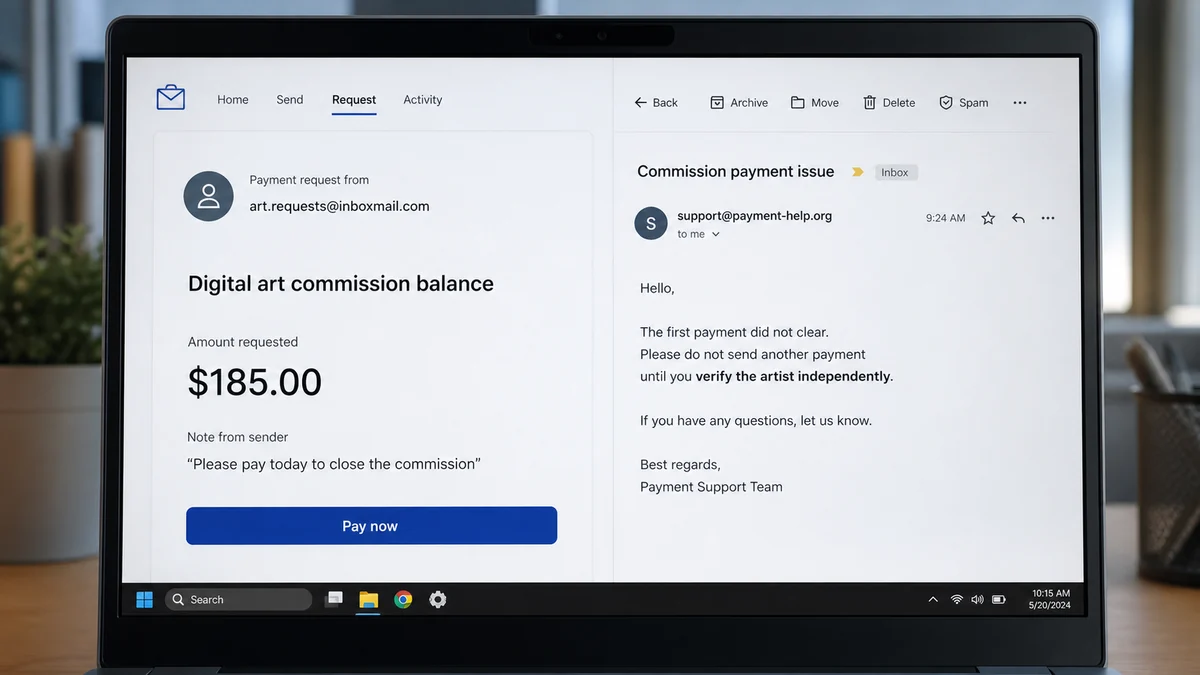
The sender provides a payment link, invoice, cryptocurrency address, gift-card request, or personal payment handle. The destination may not match any artist identity known to the recipient.
A first payment can trigger another claim: wrong currency, failed transfer, processing fee, account limit, or amount sent to the wrong type of account.
Step 6: The sender uses engagement to build a better story
If the recipient replies with names, dates, character details, or past artist relationships, the scam becomes more convincing. The attacker can mirror those details in later messages.
Even if no payment occurs, the reply confirms that the address is active and the topic is relevant. The target may receive more specialized invoice or commission scams later.
How to Verify an Old Commission Without Insulting a Real Artist
Start with records, not accusations. Ask for the original platform, username, commission date, agreed amount, character brief, payment schedule, and complete conversation history.
Do not send a list of possibilities. An open question requires the claimant to supply details independently. A scammer should not learn the correct artist, platform, or character from the person being billed.
Search your own email, direct messages, cloud storage, payment history, and downloaded files. Use the claimed date and artist handle, then compare creation dates and file names.
Contact the artist through an account or portfolio link you already followed at the time. Do not use a new phone number or social profile supplied in the payment email.
If the known account is gone, use archived portfolio pages, convention records, mutual contacts, or a marketplace order history. Confirm identity before discussing payment.
Ask for a low-resolution watermarked proof and the source-file history if artwork is central to the claim. Layered files and dated work-in-progress records can support authorship, though they still do not prove an unpaid order.
A real artist may have incomplete records after several years. The customer can still decline to pay a demand that cannot be connected to an agreement. Compassion does not require accepting an unverified debt.
What Artwork Evidence Can Actually Establish
A reverse-image search can show whether the attachment appeared earlier under another artist’s name. Search the whole image and distinctive cropped details because scammers may resize, mirror, recolor, or partially cover the source.
File metadata can contain creation software, dates, and author fields, but it is not conclusive. Metadata can be removed, changed, or regenerated during export and social-media upload.
Layered source files are stronger evidence of authorship than a flat image. Even then, possession of the source file does not prove that the recipient ordered the work or agreed to pay the amount demanded.
Work-in-progress screenshots can be fabricated or borrowed. A consistent sequence of dated sketches, conversation references, and private brief details is more useful than one finished picture.
Compare the style with the artist’s archived portfolio, but avoid relying on AI-detection websites. Their results are not reliable enough to determine authorship or fraud by themselves.
Ask which reference files were supplied by the customer. A claimant who cannot identify the character name, pose request, clothing details, or revision notes may be using public material.
Look for the original delivery method. A real commission may have a cloud link, marketplace download, invoice number, or sent-email record that connects the finished file to the buyer.
Do not upload private character files or personal evidence to an unknown verification service suggested by the sender. That can provide the attacker with better material for the next message.
The verification goal is a chain, not one perfect artifact. Identity, agreement, price, work history, delivery, and payment recipient should support the same transaction.
If those elements conflict, pause and document the discrepancies. An honest artist can clarify mistakes without demanding immediate payment through a new account.
Search old payment records by amount as well as name. Artists may have used a legal name, studio name, platform handle, or payment processor descriptor that differs from the portfolio identity.
Check whether a deposit was already paid. Some scams frame an old deposit as a new balance or ignore an earlier refund. A complete ledger is more reliable than a single remembered conversation.
If the claimant provides screenshots, ask for an exported conversation or verifiable message link. Screenshots can omit surrounding context, change names, or combine messages from different dates.
Do not let the sender rush verification by threatening a public callout. Preserve the threat and keep communication factual. A legitimate debt can be documented without harassment.
For large or complex claims, consider obtaining advice from the payment platform or a qualified lawyer before responding. Do not accept a legal referral selected by the person demanding money.
Artists can protect themselves by issuing written terms, invoices, deposits, and delivery confirmations. Buyers can protect themselves by saving the same records outside temporary direct-message platforms and keeping a dated copy of every final approval.
Company, Address, and Fulfillment Checks
Verify the artist through an older trusted identity
Use the portfolio, marketplace profile, social account, or email address associated with the original work. A newly created account using the same display name may be an impersonator.
Ask the artist to confirm the payment request through that independent channel. Do not treat a link inside the disputed email as identity verification.
Compare sender, reply-to, and portfolio domains
Expand the email details. The sender may use a free mailbox while the reply-to or payment page belongs to another identity.
A free address is not automatically fraudulent, especially for independent artists. The problem is inconsistency combined with missing transaction records and a new payment route.
Inspect the payment recipient before sending
Confirm the recipient name, handle, merchant type, buyer protection, currency, fees, and refund route. Do not use friends-and-family payment for a disputed commercial purchase.
Never send a second payment because the first supposedly failed until the payment provider independently confirms its status. A screenshot from the requester is not confirmation.
Fulfillment requires an agreed commission and deliverable
A finished image does not automatically create a debt. Real fulfillment requires evidence that the recipient ordered the work, agreed to the price and terms, and received or accepted the promised deliverable.
If the sender cannot identify the original agreement, pause. Do not let an attachment redefine unsolicited art as an accepted commission.
Warning Signs in an Old Commission Payment Request
- The first contact arrives years after the alleged order.
- The date range is broad but the exact commission is vague.
- A dramatic hardship story appears before transaction details.
- The sender cannot produce the original message thread.
- The recipient is encouraged to guess which artist or character is involved.
- Attached art uses references already visible on public profiles.
- The payment identity differs from the artist identity.
- Urgency appears even though the claimed debt is several years old.
- The sender requests cryptocurrency, gift cards, or a personal transfer.
- A new fee appears after the first payment.
- Questions about records trigger guilt, anger, or threats.
- The alleged artist cannot be reached through any old account.
The FTC warns that unexpected invoices can be phishing or payment traps. Its fake invoice guidance recommends checking whether the product or service was actually ordered before approving a bill.
MalwareTips’ fake login email guide covers a different lure but the same link risk. An invoice button can lead to credential theft even when no payment is completed.
What to Do if You Have Fallen Victim to This Scam
- Stop further payments. Do not send a replacement transfer, processing fee, release fee, currency correction, or refund charge. A second payment will not validate the first.
- Contact the payment provider immediately. Use the official application or known website. Report the payment as induced by a false commission claim and ask about cancellation, reversal, dispute, or buyer protection.
- Contact the bank or card issuer. Use the number on the card. Explain what was promised, why the debt appears false, and what evidence is available.
- Verify the real artist independently. Use an old account, portfolio, marketplace record, or mutual contact. Ask whether that person sent the demand and owns the payment recipient.
- Preserve the complete email. Save headers, attachments, metadata, payment links, sender and reply-to addresses, dates, usernames, invoices, and every follow-up demand.
- Search the artwork carefully. Use reverse-image search and compare portfolios, file dates, visible signatures, and source information. Do not publicly accuse an artist based only on a visual similarity.
- Change passwords entered through the link. Replace exposed credentials and reused copies, turn on multifactor authentication, and review recent devices and recovery settings.
- Secure social profiles. Remove public contact details and limit access to original character sheets, commission histories, friend lists, and personal information that could support another targeted message.
- Scan devices if files or software were opened. Image attachments are not automatically malicious, but archives, installers, scripts, extensions, and unusual document formats need caution. Run a full Malwarebytes scan after suspicious downloads.
- Block malicious destinations. AdGuard can reduce access to known phishing pages, tracking redirects, and malicious advertisements. It cannot determine whether an artwork debt is genuine.
- Report the accounts. Notify the email provider, social platform, portfolio site, and payment service. Include evidence of impersonation or deceptive billing.
- Report consumer fraud. File at ReportFraud.ftc.gov and at IC3.gov if the campaign involved account theft, substantial loss, or repeated online targeting.
- Warn the art community without doxxing. Share the scam pattern, sender domain, and payment method where platform rules allow. Remove private information and distinguish verified facts from suspicion.
Frequently Asked Questions
Can real artwork still be used in a scam?
Yes. It can be copied, purchased, generated, traced, or created as bait. Authorship and a valid unpaid order are separate questions.
How could the sender know I bought commissions years ago?
Public posts, artist tags, portfolios, breached data, mutual communities, and broad guessing can reveal or predict that history. Accurate timing does not prove a debt.
Should I reply to ask for more information?
You can request records without supplying clues, but avoid prolonged engagement. Verify the claimant through an older trusted channel and preserve the original message.
What proof should a legitimate artist provide?
The original platform and username, message history, brief, agreed price, payment terms, dated work records, and the connection between artist identity and payment recipient are useful evidence.
What if I paid through a friends-and-family transfer?
Contact the provider and bank immediately. Protection may be limited, but fast reporting can still help. Never pay a recovery service that promises guaranteed reimbursement.
Could opening the attached artwork infect my device?
A normal image is lower risk than an installer or script, but disguised files and archives can be dangerous. Do not open unexpected executable content and scan suspicious downloads.
The Bottom Line
The old art commission email is designed to make uncertainty feel like obligation. A believable date, emotional hardship, and attractive artwork can create sympathy without proving that an order existed.
Reconnect the claim to the original thread, artist identity, agreed price, and payment record. If the sender cannot supply that chain, do not let an unexpected attachment become a debt.








