

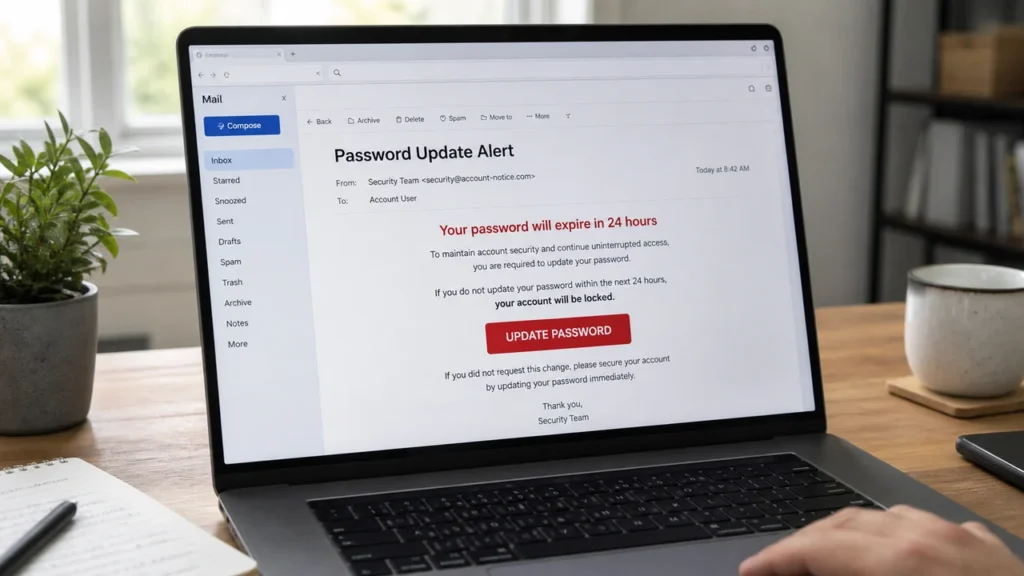
An email says your password will expire in 24 hours. If you do nothing, it warns, your inbox may be suspended and new messages could stop arriving.
That sounds like a problem worth fixing immediately. It is also exactly the reaction behind the Password Update Alert email scam, a phishing campaign designed to make people hand their email password to a convincing fake login page.
Overview
The Password Update Alert email scam impersonates an automated security message from an email provider. It claims the recipient’s password is about to expire and presents an “Update Password Now” button as the only way to prevent an interruption or temporary suspension.
The warning is not connected to the company that actually provides your email service. The sender, deadline, security language, and update button are parts of a phishing story created to move you from your inbox to a fraudulent website.
In the campaign examined for this report, the subject line warned, “Urgent Notice: Your E-mail Password Will Expire In 24hours.” The message said the password was scheduled to expire within a day and threatened a temporary account suspension if the recipient failed to update it.
The linked page was no longer active when researchers checked it. However, the email’s wording and button are consistent with credential-phishing pages that copy a generic webmail sign-in screen or change their appearance to match the victim’s email provider.
The scam succeeds when a recipient types an email address and password into that copied page. The form does not update anything. It sends the credentials to the criminals operating the campaign.
Merely receiving or reading the email does not infect your device. The immediate danger begins when you follow its link, submit information, download a file, approve a sign-in request, or reuse an exposed password elsewhere.
What the Password Update Alert Email May Look Like
There is no single design used in every version. Some messages resemble Microsoft 365, Outlook, Gmail, cPanel webmail, or a company’s internal IT desk. Others stay deliberately generic so the same email can be sent to people using many different providers.
The observed message used a short deadline, an account-suspension warning, and a large update button. These details are meant to turn a routine security task into an emergency.
Common warning signs
- An unexpected password deadline: The message says your password expires in 24 hours, today, or at the end of the business day.
- A threat of immediate disruption: It warns that your account, incoming mail, or access to stored messages will be suspended.
- A generic sender identity: The display name may say “Security Team,” “Webmail Administrator,” or “Email Support” without naming your real provider.
- A link that does not match the provider: Hovering over the button reveals an unrelated domain, a shortened address, or a page hosted on a compromised website.
- Awkward language: Phrases such as “24hours,” unusual capitalization, or vague references to “your e-mail provider” can expose the mass-produced message.
- No matching notice inside your account: When you open the provider’s real website or app independently, there is no password-expiration warning.
A polished logo does not prove that an email is genuine. Logos, colors, signatures, and copyright notices can be copied in seconds. The destination behind the button and the situation shown in your real account are far more useful checks.
Why a 24-hour deadline is so effective
Password notices are believable because workplaces sometimes require periodic changes. The scam borrows that familiar process, then removes the time a person would normally use to confirm it.
The threat of losing email access is especially powerful. An inbox may contain work conversations, password-reset links, receipts, family messages, and access to other services. The possibility of being locked out can make clicking feel safer than waiting.
That emotional calculation is backwards. A real password can be changed by opening the provider’s official app or typing its known address into a fresh browser tab. There is no reason to begin from an unexpected email.
How The Scam Works
1. Scammers obtain or generate lists of email addresses
The campaign usually begins with a large list rather than a carefully chosen individual. Addresses may come from public websites, marketing databases, previous breaches, infected contact lists, or automated combinations of common names and company domains.
This explains why the message may contain little personal information. The criminals do not need to know which provider you use if their landing page is generic or can be adjusted after it sees your address.
2. The email creates a believable security emergency
The subject is written to compete with everything else in a busy inbox. Words such as “urgent,” “expiration,” “security,” and “suspension” make the message appear both important and routine.
Inside, the story remains simple: your password is expiring, waiting will interrupt service, and one button will fix the problem. Simplicity is useful to the attacker because it discourages questions about why the provider needs an email link to perform an account-level change.
3. The update button hides the real destination
The visible button may say “Update Password Now,” but that text is only a label. The underlying address can lead anywhere.
Some phishing links pass through tracking or redirect services before reaching the fake login page. This records who clicked and may help the operators show different pages based on the recipient, device, country, or email domain.
On a phone, the destination can be difficult to inspect before tapping. That is one reason these campaigns often look unusually convincing on mobile devices.
4. A copied login page asks for the current password
The fraudulent page may show a webmail sign-in box, a company logo, the recipient’s email address, or a blurred inbox in the background. It can claim that authentication is required before the password can be changed.
This is the decisive moment. Any username, password, recovery email, phone number, or security answer submitted on the page becomes available to the attacker.
Some pages deliberately show an error after the first attempt and ask the victim to type the password again. This can help criminals collect more than one password when a person assumes the first entry was mistyped.
5. The stolen credentials are tested quickly
Phishing kits can send captured credentials to an operator in real time. The attacker may immediately try them against the genuine provider while the victim still believes a normal update is in progress.
If multifactor authentication is enabled, the fake page may ask for a one-time code or tell the victim to approve a sign-in notification. A code should never be entered into a page reached through an unsolicited message.
6. The mailbox becomes a gateway to other accounts
Access to email is valuable because many services use the inbox for password recovery. A criminal who controls it may reset shopping, cloud-storage, social-media, payroll, or financial accounts.
The attacker can search messages for invoices, identity documents, customer records, cryptocurrency information, or previous password-reset emails. They may also create forwarding rules so copies of future messages are delivered to an address the victim does not recognize.
Business accounts create another opportunity. A hijacked mailbox can be used to send quotation requests, fake invoices, or changed-payment instructions from a person the recipient already trusts.
7. The victim is shown a harmless ending
After collecting the information, the phishing site may display “Password updated,” redirect to the real provider, or report a temporary service error. The ordinary ending reduces the chance that the victim changes the exposed password immediately.
Some versions also deliver a malicious attachment or download. That is not necessary for credential theft, but any file received through the page should be treated as untrusted until it has been checked.
Why a Stolen Email Password Can Cause Wider Damage
An email password is not just another login. For many people, the inbox is the recovery channel and historical record for most of their online life.
Once inside, an attacker may learn which banks, stores, employers, and subscription services you use. Search terms such as “verification code,” “invoice,” “statement,” and “password reset” can reveal high-value targets quickly.
The criminal may delete security warnings, mark them as read, or add mailbox rules that hide replies. This can allow an account takeover to continue even after the owner resumes normal use.
Password reuse increases the damage. If the same credentials protect several accounts, criminals can test them automatically against other popular services. This is known as credential stuffing.
A compromised work mailbox can also expose colleagues and customers. Messages sent from a genuine account bypass the suspicion created by an unknown sender, making follow-up phishing attempts much more persuasive.
Watch for quiet signs rather than waiting for a complete lockout. Unexpected sent messages, missing security alerts, password-reset emails you did not request, unfamiliar devices, and replies to conversations you never started can all indicate that somebody else has used the account.
Also check whether messages are being marked as read before you see them. An attacker may monitor the inbox for authentication codes or replies from financial services while trying to avoid visible changes that would alert the owner.
Recovery should therefore include more than replacing one password. Sessions, forwarding rules, recovery methods, connected applications, and accounts linked to the inbox all need attention before the incident can be considered contained.
For another example of this pattern, see our guide to the DocuSign Document Review email scam, which uses a fake document workflow to collect login details.
What to Do if You Have Fallen Victim to This Scam
- Change the exposed password from a trusted device. Open the provider’s official app or type its address yourself. Do not return through the email. Create a new, unique password that has never protected another account.
- Sign out other sessions. Use the account’s security page to revoke unfamiliar devices and active sessions. Changing a password does not always invalidate every existing session immediately.
- Turn on strong multifactor authentication. An authenticator app, passkey, or security key offers better protection than a password alone. Never approve a prompt you did not initiate.
- Review recovery details. Check the recovery email, phone number, security questions, app passwords, and trusted devices. Remove anything you do not recognize.
- Inspect mailbox rules and forwarding. Look for automatic forwarding, hidden filters, inbox rules, delegates, or connected applications created without your permission.
- Change reused passwords. Update every account that used the same or a similar password. Start with banking, cloud storage, shopping, social media, and workplace services.
- Contact your workplace administrator if applicable. A business mailbox may contain customer data or provide access to internal systems. The security team can review login logs, revoke tokens, and warn affected contacts.
- Scan the device if you downloaded or opened anything. Update the operating system and security software, then run a full scan. Disconnect the device from sensitive work until suspicious files have been assessed.
- Warn contacts about messages sent from your account. Tell them not to open unexpected links, attachments, invoices, or document requests that appeared to come from you.
- Report the phishing email. Use your provider’s phishing-report option. In the United States, the FTC recommends forwarding phishing emails to reportphishing@apwg.org and filing a report at ReportFraud.ftc.gov.
If personal, financial, or identity information was exposed, contact the relevant bank or provider directly. U.S. victims can use IdentityTheft.gov to build a recovery plan based on the information that was stolen.
Act even if the fake page displayed an error. An error can be part of the collection process, and information may have been transmitted before the page changed.
Is Your Device Infected? Run a Free Malware Scan
Slow performance, constant pop-ups, or strange behavior? These are classic signs of a malware infection. The fastest way to find out is to scan your device with Malwarebytes Free — one of the most trusted malware removal tools available.
The free version detects and removes the most common threats, including:
- Adware — the cause of those annoying pop-ups
- Browser hijackers — unwanted redirects and changed homepages
- Trojans and spyware — hidden programs stealing your data
- Potentially unwanted programs (PUPs) — software you never asked for
👉 Select your device below — Windows, Mac, or Android — then follow the simple steps to download Malwarebytes, scan your system, and remove any threats it finds. The scan usually takes 5 to 20 minutes.
Run a Malware Scan with Malwarebytes for Windows
Malwarebytes is one of the most popular and trusted anti-malware tools for Windows — and it’s completely free for removing infections. It catches threats that many antivirus programs miss, including adware, browser hijackers, and trojans. Follow the steps below to scan and clean your PC in just a few minutes.
Download Malwarebytes
Click the button below to download the latest version of Malwarebytes for Windows from the official source. The free version is all you need — it will scan your computer and remove adware, browser hijackers, and other malicious software at no cost.
Download MalwarebytesOfficial installer for Windows 11 and 10. Your download starts right away.Want real-time protection? See Malwarebytes Premium Malwarebytes Free for WindowsScans and removes malware at no cost
-
Install Malwarebytes
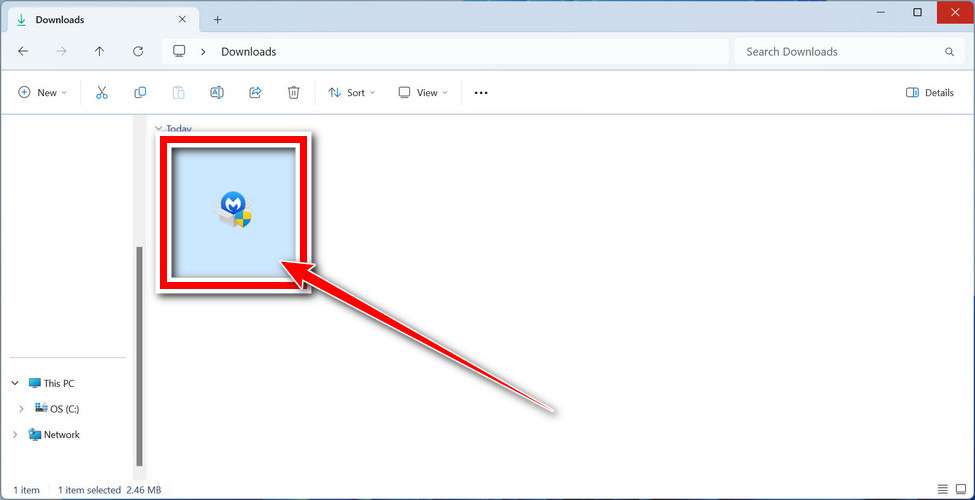
When the download finishes, open your Downloads folder and double-click the MBSetup file. If Windows shows a User Account Control pop-up, click “Yes” to allow the installation.
Follow the On-Screen Prompts to Install Malwarebytes
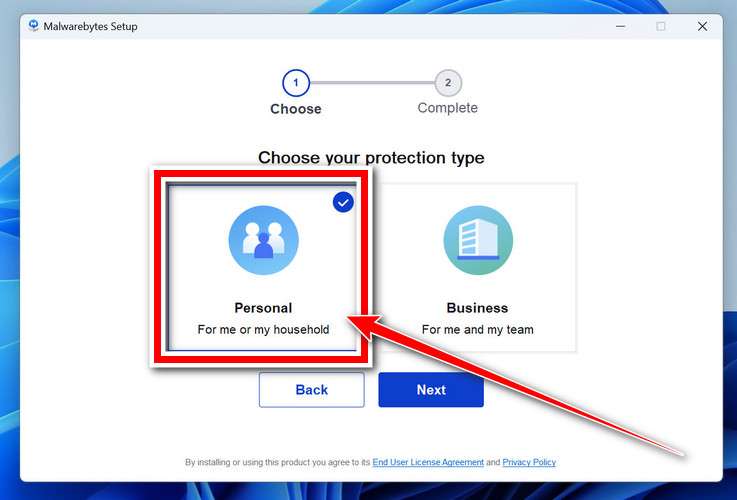
The setup wizard will walk you through a few quick screens:
-
Choose where you’re installing the program — “Personal Computer” or “Work Computer” — then click Next.
-
Malwarebytes will now install on your device. This usually takes under a minute.

-
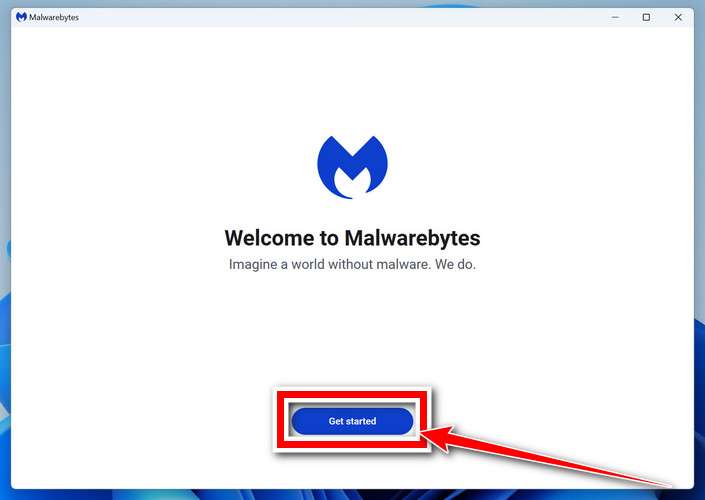
When installation is complete, the “Welcome to Malwarebytes” screen will open automatically.
-
On the final screen, click Open Malwarebytes to launch the program.

-
Enable “Scan for Rootkits”
Before scanning, turn on rootkit detection so Malwarebytes can find even the most hidden threats. Click the Settings gear icon on the left side of the screen.
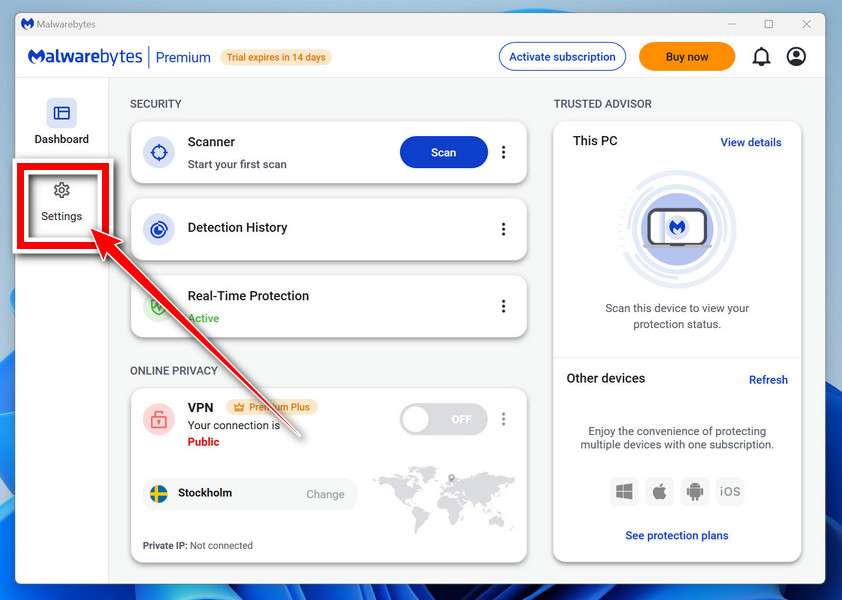
In the settings menu, find “Scan for rootkits” and click the toggle so it turns blue.

Done? Click “Dashboard” in the left pane to return to the main screen.
Start the Scan
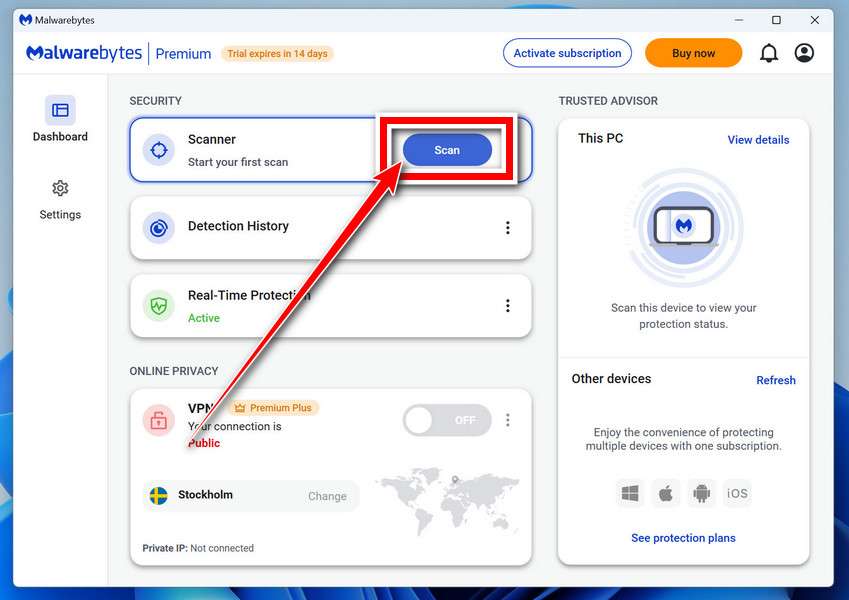
Click the blue Scan button. Malwarebytes will automatically update its virus database and start checking your computer for malware.
-
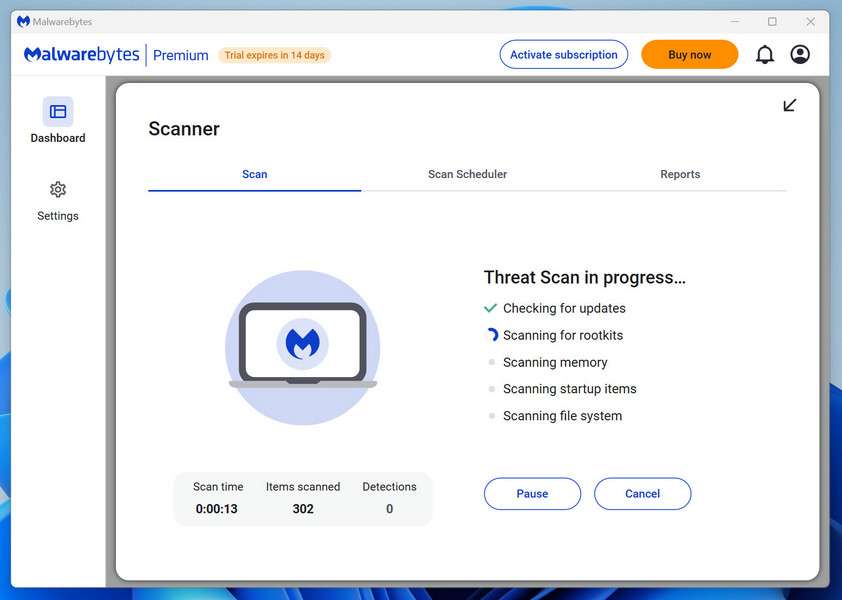
Wait for the Scan to Finish
The scan checks your entire system for browser hijackers and other malicious programs, so it can take 5 to 20 minutes depending on your computer. Feel free to do something else — just check back occasionally to see the progress.
-
Quarantine the Detected Threats
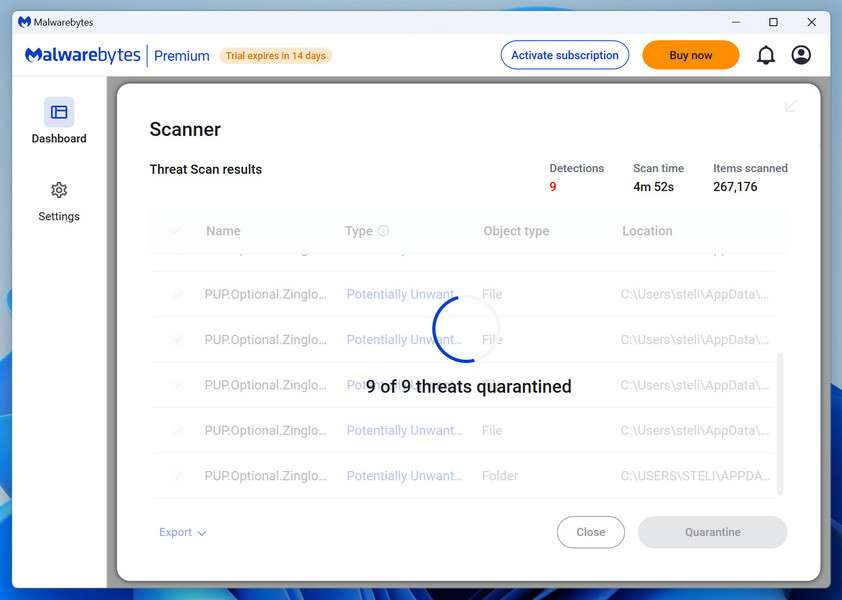
When the scan is done, you’ll see a list of everything Malwarebytes found — malware, adware, and potentially unwanted programs. Click the “Quarantine” button to remove all of them at once.
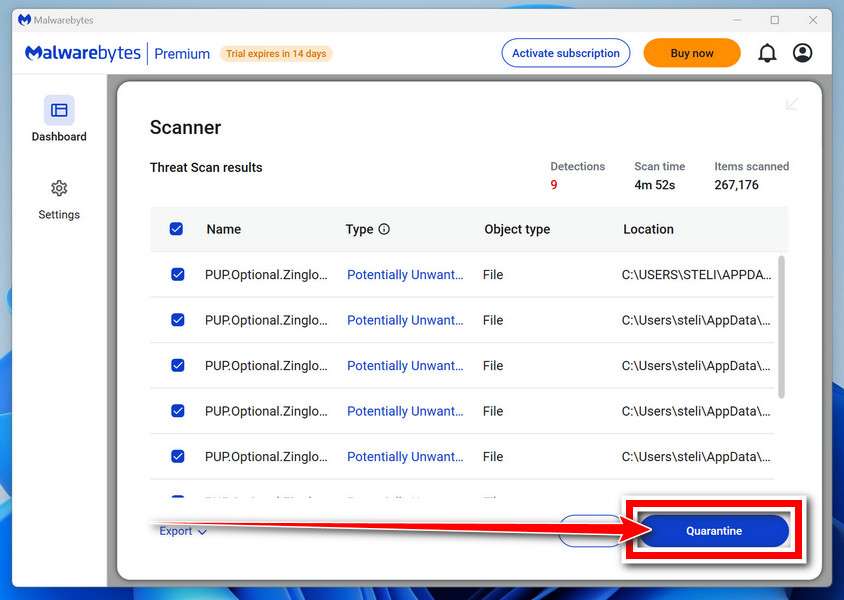
Malwarebytes will now remove the malicious files and registry entries and move them safely into quarantine.
-
Restart Your Computer
Some threats can only be fully removed after a reboot. If Malwarebytes asks you to restart, click Yes. Once you’re logged back in, Malwarebytes has finished removing the threats it found.
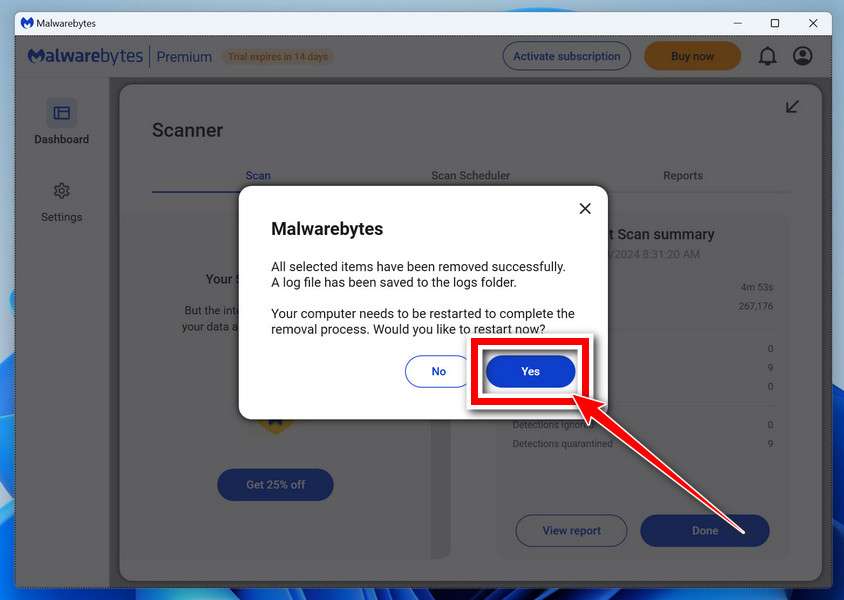
That’s it — your Windows PC is now clean of trojans, adware, and other malware, and should be back to running smoothly.
If you are still having problems with your computer after completing these instructions, then please follow one of the steps:
- Run a computer scan with ESET Online Scanner
- Ask for help in our Windows Malware Removal Help & Support forum.
Run a Malware Scan with Malwarebytes for Mac
Malwarebytes for Mac is a free on-demand scanner that removes the malware other security software tends to miss — adware, browser hijackers, and unwanted programs included. Cleaning an infected Mac with Malwarebytes has always been completely free, and it’s our go-to recommendation. Follow the steps below to scan and clean your Mac in just a few minutes.
-
Download Malwarebytes for Mac
Click the button below to download the latest version of Malwarebytes for Mac.
Download MalwarebytesOfficial installer for macOS. Your download starts right away.Want real-time protection? See Malwarebytes PremiumMalwarebytes Free for MacScans and removes malware at no cost -
Open the Malwarebytes setup file
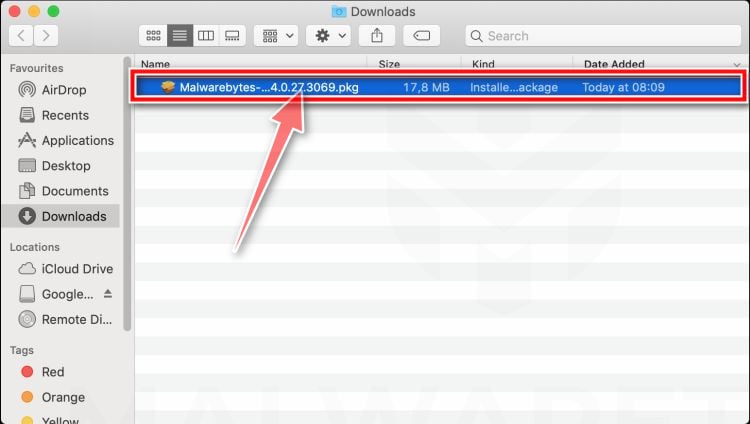
When the download finishes, open your Downloads folder and double-click the setup file to begin the installation.
-
Follow the On-Screen Prompts to Install Malwarebytes
The Malwarebytes for Mac Installer will guide you through a few quick screens. Click “Continue” and keep following the prompts until the installation completes.
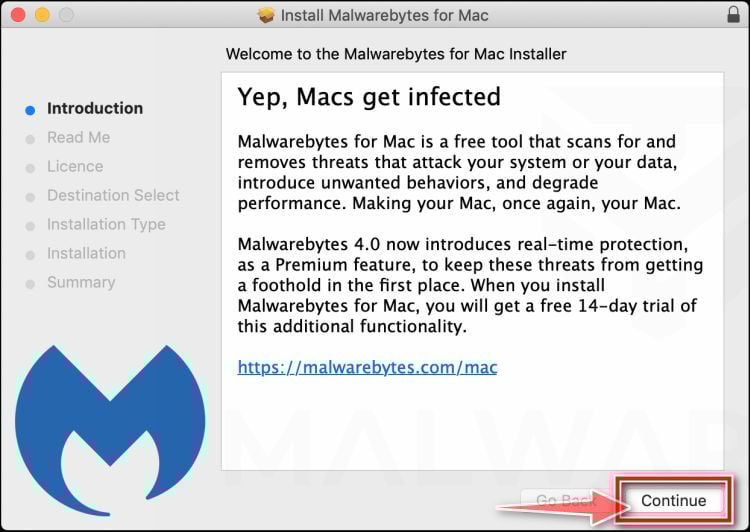
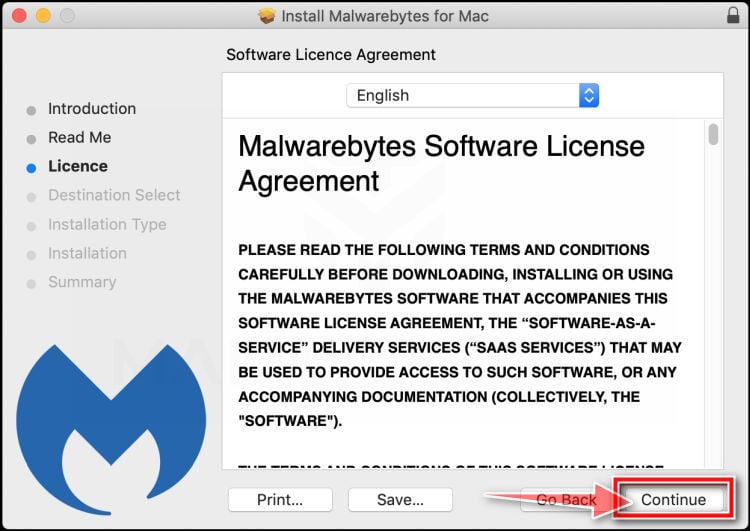
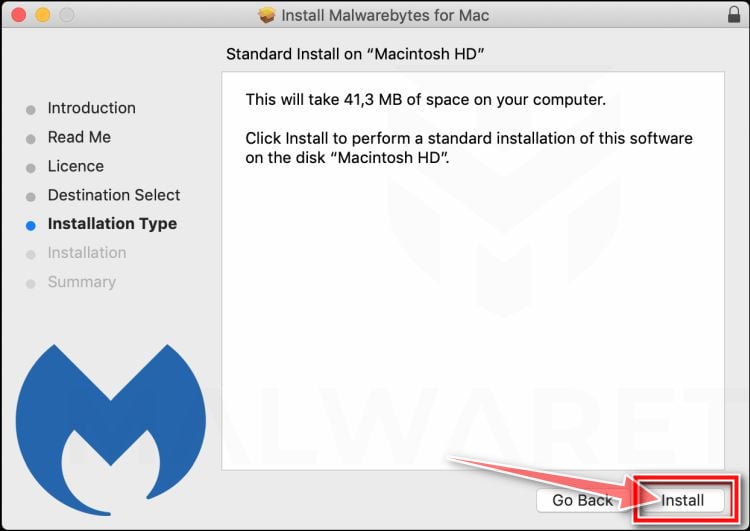
When the installation is complete, Malwarebytes opens to the Welcome to Malwarebytes screen. Click “Get started“.
-
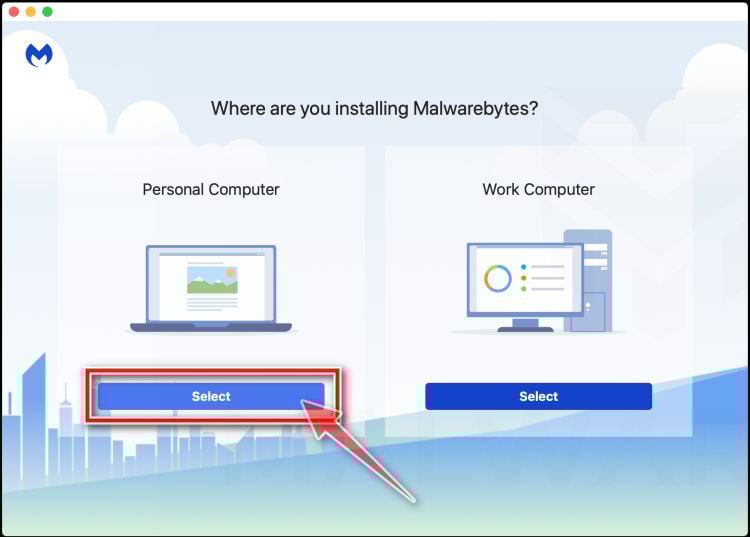
Select “Personal Computer” or “Work Computer”
Malwarebytes will ask what type of computer you’re installing it on. Click either Personal Computer or Work Computer, whichever applies.
-
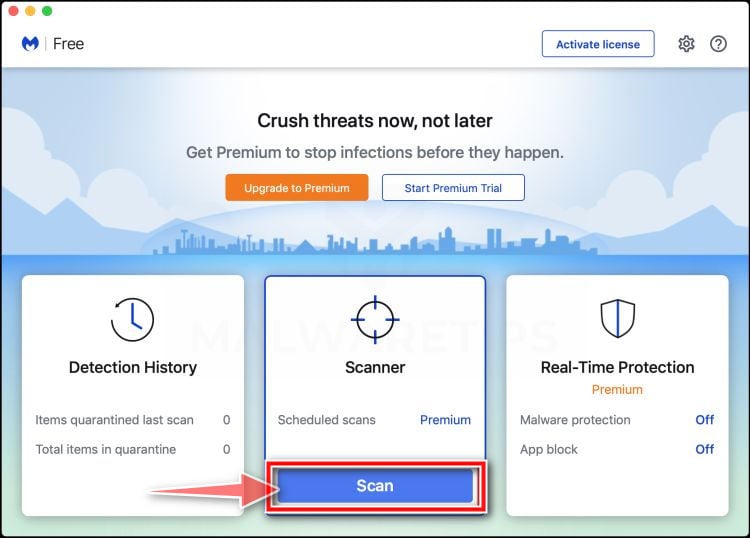
Start the Scan
Click the “Scan” button. Malwarebytes will automatically update its detection database and begin checking your Mac for malware.
-
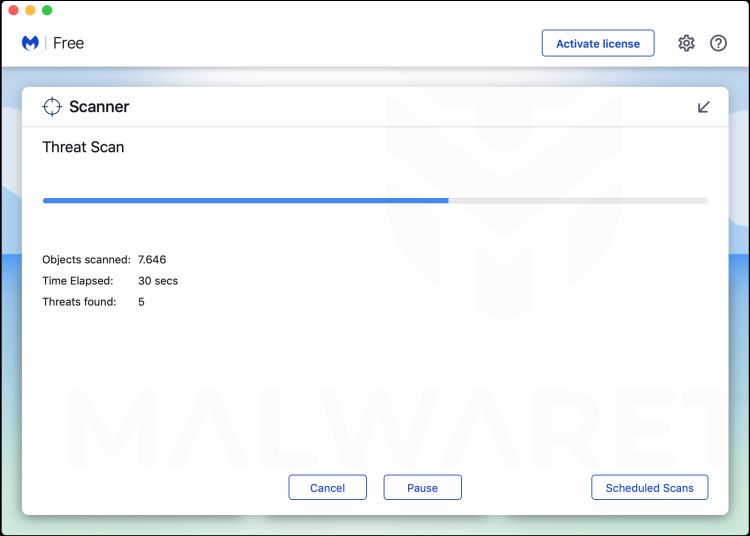
Wait for the Scan to Finish
Malwarebytes will scan your Mac for adware, browser hijackers, and other malicious programs. This can take a few minutes, so feel free to do something else — just check back occasionally to see the progress.
-
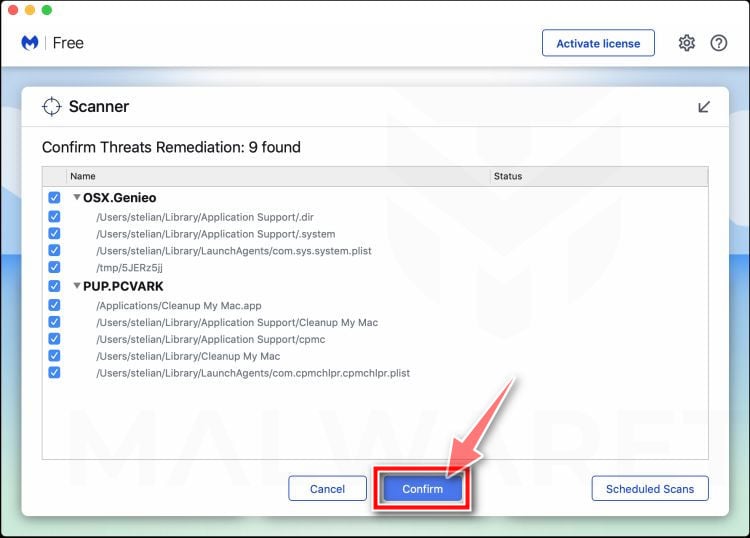
Quarantine the Detected Threats
When the scan is done, you’ll see a list of everything Malwarebytes found. Click the “Quarantine” button to remove all the threats at once.
-
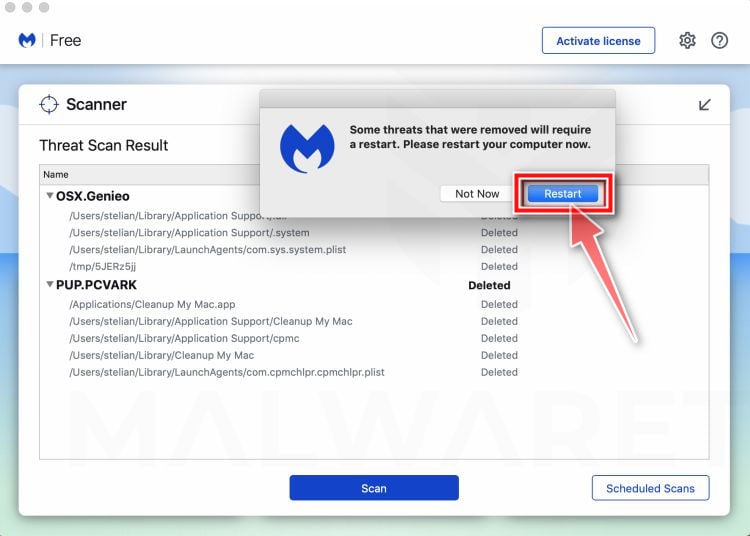
Restart Your Mac
Malwarebytes will now remove all the malicious files it found. Some threats can only be fully removed after a reboot — if Malwarebytes asks you to restart, allow it. Once you’re logged back in, your Mac is clean.
That’s it — your Mac is now free of adware, rogue browser extensions, and other potentially harmful software.
If you are still experiencing problems while trying to remove a malicious program from your computer, please ask for help in our Mac Malware Removal Help & Support forum.
Run a Malware Scan with Malwarebytes for Android
Malwarebytes for Android automatically detects and removes dangerous threats like malware and ransomware so you don’t have to worry about your most-used device being compromised. Aggressive detection of adware and potentially unwanted programs keeps your Android phone or tablet running smooth.
-
Download Malwarebytes for Android.
You can download Malwarebytes for Android by clicking the link below.
Get Malwarebytes for AndroidOpens Google Play in a new tab.Want real-time protection? See Malwarebytes Premium for AndroidMalwarebytes for AndroidScans your phone and removes malware at no cost -
Install Malwarebytes for Android on your phone.
In the Google Play Store, tap “Install” to install Malwarebytes for Android on your device.

When the installation process has finished, tap “Open” to begin using Malwarebytes for Android. You can also open Malwarebytes by tapping on its icon in your phone menu or home screen.

-
Follow the on-screen prompts to complete the setup process
When Malwarebytes will open, you will see the Malwarebytes Setup Wizard which will guide you through a series of permissions and other setup options.
This is the first of two screens that explain the difference between the Premium and Free versions. Swipe this screen to continue.
Tap on “Got it” to proceed to the next step.
Malwarebytes for Android will now ask for a set of permissions that are required to scan your device and protect it from malware. Tap on “Give permission” to continue.
Tap on “Allow” to permit Malwarebytes to access the files on your phone.
-
Update database and run a scan with Malwarebytes for Android
You will now be prompted to update the Malwarebytes database and run a full system scan.

Click on “Update database” to update the Malwarebytes for Android definitions to the latest version, then click on “Run full scan” to perform a system scan.

-
Wait for the Malwarebytes scan to complete.
Malwarebytes will now start scanning your phone for adware and other malicious apps. This process can take a few minutes, so we suggest you do something else and periodically check on the status of the scan to see when it is finished.

-
Click on “Remove Selected”.
When the scan has been completed, you will be presented with a screen showing the malware infections that Malwarebytes for Android has detected. To remove the malicious apps that Malwarebytes has found, tap on the “Remove Selected” button.

-
Restart your phone.
Malwarebytes for Android will now remove all the malicious apps that it has found. To complete the malware removal process, Malwarebytes may ask you to restart your device.
That’s it — your Android phone is now clean — no more malicious apps, adware, or browser redirects.
If you are still having problems with your phone after completing these instructions, then please follow one of the steps:
- Restore your phone to factory settings by going to Settings > General management > Reset > Factory data reset.
- Ask for help in our Mobile Malware Removal Help & Support forum.
Stay Protected: Block Ads and Malicious Sites
Now that your device is clean, keep it that way. Most infections start with a malicious ad or a fake download button — so blocking them at the source is your best defense.
We recommend AdGuard, which blocks malicious ads, phishing pages, and dangerous redirects before they can reach you.
👉 Download AdGuard and browse safely
How to Avoid Password-Expiration Phishing Emails
The safest habit is to separate the warning from the action. You can investigate a message without using its button, attachment, phone number, or reply address.
- Open the provider’s real app or type the known website address into a new tab.
- Use a password manager, which is less likely to fill credentials on an unrelated domain.
- Enable multifactor authentication and store backup codes securely.
- Hover over desktop links before clicking, but do not treat a familiar-looking address as proof by itself.
- Ask an IT administrator through a known channel when a workplace policy is mentioned.
- Keep browsers, operating systems, mail apps, and security software updated.
- Report suspicious messages so the sender and linked domain can be investigated.
The FTC’s phishing guidance recommends contacting a company through a website or number you already know is genuine rather than using information supplied in the message. CISA gives the same practical advice: recognize the warning signs, report the message, and delete it.
Older campaigns use similar expiration stories. Our earlier report on the Password Expiring email scam shows why this theme continues to return even when the wording and landing pages change.
The Bottom Line
The Password Update Alert email scam turns a familiar security task into a false emergency. Its button does not protect your mailbox; it leads toward a page built to capture the password that protects it.
Do not use the link. Open your email provider independently and check the account there. If you already entered information, change the password immediately, revoke unknown sessions and rules, secure every account that reused the credentials, and report the message.








