

A new scam has emerged on social media platforms like Facebook, Instagram, and TikTok promoting a fake giveaway for free Le Creuset cookware sets endorsed by celebrity chef Paula Deen. This in-depth article will provide a comprehensive overview of how this predatory scam operates, luring unsuspecting victims into signing up for expensive monthly subscription plans under false pretenses.
Read on to learn more about the scam mechanics, including the use of artificial intelligence and fake celebrity endorsements, and most importantly, how to protect yourself from falling prey.

Scam Overview – Leveraging Celebrities and AI For Deception
This incredibly deceptive scam takes advantage of Paula Deen’s celebrity status and likeness to promote non-existent free Le Creuset cookware giveaways across social media platforms. It ensnares victims by creating an elaborate facade of fake promotions before stealing their money through concealed subscription fees.
The scam heavily utilizes sponsored video ads and posts on Facebook, Instagram, TikTok, and more. These ads feature deepfake AI-generated footage of Paula Deen herself announcing exclusive giveaways of Le Creuset cookware sets worth over $500.
In the fabricated videos, Paula cites reasons like clearing out excess inventory or mislabeled products as justification for gifting free cookware sets to fans. The ads urge viewers to click through to claim their free set.
Some examples of the AI-generated video ad captions used include:
- “Y’all, we’ve got too many Le Creuset sets after a packing mishap! First 5000 fans to click below get a set for free!”
- “Hey y’all! Thanks to a labeling mix-up we’re giving away 1000 Le Creuset sets for FREE if you click below!”
- “I’ve teamed up with Le Creuset to give away cookware sets because of cancelled big retailer orders! Click below to claim this exclusive giveaway!”
The consistent scam narrative portrays a sense of urgency, exclusivity, and high perceived value of the giveaway – but it’s entirely fabricated.
After luring victims through social media, the scam guides them through a sequence of sophisticated deceptions to eventually steal sensitive personal and financial information.
First, the social posts redirect to fake “news” articles published on websites impersonating legitimate news organizations like Fox News, Buzzfeed, and more. These sites appear authentic at first glance but are entirely illegitimate.
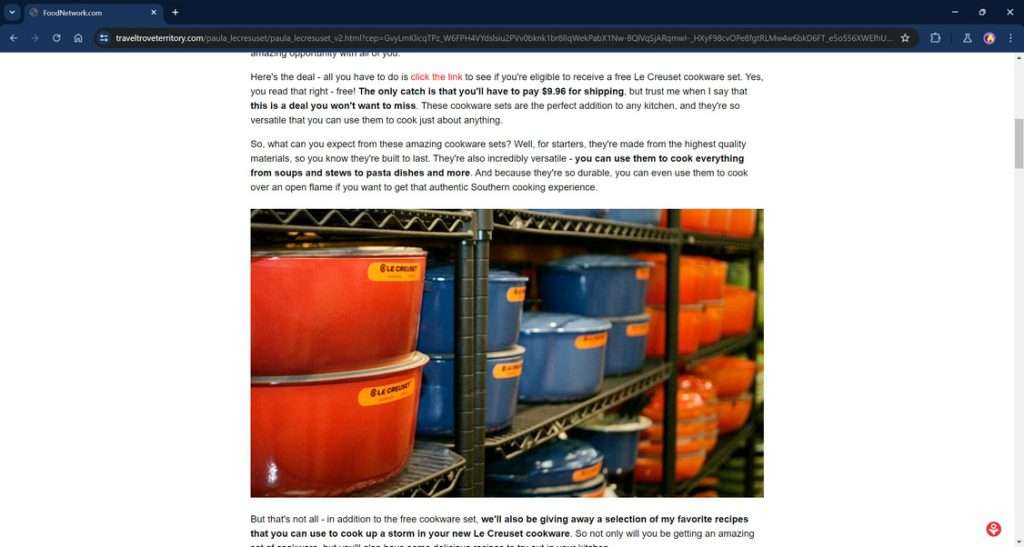
The fraudulent articles echo the same story about Paula Deen partnering with Le Creuset for an exclusive cookware giveaway promotion. This adds a veneer of credibility that major news outlets have validated the promotion.
High-quality photos of Le Creuset products make the free offer seem even more enticing and realistic. The articles utilize flowing, natural writing packed with keywords to boost their search visibility – which helps lend to their façade of authenticity.
After consuming the fake news reports, users are led to spoofed Le Creuset or Paula Deen product listing pages. These display beautiful visual catalogs advertising expensive Le Creuset cookware sets being offered for free or huge discounts for Paula’s fans.
These fake retail pages utilize stolen branding assets and imagery from Le Creuset’s real website to bolster legitimacy. Users see the familiar swirling orange accents and cursive branding so strongly associated with the Le Creuset brand.
The only apparent “catch” to the deal is a reasonable $4.99 – $9.96 shipping and handling fee. Of course, this is itself another deception, as revealed later in the scam funnel.
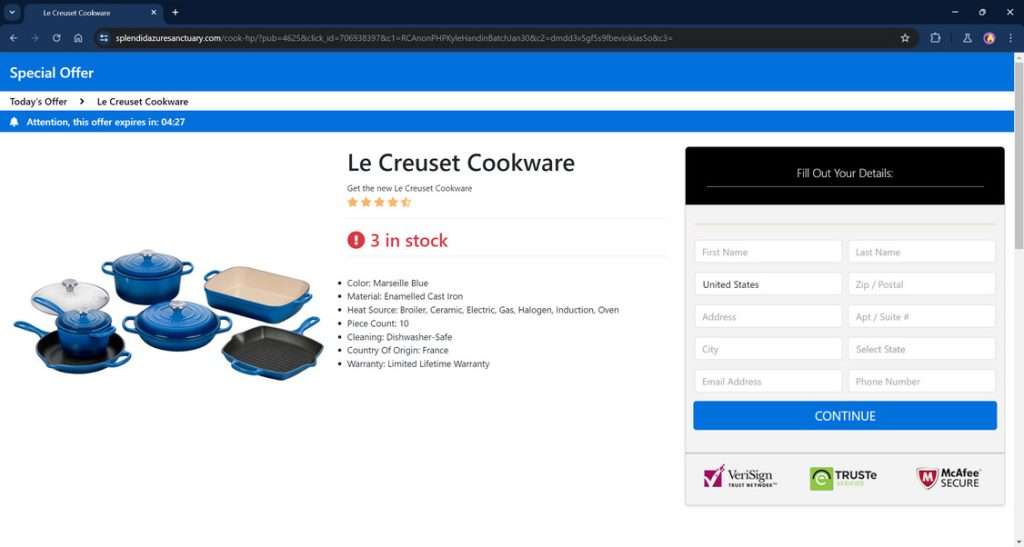
With defenses lowered by perceiving such an incredible deal, users are prompted to “confirm eligibility” by entering personal details like name, address, email, and crucially, credit card information to cover shipping costs.
In reality, by handing over their credit card number, victims are automatically signed up to recurring monthly subscription plans without consent, often exceeding $79 per month. They will never receive any free products.
This extremely deceptive scam relies on impersonation and fabrication at every stage to successfully mislead consumers. The promise of valuable free gifts from Paula Deen herself drives desire and motivation to progress through its sequence of false promises.
Ultimately, it exploits fans of Paula Deen and Le Creuset products by weaponizing their brands through deepfake media and spoofed websites. This allows the operators behind the scam to steal user data and money before any realization of the deceit.
How the Scam Works – A Multi-Step Funnel Optimized For Deception
The Paula Deen Le Creuset giveaway operates via an intricate multi-step funnel optimized to mislead victims and extract payments. Here is a step-by-step breakdown:
Step 1) Fake Social Media Ads
The first touchpoint are the AI-generated social media ads on platforms like Facebook, Instagram, and TikTok. As outlined earlier, these showcase fabricated videos of Paula Deen announcing exclusive giveaways for free Le Creuset cookware sets.
Optimized for engagement, the ads leverage Paula’s celebrity status and her affiliation with cooking to target her fanbase. This immediately imbues a sense of trust and enthusiasm.
Step 2) Fake News Pages
Clicking the ad redirects targets to convincingly designed fake news pages hosted on fraudulent domains. Mimicking leading publishers, the sites feature fake articles reiterating details about the free Le Creuset giveaway.
A veneer of credibility is established by displaying logos of networks like Food Network, Fox News, CNN, and NBC News.
Step 3) Registration Form
The fake news articles contain a call-to-action button to “Claim My Offer” or “Sign Up Now” – linking to the registration form. To maintain the illusion, minimal details are asked like name, address, phone number and email ID.
Step 4) Credit Card Billing
This is where the deception culminates. After registering, users are taken to a payment page asking for credit card information to cover a small $9.95 shipping & handling fee.
Entering card details enrolls victims in an expensive monthly subscription plan charging between $80 to $90 per month. The minimal shipping fee is essentially a trap to secure recurring billing authorization.
Step 5) Expensive Monthly Subscriptions
With credit card information stored, victims are unwittingly signed up for costly monthly plans totally unrelated to a free Le Creuset giveaway.
The monthly plans can extend up to 6 months with charges ranging from $80 – $90 per cycle. No products are ever shipped.
Step 6) Difficult Cancellation
Cancelling these monthly plans is made purposely difficult by the scammers. Contact information is hidden, accounts are unresponsive, and victims are often passed through confusing IVR systems when trying to call. This maximizes illegitimate revenue.
So in summary, this scam leverages AI-generated celebrity endorsements, fake news articles, and deception around “free” products to mislead targets and burden them with expensive monthly subscriptions.
How to Spot This Paula Deen Cookware Giveaway Scam
Unfortunately, tech-savvy scammers are getting better at disguising their deceitful promotions as legitimate giveaways. But there are some telltale signs you can watch out for to avoid getting duped by this predatory Paula Deen free cookware scam:
1. Look for Use of AI Deepfake Technology
One clear red flag is if the Paula Deen videos or voice recordings promoting the giveaway seem just a little “off.” Subtle uncanny facial movements or unnatural speech patterns could indicate an AI deepfake produced without Paula’s real involvement.
2. Hyperbolic Language & Sense of Urgency
Phrases like “limited time only!” or “Hurry, supplies running out!” are common scam tactics to incite urgency. Legitimate brands rarely hype up giveaways this aggressively. Big red flag if they try to pressure you into acting fast.
3. Too-Good-to-Be-True Pricing
Rationalize the offer. Why would a premium brand give away luxury products absolutely free without an obvious profit incentive? If it seems too good to be true, it almost always is.
4. Look for Fake News Articles
Scammers often pad their promotions with fake news articles to establish credibility. But look closely – the articles are hosted on shady domains completely unaffiliated with real news sites, despite appearances.
5. Check for Verified Blue Checkmarks
Social media posts by real public figures always have a blue verification checkmark by their name. A missing checkmark on celebrity-sponsored giveaways is a clear scam sign.
6. Research the Brands Involved
Search for any press releases or announcements from Le Creuset and Paula Deen officially confirming their joint giveaway. If you find nothing, it’s likely faked.
7. Trust Your Instincts
If any aspect of the promotion feels “off” or too sketchy, that’s often your best indicator to avoid the offer entirely. Go with your gut – scams sets off our natural skepticism for a good reason.
Stay vigilant! With awareness of how this scam operates, you can hopefully spot the deceit before getting ensnared. Remember, if an offer is truly too good to be true – it always is.
Falling Victim – What To Do If You Are Scammed
If you suspect you have fallen prey to the fake Paula Deen Le Creuset cookware giveaway scam, immediate action is required to halt further fraudulent charges and cancel any unauthorized memberships. Here are the key steps:
Step 1) Contact Bank
Get in touch with your bank or credit card provider immediately and explain the situation. Request them to stop payments on any recurring monthly plans or subscriptions initiated by the scammers.
Step 2) Cancel Membership
If you can locate any membership cancellation information on the confirmation emails or webpages, submit the cancellation request. Alternatively, call up and clearly state you did not consent and want to terminate the plan.
Step 3) Issue Chargeback
For any past transaction payments already processed, contact your bank/credit card company and raise a chargeback request. Provide transaction IDs, company names, email confirmations etc as proof of unauthorized billing.
Step 4) Notify Authorities
File formal complaints regarding the scam with the FTC (Federal Trade Commission), state attorney general’s office, and the local police cybercrime department. The more complaints, the higher chance of investigations and prosecutions.
Step 5) Block Communication
Prevent any further outreach from the scammers by blocking their email addresses and phone numbers. Report their social media profiles. Delete apps if scammy links were sent through them.
Step 6) Secure Accounts
Since credit card information was compromised, strongly consider changing passwords and adding enhanced security provisions to all online accounts as a safety precaution.
Acting quickly and decisively is crucial to contain the scam damage. Seek help from banks, authorities, and cybersecurity experts as required in dealing with this criminal activity.
Frequently Asked Questions About the Paula Deen Le Creuset Giveaway Scam
1. Is the Paula Deen free Le Creuset cookware giveaway real?
No. This is a fake giveaway scam designed to mislead social media users. Paula Deen and Le Creuset have no actual affiliation with the promotion. The deepfake videos and claims of excess inventory being given away for free are false. This is a scam through-and-through.
2. How does the Paula Deen Le Creuset cookware giveaway scam work?
The multi-stage scam works by first luring victims through deceptive social media ads featuring AI-generated footage of Paula Deen announcing the fake promotion. Users are funneled through a sequence of fake news articles, product listings, and order forms tricking them into entering personal information and credit card numbers. Victims are then unwillingly signed up for expensive monthly subscription plans without their consent.
3. What payment and personal information do you have to provide?
The scam requests users enter details like their name, home address, phone number, email address, and crucially their credit card number under the guise of paying shipping fees for the free cookware set. Entering credit card data enrolls victims in costly monthly subscription plans exceeding $79 per month.
4. What happens after you enter your payment information?
Right after users enter credit card information, they are automatically signed up for overpriced subscription plans without any confirmation. These useless subscriptions can be very difficult to cancel. Victims never receive any free cookware despite completing the steps. The promoters behind the scam immediately monetize stolen user data.
5. How much does the Paula Deen Le Creuset giveaway scam cost?
While the ads emphasize that the Le Creuset cookware sets are completely free, entering a credit card triggers subscriptions costing $79.99-$99.99 per month. These charges recur continuously each month until users are able to successfully cancel the plans. Total costs add up quickly over time.
6. What are common excuses used for the fake giveaway?
Common reasons used in the deceptive ads include clearing excess inventory, mislabeled products, retailer order cancellations, limited holiday promotions, or birthday celebrations. The variety of excuses aim to seem plausible but are complete fabrications meant to drive interest.
7. Are there any real free Le Creuset giveaways hosted by Paula Deen?
No, there are currently no legitimate giveaways for free Le Creuset products being offered by Paula Deen in affiliation with the brand. All promotions featuring Paula Deen giving away free Le Creuset cookware sets are scams regardless of what social media ads may claim.
8. How can you tell the Paula Deen free cookware ads are fake?
Indicators include too-good-to-be-true offers, low shipping fees, usage of fake celebrity deepfakes, and flashy urgency tactics. Legitimate brands do not give away expensive products for free without obvious profit benefit. Proceed with extreme caution regarding online free gift promotions using celebrities.
9. What should you do if you already fell victim to the scam?
First, contact your credit card company to report unauthorized charges. Place fraud alerts, reset account passwords that may have been compromised, monitor your statements closely for other suspicious charges, and be vigilant for any signs of wider identity theft. You can also file formal complaints against the scam with the FTC.
10. How can you avoid these Paula Deen free cookware scams?
Stay skeptical of giveaways that seem unrealistic or urgently push you to act fast. Vet links carefully before clicking. Avoid entering personal information unless on a verified domain. Be extra cautious regarding social media promotions involving celebrity endorsements or free luxury gifts. If an offer appears fake, it very likely is.
The Bottom Line
In closing, the Paula Deen Le Creuset cookware giveaway scam is an elaborate hoax orchestrated by unethical scammers to mislead consumers and profit from unauthorized monthly subscription plans.
Leveraging fake celebrity endorsements and AI technology, it ensnares victims via social media ads and fake news articles promoting non-existent free Le Creuset cookware sets. In reality, it’s a fraudulent ploy for credit card and billing information to enable recurring monthly charges.
Stay vigilant of such sophisticated scams and arm yourself with knowledge to avoid being deceived. If ensnared, take swift action to halt payments, cancel memberships, and notify the required authorities. Together we can counter the online fraudsters seeking to exploit.








