


A gold-themed claim page says Pax Gold holders can collect a new token. The name sounds familiar, and the wallet button makes participation look straightforward.
Before treating that invitation as an account benefit, look at the relationship it claims to have with the gold token you actually own.
Overview
The offer borrows trust from a real gold-backed asset
The PAXOS Token Launch scam targets people familiar with Pax Gold, whose ticker is PAXG. It presents a supposed new allocation as something existing holders can collect.
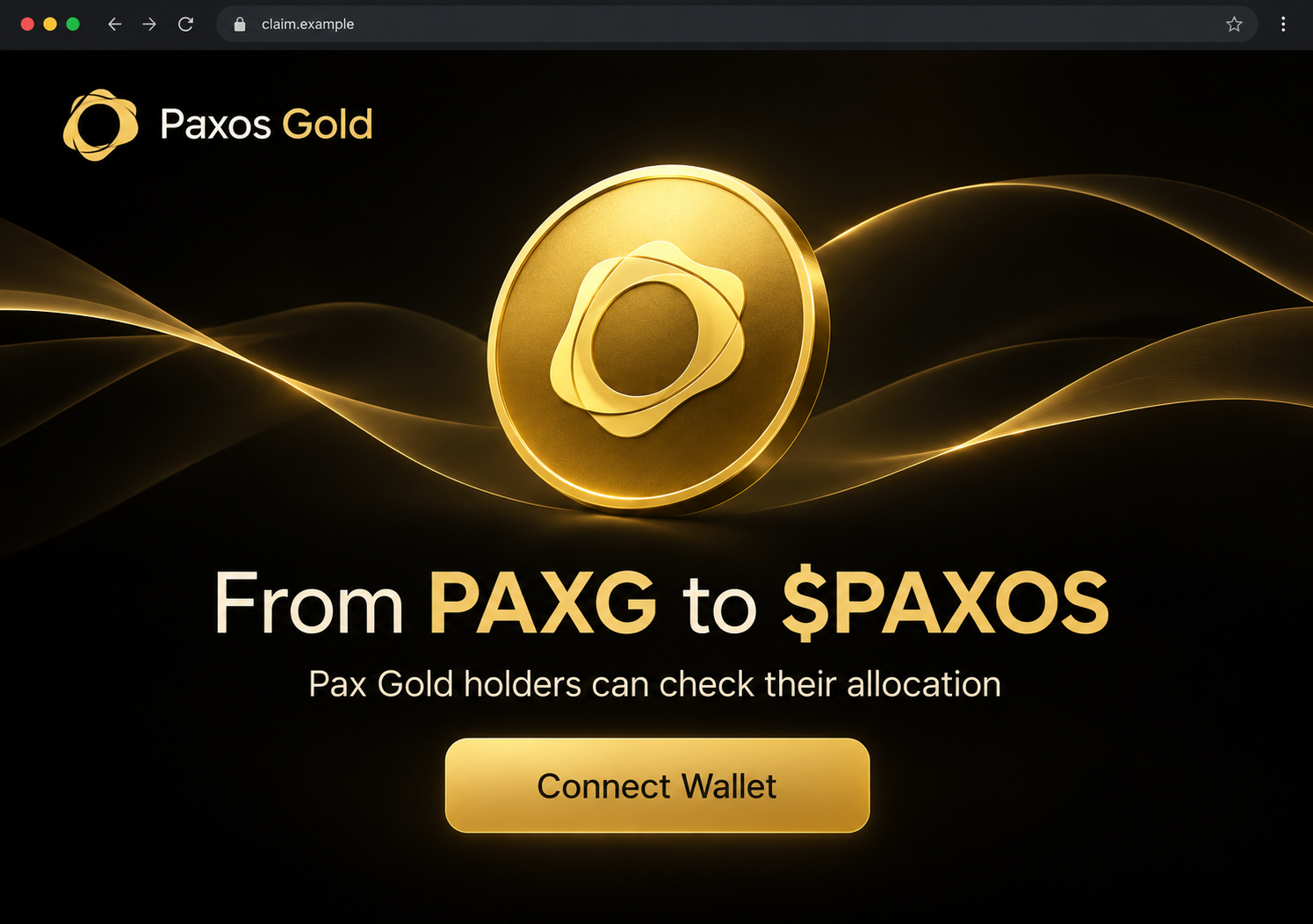
The reported page at paxolaunch[.]live uses a transition story, from PAXG to a token labeled $PAXOS. That claim should not be mistaken for an issuer announcement.
The lead image illustrates the lure with a nonfunctional example address. It is not a live capture of the reported domain or evidence of a transaction.
A familiar ticker does not authenticate a token distribution
Paxos’s genuine product information identifies Pax Gold as PAXG. The existence of that real product does not authorize an unrelated launch page using similar names.
A ticker can be copied. So can a gold graphic, issuer name, wallet logo, or promise aimed at existing holders.
- The page claims a new token benefit tied to holding PAXG.
- The claim route uses an unrelated domain rather than an independently verified issuer announcement.
- A wallet connection is presented as the gateway to the allocation.
- The central risk is an unsafe authorization, transfer, signature, or disclosure during the claim process.
The danger is wallet abuse, not automatic infection
The campaign was reported as a cryptocurrency-draining scheme. We did not connect a wallet, sign a request, or reproduce a transfer.
Connecting an uncompromised wallet ordinarily reveals an address and establishes a session. It does not, by itself, grant permission to spend every asset.
The crucial question is what came next. A misleading approval or signature can create financial exposure even when the page describes it as a harmless eligibility check.
What Pax Gold Actually Offers
Paxos’s official Pax Gold page describes PAXG as a token backed by allocated physical gold. That product identity is separate from the claim page’s invented launch narrative.
A genuine issuer can introduce new products or supported networks. Such changes still need confirmation through established issuer channels, not a stranger’s announcement wearing its branding.
The official page shown below provides that comparison. It is the real product page, not the suspicious token-claim offer.

Do not interpret the comparison as an investment recommendation. The immediate issue is whether the particular allocation request has a verified relationship with the issuer.
The scam’s shortcut is to let recognition answer a different question. Knowing what PAXG means does not tell you who controls a page promising another token.
Even someone holding genuine PAXG through an exchange may receive the pitch. Receiving it does not establish that the sender knows the recipient’s actual holdings.
Check where your assets are held before doing anything. A custodial exchange account and a self-custodial wallet are different arrangements with different recovery routes.
How the PAXOS Token Launch Scam Works
Step 1: A holder-focused message makes the offer feel earned
The pitch starts with a narrow audience: people who hold a recognizable asset. That makes the proposed allocation seem less random than an ordinary giveaway.
Someone who already bought gold-backed tokens might interpret it as a loyalty benefit, migration, or expansion of a product they understand.
The page does not need to prove any of those relationships before displaying its invitation. The reader supplies a plausible explanation for why the offer exists.
Public wallet activity can also make targeting feel personal. A visible blockchain balance is not confidential proof that the issuer contacted you.
Do not let the phrase “for holders” replace confirmation of who announced the program, where its terms appear, and which account is eligible.
Step 2: The transition story blurs two different token identities
The supposed move from one ticker to another encourages the reader to think of continuity. A new token is made to sound like the next administrative step.
That framing can discourage ordinary skepticism. People worry about missing something attached to an asset they already own, rather than evaluating a completely unfamiliar offer.
But a proposed migration needs a verifiable explanation. What changes, who authorizes it, and why would an existing holder need to expose another wallet?
A name resembling an issuer is not a contract address. Nor does a familiar token name establish which network or permissions the next screen will involve.
Treat the launch claim as unverified until the issuer confirms it independently. Do not infer authenticity from a token symbol appearing in a wallet or search result.
Step 3: Connect Wallet is presented as the beginning of a benefit
The reported page offered familiar wallet choices. A large selection can make the interface feel like ordinary crypto infrastructure rather than a stranger’s financial request.
Wallet branding does not mean those wallet companies endorse the destination. A website can display names and icons without an authorized partnership.
Likewise, a wallet’s own confirmation window is only showing what the website requested. Its appearance does not certify that the request is sensible.
If all you approved was a normal connection, do not assume every asset has already escaped. Stop there and inspect the interaction history.
If another prompt follows, read its network, account, recipient, permission, and amount. The claim page’s description is not a reliable translation of those details.
Step 4: A request labeled verification can authorize something else
A malicious flow can ask for spending permission, a transfer, or a signature whose consequences are difficult to understand. The friendly label remains on the website.
On compatible networks, a token approval can let a contract move a particular asset later. That is different from simply proving that you control an address.
Some signature-based authorizations do not require an immediate network fee. A prompt being free to sign does not establish that it has no financial consequences.
The exact authorization used by this reported page was not independently reproduced. These distinctions explain the risk without inventing a particular contract call or victim transfer.
If the requested permission does not match a clearly verified task, reject it. You do not have to sign something first to learn whether it is safe.
Step 5: The promised allocation distracts from what left the wallet
A confirmation graphic or displayed reward balance can keep attention on the supposed new token. Neither is a substitute for checking actual wallet activity.
A website can show an allocation even when no legitimate asset was delivered. Conversely, an unfamiliar token arriving does not prove that the entire interaction was safe.
Look at the permissions and transactions involving assets you already owned. A real on-chain record matters more than a congratulatory message from the claim page.
Do not pay another amount to release the allocation, correct an error, or recover a supposed failed claim. That can extend the same deception.
Once an unauthorized transfer settles, closing the website will not undo it. Quick reporting and containment remain worthwhile, but nobody should promise a guaranteed reversal.
Connection, Approval, and Recovery Phrase: Three Different Exposures
These actions can happen within minutes, yet they do not create the same problem. Describe exactly which one occurred when asking for help.
A normal connection typically lets the site see an address and request future interactions. Ending that session stops further prompts through that connection, not every existing authorization.
An approval may remain recorded on the relevant chain after disconnection. It must be reviewed and, when appropriate, revoked through a trusted route.
A disclosed recovery phrase is broader. It can let another person reconstruct the wallet’s keys, so changing the local application password is not enough.
MetaMask’s approval guidance explains how token permissions differ from ordinary wallet use. Match any remedy to the actual network and wallet involved.
Do not assume an Ethereum approval checker resolves a Solana exposure or a custodial exchange account. The account model determines which access needs examination.
If you cannot identify what you approved, keep the request details and seek the wallet provider’s genuine support. Never send a private key with that question.
What to Do if You Have Fallen Victim to This Scam
-
Stop using the allocation page. Reject pending requests and end its connection through your wallet’s own settings. Do not follow a fresh recovery link supplied there.
Preserve the page address and approximate interaction time. If you only viewed the offer, you do not need to authorize a transaction to investigate further.
-
Work out what permission was given. Review the wallet’s recent activity and the relevant network explorer. Distinguish a connection from a signed approval or completed transfer.
Record transaction hashes, contract addresses, affected assets, and the account involved. These are useful investigation details; your phrase and private keys are not.
-
Review suspicious approvals through trusted tools. Start from your wallet provider’s official documentation or built-in permission controls, not an advertisement for a wallet cleaner.
Revocation may require a genuine network transaction and fee. Verify its purpose and recipient instead of paying a stranger who claims the fee unlocks your reward.
Revoking a permission cannot reverse assets already transferred. It also does not neutralize a disclosed recovery phrase or every kind of signed authorization.
-
Escalate immediately if keys or a phrase were exposed. Use a trustworthy device and the provider’s recovery guidance. A wallet created from fresh keys is different from reimporting compromised ones.
Do not repeatedly add funds for fees to an account showing active theft. Automated sweepers can take new deposits before you complete a rescue.
-
Contact the service actually holding the assets. If the exposure involved an exchange account, secure its login, recovery details, sessions, and withdrawals through that exchange.
If a destination appears linked to a custodial service, report the transaction promptly. Freezing or tracing assets may sometimes be possible, but recovery is never guaranteed.
-
Report the impersonation with usable evidence. Contact Paxos through its independently reached support center and provide the suspicious URL, message, and relevant public transaction details.
Paxos’s phishing guidance describes established reporting and account-security steps. For email evidence, preserve the original message rather than just a cropped logo.
In the US, you can also submit a complaint through the FBI’s IC3. Elsewhere, use the appropriate local cybercrime or police reporting service.
-
Treat device changes as a separate problem. If the site persuaded you to install software or an extension, investigate that addition before using the device for further recovery.
Malwarebytes can help check suspicious software. A clean scan cannot revoke wallet permissions, restore a stolen token, or make an exposed seed phrase secret again.
AdGuard can reduce some malicious advertising exposure during browsing. It does not authenticate a token launch or approve a wallet transaction on your behalf.
-
Expect a second approach offering guaranteed recovery. A person who quotes your public wallet address may simply have read the same blockchain records you can see.
Do not pay an upfront recovery fee, share keys, or install remote-access software because someone promises insider access to Paxos or a blockchain network.
Keep the Claim Separate From the Asset You Already Hold
The offer’s strength comes from making caution feel like abandoning a benefit attached to a familiar investment. You can decline the claim without making an investment decision.
A failed or missing reward does not require you to sell genuine assets, replace an entire portfolio, or trust another unverified token offer.
Likewise, a legitimate product page does not promise protection for actions taken on unrelated sites. Identify the actual service and account before choosing a remedy.
If a friend forwarded the link, warn them privately that the claim route is unsafe. Their recommendation may have been well-intentioned or their account may need protection.
A useful warning shares the suspicious address and requested action. It does not spread another live claim link and invite people to test it themselves.
Frequently Asked Questions
Is this $PAXOS launch an official benefit for PAXG holders?
The reported offer is an impersonation scam, not a verified issuer benefit. Confirm announcements through Paxos independently instead of treating its branding as authorization.
Is Pax Gold itself the scam?
No. Pax Gold is the real product being used as bait. This warning concerns the unrelated claim page and the permissions it seeks.
Does connecting a wallet automatically let a website spend everything?
Not ordinarily. A normal connection is different from spending authorization. Review any subsequent signatures, approvals, transfers, or key disclosures rather than assuming all interactions are equivalent.
Does disconnecting remove a malicious token approval?
No. A recorded permission can survive disconnection. Use appropriate trusted controls for the actual wallet and chain, and understand that revocation does not undo settled transfers.
Can a scanner recover cryptocurrency stolen through the page?
No. Device scanning addresses a separate software concern. Wallet permissions, compromised keys, exchange access, and transaction reporting need their own response.
Should I send a payment to unlock or refund the allocation?
No. Do not pay the claim operator to release a reward or reverse the incident. Verify any genuine network operation independently through trusted wallet guidance.
The Bottom Line
Do not claim tokens through the PAXOS Token Launch offer. A recognizable gold-backed asset does not make an unrelated allocation page an authorized Paxos service.
If you already interacted, review the actual wallet requests immediately. Address approvals, exposed keys, or exchange access as appropriate, and preserve transaction evidence without trusting guaranteed recovery offers.

Join the discussion
0 commentsShare your experience or ask a question about this article.
Discussion
Start the conversation
Have a question or something useful to share? Add the first comment.