

If you’ve come across a website promoting the $GROK Token Exclusive Presale, claiming to offer guaranteed allocation and early access to Elon Musk’s new AI-powered crypto project — stop. This is not a real investment opportunity. It’s a well-orchestrated cryptocurrency scam designed to trick users into connecting their wallets or sending their crypto to criminals.
The “Grok Token Launch” scam mimics the structure and messaging of other fraudulent token launches, such as the xAI Token Launch Scam, and uses Musk’s name, AI hype, and fake presale claims to steal millions. It relies on cloned websites, fake endorsements, and wallet-draining tactics to exploit unsuspecting investors.
In this article, we’ll break down the Grok Token Launch Scam in detail: how it works, the tricks scammers use, how victims lose their funds, and what steps you should take if you’ve already interacted with the site.
Scam Overview
The Grok Token Launch Scam is a fraudulent crypto presale campaign exploiting Elon Musk’s Grok AI chatbot name — part of Musk’s real xAI company — to give the illusion of legitimacy.
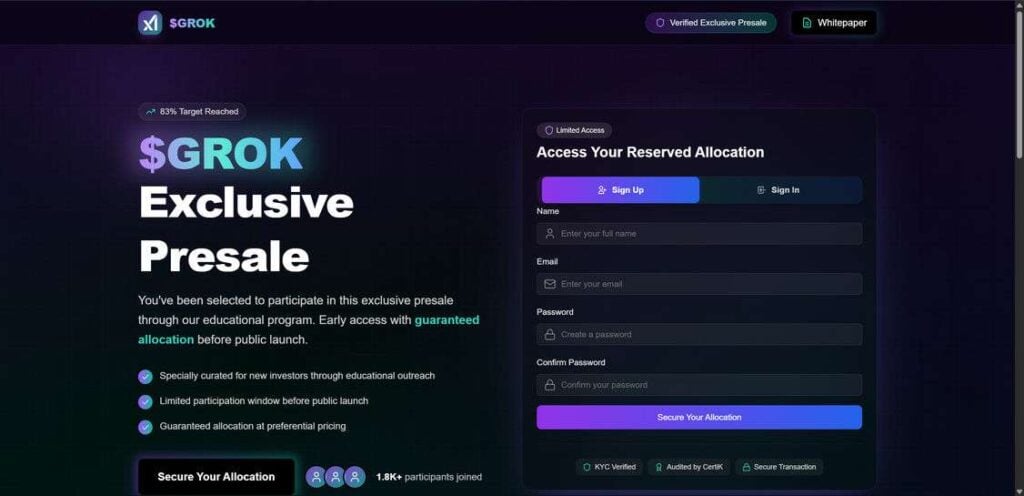
The fake websites promote an “exclusive presale” where users can “secure their allocation” of a new Grok token, promising early investor bonuses and high returns. The scam page shown above mimics legitimate token sale platforms by using slick UI design, countdown timers, fake KYC badges, and bogus audits to convince people to sign up.
Here’s how the scam is structured:
- A professional-looking landing page appears to be an “exclusive presale” event for the $GROK token.
- It claims participants have been “selected” to join through an educational program.
- The page mentions guaranteed allocation at preferential pricing before public launch.
- It displays fake stats (e.g., “83% target reached,” “1.8K+ participants joined”) to create social proof.
- The platform includes Sign Up forms, KYC and “Audited by Certik” labels, and buttons like “Secure Your Allocation” to lure users into connecting their wallets.
- Victims are told they can invest using popular cryptocurrencies like Bitcoin, Ethereum, Binance Coin, Solana, Dogecoin, Tether (USDT), and others.
Once users interact with the site, they’re either tricked into sending funds to scammer-controlled wallets or signing malicious smart contract approvals, which allow criminals to drain their crypto.
Fake Legitimacy Through Branding
The scammers capitalize on:
- Elon Musk’s reputation – Musk’s Grok AI is real, but it has nothing to do with any token presale.
- Professional design – Fake landing pages mimic trusted platforms like Binance Launchpad or CoinList.
- Fake badges – Logos such as “KYC Verified” and “Audited by Certik” give a false sense of security.
- Social proof – Counterfeit progress bars and participant counts simulate popularity.
Why This Scam Works
This scheme is particularly effective because it blends celebrity branding with crypto hype. Musk’s ventures, including SpaceX, Tesla, and xAI, are globally recognized. Scammers exploit this trust to make the presale look real. Many victims never suspect a scam because:
- They believe Musk is launching a token linked to Grok AI.
- The website looks professional and well-built.
- Bonuses and “guaranteed allocations” create urgency.
- The onboarding process mimics legitimate token sales.
But Grok AI is not launching any token, and there is no official presale. This is 100% a fake investment scheme.
How the Scam Works
The Grok Token Launch Scam uses a multi-layered funnel that starts with fake promotions and ends with the theft of funds. Here’s how scammers operate:
Step 1: Fake Ads and Promotional Content
The scam begins with targeted ads across Facebook, Instagram, TikTok, YouTube, X (Twitter), and Telegram channels. These ads often include:
- AI-generated videos of Elon Musk talking about a “Grok Token presale.”
- Fake news headlines that mimic sites like Cointelegraph or Bloomberg.
- Phrases like “Guaranteed early access” or “Official Grok Token Launch.”
- Countdown timers to create pressure.
Clicking on these ads redirects users to the fake Grok token presale page.
Step 2: Landing Page That Mimics Real Presales
The landing page (e.g., groktoken[.]xyz or other rotating domains) is designed to look professional:
- A clean dark UI with glowing buttons.
- Fake verification badges (e.g., “Audited by Certik,” “KYC Verified”).
- Progress bars showing “83% Target Reached.”
- Claims of “Exclusive Access” for selected investors.
- A sign-up form that collects basic information like name and email.
Everything is designed to lower the victim’s guard and make them believe they are participating in a legitimate opportunity.
Step 3: Wallet Connection and Investment Prompt
After sign-up, the victim is asked to:
- Connect their crypto wallet (MetaMask, Trust Wallet, Coinbase Wallet).
- Select the cryptocurrency they want to invest with.
- Confirm the “swap” to receive their GROK tokens.
At this point, one of two things happens:
- Direct theft: The funds are sent to the scammer’s wallet and the victim receives nothing.
- Wallet draining: The site tricks the victim into approving malicious smart contracts that grant the scammer unlimited spending permissions, allowing them to drain all assets from the wallet later.
Step 4: Fake Confirmation and No Tokens
The website displays a fake confirmation message like:
“Congratulations! Your GROK tokens have been reserved. They will appear in your wallet shortly after the presale ends.”
No tokens ever arrive. The victim has simply transferred their crypto to the scammer’s wallet.
Step 5: Domain Rotation and Vanishing
Once enough victims are scammed or the domain gets flagged:
- Scammers abandon the domain.
- They launch new ones with slight name variations.
- Ads are updated with fresh URLs and new fake testimonials.
This domain rotation strategy allows the scam to stay active for weeks or months.
Common Red Flags of the Grok Token Launch Scam
- Celebrity association: No real Elon Musk token exists.
- Misspelled or unusual domain names.
- Fake progress bars and user counters to simulate activity.
- Unverified token contracts with no real blockchain activity.
- No legitimate whitepaper or team information.
- Fake “audit” badges with no actual verification.
- Urgency tactics — countdowns, “exclusive access,” “guaranteed allocations.”
What to Do If You Have Fallen Victim to This Scam
If you sent funds or connected your wallet to the fake Grok token presale, act fast to minimize damage.
1. Revoke Malicious Wallet Permissions
If you connected your wallet, immediately revoke permissions:
This prevents the scammer from draining remaining funds.
2. Transfer Remaining Assets to a New Wallet
If your wallet may be compromised, create a new secure wallet and transfer any remaining funds immediately. Do not reuse the compromised one.
3. Collect Evidence
- Take screenshots of the scam website.
- Save your transaction hashes.
- Record the domain names, wallet addresses, and communication logs.
This will help in reporting and potentially tracing the funds.
4. Report the Scam
Depending on your region, report the incident to:
- FBI Internet Crime Complaint Center (IC3.gov) – U.S.
- Action Fraud – U.K.
- Chainabuse (https://www.chainabuse.com) – Global crypto scam reporting
- National cybercrime centers in your country.
Also, report the domain to web hosting companies and block explorers to help flag it.
5. Warn Others
- Post about your experience on Reddit (r/scams, r/cryptocurrency).
- Share warnings on social media platforms.
- Report the ads on Facebook, Instagram, or YouTube.
Victims sharing information often helps others avoid losing money.
6. Consult a Blockchain Forensics Expert (Optional)
If a significant amount was lost, blockchain investigators can:
- Trace stolen funds.
- Monitor mixers or exchange inflows.
- Provide legal evidence for further action.
While recovery isn’t guaranteed, these steps can be useful in serious cases.
How to Protect Yourself from Similar Scams
- Verify URLs carefully — avoid domains with strange characters or misspellings.
- Never trust celebrity token promotions — Musk is not launching a token.
- Check for legitimate audits — real projects link to verifiable audit reports.
- Use hardware wallets for large amounts.
- Double-check on official channels — no legitimate project will promise guaranteed returns.
- Join crypto communities where scams are reported quickly.
- Avoid urgent investment decisions triggered by countdowns or bonus claims.
Related Elon Musk Scam Campaigns
The Grok Token Launch Scam is part of a much wider ecosystem of Musk-themed crypto frauds. Common fake campaigns include:
- Tesla Token / Tesla Giveaway scams
- SpaceX crypto investment schemes
- Neuralink coin hoaxes
- Fake Musk livestreams on YouTube
- Phishing ads impersonating Musk’s official accounts
Known scam domains include:
- elonbitcoin.fun
- teslapresale.net
- teslatoken-presale.online
- ceomusk.org
- x-coin-platform.io
All of these operate under similar fake presale models designed to steal crypto quickly and disappear.
Frequently Asked Questions About the Grok Token Launch Scam
What is the Grok Token Launch Scam?
The Grok Token Launch Scam is a fraudulent cryptocurrency presale scheme that uses Elon Musk’s Grok AI branding to lure victims into sending funds to scammers. It presents a fake token called “GROK” as an exclusive presale opportunity with guaranteed allocation and early investor bonuses. In reality, there is no token, no project, and no connection to Elon Musk or his company xAI. The scammers rely on fake landing pages, fake KYC badges, and deepfake Musk content to make the scheme look legitimate and trustworthy.
Is Elon Musk really launching a Grok token?
No. Elon Musk and xAI have not launched any cryptocurrency presale. Any website or social media post claiming otherwise is fraudulent. Scammers exploit Musk’s public image, as well as the hype around AI and blockchain, to create fake investment opportunities. Musk does not sell or promote any tokens, and any claim that he does is a scam.
How do scammers make the Grok Token Launch scam look real?
Scammers use sophisticated techniques to build trust quickly. They clone the design of legitimate token launchpads, use professional graphics, add fake verification labels like “Audited by Certik” and “KYC Verified,” display countdown timers to create urgency, and show false progress bars and participant numbers. These psychological tricks make people believe they are investing in a real and time-sensitive opportunity.
What happens if I send crypto to the fake Grok presale?
If you send funds to the scammer’s wallet, your money is gone. There are no tokens, no refunds, and no legitimate project behind the presale. The scammers either take your crypto directly or use malicious smart contracts to drain your wallet. Once the funds are transferred, cryptocurrency transactions cannot be reversed.
Can I get my funds back after being scammed?
Unfortunately, recovering funds from crypto scams is extremely difficult. Blockchain transactions are irreversible, and the wallets are often anonymous. However, you can still report the theft to authorities, including cybercrime units, blockchain explorers, and crypto exchanges. In some cases, exchanges may freeze stolen funds if they are moved into identifiable accounts.
What should I do immediately after falling for the Grok Token Launch scam?
First, revoke any wallet approvals you granted to the scam site using tools like revoke.cash or Etherscan’s token approval checker. Then, transfer any remaining funds to a new secure wallet. Gather evidence including transaction hashes, screenshots, URLs, and wallet addresses, and file reports with your local cybercrime unit and platforms like Chainabuse. Warning other users online can help prevent further losses.
How does the scam drain wallets if I didn’t send funds?
Even if you don’t send funds, simply connecting your wallet can be dangerous. The scam site may prompt you to approve malicious smart contracts that grant scammers permission to withdraw assets directly from your wallet later. This is why revoking approvals immediately after interacting with a suspicious site is critical to protect your crypto.
What are some red flags that indicate the Grok presale is fake?
Clear warning signs include fake countdown timers, suspicious domain names, lack of a verifiable whitepaper, unrealistic claims of guaranteed profits, celebrity endorsements that don’t exist, fake audit badges, and urgent sales language. If a presale is promising guaranteed returns or exclusive access linked to Elon Musk, it is a scam.
How can I verify if a token presale is legitimate?
Always verify presales through official company websites, not through ads or random links on social media. Check the project’s smart contract address on trusted block explorers, confirm listings on well-known exchanges, and look for credible third-party audits. Legitimate projects never rely solely on celebrity branding or deepfake videos.
Why are so many scams using Elon Musk’s name?
Elon Musk is one of the most recognized figures in the world of technology, AI, and cryptocurrency. His name carries enormous trust and media attention. Scammers exploit this recognition to create fake presales and investment schemes. Similar scams have used fake Tesla tokens, SpaceX crypto, Neuralink tokens, and other Musk-related themes to trick victims into parting with their money.
Where can I report the Grok Token Launch scam?
You can report this scam to the FBI’s Internet Crime Complaint Center (IC3.gov) if you are in the US, or to your country’s cybercrime reporting agency. You can also submit reports to Chainabuse.com, contact relevant crypto exchanges, and flag the domain with its hosting provider. Additionally, posting warnings on forums like Reddit’s r/scams and r/cryptocurrency can help others avoid becoming victims.
The Bottom Line
The Grok Token Launch Scam is a dangerous and convincing crypto fraud that exploits Elon Musk’s Grok AI branding, fake presale tactics, and investor FOMO. It uses high-quality landing pages, deepfake content, and fake verifications to make people believe they’re buying into the next big AI-crypto revolution.
But there is no real Grok token presale. This is 100% a scam.
If you interacted with the site:
- Revoke any wallet permissions immediately
- Move your funds to a secure wallet
- Report the scam to relevant authorities
- Share warnings to protect others
Legitimate projects don’t offer guaranteed allocations, bonuses, or urgent “exclusive presales.” Always verify claims through official company channels and trusted sources before investing.

Join the discussion
0 commentsShare your experience or ask a question about this article.
Community experiences
Did this happen to you?
Your experience could help someone recognize the same scam. Submit a private report for our team to review.
I experienced this tooReports are reviewed before publication. Sharing publicly is always your choice.
Discussion
Start the conversation
Have a question or something useful to share? Add the first comment.