

An urgent appeal for children needing medical care arrives in your inbox. The charity’s familiar name makes the message feel like a chance to help immediately.
Before responding to a PCRF donation email, take a moment to check the path your contribution will follow. That small pause can protect the help you intended.
Overview
The fraudulent appeal abuses a real relief organization’s identity
The PCRF donation email scam impersonates the Palestine Children’s Relief Fund to solicit money through a fraudulent appeal. PCRF itself is not the scam.
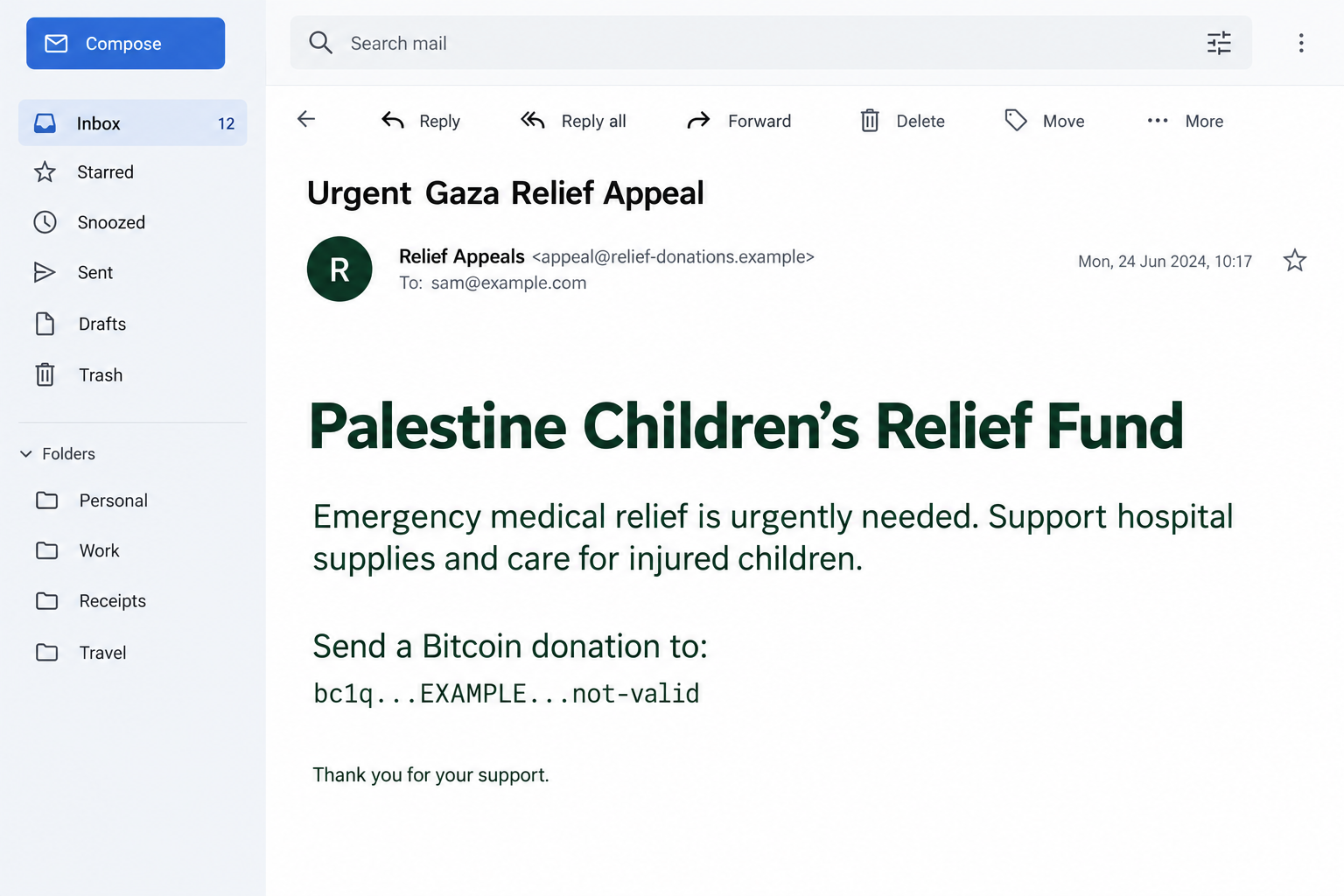
A documented version asks for emergency help in Gaza and directs recipients to send Bitcoin to an address supplied inside the message.
The deception concerns who receives that payment. Real humanitarian needs and a real organization’s name do not establish that the email’s recipient is authorized.
This particular appeal was documented in 2023. We are explaining an uncovered, durable impersonation tactic, not claiming a newly verified October 2026 outbreak.
Medical details make the appeal recognizable without verifying it
The reported message mentions medical personnel, hospital power and equipment, and evacuation of injured people. Those details connect the request to concerns donors already understand.
However, information about an emergency can be copied. Accuracy about suffering does not authenticate the person collecting contributions.
The real PCRF website describes its medical and humanitarian work and provides its own donation routes. Start there independently when checking a claimed PCRF appeal.
- A known charity’s name is placed above an unexpected fundraising request.
- The message uses urgent medical needs to shorten the donor’s decision time.
- A Bitcoin recipient is supplied without independent confirmation from the actual organization.
- The donor is asked to trust the email’s identity and payment instructions together.
The beneficiary, not the donation label, determines the outcome
Typing “relief” into a payment note does not ensure a charity receives the money. The transaction follows the recipient details you authorize.
A cryptocurrency donation can be legitimate. The warning is not that every charity accepting crypto is fraudulent, but that an impersonator can substitute its own destination.
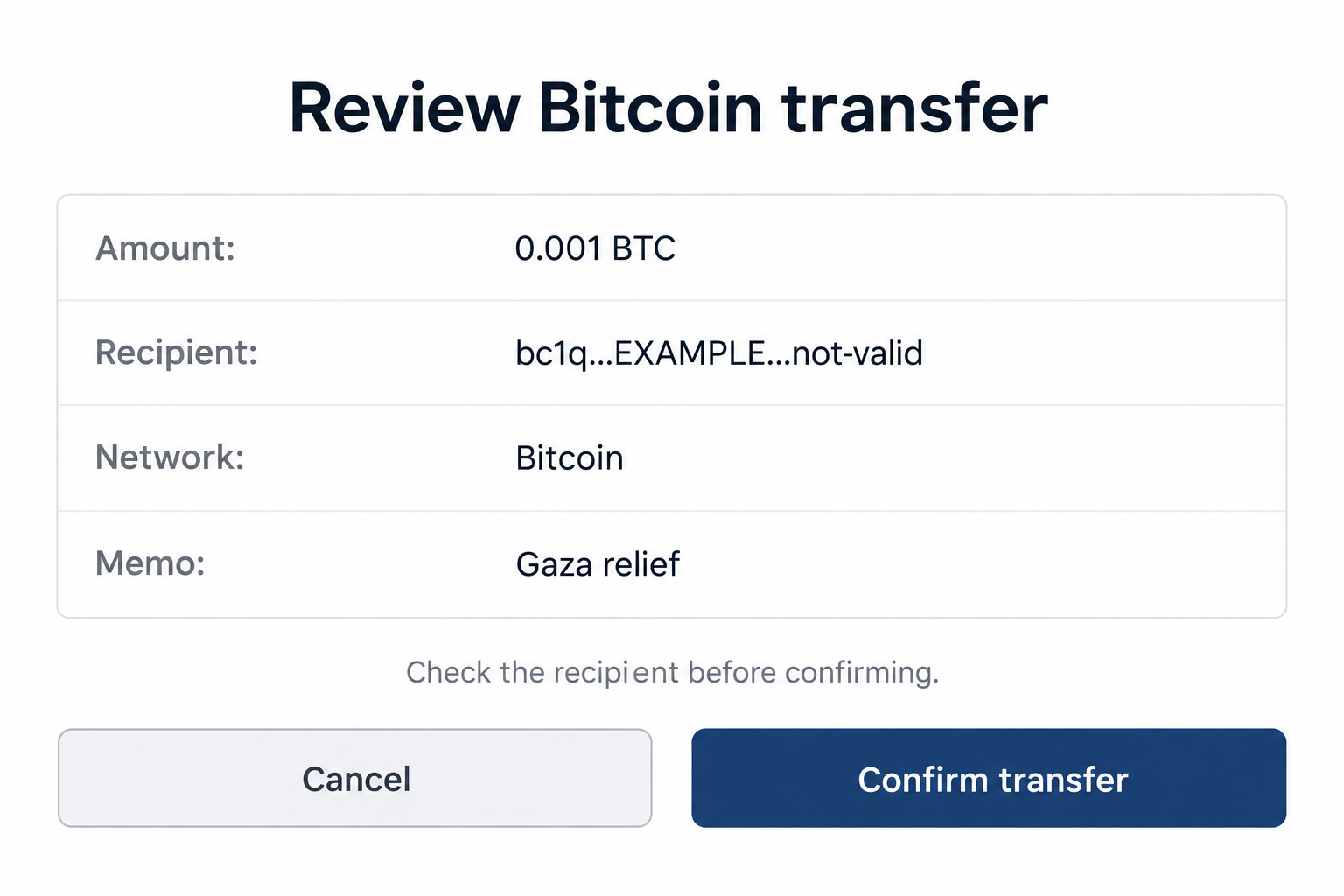
Our images use fictional email details and an incomplete Bitcoin address. They illustrate the decision points without providing a usable payment destination.
Why a Genuine Emergency Can Support a False Appeal
The message appeals to an intention that deserves respect
Someone who responds to this kind of email is often trying to help, not trying to earn money or secure a prize.
That generosity is precisely what the impersonator exploits. The request places a payment decision next to a distressing situation, making verification feel like an unnecessary delay.
You can care about the emergency and still reject unverified instructions. Confirming the collector protects the intended beneficiaries rather than withholding support from them.
Copied facts can hide the only fact that matters
A fraudulent appeal may accurately describe an organization’s mission or name a real location. Those details can be gathered without any relationship to the charity.
The missing fact is authorization: did the organization actually send this message and designate this payment recipient? The email cannot answer that question by asserting it.
Even a logo, signature, or familiar program name would be supporting decoration unless confirmed independently. None establishes ownership of a Bitcoin address.
Forwarding can add trust without adding verification
A friend may share an appeal because they believe it is useful. Their good intention does not show that they checked the payment details.
If a message comes from someone you know, ask where the original instructions came from. Then verify the charity separately before donating or sharing again.
Do not accuse a person of fraud simply for forwarding a questionable email. Explain the beneficiary problem and give them a verified route to investigate.
How the PCRF Donation Email Scam Works
Step 1: The email borrows PCRF’s name and a humanitarian context
The reader receives a fundraising message presented as connected to the Palestine Children’s Relief Fund. The organization’s identity supplies credibility the sender has not earned.
The urgent relief theme encourages quick attention. People who recognize the name may focus on the needs described rather than on the sender’s actual relationship.
You do not need to have subscribed to the charity for such a message to reach you. Receiving it is not proof of an existing donor relationship.
Equally, being a previous donor does not authenticate a new email. A familiar cause can be impersonated regardless of whether the recipient has supported it before.
Step 2: The appeal makes a contribution feel immediately actionable
The reported version describes urgent medical and relief needs, then supplies a direct Bitcoin destination. It presents payment as a practical response to those needs.
Direct instructions remove the step where the donor would otherwise browse the charity’s own site, select a program, and confirm the donation channel.
The convenience is part of the risk. A simple address inside an email is easier to act on than a recipient whose affiliation you must establish.
Imagine planning to give $50 and being told that the fastest route is a crypto transfer. Verify the beneficiary before converting or sending anything.
Step 3: The charity’s identity is attached to an unverified recipient
The important substitution happens in the payment instructions. The email names a real organization while directing the transaction to a destination the donor has not independently verified.
A Bitcoin address does not normally display a verified charity identity in the transaction itself. A sender can place a charity name beside any address.
A valid address format would only show that a transfer can be made. It would not prove that PCRF controls the destination.
Likewise, an address appearing in earlier public transactions is not ownership proof. Records of activity and proof of an authorized fundraiser are different things.
Step 4: The donor authorizes the payment based on the appeal
The person sends Bitcoin using a wallet or exchange. The software processes the transfer according to the entered recipient, not the humanitarian intention behind it.
A confirmation screen may include a personal memo. That memo can help you remember the transaction, but it does not verify the receiving organization.
The illustrative payment screen below shows this distinction. Its incomplete example recipient cannot receive funds and is not the address from the documented appeal.
Before confirming any real payment, compare the destination with independently obtained instructions. Do not accept the suspicious sender’s own confirmation as that independent check.
Step 5: The contribution can be lost without an account hack
This mechanism does not necessarily involve a stolen wallet password, malicious contract, or infected computer. It can succeed through a normal payment to the wrong beneficiary.
A person may still control their wallet afterward. The financial harm comes from having authorized a transfer under a false claim about who would receive it.
Confirmed Bitcoin transfers cannot ordinarily be reversed by the donor’s wallet provider. That makes prevention especially important, but it does not make all transaction records useless.
Public blockchain records may preserve relevant information. Whether investigators can identify recipients or recover funds depends on the circumstances, not a promise from the email sender.
How to Verify a PCRF Fundraiser and Its Payment Route
Start from the real organization’s website
Type the known PCRF address yourself or use a trusted bookmark. Look for the program and donate through a route provided by the organization.
At the time of our check, the official site links donation forms on pcrf1.app.neoncrm.com. An external payment processor is not automatically suspicious.
The meaningful distinction is how you reached it. A processor linked from the independently opened charity site has a different basis for trust than an unsolicited substitute.
Do not assume every address containing a charity’s name belongs to that charity. Read the complete domain and follow the verified organization’s own navigation.
Ask about the exact appeal, not just the charity’s existence
Use contact details found on the official website to ask whether the particular message and payment instructions are authorized.
A real charity existing is only the first check. It does not validate every person collecting under its name, every email signature, or every payment account.
We have not verified a current PCRF cryptocurrency donation option for this article. If you want that method, ask the organization directly for its present instructions.
Check the beneficiary before the payment method
The FTC’s crypto-donation warning recommends checking the charity and destination independently. Cryptocurrency can be legitimate, but impersonation changes where the contribution goes.
Prefer a payment method with suitable protections when available. Those protections vary and do not replace verifying the fundraiser before you pay.
Do not transfer a small test amount to an unverified beneficiary as proof of legitimacy. A scammer can receive the test just as easily as the full donation.
Keep donation records that establish what actually happened
Save the organization’s confirmation, payment receipt, and any campaign reference. Compare what you intended to support with the entity shown as receiving the payment.
A receipt created by an unknown sender is not sufficient proof. If unsure, ask the real organization to confirm the transaction using details that do not expose secrets.
The FTC’s charity guidance also encourages reviewing payment records and checking for unintended recurring contributions. Apply that advice to the actual donation channel you choose.
What to Do if You Have Fallen Victim to This Scam
You were trying to support people in need. Focus now on preserving records and limiting further harm, rather than letting embarrassment delay the response.
- Stop any additional payment.
Do not send a second contribution, processing fee, refund deposit, or identity-verification payment requested by the same sender. Preserve the follow-up messages instead.
If a withdrawal is still pending inside an exchange account, contact that exchange immediately. A pending withdrawal and a confirmed blockchain transfer are different situations.
- Gather the payment details.
Record the amount, currency, time, sending service, recipient address, and transaction hash. Keep the original fundraising email with its sender information and headers if available.
Do not post recovery phrases or private keys while asking for help. Public transaction details are usually the appropriate evidence for a transfer report.
- Contact the payment provider through official support.
Tell the exchange or payment service that an impersonation appeal induced the transfer. Provide the recipient and transaction identifiers, and ask what action remains possible.
If you paid by card or another method instead, contact that provider about its fraud or dispute process. Do not assume every method has identical recovery options.
No provider should be expected to reverse a confirmed Bitcoin transfer on demand. Prompt reporting can still support an investigation or action within its own systems.
- Tell the real charity about the impersonation.
Reach PCRF through its independently located contact page. Send the suspicious appeal and ask whether the donation route was authorized.
Do not blame the organization for a stranger using its identity. Reporting helps it understand what donors are seeing and may help prevent further mistaken payments.
- Report the fraud to the relevant authorities.
In the US, submit a report at ReportFraud.ftc.gov. Contact local law enforcement or the appropriate cybercrime service for your location and circumstances.
Include the payment route and original message, not just the charity’s name. The impersonating sender and receiving destination are the details investigators need to distinguish.
- Review additional exposure only if it occurred.
A normal crypto payment does not automatically mean your entire wallet was compromised. However, secure any account whose password, code, or recovery information you separately disclosed.
If the email also led to a suspicious attachment or installed software, run a current Malwarebytes scan. Review browser permissions after unwanted notifications or continuing redirects.
AdGuard can help reduce some deceptive ads and known malicious destinations. It cannot verify a donation beneficiary or undo a contribution sent to the wrong recipient.
- Warn anyone who received your forwarded appeal.
Explain that the payment instructions were unverified and should not be followed. Share the genuine charity website as a place to check authorized giving options.
Refuse strangers offering guaranteed Bitcoin recovery for an upfront fee. A person quoting your transaction does not necessarily know the recipient or have recovery powers.
Frequently Asked Questions
Is the Palestine Children’s Relief Fund a scam?
No. The warning is about an email impersonating PCRF. The real organization has its own website, programs, and donation channels separate from this fraudulent solicitation.
Does an urgent Gaza appeal automatically mean fraud?
No. Real organizations conduct urgent relief campaigns. Verify who sent the particular appeal and who receives the payment rather than judging only the cause.
Are all charity requests for Bitcoin suspicious?
Crypto donations can be genuine. An unexpected request still needs independent confirmation of the charity and recipient, especially when the supplied address is the only payment route.
Why does PCRF’s official website use a different donation domain?
Organizations can use external fundraising processors. Follow the link from the independently opened official site instead of assuming a different hostname always proves deception.
Did sending Bitcoin give the sender access to my wallet?
A normal Bitcoin transfer does not itself reveal your private key. Check separately whether you disclosed secrets, installed software, or authorized anything beyond the payment.
Can I get back a donation sent to the wrong address?
A confirmed transfer usually cannot be canceled through wallet support. Report it promptly, preserve records, and avoid anyone promising certain recovery in exchange for another payment.
The Bottom Line
The PCRF donation email scam redirects generosity by attaching a real charity’s identity to an unverified Bitcoin recipient. The emergency does not authenticate the collector.
Use the genuine organization’s donation route and verify unexpected instructions separately. If you already paid, preserve the transfer records and report the impersonation without sending more.








