

A homeowner falls behind, searches for help, and receives an offer that sounds more decisive than anything the mortgage company has provided.
The mortgage relief scam promises to stop foreclosure, cut the monthly payment, or force the lender to approve a modification.
The reassuring voice may arrive through a call, email, search ad, social media post, or letter designed to resemble an official notice.
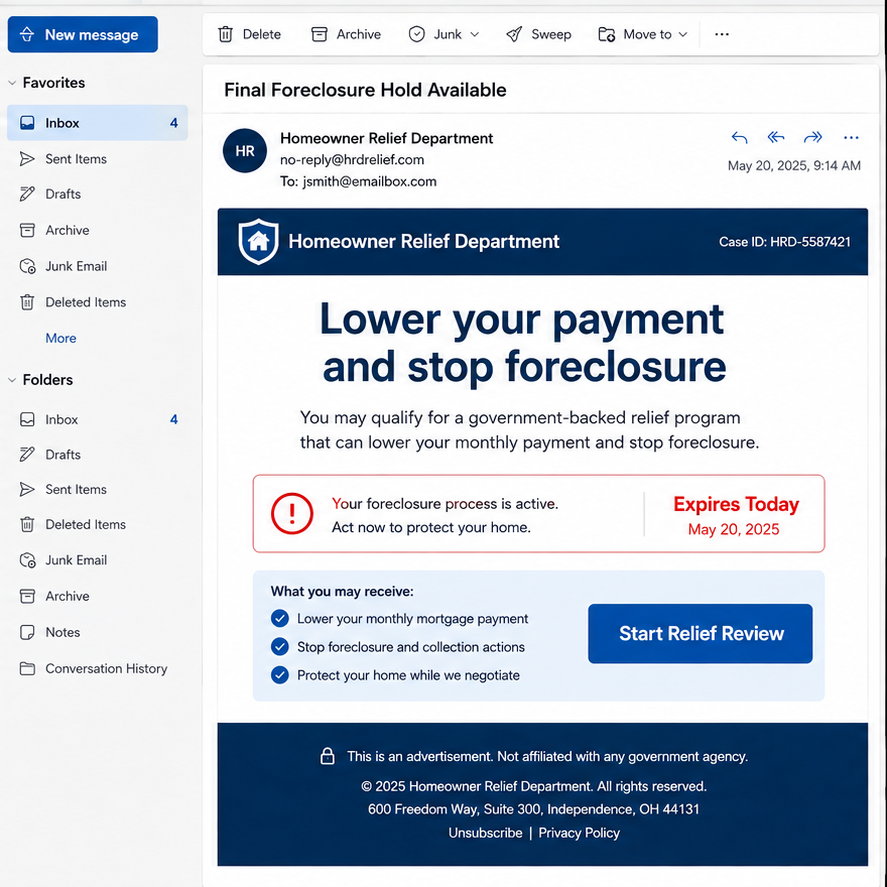
The company may know the property address, lender name, loan amount, or filing date. Much of that information can come from public records and lead lists.
The representative says the case is urgent but fixable. An upfront fee opens the file, and future mortgage payments may be redirected to a new account.
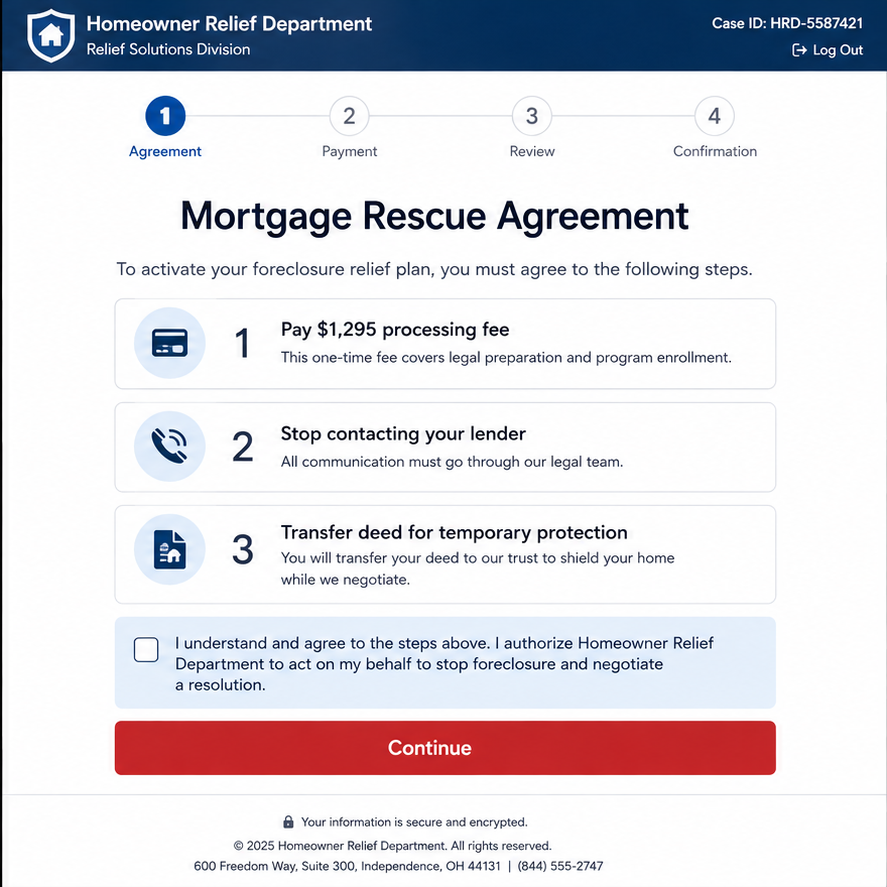
Some operators tell homeowners to stop speaking with the lender. Others request authority to negotiate, ask for blank signatures, or propose transferring the deed temporarily.
By the time the victim learns that little or nothing was done, missed payments, late fees, legal deadlines, and title problems may have become worse.
Overview
The offer guarantees control over a lender or court
Scammers claim a special relationship, government program, legal loophole, forensic audit, or proven negotiation method will stop foreclosure. The result is promised before the loan and legal posture are fully reviewed.
No outside company can guarantee that a lender will modify a loan or that a court will halt a case.
Payment and control move away from the homeowner
The victim is asked to pay fees before meaningful work, send mortgage payments somewhere new, sign broad documents, or place title in another person’s name.
Each move makes the homeowner less able to verify and control the real loan.
Typical elements of the scheme include
- an unsolicited promise to save the home;
- an official-looking foreclosure or government notice;
- a guaranteed modification or principal reduction;
- a large fee before relief is obtained;
- instructions to stop communicating with the servicer;
- payments redirected to the rescue company;
- a request to sign incomplete or confusing paperwork;
- a deed transfer described as temporary protection.
Federal Consumer Agencies Confirm the Pattern
In April 2026, the Federal Trade Commission warned about mortgage relief offers that promise to prevent foreclosure or modify a loan and then demand money.
The Consumer Financial Protection Bureau also identifies advance fees, guaranteed results, instructions to stop paying the mortgage, and requests to sign over property as major foreclosure relief scam warning signs.
Federal rules generally prohibit mortgage assistance relief companies from collecting fees until they have obtained an offer of relief from the lender and the consumer has accepted it.
There are specific requirements and limited legal-professional exceptions. A person merely calling themselves a lawyer does not automatically make an advance fee lawful.
The core fraud is not an ordinary disagreement over whether a service was useful. It is a deceptive promise used to take money, divert payments, or obtain rights in the home.
Legitimate housing counselors and attorneys cannot guarantee an outcome either. They should explain choices, risks, fees, and who makes the final decision.
Why Homeowners Are Vulnerable at This Moment
Foreclosure pressure compresses time. Letters arrive with deadlines, unfamiliar legal language, and amounts that may seem impossible to catch up.
A confident outsider can sound like the first person offering a clear plan. The relief pitch often uses compassionate language before introducing urgency.
Public filings can reveal that a property owner is in distress. Scammers use the address, lender, court, or case information to make an unsolicited approach appear official.
The information is real, but the rescue offer is not. Knowing about a foreclosure does not prove that the sender represents the lender, court, or government.
Victims may also be embarrassed about missed payments. The scammer encourages privacy and says relatives or the lender will only interfere.
That isolation prevents the homeowner from comparing the offer with free or lower-cost help. It also allows fake progress reports to continue unchallenged.
Hope becomes another pressure point. After paying an initial fee, the victim may send more because admitting the service failed feels like giving up on the home.
A real solution begins with accurate information about the loan and timeline. It does not require the homeowner to surrender communication, payments, or title to an unverified stranger.
How the Mortgage Relief Scam Works
Step 1: The operator finds a distressed homeowner
Targets may come from public foreclosure records, online searches, credit-related leads, social media activity, or mass calling lists.
The first message references the property or lender so the offer feels specifically approved.
Step 2: A guaranteed rescue is presented
The representative claims to know a government program, lender contact, audit technique, or legal strategy that will stop the sale and reduce payments.
The promise is made quickly, sometimes without reviewing the note, income, notices, bankruptcy history, or pending court dates.
Step 3: An upfront fee supposedly opens the case
The victim is charged for enrollment, processing, legal review, an audit, document preparation, or a required reserve account.
The amount may be framed as small compared with the home’s value. Pressure increases as the supposed deadline approaches.
Step 4: Contact with the lender is cut off
The company tells the homeowner not to answer the servicer or court because negotiations are sensitive. Mail may be redirected to the operator.
Important notices and document requests can then be missed. The scammer becomes the only source of information.
Step 5: Mortgage payments are diverted
The victim may be instructed to send the normal payment to the rescue business, escrow agent, lawyer, or investor instead of the servicer.
The account continues falling behind because the lender does not receive the money.
Step 6: Signatures or title are obtained
Documents may be described as negotiation authority, refinancing papers, temporary title protection, or a leaseback arrangement.
In reality, they can create ownership, lien, rental, or sale consequences the victim did not understand.
Step 7: Fake updates run out the clock
The homeowner is told that approval is pending, a hearing was delayed, or the lender requested another fee. Screenshots and case numbers provide false reassurance.
When the foreclosure date arrives, the operator may disappear or blame the homeowner for incomplete cooperation.
Identity, Address, Support, and Traceability Checks
The company name must match licenses and records
Verify the exact legal name, professional license, and registration through official state sources. Similar names and copied license numbers are common impersonation tools.
Contact the listed professional through the number in the official directory, not the advertisement.
The office address should be independently confirmed
Search the address and compare it with licensing records, contracts, and payment instructions. A mailbox or virtual office is not proof of fraud, but contradictions demand caution.
Ask who will actually perform the work and where notices should be delivered.
The lender must confirm any modification or payment change
Call the mortgage servicer using the number on a statement. Ask whether a complete application exists, whether a representative is authorized, and where payments belong.
Do not rely on a conference call arranged and controlled by the rescue company.
The deed and court record must remain visible
Check the county property record and pending court docket. A legitimate professional should explain every filing and provide copies.
Never sign a deed, power of attorney, or blank document without independent legal advice.
Warning Signs in a Mortgage Rescue Offer
- The company guarantees it can stop foreclosure.
- A large fee is required before an offer is obtained.
- The sender uses government seals without a verifiable agency relationship.
- You are told to stop talking with the servicer.
- Mortgage payments should go to a different account.
- The company promises a secret government or lender program.
- A forensic audit is sold as automatic leverage.
- Blank or incomplete documents require a signature.
- Transferring the deed is described as harmless and temporary.
- The representative becomes aggressive when you seek independent advice.
A professional title and polished contract do not cancel these warning signs. The actual transaction and authority must withstand independent verification.
Where Legitimate Help Starts
Contact the mortgage servicer as early as possible using a statement or its official website. Ask for the loss-mitigation department and available application options.
Keep a call log with dates, names, reference numbers, and requested documents. Submit information through verified channels and retain complete copies.
A housing counselor approved by the United States Department of Housing and Urban Development can help homeowners understand options. Counseling should not come with a guaranteed modification.
An independent attorney may be important when a foreclosure case, bankruptcy, deed, or court deadline is involved. Verify the license and engagement terms.
Open every notice from the servicer and court. A scammer’s instruction to ignore correspondence does not pause a legal deadline.
Do not assume that one denied option ends the conversation. Depending on timing and facts, the servicer or counselor may explain appeal, repayment, forbearance, sale, or other paths.
The best option is individual. A truthful helper will discuss disadvantages and uncertainty instead of selling one guaranteed rescue.
The Deed Transfer and Leaseback Trap
One of the most dangerous rescue pitches says an investor must hold title temporarily. The transfer supposedly prevents foreclosure while the homeowner remains in the property.
The paperwork may actually sell the home or give another person broad ownership rights. The former owner can become a tenant responsible for rent under unfamiliar terms.
Promises to return the deed later may exist only in conversation. The signed documents can tell a very different story about purchase price, equity, occupancy, and default.
An operator may also borrow against the property or collect rent without making the mortgage payment. Foreclosure can continue while the home’s remaining equity is stripped away.
Never treat a deed as routine security paperwork. It changes legal ownership and should be reviewed by an independent attorney who does not represent the buyer or rescue company.
Check the county record after any suspicious signing. If a deed was recorded without informed authorization, prompt legal action may be critical.
A leaseback deserves the same scrutiny. Ask who owns the property, who pays the mortgage and taxes, what allows eviction, and whether repurchase terms are written and realistic.
What to Do if You Have Fallen Victim to This Scam
- Contact the mortgage servicer now. Use a verified number, explain what happened, and ask for the exact loan status and next deadlines.
- Resume verified payments when instructed. Do not send another payment to the rescue company. Ask the servicer how current funds should be handled.
- Get independent legal help. A foreclosure, deed transfer, power of attorney, or pending sale may require urgent advice from a licensed attorney.
- Contact a HUD-approved counselor. A counselor can help organize documents, communicate with the servicer, and evaluate available loss-mitigation options.
- Preserve all records. Save advertisements, contracts, emails, call logs, payment receipts, bank details, forms, recordings, and every supposed approval.
- Check the deed and court docket. Confirm whether ownership, liens, mailing addresses, representation, or hearing dates changed.
- Notify the payment provider. Report fraudulent charges or transfers promptly and ask what reversal or tracing options remain.
- Revoke risky authority. Ask a lawyer how to address powers of attorney, document-access permissions, mail changes, or authorizations given to the operator.
- Secure online accounts. Change exposed email, banking, and mortgage passwords. Remove unknown sessions and enable multifactor authentication.
- Report the scam. File with the FTC, CFPB, state attorney general, local law enforcement, and professional licensing bodies where appropriate.
- Scan suspicious downloads. Malwarebytes can check attachments and remote-access tools. It cannot reverse a deed or pause a foreclosure.
- Block malicious follow-ups. AdGuard can reduce known phishing and deceptive advertising, but official lender verification remains necessary.
- Refuse recovery guarantees. A second company promising to recover every fee or restore the home for advance payment may be another scam.
Frequently Asked Questions
Can a company guarantee a mortgage modification?
No outside company controls the lender’s decision. A guaranteed approval or foreclosure stop before full review is a serious warning sign.
Is it legal to charge upfront for mortgage relief?
Federal rules generally restrict advance fees for mortgage assistance relief services. Narrow professional exceptions have conditions, so verify claims with an independent attorney or regulator.
Should I stop paying my lender during negotiations?
Do not redirect or stop payments because an unsolicited company says so. Confirm instructions directly with the mortgage servicer and qualified counsel.
Can transferring my deed temporarily stop foreclosure?
A deed transfer can create severe ownership and occupancy consequences. Never sign one as a quick rescue without independent legal advice.
How did the caller know my address and lender?
Property and foreclosure information may be public or sold through lead lists. Correct details do not prove that the caller represents the lender or government.
Where can I find trustworthy foreclosure help?
Begin with the verified mortgage servicer, a HUD-approved housing counselor, and an independently verified attorney when legal proceedings are involved.
The Bottom Line
The mortgage relief scam arrives when delay is already dangerous. It offers certainty, then takes fees, communications, payments, or control of the property.
Keep the mortgage company and court visible. Never redirect payments or transfer a deed based on an unsolicited promise.
Early contact with the real servicer, a HUD-approved counselor, and independent legal help offers a better chance of protecting both the home and the remaining options.

Join the discussion
0 commentsShare your experience or ask a question about this article.
Discussion
Start the conversation
Have a question or something useful to share? Add the first comment.