

The Purevlab Sun-Free Glow Micro-Needle Patch is being promoted as a futuristic tanning product that supposedly gives users a natural bronze glow without sun exposure, tanning beds, sprays, lotions, or messy self-tanner.
The pitch sounds convenient: apply one tiny patch every two weeks, let the dissolving micro-needles deliver active ingredients beneath the skin, and wait for your body to produce a “real” sun-free tan.
But once you look past the polished product page, the red flags start piling up. The Purevlab Sun-Free Glow patch appears to follow the same pattern used by many viral beauty dropshipping schemes: exaggerated scientific claims, inflated pricing, suspicious reviews, social media hype, difficult returns, and customer complaints about products that do not work as advertised.
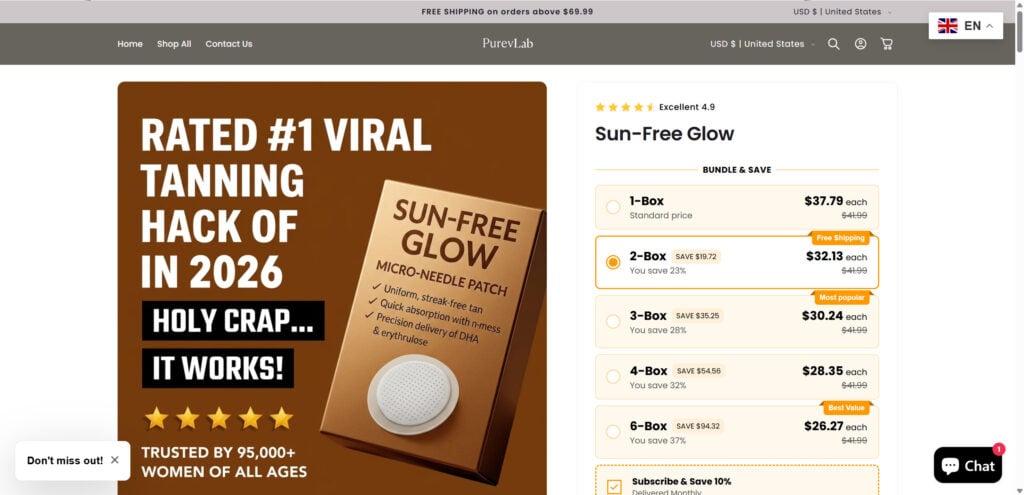
What Is the Purevlab Sun-Free Glow Micro-Needle Patch?
Purevlab sells a product called Sun-Free Glow, described as a “First-of-its-kind Micro-Needle Tanning Patch.” The product page claims it can deliver a “Gradual, Real Tan in 6–12 Weeks,” requires “Just One Patch Every Two Weeks,” and uses a “Patented EryGlow™ Complex.” The listed price is $41.99 for one box.
The product description says each patch delivers EryGlow™ Complex “deep beneath the skin” using transdermal micro-needle delivery. Purevlab claims this activates the body’s own melanin production for a safe, even, long-lasting glow.
That is a very big promise.
This is not just a normal self-tanner being sold as a cosmetic. The product is marketed as something that can influence the body’s natural tanning response from within. That kind of claim deserves strong evidence, not just a slick landing page and dramatic before-and-after style advertising.
The Main Claim: A Tan Without Sunlight
Purevlab’s page claims the patch uses more than 1,000 dissolving micro-needles to create micro-channels in the skin and deliver active ingredients directly to the epidermis. It then claims the EryGlow™ Complex combines Erythrulose, skin-tone boosting ingredients, and tyrosine activators to mimic the skin’s natural tanning process and stimulate melanin formation without sunlight.
This is where consumers should slow down.
Real tanning is a biological process involving melanin, UV exposure, skin type, genetics, and cellular signaling. A product that claims to create a “real tan” by activating melanin without UV exposure is making a significant cosmetic and biological claim.
The FTC says health-related product claims generally require “competent and reliable scientific evidence.” It also says randomized, controlled human clinical testing is generally the kind of substantiation experts require for health benefit claims.
Purevlab’s page uses a lot of scientific-sounding language, but the page does not appear to provide transparent, independent clinical studies proving that this exact patch can reliably create the dramatic tanning results shown in ads.
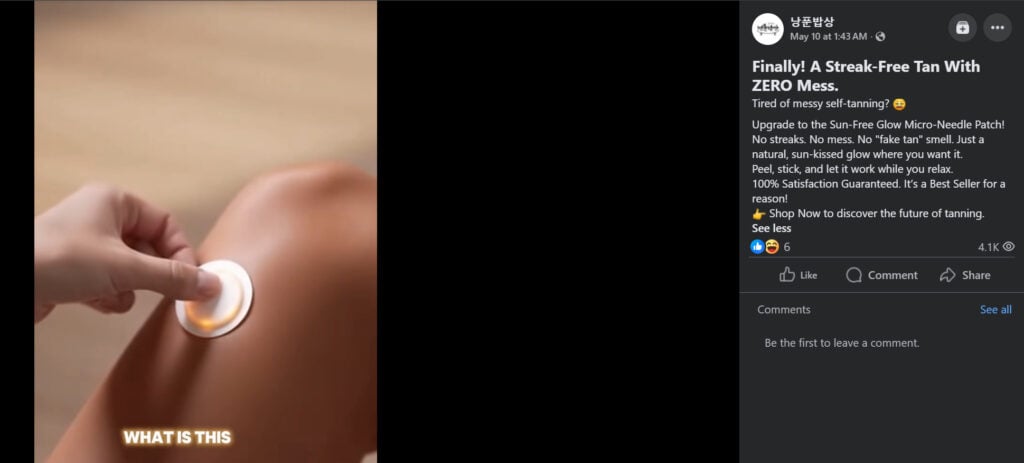
Red Flag #1: The Science Sounds Impressive, But It Is Vague
The Purevlab page uses phrases such as:
- “Transdermal micro-needle delivery”
- “Activating your body’s own melanin production”
- “Patented EryGlow™ Complex”
- “Nano Micro-Needles”
- “Cellular tanning pathways”
- “Peptide-Tan B3™ blend”
- “Advanced Transdermal Tanning Technology”
These phrases are designed to make the product feel advanced and scientific. But technical wording is not proof.
The FTC specifically warns that marketers must consider what consumers are likely to take from ads and must make sure claims are scientifically sound, adequate, and relevant to the specific product being advertised.
That matters here because the average buyer is not just being told this is a moisturizing patch. They are being told this patch can stimulate a tanning response inside the skin.
Red Flag #2: Microneedling Claims Raise Safety Questions
Purevlab repeatedly frames the product around micro-needle delivery. The page claims the patch uses 1,000+ dissolving micro-needles that “painlessly infuse” the skin’s surface and deliver actives directly to the epidermis.
Microneedling is not a harmless buzzword. The FDA explains that microneedling devices create many small puncture holes in the skin and that there are risks involved with their use. Common risks can include dryness, redness, itching, peeling, discomfort, burning, bruising, bleeding, and crusting. Less common risks can include pigmentation changes, infection, and other complications.
The FDA also states that microneedling devices are not approved for delivery of cosmetics, topical medications, vitamin solutions, drugs, or blood products into the skin.
This does not automatically mean the Purevlab patch is unsafe. But it does mean consumers should be cautious when a product claims to use micro-needles to push tanning ingredients into the skin while making bold claims about melanin activation.
Red Flag #3: The Product Looks Like a Dropshipping Campaign
The Purevlab Sun-Free Glow patch appears to be part of a broader viral tanning patch trend. Similar products are sold across multiple websites under slightly different names, often using the same general promises: micro-needles, transdermal tanning, melanin activation, sun-free bronze results, and effortless glow.
That is a classic dropshipping pattern.
The operation usually works like this:
- A cheap generic patch is sourced from overseas suppliers.
- A new brand name is created around it.
- A premium-looking product page is built.
- AI-style social media ads promote dramatic results.
- The product is sold at a large markup.
- Customers receive a low-cost patch that does not match the hype.
- Refunds become difficult because returns require international shipping.
This is why many buyers do not realize the problem until after the package arrives.
A product can physically arrive and still be part of a misleading sales operation. The issue is not only whether buyers receive something. The issue is whether the product performs as advertised and whether the sales process is honest.
Red Flag #4: The Reviews Look Too Convenient
Purevlab’s product page displays a high rating, customer testimonials, and “Verified Buyer” style reviews. The page shows a 4.8 rating with 1,356 reviews and includes glowing customer comments describing natural-looking results.
That kind of review block can be persuasive. But shoppers should not automatically trust reviews displayed on a seller’s own product page, especially for a viral product being pushed through social media ads.
The FTC’s final rule on fake reviews prohibits fake or false consumer reviews and testimonials, including reviews by people who do not exist, AI-generated fake reviews, or reviews by people who did not actually use the product
That does not prove Purevlab’s reviews are fake. But it is a warning sign when a product relies heavily on perfect testimonials while offering little independent evidence outside its own sales page.
Red Flag #5: The Before-and-After Marketing Is Easy to Fake
Products like the Sun-Free Glow patch often rely on visual transformation content. A pale person becomes bronzed. A “before” image looks dull, while the “after” image looks golden, smooth, and vacation-ready.
That is exactly the type of marketing that can mislead buyers.
Before-and-after images can be manipulated with:
- Lighting changes
- Filters
- Makeup
- Self-tanner
- AI-generated faces or skin
- Stock footage
- Different camera settings
- Edited contrast and saturation
- Unrelated customer photos
For a product that claims to change skin tone through a biological process, photos alone are not enough. Consumers should expect real clinical testing, transparent ingredients, realistic limitations, and clear safety information.
Red Flag #6: The Refund Policy May Be the Real Trap
Many complaints around this type of product involve the refund process. Buyers say the product does not work, but when they ask for a refund, the seller requires them to ship the item back to China or another overseas return address.
That creates a practical barrier. International return shipping can be expensive, slow, and difficult to track. In some cases, the cost of returning the product may be close to the amount the customer paid.
The FTC advises online shoppers to check refund policies before buying and specifically look at who pays return shipping, how many days they have to return the item, and whether restocking fees apply.
This is important because many dropshipping stores advertise “money-back guarantee” language while making the actual refund process difficult enough that many customers give up.
Red Flag #7: Reports of Extra Units and Subscription Charges
Another common complaint linked to viral dropshipping beauty products is that customers order one item but receive multiple units or are charged more than expected.
This can happen through:
- Pre-selected bundles
- Misleading quantity selectors
- Post-purchase upsells
- “VIP” discount clubs
- Subscription boxes
- Hidden recurring billing terms
- Confusing checkout pages
Some buyers also report unwanted subscriptions that are difficult to cancel. That is especially concerning because a tanning patch should not require recurring billing unless the customer clearly and knowingly agrees to it.
If someone bought Purevlab Sun-Free Glow and later sees additional charges, they should contact their bank or credit card provider quickly.
Common Complaints About Purevlab Sun-Free Glow
Complaints associated with this type of campaign usually include the following:
The Product Does Not Work as Advertised
Many buyers say they do not get the tan shown in the ads. Some report no visible change at all. Others say the result is weak, uneven, or nothing like the “natural bronze glow” promoted online.
The Product Looks Cheap
Customers often expect a premium beauty technology product but receive a small patch that looks generic. This is a common complaint with dropshipped viral products sold at inflated prices.
Multiple Units Are Sent
Some buyers report ordering one box but receiving or being charged for more than one. This may happen because of confusing checkout offers or bundle-based sales funnels.
Refunds Are Difficult
Customers may be told they need to return the product to China at their own expense. This makes refunds impractical for many buyers.
Subscription Cancellation Is Hard
Some customers report recurring charges or unwanted subscriptions. In these cases, contacting the card issuer may be more effective than trying to argue with the seller.
Is Purevlab Sun-Free Glow a Scam?
Based on the product claims, marketing style, and complaint pattern, the Purevlab Sun-Free Glow Micro-Needle Patch has serious scam red flags.
The product may be real in the sense that buyers may receive a physical patch. But the marketing appears highly questionable because it suggests the patch can activate melanin and create a real sun-free tan without providing strong independent proof on the sales page.
The biggest concerns are:
- Bold tanning claims without strong public evidence
- Scientific-sounding language used as persuasion
- Micro-needle delivery claims that raise safety questions
- High price for what appears to be a simple patch product
- Dropshipping-style sales pattern
- Similar products sold on multiple websites
- Heavy reliance on glowing reviews and transformation imagery
- Refund barriers involving overseas returns
- Reports of unwanted extra units or subscription issues
Verdict: Purevlab Sun-Free Glow looks like a high-risk dropshipping beauty product promoted with exaggerated tanning claims. Consumers should avoid buying it from social media ads.
What To Do If You Bought Purevlab Sun-Free Glow
If you already ordered the patch, take action quickly.
1. Save All Evidence
Take screenshots of:
- The product page
- The price shown at checkout
- Any bundle offers
- The refund policy
- The subscription terms, if shown
- Your order confirmation
- All customer support messages
- The shipping label
- The package contents
- Any recurring charges
This evidence helps if you need to dispute the transaction.
2. Contact the Seller Once
Send a clear refund request. Do not get dragged into endless back-and-forth emails.
Use something like:
“I purchased Purevlab Sun-Free Glow based on the advertised claims. The product does not work as advertised, and I am requesting a full refund. Please also confirm that no subscription or recurring billing is active on my account.”
3. Check Your Bank Statement
Look for additional charges. The billing name may not always match the product name.
Check for:
- Duplicate charges
- Extra unit charges
- Monthly subscription charges
- Unknown merchant names
- Small recurring payments
4. Dispute the Charge
If the seller refuses to refund you, demands unreasonable international return shipping, charged you for items you did not order, or enrolled you in recurring billing without clear consent, contact your credit card company or payment provider.
Credit card disputes are often the fastest way to deal with sellers that make refunds difficult.
5. Report the Ads
Report the ad on the platform where you saw it. Viral beauty scams often disappear under one brand name and return under another.
You can also report misleading online shopping practices to consumer protection agencies.
The Bottom Line
The Purevlab Sun-Free Glow Micro-Needle Patch is marketed as a breakthrough tanning product, but the evidence does not match the promise.
The product page claims the patch can deliver active ingredients beneath the skin, stimulate melanin production, and create a natural sun-free bronze glow over several weeks. But the page relies heavily on scientific-sounding language, testimonials, and polished marketing rather than transparent independent proof.
When you combine the exaggerated claims, micro-needle safety questions, dropshipping-style structure, refund complaints, possible subscription issues, and suspicious review-heavy marketing, the conclusion is clear:
Purevlab Sun-Free Glow appears to be an overhyped micro-needle tanning patch campaign with major scam red flags. Avoid it, and dispute the charge quickly if you were misled.








