


QuenX makes earning from cryptocurrency sound almost effortless: open an account, add a little money, and let its AI trading system handle the difficult work.
The pitch combines daily growth with rewards for inviting friends. Before following either promise, look closely at the offer and the records attached to its name.
Overview
The daily-return promise comes from an archived offer
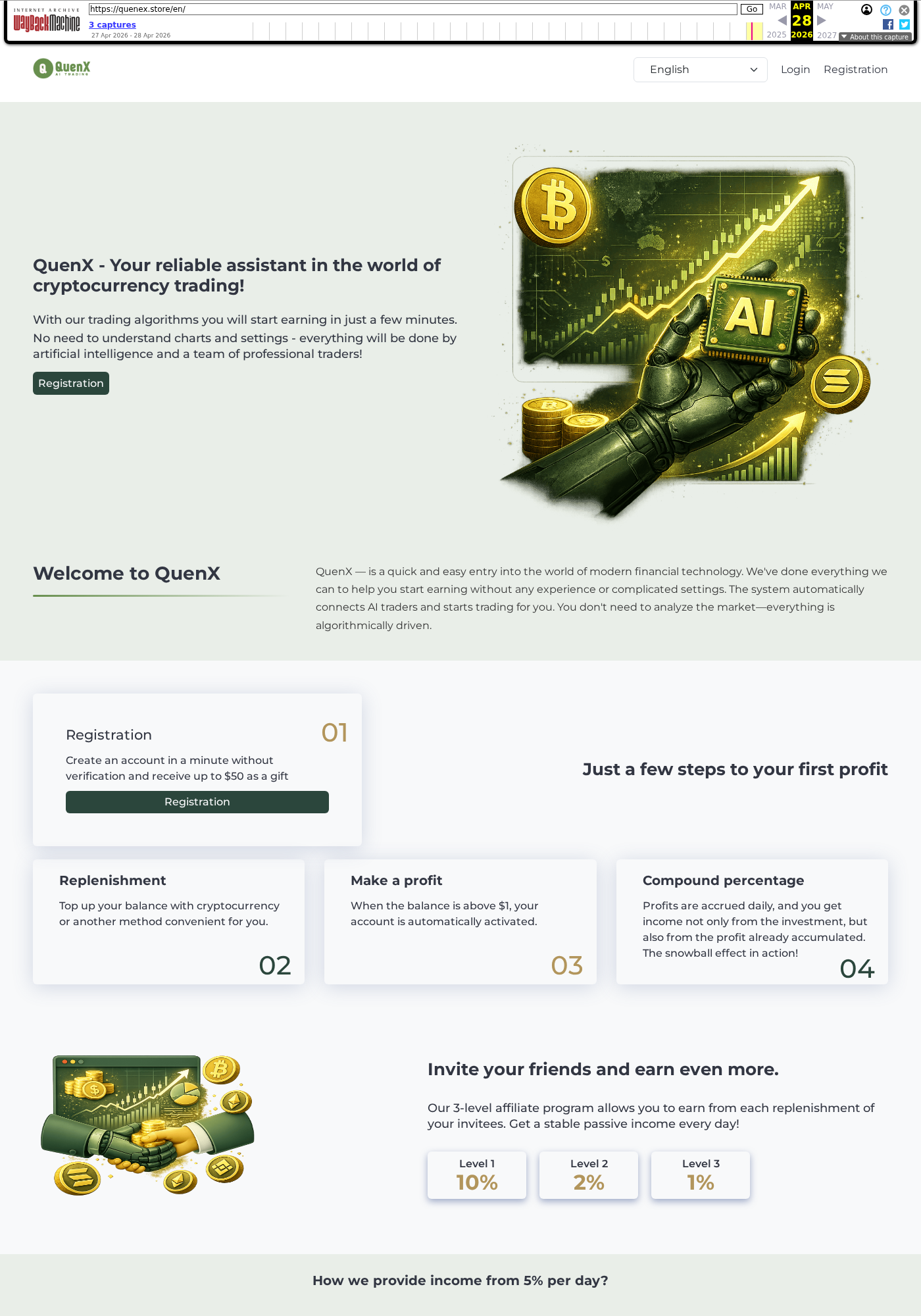
A preserved QuenX homepage from April 2026 advertises income starting at 5% per day. It describes automated cryptocurrency trading, daily compounding, and rewards linked to recruits’ deposits.
The offer names trading, arbitrage, and DeFi as income sources. Those are explanations supplied by the platform, rather than an independently verified record of trades or payouts.
The archive establishes what QuenX promoted then. It doesn’t establish that the same terms applied later, or what a new account would display today.
Two official records identify the same website
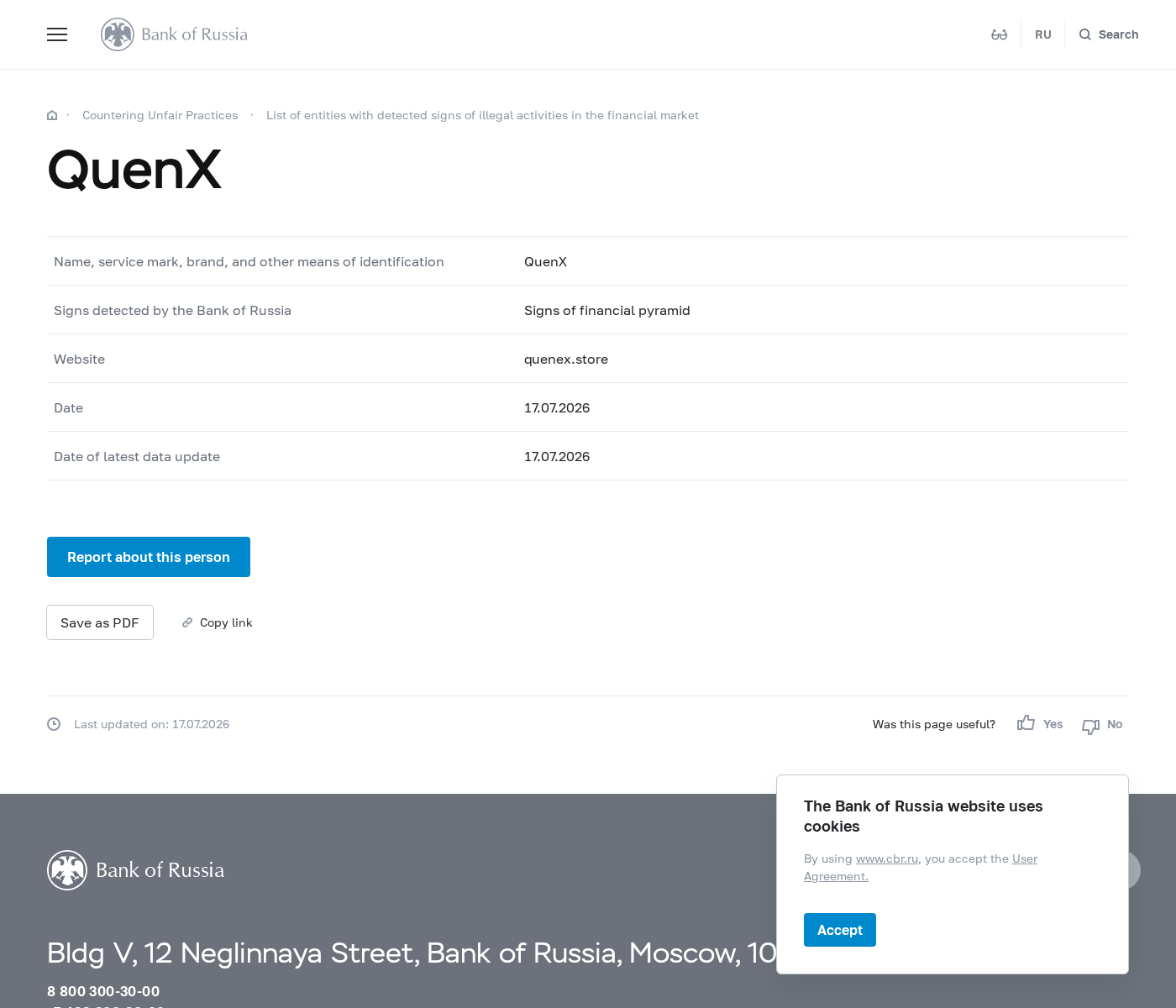
The Bank of Russia’s QuenX entry identifies quenex[.]store and records signs of a financial pyramid. The entry is dated July 17, 2026.
Australia’s ASIC investor-alert data also identifies QuenX and that domain. Its August 31, 2026 record categorizes the offer as unlicensed.
These are matched official warnings. They aren’t a court conviction or a complete account of where investors’ money went.
The decision involves more than an attractive rate
Don’t deposit into QuenX on the strength of this promotion. The regulatory warnings and unresolved responsibility for your money outweigh the polished trading explanation.
- Offer: Automated crypto income and daily compounding.
- Recruitment: Three levels of commissions tied to invited users’ balance replenishments.
- Official concern: An unlicensed listing and a separate financial-pyramid warning.
- Unresolved essentials: The verified operator, actual trading performance, and complete withdrawal conditions.
- For existing payers: Preserve real transfer records and seek help through the institution that handled the payment.
What a 5% Daily Pitch Would Mean for Your Balance
A daily figure can sound modest because the interval is short. Compounding changes its meaning: the next day’s growth would apply to the previous day’s enlarged balance.
For illustration, start with 100 units and assume exactly 5% growth every day. The arithmetic would look like this, rounded to whole units:
| Time | Illustrative balance |
|---|---|
| At the start | 100 |
| After 1 day | 105 |
| After 15 days | 208 |
| After 30 days | 432 |
That calculation is hypothetical. It isn’t a QuenX account statement, verified performance history, or prediction that a withdrawal would be available.
The point is the scale of the promise. Consistent daily growth at that rate would more than quadruple the starting balance within a month.
Before treating such a display as income, you would need reliable information about the assets, custody, losses, fees, and the party obliged to return funds.
A chart inside a platform can’t answer all those questions. It can show the platform’s calculation without demonstrating that the underlying money exists or remains accessible.
How the QuenX Offer Is Presented
Step 1: Registration looks quick and inexpensive
The archived page promotes an account without verification and a gift of up to $50. That makes trying the service appear easy.
A signup incentive can shift attention toward what you might receive. The more important issue is what must happen before you can keep or withdraw anything.
Read a bonus as an offer with conditions until those conditions are clear. A credited promotional amount isn’t necessarily cash you own and can remove.
Don’t supply documents or pay an activation charge merely to investigate a gift. The size of a promised reward doesn’t establish the reliability of its provider.
Step 2: Adding money supposedly activates the account
QuenX’s April page says an account activates once its balance is above $1. It invites replenishment using cryptocurrency or another convenient method.
The low starting figure can make a deposit feel inconsequential. Yet sending a small amount still doesn’t independently identify who receives it or what safeguards apply.
It also creates a relationship that can become harder to question after more money is involved. Decide on the service before testing it with savings.
The published marketing doesn’t supply a verified list of payment processors. If you’ve already paid, record the actual route you used rather than relying on the site’s description.
Step 3: Automation is presented as the source of growth
The offer describes AI systems and professional traders handling the work, with profits credited daily and added to the amount generating further income.
Automation can execute instructions, but the word AI doesn’t tell you what trades occur, who holds the assets, or how a losing period would be handled.
A meaningful explanation should connect the displayed result to independently checkable activity. Technical language alone can’t replace records of transactions, costs, and ownership.
Leaving a growing balance inside an account may feel different from depositing again. Financially, you still need to know what amount could actually be returned.
Keep screenshots of claims if you need to document the promotion. Treat them as statements by the platform, rather than independent evidence that the strategy produced those results.
Step 4: Inviting others becomes another income route
The archived referral program displays commissions of 10%, 2%, and 1% across three levels. The stated trigger is replenishment by invited users.
That detail matters because the advertised reward follows new money entering through recruits. It isn’t described as payment for selling an ordinary product to an outside customer.
The public page doesn’t provide an accounting of how every payout was funded. Recruitment-based marketing and proven cash flows are separate questions.
For example, if 100 units qualified for all three advertised levels, the listed percentages would imply commissions of 10, 2, and 1 units.
That illustrates the recruitment incentive, rather than an observed payout. The reward is linked to someone adding funds, not to their independently verified investment success.
If a friend recommends QuenX, ask about any referral benefit. An incentive doesn’t prove that the friend understands the risks or intends to mislead you.
A referral recommendation can therefore come with a financial interest that a newcomer doesn’t see. Ask for that interest to be disclosed before discussing projected gains.
Nor does a friend’s confidence establish financial authorization. Check the offer independently before allowing a personal relationship to stand in for information about your money.
Who Takes Responsibility for the Investment?
The public brand doesn’t establish the legal operator
The archived homepage names QuenX but doesn’t identify the legal company that would owe you money. A brand name alone won’t answer a refund demand.
Before transferring funds, you should be able to identify the contracting entity and match its contact details with independent records relevant to its activities.
A same-name company found in a registry isn’t automatically the operator. Match the actual domain and identifying details before assuming a relationship.
The London address is a claim of location
The archived footer gives 36-37 Bloomsbury Way, London, GB. The same address appears in ASIC’s exact QuenX alert record.
That match helps identify the offer being warned about. It doesn’t establish that QuenX occupies the premises or that an unrelated occupant is responsible for it.
Don’t visit an address to confront people or recover a deposit. Provide the published location as part of your records and let the appropriate institution assess it.
The license question needs an exact match
ASIC’s category is unlicensed. Its investor-alert guidance explains that listed entities aren’t allowed to offer investments in Australia.
Don’t interpret a London address, company certificate, or technical website as a substitute for the permission relevant to the service and jurisdiction.
If someone offers a license number, compare the registered firm, permitted activity, and genuine contact details. A number belonging to another business doesn’t authorize this offer.
Support isn’t a substitute for published withdrawal terms
The archived homepage includes a technical-support link pointing into a member-dashboard route. It doesn’t supply the complete withdrawal rules or independently verified operator identity.
The linked FAQ, rules, and About material wasn’t recovered in the available archive checks. That limits what can be said about the terms behind the promotion.
Without those conditions, you can’t assess processing times, deductions, or the circumstances under which access could be restricted. Keep your money out until those essentials are clear.
What the Pyramid Warning Says, and What It Doesn’t
The Bank of Russia record is specific: it names QuenX, gives the website, and identifies signs of a financial pyramid. It isn’t merely a comment about cryptocurrency generally.
That warning belongs beside the actual marketing. QuenX’s archived offer combines daily-growth claims with referral rewards tied to other people’s deposits.
The record gives you a place to check outside the promotion. Match its domain to the one in your invitation or receipt.
An exact official warning is a serious reason to keep your money out while essential safeguards remain unestablished.
What to Do If You Sent Money to QuenX
-
Pause further funding. Don’t increase a deposit because an account displays growth or someone says another replenishment will make the return more attractive.
Keep any new payment request. If a supposed withdrawal later requires another payment, have it assessed independently before sending anything.
-
Identify the transfer you actually made. Save its date, currency, amount, receiving account or wallet, and the transaction reference.
For cryptocurrency, retain the transaction hash and the sending exchange’s records. A platform username alone may not identify where the funds traveled.
-
Keep the original payment amount clear. Retain the cryptocurrency quantity as well as any conversion shown on a receipt.
A later exchange rate can change a valuation without changing the transfer itself. Don’t replace the original transaction record with a current balance estimate.
-
Contact the institution handling your payment. Explain the QuenX connection and provide the official warning records alongside your transaction details.
Ask what fraud-reporting or recovery steps are available for that particular transfer. Don’t assume that a displayed account balance can simply be reversed.
A bank or exchange needs the payment trail, not an estimate based on hoped-for profits. Keep actual deposits and money received back separate.
-
Explain a personal-wallet transfer accurately. The exchange where you originally bought cryptocurrency may not control the receiving platform.
Provide the wallet transaction details when reporting. A purchase receipt for cryptocurrency and a later transfer to an investment address document different stages.
-
Preserve the offer and account communications. Save any invitation, rate explanation, referral promise, withdrawal instruction, and reply from support.
Include dates so an investigator can distinguish an archived April advertisement from the terms you were personally given later.
Store originals privately. Remove account numbers and other people’s information before discussing the situation in a public forum.
-
Review the information you shared. If you reused a password, replace it on genuine services, especially your main email and financial accounts.
Tell your bank about exposed identification or account documents where relevant. A regulator warning alone doesn’t establish that an installed program infected your device.
-
Report the actual circumstances. Describe how you encountered QuenX, what was promised, which domain you used, and where your payments went.
U.S. readers can submit suspected online investment fraud to IC3. Other readers should use their local police and financial regulator’s official reporting route.
Give each institution the records it requests through its verified channel. An official report doesn’t guarantee reimbursement, but it documents the incident.
-
Don’t recruit others while your own concerns remain unresolved. If you’ve already shared the offer, pass on the official alerts and encourage people to check their transfers.
Avoid circulating another investor’s identification or wallet-recovery information. Sharing a warning doesn’t require exposing private financial records.
-
Be wary of a paid recovery shortcut. A stranger who recognizes the QuenX name hasn’t demonstrated access to your money.
Never disclose a recovery phrase, private key, banking code, or remote-control access to prove ownership of a balance. Verify any professional independently before hiring them.
Frequently Asked Questions
Is QuenX the same website as quenex.store?
The archived QuenX page and both official records identify that domain. Similarly named pop-up sites or unrelated companies shouldn’t be treated as the same operator.
Did the archived offer promise hourly returns?
The recovered April homepage describes income starting at 5% per day and daily accumulation. It doesn’t establish an hourly rate or the terms offered later.
What does ASIC’s warning establish?
ASIC lists the exact QuenX offer as unlicensed. The record supports an authorization warning, not a claim that ASIC announced a criminal conviction.
Does the London address prove who operates QuenX?
No. The address matches the one in ASIC’s warning, but that doesn’t verify an operating office, property occupancy, or the legal entity responsible for the investment.
Does a referral payment prove the AI trading works?
No. A payment could establish that a particular transfer arrived. It doesn’t independently demonstrate the strategy, the source of all revenue, or the accessibility of your remaining balance.
Should I make a small deposit to test a withdrawal?
Don’t send money to test this offer. The matched official warnings and unresolved operator and withdrawal conditions already provide strong reasons to avoid funding it.
The Bottom Line
Don’t deposit into QuenX based on its daily AI-trading pitch. The exact-domain regulatory warnings deserve more weight than an advertised growth rate or referral reward.
If you’ve already transferred money, preserve the offer and payment trail, then contact the institution handling the transfer. Don’t add another payment simply to pursue a displayed balance.

Join the discussion
0 commentsShare your experience or ask a question about this article.
Discussion
Start the conversation
Have a question or something useful to share? Add the first comment.