


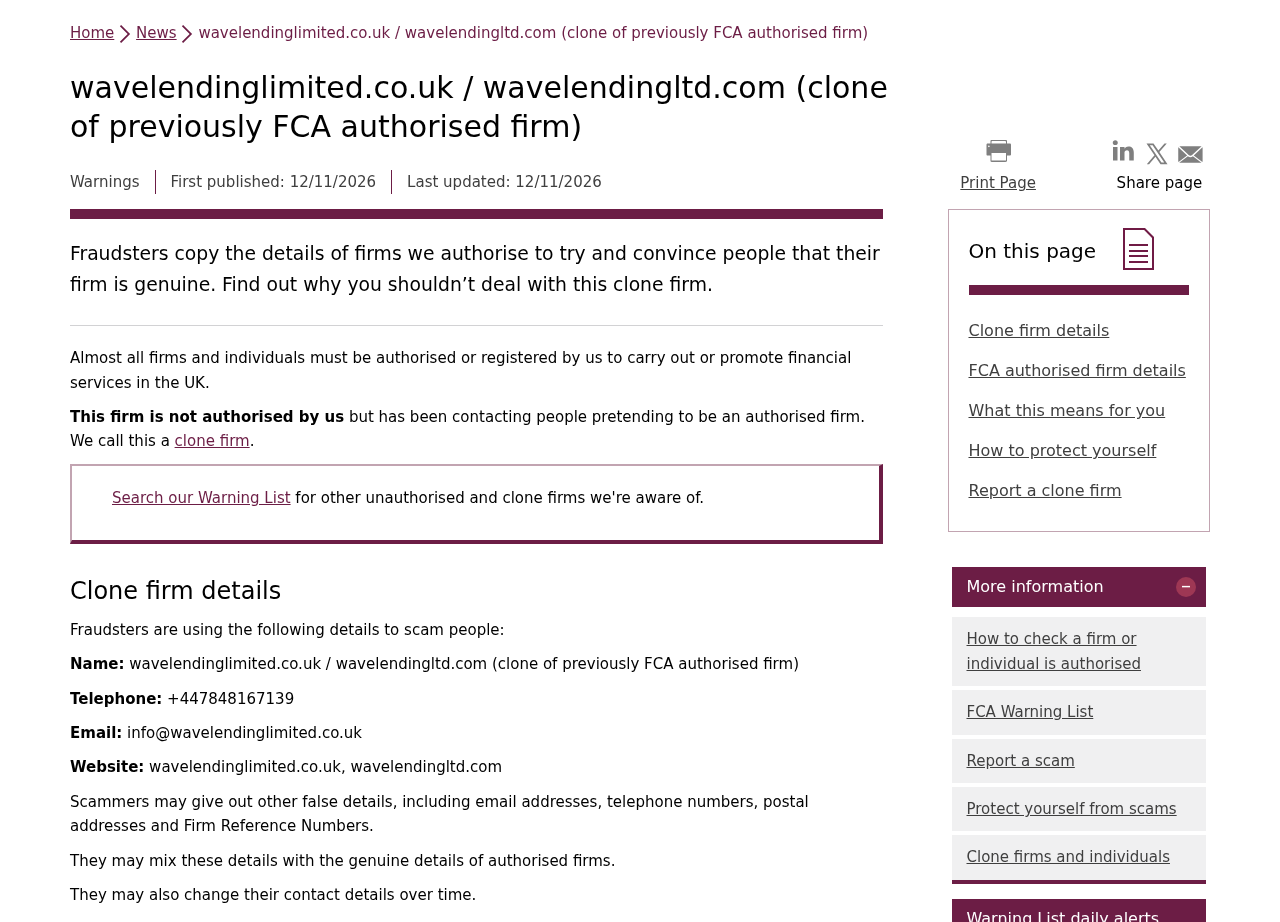
Two websites using the Wave Lending name are on the UK Financial Conduct Authority’s warning list. The regulator identifies both as a clone, not the real lender.
Do not send them money or mortgage paperwork. If you already have a Wave mortgage, verify any instruction through your established servicer before changing a payment.
Overview
The two websites to avoid
The FCA’s November 12, 2026 warning names wavelendinglimited.co.uk and wavelendingltd.com. Neither spelling is a first-party route for dealing with the genuine Wave Lending business.
- The longer address spells out “limited” and uses a UK domain ending.
- The shorter one substitutes “ltd” and uses a dot-com ending.
- The regulator also lists a UK mobile number. A different number does not make either address safe.
If either exact address appears on a document, in an email signature, or in the link you were asked to follow, stop using that route.
Why the real firm appears in the warning
Wave Lending Limited is a real company. Its existence is precisely what makes the copied name useful to an impersonator.
The FCA calls this a clone of a previously authorized firm. Its warning separately gives the genuine firm’s name, reference number and established customer website.
Those details identify the business being imitated. They do not give the two listed websites the right to arrange credit, collect mortgage payments or receive documents.
What to do if there is money on the line
For a new loan, walk away from the clone and restart your search independently. For an existing loan, keep dealing with the genuine account servicer.
Already paid the wrong destination? Call your bank using a trusted number and explain that the recipient was impersonating a lender. Then contact the real servicer separately.
Those are different jobs. The bank can investigate the transfer; the servicer can tell you how your actual mortgage account stands.
How the Wave Lending Clone Scam Works
Step 1: A familiar company name gets the conversation started
The FCA says the clone has been contacting people while pretending to be an authorized firm. Its warning does not describe one universal message or sales pitch.
A borrower researching the name may land on an authentic record and feel reassured. That search answers whether the name exists, not whether the contact belongs to it.
The correct test uses the exact route that brought you here. Match the website, reply address and callback number against an independent source, not a search-result headline.
Domain endings deserve a separate look. A UK suffix can look familiar to a British borrower, but it does not certify that a firm has UK lending permission.
Step 2: Real details can get mixed into the wrong contact
The FCA explicitly warns that clones can mix genuine details with false ones. An address or firm number copied correctly does not make the adjoining contact information reliable.
Searching the lender’s name from a PDF may bring up the genuine business, even when every payment instruction in the document is false.
For that reason, run the check outside the conversation. Open your established lender portal or find the regulator through a page you opened independently.
Don’t rely on a screenshot of a regulator entry supplied by the sender. Even a genuine screenshot cannot confirm the sender’s identity or authority.
Step 3: An unverified request crosses the line into money or data
The regulator has not published a Wave-specific fee schedule, payment account or application form in this alert. Do not assume any particular price or loss applies to everyone.
Its broader loan fee fraud guidance describes upfront payment requests disguised as deposits, insurance or administration charges. Treat those as possible warning signs, not confirmed facts about these domains.
Existing mortgage customers face a different decision if a message asks them to redirect payments. An apparent change of bank details deserves a separate callback to the known servicer.
Send neither a test payment nor identity paperwork while you investigate. A small transfer that goes through shows only that an account accepted it.
Which Wave Lending Details Are Genuine?
Companies House confirms the legal name
The Companies House entry for Wave Lending Limited identifies company number 03312246. It shows an active private limited company incorporated in February 1997.
The recorded office is 2 King Edward Street, London. That agrees with the genuine firm’s address printed in the FCA warning.
There is no contradiction between an active company record and an impersonation warning. One describes a legal entity; the other describes someone using its identity.
The registered office is not a payment instruction. Even if a contract repeats that address perfectly, independently verify the person and service named on the contract.
The FCA warning distinguishes the real firm from the clone
The warning gives 305391 as the genuine firm’s reference number. It is a comparison point, not a number that proves any offer quoting it is genuine.
Pay attention to the word “previously” in the alert’s headline. Do not take the number, or the warning’s standard genuine-firm heading, as current authorization for a new offer.
For a prospective financial service, use the FCA Firm Checker to inspect the current firm and the relevant permission. If the listing does not resolve the question, ask the FCA.
The result needs to match the activity you want. Being able to find a company across a regulator’s records is not the same as confirming a particular credit product.
Mortgages plc gives existing borrowers a separate route
The FCA lists Mortgages plc as the genuine website. Its home page identifies Wave Lending Ltd as a subsidiary and gives Wave customers their own route.
Use a known statement, a saved account link or that independently verified site to find the appropriate servicing contact. Do not start with the message you are trying to authenticate.
A payment mandate might already be working correctly. If a suspicious message claims it failed, check the servicing record and bank account before making a manual replacement payment.
If the servicer really has changed the way it accepts payments, it should be able to confirm the instruction when you contact it through a known channel.
The warning does not rewrite your mortgage contract
Seeing the clone notice does not mean your original Wave paperwork is fake. It also does not, by itself, cancel a scheduled instalment or suspend a contractual due date.
Keep your ordinary payment arrangements until the genuine servicer tells you otherwise. Ask it to confirm the status of your account before taking action on a suspicious demand.
If a third party claims to have bought your loan, ask the established servicer to verify that transfer. A notice bearing a real name is not enough on its own.
Three Checks to Run Before You Send Anything
First, record the exact address you encountered. Compare the entire domain, not the title on the page or the word “Wave” in your browser history.
For an email, look at the full sending address. A friendly display name may be identical to a genuine lender’s name even when the actual address differs.
For a phone call, do not transfer back through the caller’s menu or accept a second number supplied by them. End the call and find an independent route.
Second, check what the person is authorized to do. A registration entry alone does not establish that the caller can market, arrange or service the product being discussed.
For a new loan inquiry, check the lender or broker’s current permission via the regulator. For an existing account, ask the established servicer about your specific contract.
Third, verify the destination independently. A recognizable bank name can still sit behind a beneficiary that has nothing to do with your loan.
Do not use a successful payee name check as the sole basis for the transfer. You still need the real firm to confirm whom you should pay and why.
If different clues point in different directions, do not choose the most reassuring one. Stop until the genuine firm resolves the discrepancy through a trusted route.
How to Check an Instruction Without Losing Time
Imagine an email says the next instalment is due tomorrow but the account has moved. Start with the date and amount on your last authentic statement.
Check whether the supposed new instruction describes an existing payment, a fresh authorization, or an investment in something unrelated. Don’t let the subject line decide for you.
Ask the servicer whether it issued the message and whether it can independently identify the new details. Avoid volunteering the recipient first and listening for a simple yes.
Keep a contemporaneous note of the conversation. Record the time and the department, along with the instructions the real servicer gives you about your particular account.
If you cannot get through promptly, don’t substitute the number on the suspicious notice. Use a verified alternative contact channel and keep trying as the deadline approaches.
For a new loan, compare the lender named in the documentation with the broker who introduced you. Both may have different responsibilities; verify each role separately.
A real loan offer may involve documentation about charges. A fee label is not proof either way. Check the firm and its permission before agreeing to the charge.
Look for contradictions between the company that says it is lending, the firm named on disclosures and the account receiving payment. Resolve them before signing anything.
If the offer reached you after an online credit inquiry, don’t assume the person earned your trust by knowing that fact. Ask the original site how it handled referrals.
A quoted account reference or accurate postal address is similarly not a password. Read it as one piece of background information, not proof that the person can act.
When documenting the clone, keep originals privately. Share redacted copies with anyone who doesn’t need the full file, especially when it includes an address or account number.
If an unfamiliar business contacts you about recovering the payment, check it independently too. A fraud complaint does not authorize a stranger to act on your behalf.
What to Do If You Responded or Sent Money
-
Stop communicating through the suspicious route. Keep the message and note the exact address, but don’t reopen links or send a document to see who answers.
-
Contact your bank promptly if money moved. Give the amount, time, beneficiary and payment reference. Say the FCA has warned about a clone using the lender’s identity.
-
Ask the bank to explain the fraud reporting and recovery process that applies to that payment. Keep its reference number and any response deadline.
-
Contact the real servicer separately. If a mortgage instalment went to the wrong account, ask whether the real balance shows a missed payment and how to address it.
-
List the information you shared. A basic call-back number needs a different response from a passport copy, mortgage statement, banking credentials or one-time code.
-
Use the FCA’s official reporting route on its warning page. Share the exact clone contact details privately, including any new address or number the sender used.
-
Expect possible follow-up impersonation. An unsolicited person claiming to have traced your transfer still does not get a recovery fee or access to your banking app.
Keep your original records together. The message trail establishes what you were told; the bank transaction establishes what actually moved. Both may matter to a fraud report.
If you received only an email and did not open anything, pay or share information, focus on preserving and reporting the message. Don’t assume your accounts were breached.
If you entered banking credentials, call your bank through its usual app or the number printed on your card. Let the bank guide any urgent changes to access.
If you entered a password on a clone page and use it elsewhere, change it on the affected real services. Do not reset it through the suspicious message.
If you shared identity documents, be specific about what they show. Ask your bank what monitoring is appropriate for the exposure, and retain the request you received.
The FCA notes that some people who transferred money under false pretenses may have payment protections. Eligibility depends on the transfer and situation, not simply on the warning date.
Don’t wait for the clone to acknowledge your request before involving your bank. A conversation about a supposed reversal is not evidence the money is coming back.
Frequently Asked Questions
Is wavelendinglimited.co.uk the genuine Wave Lending site?
No. The FCA lists it as a clone domain, alongside wavelendingltd.com. The FCA gives Mortgages plc’s website as the genuine reference.
Does FCA reference number 305391 make a loan message safe?
No. It identifies the genuine firm in the warning. It does not prove the message comes from that firm or that a new service is authorized.
Should I stop paying my existing Wave mortgage?
Don’t change your genuine payment arrangements because of an impersonation notice. Verify any new instructions with the actual servicer and confirm what is currently due.
Did the FCA identify a particular upfront charge?
Not in this notice. It named the clone and its contact details. Its separate loan fee fraud guide explains what an advance-fee request can look like.
Can an address match the real lender while the email is fake?
Yes. The regulator warns that genuine and false details can be mixed. Confirm who is contacting you separately rather than accepting a single matching detail.
Can my bank get a transfer back?
Contact the bank promptly and ask. Its options depend on how you paid and the facts of the transfer; neither a recall nor reimbursement is automatic.
The Bottom Line
The FCA identifies both Wave Lending lookalikes as a clone. Do not use either domain to submit a loan application, share mortgage records or pay anyone.
If you’re already a customer, take payment questions to your genuine servicer. If money has already gone to the wrong account, tell your bank first and confirm the mortgage separately.

Join the discussion
0 commentsShare your experience or ask a question about this article.
Community experiences
Did this happen to you?
Your experience could help someone recognize the same scam. Submit a private report for our team to review.
I experienced this tooReports are reviewed before publication. Sharing publicly is always your choice.
Discussion
Start the conversation
Have a question or something useful to share? Add the first comment.