


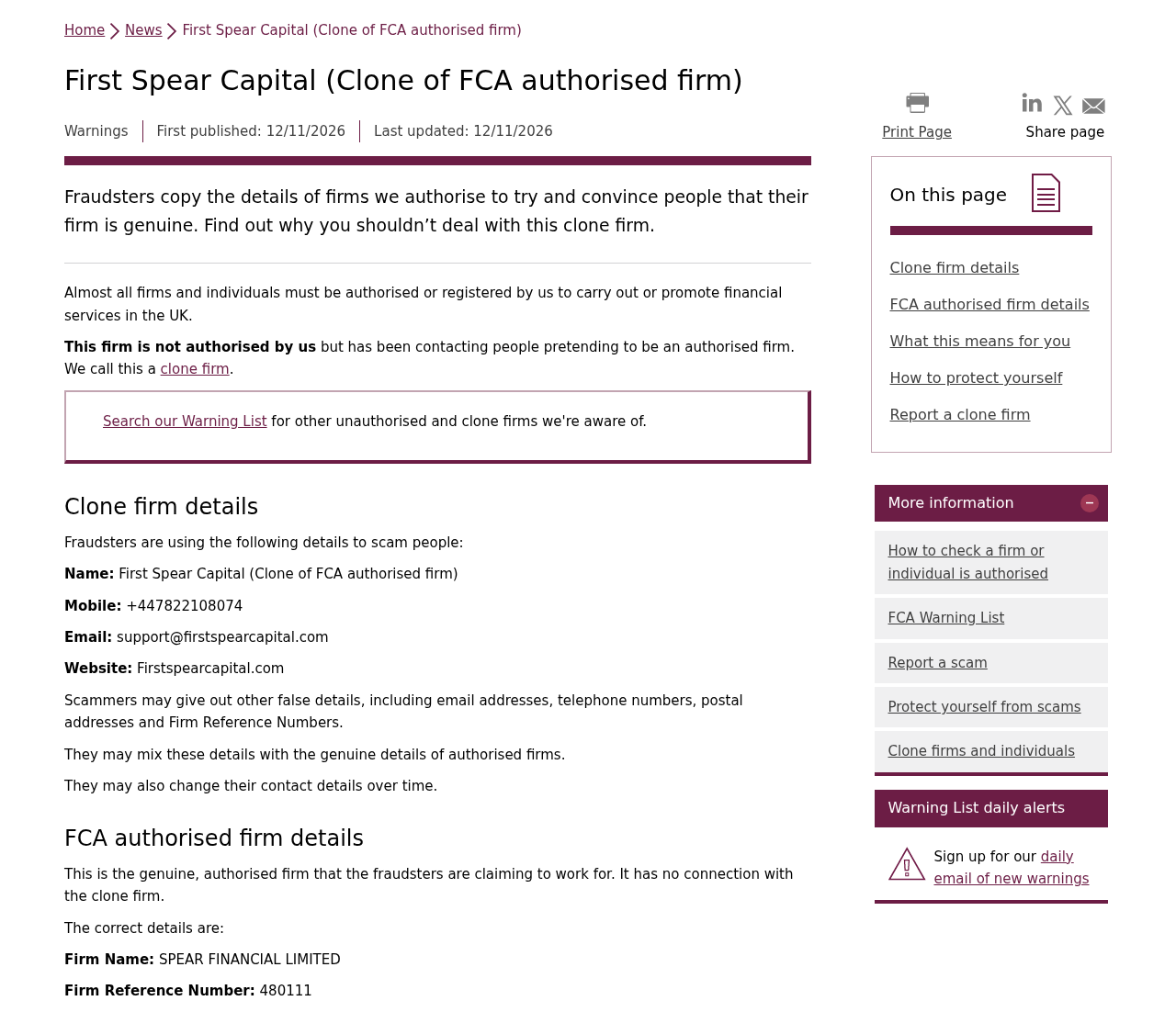
First Spear Capital is not Spear Financial Limited. The UK’s Financial Conduct Authority identified the First Spear Capital contact as a clone of the genuine advisory firm.
If the conversation involves firstspearcapital.com, don’t sign an investment form or send a deposit. A genuine FCA reference number in the pitch wouldn’t make the sender genuine.
Overview
The source of the warning
The November 12, 2026 FCA notice identifies First Spear Capital as a clone using firstspearcapital.com. The regulator says it is not authorized and has no connection with the genuine firm.
The notice also lists a mobile number and an email address at the clone domain. Those identifiers describe the contact already flagged, not all aliases it may use.
- Flagged name: First Spear Capital.
- Flagged domain: firstspearcapital.com.
- Genuine firm: Spear Financial Limited, firm reference number 480111.
The genuine firm’s number doesn’t travel with the name
A register match for Spear Financial Limited does not authenticate First Spear Capital or anybody who claims to work for it. The FCA specifically separates the two.
On the genuine site, the firm presents itself as an independent financial adviser. Finding that real business says nothing about who sent a new offer.
Use the individually verified firm to confirm the adviser, service and supporting paperwork. Don’t ask the suspect contact to explain away the difference first.
Our verdict for anyone with an offer in hand
Walk away from an offer sent through the channel the FCA named. If you want advice from the legitimate firm, begin an entirely new conversation.
The FCA did not identify a specific fund, yield or minimum deposit in the notice. The reason to decline is the confirmed impersonation, regardless of the product.
If you’ve moved money, treat that as a bank incident now. Use the firm’s actual contact only to verify the impersonation, not as the place to request recovery.
How the First Spear Capital Impersonation Works
Step 1: The contact borrows enough of a real name to pass a quick search
“First Spear Capital” and “Spear Financial Limited” share a memorable word and sound like plausible names in the same sector. They are not the same firm.
The FCA received enough information to identify an unauthorized contact purporting to represent a regulated firm. The agency did not specify how every approach began.
If you landed here after searching only “Spear,” check the name on the actual message. Match the whole address, not the familiar word in the middle.
Once you know the exact identity asserted, put the original message aside. Carry out the rest of the verification from a separate tab or known phone contact.
Step 2: A distributor, adviser or principal is named without a verified chain
A seller may insist the firm behind the paperwork is real. That doesn’t answer who contacted you, which business they represent, or where your funds would go.
The regulator cautions that impersonators can mix copied firm identifiers with false contact details. A perfectly accurate firm number may make the surrounding claim look convincing.
If a document names an investment issuer, an adviser and a custodian, treat each role as a separate claim. One genuine name does not authenticate three relationships.
Ask the independently contacted firm whether it knows the individual and has approved the specific offer. Don’t turn a general confirmation that the firm exists into an endorsement.
Step 3: Once you accept the identity, the next request gets less scrutiny
For a financial impersonation, risk increases when someone asks you to sign, share identity information or fund an account. These are checkpoints, not a transcript of this case.
A banking confirmation, application reference or formal-looking statement cannot fix the wrong identity. What matters is whether the genuine party acknowledges and is responsible for the transaction.
If an offer says the place will be released unless you transfer today, let it go. No deadline can substitute for independent confirmation of the seller and account.
Don’t send a small sum just to see what happens. A successful transfer isn’t a test of regulatory protection, ownership or whether you’ll ever be able to withdraw.
Who Is Spear Financial Limited?
The name the regulator verifies
The FCA names Spear Financial Limited as the genuine firm and gives firm reference number 480111. It lists the genuine business in Pilsley, Bakewell, Derbyshire.
Use that name as the starting point for independent verification. Do not paste a number the clone supplied into a form it controls.
The FCA’s listing of the genuine firm does not imply any involvement in the clone. In fact, the warning expressly says there is no connection.
The real site offers a separate starting point
The FCA points to Spear Financial’s genuine website. The firm describes the service it offers there and gives its own contact information.
You can start from that independent site if you need to confirm whether a message came from the firm. Do not forward identity documents just to ask.
Give the person’s name, exact claimed role and date of contact. The general question “Do you offer investments?” is less useful than asking about the exact proposal.
The regulator checks what the firm can do
The FCA Firm Checker helps establish whether a firm can provide the financial service you want. A match for the legal name is only the first part.
Check the relevant activity. If an offer claims protections that aren’t clear from the actual arrangement, ask the independently verified provider to explain them before paying.
If you already work with an adviser, contact them in the usual way. A new person claiming to have taken over the account needs independent confirmation.
The clone cannot give you the genuine firm’s protections
The FCA says dealing with this clone does not give access to the Financial Ombudsman Service or protection from the Financial Services Compensation Scheme for that dealing.
That is different from whether your bank can help after a fraudulent transfer. The FCA says some payments from October 7, 2024 onward may have separate protections.
Ask your bank about the rules for your payment method and circumstances. Don’t accept an impersonator’s promise that an investment itself is covered.
How to Check an Investment Proposal Without Continuing the Pitch
Read the proposal once for names. Make a list of the adviser, the regulated firm, the issuer and whoever the instructions say will receive the funds.
Read it again for actions. Underline anything you are expected to sign, upload or pay, and write down the deadline if one is stated.
Put aside statements about returns while you verify who is behind the offer. Even a modest return does not make a false identity acceptable.
If you find an authentic factsheet separately, compare the identifier, currency and issuing institution. A real factsheet sent by an impersonator still doesn’t make the offer genuine.
For an offer from the known clone domain, you already have the answer. Save the details for a report instead of opening files to find more clues.
If the request arrived at a work inbox, follow your organization’s reporting process. Don’t forward a live link to colleagues for a second opinion.
A new email address with the correct words in its display name deserves the same independent check. The displayed name and the sending domain are different fields.
If the sender sends a website link after you question its identity, disregard it. Start with the regulator’s genuine contact details, not a page the sender has selected.
Check payment instructions only with the real firm or provider you independently reached. A screenshot supposedly proving the beneficiary belongs to them won’t establish that.
Save any contradictions without arguing with the caller. You can report both versions while protecting the personal information that appears in your correspondence.
If you already have a real investment held elsewhere, a call suggesting you switch or transfer it shouldn’t change it. Verify any instruction with your existing provider.
If you investigated the offer on behalf of a relative, share the exact flagged name and why you stopped. Don’t simply say all businesses with “Spear” are unsafe.
Check the Adviser, Product and Payment as Separate Claims
Start with the adviser. Look for a name and firm you can confirm through the established provider. Ask whether the individual is authorized to handle your specific inquiry.
Someone claiming to be a partner could be describing a genuine relationship, making a mistake or inventing it. Confirm the relationship with the party being named.
Then check the product. A copied prospectus may accurately describe a bond or fund but say nothing about the stranger who emailed it to you.
A product reference, regulatory notice or listing may assist the genuine provider in identifying it. Use that reference when asking the provider to confirm the specific offer.
Now look at where the money goes. Establish whether the beneficiary should be the issuer, an established custodian or another party under the genuine provider’s instructions.
If the pitch puts you in contact with an intermediary who claims to collect the money first, confirm that arrangement independently. Do not assume introductions authorize payment collection.
If you intend to transfer a pension or an existing investment, contact the institution that currently holds it. Ask what to verify before any transfer is authorized.
Don’t sign a form solely to reserve a place. Read what authority it grants first, including permission to obtain account information or act on your behalf.
A named UK address in a signature isn’t the same as a regulated relationship. Ask how that address relates to the person asking you for documents.
If a proposal references tax treatment or a compensation scheme, stop treating the brochure as the final word. Verify those claims separately through the relevant institution.
Keep an offer that changed names halfway through distinct from a genuine firm’s own materials. When reporting it, explain which entity appeared at each stage.
If the bank queries the transfer, don’t accept coaching from the seller on how to answer. Tell the bank who contacted you and what the transaction represents.
A real adviser can tell you what service they’re providing and how their firm takes responsibility. A claim to be regulated is not an answer to either question.
What to Do If You Signed, Paid or Shared Documents
-
Cut contact with First Spear Capital. Save messages, documents you already have, payment instructions and the name the person used. Don’t click through to gather extra material.
-
If you sent money, call your bank from its regular app or number. Explain that a firm identified by the FCA as a clone induced the payment.
-
Give the bank the amount, recipient and timestamps. Ask what it can do about the transfer and what evidence it needs to consider a fraud report.
-
Check what you signed or shared. If it includes access credentials, identity documents or a payment mandate, tell the affected institution exactly which items were exposed.
-
Contact the genuine firm separately if its adviser or paperwork was named. It can help establish whether the offer came from anyone it recognizes.
-
Report the contact via the FCA’s official warning page. Include the exact names, sending addresses, dates and any independently documented discrepancies.
-
Refuse demands for recovery fees or additional transfers. An unsolicited promise to recover investments does not prove the caller knows where your money went.
If the bank tells you a transaction is pending, ask what you should do next rather than waiting for the other party to cancel it.
Don’t confuse recovery steps with safeguarding an unrelated account. Be explicit about which credentials, documents or transactions are actually involved when speaking with your bank.
Preserve the bank case number with your records. If a new caller later claims to know about the report, verify through the institution you called yourself.
If nothing was signed or sent, you can still report the impersonation. You don’t need to submit an application to prove that the unverified contact occurred.
Frequently Asked Questions
Is firstspearcapital.com authorized by the FCA?
No. It is the website the FCA names in its warning about the unauthorized First Spear Capital clone.
Is Spear Financial Limited involved?
The FCA says the genuine firm has no connection to the clone. Use the FCA’s genuine contact details if you need to reach the legitimate business.
What if an offer shows firm reference 480111?
The number belongs to the genuine firm in the warning. It’s an identifier for a new independent check, not proof that an email, signature or account belongs to it.
Did the FCA name a bond or investment return?
Not in this warning. Its finding concerns the identity used to contact people. Do not assume an independently existing investment is part of the case without evidence.
Can I check a brochure without replying?
Yes. Compare the names with the FCA warning and contact the genuine firm from independently sourced details. There’s no need to reply to the sender.
Can I get my investment back from the bank?
Ask promptly. It depends on the payment and circumstances. The clone cannot give you the protections of an authorized firm, but bank fraud processes are a separate question.
The Bottom Line
Don’t invest through First Spear Capital or act on instructions from its flagged domain. Check any offer separately with the genuine firm, using the regulator’s contact details.
If you paid, call your bank now. A formal-looking statement or copied firm reference changes neither who received the money nor how quickly it needs reporting.

Join the discussion
0 commentsShare your experience or ask a question about this article.
Community experiences
Did this happen to you?
Your experience could help someone recognize the same scam. Submit a private report for our team to review.
I experienced this tooReports are reviewed before publication. Sharing publicly is always your choice.
Discussion
Start the conversation
Have a question or something useful to share? Add the first comment.