

If you are seeing a Serious Disk Error Writing Drive C:\ alert on your computer screen,then as you probably already suspect you’re computer has been infected with a rogue software.
The malicious software is known as Smart HDD,Data Recovery,S.M.A.R.T Virus or S.M.A.R.T Check and has changed your desktop background,hidden your files and shortcuts and it’s causing browsing redirects.
In addition the S.M.A.R.T Virus will display fake alerts, claiming that several hard drive errors were detected on your computer.In reality, none of the reported issues are real, and are only used to scare you into buying S.M.A.R.T Virus and stealing your personal financial information.
We strongly advise you to follow our S.M.A.R.T Virus removal guide and ignore any alerts that this malicious software might generate.Under no circumstance should you buy this rogue security software as this could lead to identity theft.
If you’ve got a S.M.A.R.T Virus infection , you’ll be seeing this screens :
![[Image: Smart-HDD.png]](http://malwaretips.com/blogs/wp-content/uploads/2012/05/Data-Recovery-Rogue.png "S.M.A.R.T Virus")
![[Image: Smart-HDD.png]](http://malwaretips.com/blogs/wp-content/uploads/2012/05/Data-Recovery-fake-alert.png "S.M.A.R.T Virus")
![[Image: Smart-HDD.png]](http://malwaretips.com/blogs/wp-content/uploads/2012/05/Data-Recovery-Rogue-alert.png "S.M.A.R.T Virus")
Registration codes for S.M.A.R.T Virus
As an optional step,you can use the following license key to register S.M.A.R.T Virus and stop the fake alerts.
Data Recovery Rogue: 08869246386344953972969146034087
SMART HDD Rogue: 15801587234612645205224631045976
Please keep in mind that entering the above registration code will NOT remove S.M.A.R.T Virus from your computer , instead it will just stop the fake alerts so that you’ll be able to complete our removal guide more easily.
Removal guide for S.M.A.R.T Virus
STEP 1 : Start your computer in Safe Mode with Networking
- Remove all floppy disks, CDs, and DVDs from your computer, and then restart your computer.
- Press and hold the F8 key as your computer restarts.Please keep in mind that you need to press the F8 key before the Windows start-up logo appears.
- On the Advanced Boot Options screen, use the arrow keys to highlight Safe Mode with Networking , and then press ENTER.
![[Image: Safemode.jpg]](//malwaretips.com/images/removalguide/safemode.jpg "Safe Mode with Networking screen")
- Log on to your computer with a user account that has administrator rights
![[Image: Safemode.jpg]](http://malwaretips.com/images/removalguide/safemode.jpg "Safe Mode with Networking screen")
STEP 2: Remove S.M.A.R.T Virus malicious proxy server
S.M.A.R.T Virus may add a proxy server which prevents the user from accessing the internet,follow the below instructions to remove the proxy.
- Start Internet Explorer
![[Image: S.M.A.R.T Virus- IE]](//malwaretips.com/images/removalguide/Ieicon.png "IE 9") and if you are using Internet Explorer 9 ,click on the gear icon
and if you are using Internet Explorer 9 ,click on the gear icon ![[Image: IE gear icon]](//malwaretips.com/images/removalguide/icongear.jpg "Gear Icon") (Tools for Internet Explorer 8 users) ,then select Internet Options.
(Tools for Internet Explorer 8 users) ,then select Internet Options.
![[Image: Internet-options-IE.png]](//malwaretips.com/images/removalguide/ie1.png "Internet Options in IE")
- Go to the tab Connections.At the bottom, click on LAN settings.
![[Image: Remove-proxy-server2.png]](//malwaretips.com/images/removalguide/ie2.png "Connections tab in Internet Explorer")
- Uncheck the option Use a proxy server for your LAN. This should remove the malicious proxy server and allow you to use the internet again.
![[Image: Remove-proxy-server3.png]](//malwaretips.com/images/removalguide/ie3.png "Uncheck the option Use a proxy server for your LAN")
![[Image: S.M.A.R.T Virus- IE]](http://malwaretips.com/images/removalguide/Ieicon.png "IE 9") and if you are using Internet Explorer 9 ,click on the gear icon
and if you are using Internet Explorer 9 ,click on the gear icon ![[Image: IE gear icon]](http://malwaretips.com/images/removalguide/icongear.jpg "Gear Icon") (Tools for Internet Explorer 8 users) ,then select Internet Options.
(Tools for Internet Explorer 8 users) ,then select Internet Options.![[Image: Internet-options-IE.png]](http://malwaretips.com/images/removalguide/ie1.png "Internet Options in IE")
![[Image: Remove-proxy-server2.png]](http://malwaretips.com/images/removalguide/ie2.png "Connections tab in Internet Explorer")
![[Image: Remove-proxy-server3.png]](http://malwaretips.com/images/removalguide/ie3.png "Uncheck the option Use a proxy server for your LAN")
If you are a Firefox users, go to Firefox(upper left corner) → Options → Advanced tab → Network → Settings → Select No Proxy
STEP 3: Run RKill to terminate known malware processes associated with S.M.A.R.T Virus.
RKill is a program that attempts to terminate any malicious processes associated with S.M.A.R.T Virus ,so that your normal security software can then run and clean your computer of infections.
As RKill only terminates a program’s running process, and does not delete any files, after running it you should not reboot your computer as any malware processes that are configured to start automatically will just be started again.
- While your computer is in Safe Mode with Networking ,please download the latest official version of RKill.

- Double-click on the RKill iconin order to automatically attempt to stop any processes associated with S.M.A.R.T Virus.
![[Image: run-rkill-1.png]](//malwaretips.com/images/removalguide/rkill1.png "RKILL ICON")
- RKill will now start working in the background, please be patient while the program looks for various malware programs and tries to terminate them.
![[Image: run-rkill-2.png]](//malwaretips.com/images/removalguide/rkill2.png "RKILL Command prompt")
IF you receive a message that RKill is an infection, that is a fake warning given by the rogue. As a possible solution we advise you to leave the warning on the screen and then try to run RKill again.Run RKill until the fake program is not visible but not more than ten times.
IF you continue having problems running RKill, you can download the other renamed versions of RKill from here. - When Rkill has completed its task, it will generate a log. You can then proceed with the rest of the guide.
![[Image: S.M.A.R.T Virus rkill3.jpg]](//malwaretips.com/images/removalguide/rkill3.png "RKILL LOG")
![[Image: run-rkill-1.png]](http://malwaretips.com/images/removalguide/rkill1.png "RKILL ICON")
![[Image: run-rkill-2.png]](http://malwaretips.com/images/removalguide/rkill2.png "RKILL Command prompt")
![[Image: S.M.A.R.T Virus rkill3.jpg]](http://malwaretips.com/images/removalguide/rkill3.png "RKILL LOG")
WARNING: Do not reboot your computer after running RKill as the malware process will start again , preventing you from properly performing the next step.
STEP 4: Remove S.M.A.R.T Virus malicious files with Malwarebytes Anti-Malware FREE
- Please download the latest official version of Malwarebytes Anti-Malware FREE.
- Install Malwarebytes’ Anti-Malware by double clicking on mbam-setup.
![[Image: malwarebytes-installer.png]](//malwaretips.com/images/removalguide/mbam1.png "Malwarebytes Anti-Malware Installer")
- When the installation begins, keep following the prompts in order to continue with the installation process. Do not make any changes to default settings and when the program has finished installing, make sure you leave both the Update Malwarebytes’ Anti-Malware and Launch Malwarebytes’ Anti-Malware checked. Then click on the Finishbutton. If Malwarebytes’ prompts you to reboot, please do not do so.
![[Image: install-malwarebytes.png]](//malwaretips.com/images/removalguide/mbam2.png "Install Malwarebytes Anti-Malware")
- Malwarebytes Anti-Malware will now start and you’ll be prompted to start a trial period , please select ‘Decline‘ as we just want to use the on-demand scanner.
![[Image: decline-trial-malwarebytes.png]](//malwaretips.com/images/removalguide/mbam3.PNG "Decline trial period in Malwarebytes Anti-Malware")
- On the Scanner tab,please select Perform full scan and then click on the Scan button to start scanning your computer for any possible infections.
![[Image: malwarebytes-full-system-scan.png]](//malwaretips.com/images/removalguide/mbam4.png "Perform a Full System Scan")
- Malwarebytes’ Anti-Malware will now start scanning your computer for S.M.A.R.T Virus malicious files as shown below.
![[Image: malwarebytes-scanning.png]](//malwaretips.com/images/removalguide/mbam5.png "Malwarebytes Anti-Malware scanning for S.M.A.R.T Virus")
- When the scan is finished a message box will appear, click OK to continue.
![[Image: malwarebytes-scan-finish.png]](//malwaretips.com/images/removalguide/mbam9.png "Malwarebytes when the scan is finished")
- You will now be presented with a screen showing you the malware infections that Malwarebytes’ Anti-Malware has detected.Please note that the infections found may be different than what is shown in the image.Make sure that everything is Checked (ticked) and click on the Remove Selected button.
![[Image: malwarebytes-scan-results.png]](//malwaretips.com/images/removalguide/mbam6.png "S.M.A.R.T Virus infection scan results")
- Malwarebytes’ Anti-Malware will now start removing the malicious files.If during the removal process Malwarebytes will display a message stating that it needs to reboot, please allow this request.
![[Image: malwarebytes-reboot-prompt.png]](//malwaretips.com/images/removalguide/mbam10.png "Reboot prompt from Malwarebytes")
![[Image: malwarebytes-installer.png]](http://malwaretips.com/images/removalguide/mbam1.png "Malwarebytes Anti-Malware Installer")
![[Image: install-malwarebytes.png]](http://malwaretips.com/images/removalguide/mbam2.png "Install Malwarebytes Anti-Malware")
![[Image: decline-trial-malwarebytes.png]](http://malwaretips.com/images/removalguide/mbam3.PNG "Decline trial period in Malwarebytes Anti-Malware")
![[Image: malwarebytes-full-system-scan.png]](http://malwaretips.com/images/removalguide/mbam4.png "Perform a Full System Scan")
![[Image: malwarebytes-scanning.png]](http://malwaretips.com/images/removalguide/mbam5.png "Malwarebytes Anti-Malware scanning for S.M.A.R.T Virus")
![[Image: malwarebytes-scan-finish.png]](http://malwaretips.com/images/removalguide/mbam9.png "Malwarebytes when the scan is finished")
![[Image: malwarebytes-scan-results.png]](http://malwaretips.com/images/removalguide/mbam6.png "S.M.A.R.T Virus infection scan results")
![[Image: malwarebytes-reboot-prompt.png]](http://malwaretips.com/images/removalguide/mbam10.png "Reboot prompt from Malwarebytes")
STEP 5: Double check your system for any left over infections with HitmanPro
- This step can be performed in Normal Mode ,so please download the latest official version of HitmanPro.
- Double click on the previously downloaded file to start the HitmanPro installation.
![[Image: hitmanpro-icon.png]](//malwaretips.com/images/removalguide/hpro1.png "HitmanPro Installer")
NOTE : If you have problems starting HitmanPro, use the “Force Breach” mode. Hold down the left CTRL-key when you start HitmanPro and all non-essential processes are terminated, including the malware process. (How to start HitmanPro in Force Breach mode – Video) - Click on Next to install HitmanPro on your system.
![[Image: installing-hitmanpro.png]](//malwaretips.com/images/removalguide/hpro2.png "HitmanPro installation process")
- The setup screen is displayed, from which you can decide whether you wish to install HitmanPro on your machine or just perform a one-time scan, select a option then click on Next to start a system scan.
![[Image: hitmanpro-setup-options.png]](//malwaretips.com/images/removalguide/hpro3.png "HitmanPro setup options")
- HitmanPro will start scanning your system for malicious files. Depending on the size of your hard drive, and the performance of your computer, this step will take several minutes.
![[Image: hitmanpro-scanning.png]](//malwaretips.com/images/removalguide/hpro4.png "HitmanPro scanning for S.M.A.R.T Virus")
- Once the scan is complete,a screen displaying all the malicious files that the program found will be shown as seen in the image below.After reviewing each malicious object click Next.
![[Image: hitmanpro-scan-results.png]](//malwaretips.com/blogs/wp-content/uploads/2012/02/rsz_hpro5.png "HitmanPro S.M.A.R.T Virus scan results")
- Click Activate free license to start the free 30 days trial and remove the malicious files.
![[Image: hitmanpro-activation.png]](//malwaretips.com/images/removalguide/hpro6.png "Activate HitmanPro free license to remove detected infections")
- HitmanPro will now start removing the infected objects, and in some instances, may suggest a reboot in order to completely remove the malware from your system. In this scenario, always confirm the reboot action to be on the safe side.
![[Image: hitmanpro-icon.png]](http://malwaretips.com/images/removalguide/hpro1.png "HitmanPro Installer")
![[Image: installing-hitmanpro.png]](http://malwaretips.com/images/removalguide/hpro2.png "HitmanPro installation process")
![[Image: hitmanpro-setup-options.png]](http://malwaretips.com/images/removalguide/hpro3.png "HitmanPro setup options")
![[Image: hitmanpro-scanning.png]](http://malwaretips.com/images/removalguide/hpro4.png "HitmanPro scanning for S.M.A.R.T Virus")
![[Image: hitmanpro-scan-results.png]](http://malwaretips.com/blogs/wp-content/uploads/2012/02/rsz_hpro5.png "HitmanPro S.M.A.R.T Virus scan results")
![[Image: hitmanpro-activation.png]](http://malwaretips.com/images/removalguide/hpro6.png "Activate HitmanPro free license to remove detected infections")
STEP 6: Unhide your files and folders
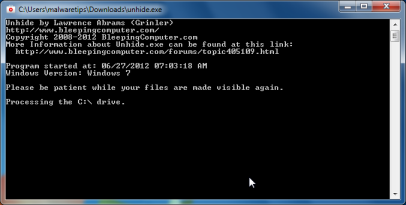
S.M.A.R.T Virus modifies your file system in such a way that all files and folders become hidden, to restore the default settings , you’ll need to run the below program.
- Download Unhide.exe, to unhide your files and folders.
- Double-click on the Unhide.exe icon on your desktop and allow the program to run.The whole process should not take more than 5 minutes to complete,and at the end this utility will generate a report.
STEP 7 : Restore your shortcuts and remove any left over malicious registry keys
S.M.A.R.T Virus has moved your shortcuts files in the Temporary Internet folder and added some malicious registry keys to your Windows installation , to restore your files we will need to perform a scan with RogueKiller.
- Please download the latest official version of RogueKiller.
- Double click on RogueKiller.exe to start this utility and then wait for the Prescan to complete.This should take only a few seconds and then you can click the Start button to perform a system scan.
![[Image: roguekiller-1.png]](//malwaretips.com/blogs/wp-content/uploads/2012/04/roguek-1.png "Click on the Start button to perform a system scan")
- After the scan has completed, press the Delete button to remove any malicious registry keys.
![[Image: roguekiller-2.png]](//malwaretips.com/blogs/wp-content/uploads/2012/04/roguek-2.png "Press Delete to remove the malicious registry keys")
- Next we will need to restore your shortcuts, so click on the ShortcutsFix button and allow the program to run.
![[Image: roguekiller-1.png]](//malwaretips.com/blogs/wp-content/uploads/2012/04/roguek-3.png "Click on the Start button to perform a system scan")
![[Image: roguekiller-1.png]](http://malwaretips.com/blogs/wp-content/uploads/2012/04/roguek-1.png "Click on the Start button to perform a system scan")
![[Image: roguekiller-2.png]](http://malwaretips.com/blogs/wp-content/uploads/2012/04/roguek-2.png "Press Delete to remove the malicious registry keys")
![[Image: roguekiller-1.png]](http://malwaretips.com/blogs/wp-content/uploads/2012/04/roguek-3.png "Click on the Start button to perform a system scan")
STEP 8: Get your desktop look back!
S.M.A.R.T Virus changes your desktop background to a solid black color,to change it back to default one follow the below instruction.
- Windows XP : Click on the Start button and then select Control Panel. When the Control Panel opens, please click on the Display icon. From this screen you can now change your Theme and desktop background.
- Windows 7 and Vista : Click on the Start button and then select Control Panel. When the Control Panel opens, please click on the Appearance and Personalization category. Then select Change the Theme or Change Desktop Background to revert back to your original Theme and colors.
What’s next? Join our amazing community and build up your malware defenses !









Hola cool that you’re a Barce fan :) I was infected by the file restore virus I then got a programme on line that said it would kill it pctools spyware they told me to rename it then delete it and it has relaunched itself as hidden it stops me from using my various email accounts makes browsing very tricky and previously I tried to save my data on a usb stick and windows wouldn’t upload it’s a cyber nightmare real messy and it seems no way out of this cyber maze . I went to the registry but was uncertain of what to delete there any help at all would you be so much appreciated . I have downloaded malaware but not sure if that works either !
Hello lullu,
Please follow the instructions from this article,it should remove the infection and restore your files!
Thank you so much for the help in getting my computer files back again. I followed instructions however I cannot turn on the Firewall or access any Windows updates. I have McAfee Security on the system. I have read the comments about the fix for Windows 7 please could you let me know if there is a fix for Vista?
Hello Jan,
You most likely have a ZeroAccess rootkit,please follow the steps from this guide: http://malwaretips.com/blogs/remove-zeroaccess-rootkit/
Thank you for providing this information. I almost fell into the identity theft trap until I read your blog. And the repair instructions were perfect and easy to follow. Thanks!!!!!!
I have malware which has completely wiped my desktop leaving a window instructing me that my computer is locked and to pay to have it unlocked. I have tried to implement your instructions but within a couple of seconds starting in safe mode reverts to normal mode leaving me back in square one, so I cannot access the internet or anything else. How can I overcome this, can you help?
Hello John,
You have a ransomware virus on your computer.Please follow the instructions from this guide: http://malwaretips.com/blogs/remove-fbi-alert-moneypak-virus/
Good luck!
Thank you very much for your advice but I’m afraid it’s beaten me. I succeeded in burning kav_10 and used it to boot but when I try to prompt ‘windowsunlocker’ (via ‘Terminal’) I receive ‘Command not found’. The Scan/Update window is already there and the Update takes about 10 minutes but scan does not progress beyond 0%, takes only a few seconds, and finds nothing (it appears not to work – is the virus blocking it?). After 2 or 3 attempts the program will advance no further than the licence agreement as it will no longer allow me to accept it. My PC now will not even allow me to choose between SAFE or NORMAL mode as the very first screen stops halfway for about 3 minutes, then askes me to change the disk (it requires a CD ROM). Is this all the virus, or do I now have a hardware fault? I am a pensioner using the PC for my projects and am not at all computer literate, I was actually proud of myself for having got this far which is a testimony to your instructions.
Lets see if we can fix this John.
Please see: http://support.kaspersky.com/viruses/rescuedisk/all?page=1&qid=208286101
Using Kaspersky Registry Editor, navigate to HKEY_LOCAL_MACHINE\SOFTWARE\Microsoft\Windows NT\CurrentVersion\Winlogon
– userinit parameter is supposed to be C:\Windows\system32\userinit.exe,
-shell parameter is supposed to be Explorer.exe
Please make a note of the malware parameters and then post the malware parameters and then change the parameters to the correct.Reboot you machine.
If still no go, using Kaspersky Registry Editor, navigate to HKEY_LOCAL_MACHINE\Software\Microsoft\Windows\CurrentVersion\Run and
HKEY_USERS\<name of the problem user>\Software\Microsoft\Windows\CurrentVersion\Run
and post back with anythig that looks abnormal (entries with random letters or numbers…etc).
Thank Lord Jesus first of all a trillion times for your great brain, kind heart, mind and hardworking … Please give all glory to Him… you or me is nothing on earth… and finally thanks for your precious time for all of us here…with similar kind of issues. Before getting your site here, I had installed malwarebytes as soon as I saw all files n fldrs disappearing on my desktop. Hence had started scanning as well, before your detailed instructions. After that I removed all virus by checking all boxes in the result. next in a hurry I just tried to unhide files from folder settings, so in a sense I have recovered files on my desktop, but few issues still remain, like I cannot see system restore button in start menu, progs, accesories, sys tools. I thought of doing sys restore, since there are few changes after this virus attack. And few programme files still show that its empty, means all are not unhidden still that means. And I see a shortcut icon on desktop saying file restore, which I dont know how it came, had’nt seen it before I guess. And in your 8 steps, I have done only 1 that is installed malwarebytes and scanned my system. Is it imp for me to do other steps, if yes which I should. And as I use snaggit for official work, shortcut key to capture snagit is missing although snagit is there right now. so please hurry to answer my last question atleast since I’m in a hurry to do my official work as of now.
Hello SMITA,
1.Can you please follow the instructions from this guide: http://malwaretips.com/Thread-Files-still-hidden-after-smart-hdd-removal-and-unhide-exe?pid=55462#pid55462
2.Please perform the following scans:
STEP 1: Run a scan with Emsisoft Emergency Kit.
EMSISOFT EMERGENCY KIT DOWNLOAD LINK (This link will open a download page in a new window from where you can download Emsisoft Emergency Kit)
STEP 2: Run a scan with Eset Online Scanner.
ESET Online Scanner Download Link (This link will automatically download ESET Online Scanner on your computer.)
Thank you so much for this instructions!
Hi Stelian,
Thank you so much for this it worked wonderfully the only thing is I still have a file on my computer called data recovery which when clicked on is the S.M.A.R.T checker that came up originally with all the pop up boxes. I’ve run malware bytes and my anti virus mcafee and it says there is no risk, is this the case? I’ve also tried to uninstall it but it does not show up there. Please help, I’m scared to use my computer still.
Thank you
Hello Anna,
That should be just an left over file from this infection.Right click on it and select delete to get rid of it.
NEXT,for your peace of mind, please perform the following scans:
STEP 1: Run a scan with Emsisoft Emergency Kit.
EMSISOFT EMERGENCY KIT DOWNLOAD LINK (This link will open a download page in a new window from where you can download Emsisoft Emergency Kit)
STEP 2: Run a scan with Eset Online Scanner.
ESET Online Scanner Download Link (This link will automatically download ESET Online Scanner on your computer.)
Thank you so much Stelian! I had tried to delete this leftover file a number of times and it just kept coming back but following these last instructions it has gone completely. It’s a great to know there is somewhere to come if this happens as I was ready to just buy a new computer. I have told all my friends about this site and you. Thank you again.
Thank you so much. So helpful your article ! Worked for me like a charm.
God bless you !
I followed your instructions and removed the SMART virus from my computer about 2 months ago. However, I seem to have the virus again on my computer (actually on two of my computers… grrrrrrrrrrr.) The virus seems to have changed. It is not called the SMART virus but it most of the windows look the same.
I am unable to get connection to the internet. I did use a thumb drive to run malwarebytes. However, I cannot run hitman pro, because it asks for an internet connection. Malwarebytes is unable to remove the virus by itself. Any suggestions? Thanks! Jason
Hello Jason,
Can you please run a scan with Combofix and Complete Internet Repairso that I can get an idea on what’s going on :
STEP 1 : Run a scan with Combofix
Download ComboFix from one of the following locations:
COMBOFIX DOWNLOAD LINK #1 (This link will automatically download Combofix on your computer)
COMBOFIX DOWNLOAD LINK #2 (This link will automatically download Combofix on your computer)
VERY IMPORTANT !!! Save as Combo-Fix.exe during the download.ComboFix must be renamed before you download to your Desktop
Notes:
STEP 2: Run a scan with Complete Internet Repair utility
Waiting for your reply to tell me if your machine is ok and the logs from this utilities.
Hello Stelian, You saved My Bacon. I have executed all steps. I have a dual boot system. Both drives were compromised. (A.) Drive Start Menu shows folders with prog. names. When clicked on programs do not run. When right clicked folders show as empty. (B.) Drive Start Menu show programs as icons with name of prog. left sigle click opens prog. right click will not expose sub folders. What is to be done next ? Once again you Rock. I wil be donating as well as liking you and singing your praises .
Hello Scott,
No need for money,just stay safe from now on!!
Have an awesome life!:D
Wow : I`ve been working at a distance w/my Tech. He suggested a search which turned up _U_ YOU ROCK ! Detailed accurate easy to follow advice. I am on IT at this moment. It is looking less bleak thanks to you.
I had all these same things pop up as you have stated thru the article but when I start my computer I get nothing but a black screen with a blinking cursor!!! I can press F2 for system setup but that is all if i try & do anything else it says keyboard failure!! Please HELP!!!!
Hello,
Did you go into Safe Mode with Networking as seen in Step 1 of this guide?