

If you are seeing a Serious Disk Error Writing Drive C:\ alert on your computer screen,then as you probably already suspect you’re computer has been infected with a rogue software.
The malicious software is known as Smart HDD,Data Recovery,S.M.A.R.T Virus or S.M.A.R.T Check and has changed your desktop background,hidden your files and shortcuts and it’s causing browsing redirects.
In addition the S.M.A.R.T Virus will display fake alerts, claiming that several hard drive errors were detected on your computer.In reality, none of the reported issues are real, and are only used to scare you into buying S.M.A.R.T Virus and stealing your personal financial information.
We strongly advise you to follow our S.M.A.R.T Virus removal guide and ignore any alerts that this malicious software might generate.Under no circumstance should you buy this rogue security software as this could lead to identity theft.
If you’ve got a S.M.A.R.T Virus infection , you’ll be seeing this screens :
![[Image: Smart-HDD.png]](http://malwaretips.com/blogs/wp-content/uploads/2012/05/Data-Recovery-Rogue.png "S.M.A.R.T Virus")
![[Image: Smart-HDD.png]](http://malwaretips.com/blogs/wp-content/uploads/2012/05/Data-Recovery-fake-alert.png "S.M.A.R.T Virus")
![[Image: Smart-HDD.png]](http://malwaretips.com/blogs/wp-content/uploads/2012/05/Data-Recovery-Rogue-alert.png "S.M.A.R.T Virus")
Registration codes for S.M.A.R.T Virus
As an optional step,you can use the following license key to register S.M.A.R.T Virus and stop the fake alerts.
Data Recovery Rogue: 08869246386344953972969146034087
SMART HDD Rogue: 15801587234612645205224631045976
Please keep in mind that entering the above registration code will NOT remove S.M.A.R.T Virus from your computer , instead it will just stop the fake alerts so that you’ll be able to complete our removal guide more easily.
Removal guide for S.M.A.R.T Virus
STEP 1 : Start your computer in Safe Mode with Networking
- Remove all floppy disks, CDs, and DVDs from your computer, and then restart your computer.
- Press and hold the F8 key as your computer restarts.Please keep in mind that you need to press the F8 key before the Windows start-up logo appears.
- On the Advanced Boot Options screen, use the arrow keys to highlight Safe Mode with Networking , and then press ENTER.
![[Image: Safemode.jpg]](//malwaretips.com/images/removalguide/safemode.jpg "Safe Mode with Networking screen")
- Log on to your computer with a user account that has administrator rights
![[Image: Safemode.jpg]](http://malwaretips.com/images/removalguide/safemode.jpg "Safe Mode with Networking screen")
STEP 2: Remove S.M.A.R.T Virus malicious proxy server
S.M.A.R.T Virus may add a proxy server which prevents the user from accessing the internet,follow the below instructions to remove the proxy.
- Start Internet Explorer
![[Image: S.M.A.R.T Virus- IE]](//malwaretips.com/images/removalguide/Ieicon.png "IE 9") and if you are using Internet Explorer 9 ,click on the gear icon
and if you are using Internet Explorer 9 ,click on the gear icon ![[Image: IE gear icon]](//malwaretips.com/images/removalguide/icongear.jpg "Gear Icon") (Tools for Internet Explorer 8 users) ,then select Internet Options.
(Tools for Internet Explorer 8 users) ,then select Internet Options.
![[Image: Internet-options-IE.png]](//malwaretips.com/images/removalguide/ie1.png "Internet Options in IE")
- Go to the tab Connections.At the bottom, click on LAN settings.
![[Image: Remove-proxy-server2.png]](//malwaretips.com/images/removalguide/ie2.png "Connections tab in Internet Explorer")
- Uncheck the option Use a proxy server for your LAN. This should remove the malicious proxy server and allow you to use the internet again.
![[Image: Remove-proxy-server3.png]](//malwaretips.com/images/removalguide/ie3.png "Uncheck the option Use a proxy server for your LAN")
![[Image: S.M.A.R.T Virus- IE]](http://malwaretips.com/images/removalguide/Ieicon.png "IE 9") and if you are using Internet Explorer 9 ,click on the gear icon
and if you are using Internet Explorer 9 ,click on the gear icon ![[Image: IE gear icon]](http://malwaretips.com/images/removalguide/icongear.jpg "Gear Icon") (Tools for Internet Explorer 8 users) ,then select Internet Options.
(Tools for Internet Explorer 8 users) ,then select Internet Options.![[Image: Internet-options-IE.png]](http://malwaretips.com/images/removalguide/ie1.png "Internet Options in IE")
![[Image: Remove-proxy-server2.png]](http://malwaretips.com/images/removalguide/ie2.png "Connections tab in Internet Explorer")
![[Image: Remove-proxy-server3.png]](http://malwaretips.com/images/removalguide/ie3.png "Uncheck the option Use a proxy server for your LAN")
If you are a Firefox users, go to Firefox(upper left corner) → Options → Advanced tab → Network → Settings → Select No Proxy
STEP 3: Run RKill to terminate known malware processes associated with S.M.A.R.T Virus.
RKill is a program that attempts to terminate any malicious processes associated with S.M.A.R.T Virus ,so that your normal security software can then run and clean your computer of infections.
As RKill only terminates a program’s running process, and does not delete any files, after running it you should not reboot your computer as any malware processes that are configured to start automatically will just be started again.
- While your computer is in Safe Mode with Networking ,please download the latest official version of RKill.

- Double-click on the RKill iconin order to automatically attempt to stop any processes associated with S.M.A.R.T Virus.
![[Image: run-rkill-1.png]](//malwaretips.com/images/removalguide/rkill1.png "RKILL ICON")
- RKill will now start working in the background, please be patient while the program looks for various malware programs and tries to terminate them.
![[Image: run-rkill-2.png]](//malwaretips.com/images/removalguide/rkill2.png "RKILL Command prompt")
IF you receive a message that RKill is an infection, that is a fake warning given by the rogue. As a possible solution we advise you to leave the warning on the screen and then try to run RKill again.Run RKill until the fake program is not visible but not more than ten times.
IF you continue having problems running RKill, you can download the other renamed versions of RKill from here. - When Rkill has completed its task, it will generate a log. You can then proceed with the rest of the guide.
![[Image: S.M.A.R.T Virus rkill3.jpg]](//malwaretips.com/images/removalguide/rkill3.png "RKILL LOG")
![[Image: run-rkill-1.png]](http://malwaretips.com/images/removalguide/rkill1.png "RKILL ICON")
![[Image: run-rkill-2.png]](http://malwaretips.com/images/removalguide/rkill2.png "RKILL Command prompt")
![[Image: S.M.A.R.T Virus rkill3.jpg]](http://malwaretips.com/images/removalguide/rkill3.png "RKILL LOG")
WARNING: Do not reboot your computer after running RKill as the malware process will start again , preventing you from properly performing the next step.
STEP 4: Remove S.M.A.R.T Virus malicious files with Malwarebytes Anti-Malware FREE
- Please download the latest official version of Malwarebytes Anti-Malware FREE.
- Install Malwarebytes’ Anti-Malware by double clicking on mbam-setup.
![[Image: malwarebytes-installer.png]](//malwaretips.com/images/removalguide/mbam1.png "Malwarebytes Anti-Malware Installer")
- When the installation begins, keep following the prompts in order to continue with the installation process. Do not make any changes to default settings and when the program has finished installing, make sure you leave both the Update Malwarebytes’ Anti-Malware and Launch Malwarebytes’ Anti-Malware checked. Then click on the Finishbutton. If Malwarebytes’ prompts you to reboot, please do not do so.
![[Image: install-malwarebytes.png]](//malwaretips.com/images/removalguide/mbam2.png "Install Malwarebytes Anti-Malware")
- Malwarebytes Anti-Malware will now start and you’ll be prompted to start a trial period , please select ‘Decline‘ as we just want to use the on-demand scanner.
![[Image: decline-trial-malwarebytes.png]](//malwaretips.com/images/removalguide/mbam3.PNG "Decline trial period in Malwarebytes Anti-Malware")
- On the Scanner tab,please select Perform full scan and then click on the Scan button to start scanning your computer for any possible infections.
![[Image: malwarebytes-full-system-scan.png]](//malwaretips.com/images/removalguide/mbam4.png "Perform a Full System Scan")
- Malwarebytes’ Anti-Malware will now start scanning your computer for S.M.A.R.T Virus malicious files as shown below.
![[Image: malwarebytes-scanning.png]](//malwaretips.com/images/removalguide/mbam5.png "Malwarebytes Anti-Malware scanning for S.M.A.R.T Virus")
- When the scan is finished a message box will appear, click OK to continue.
![[Image: malwarebytes-scan-finish.png]](//malwaretips.com/images/removalguide/mbam9.png "Malwarebytes when the scan is finished")
- You will now be presented with a screen showing you the malware infections that Malwarebytes’ Anti-Malware has detected.Please note that the infections found may be different than what is shown in the image.Make sure that everything is Checked (ticked) and click on the Remove Selected button.
![[Image: malwarebytes-scan-results.png]](//malwaretips.com/images/removalguide/mbam6.png "S.M.A.R.T Virus infection scan results")
- Malwarebytes’ Anti-Malware will now start removing the malicious files.If during the removal process Malwarebytes will display a message stating that it needs to reboot, please allow this request.
![[Image: malwarebytes-reboot-prompt.png]](//malwaretips.com/images/removalguide/mbam10.png "Reboot prompt from Malwarebytes")
![[Image: malwarebytes-installer.png]](http://malwaretips.com/images/removalguide/mbam1.png "Malwarebytes Anti-Malware Installer")
![[Image: install-malwarebytes.png]](http://malwaretips.com/images/removalguide/mbam2.png "Install Malwarebytes Anti-Malware")
![[Image: decline-trial-malwarebytes.png]](http://malwaretips.com/images/removalguide/mbam3.PNG "Decline trial period in Malwarebytes Anti-Malware")
![[Image: malwarebytes-full-system-scan.png]](http://malwaretips.com/images/removalguide/mbam4.png "Perform a Full System Scan")
![[Image: malwarebytes-scanning.png]](http://malwaretips.com/images/removalguide/mbam5.png "Malwarebytes Anti-Malware scanning for S.M.A.R.T Virus")
![[Image: malwarebytes-scan-finish.png]](http://malwaretips.com/images/removalguide/mbam9.png "Malwarebytes when the scan is finished")
![[Image: malwarebytes-scan-results.png]](http://malwaretips.com/images/removalguide/mbam6.png "S.M.A.R.T Virus infection scan results")
![[Image: malwarebytes-reboot-prompt.png]](http://malwaretips.com/images/removalguide/mbam10.png "Reboot prompt from Malwarebytes")
STEP 5: Double check your system for any left over infections with HitmanPro
- This step can be performed in Normal Mode ,so please download the latest official version of HitmanPro.
- Double click on the previously downloaded file to start the HitmanPro installation.
![[Image: hitmanpro-icon.png]](//malwaretips.com/images/removalguide/hpro1.png "HitmanPro Installer")
NOTE : If you have problems starting HitmanPro, use the “Force Breach” mode. Hold down the left CTRL-key when you start HitmanPro and all non-essential processes are terminated, including the malware process. (How to start HitmanPro in Force Breach mode – Video) - Click on Next to install HitmanPro on your system.
![[Image: installing-hitmanpro.png]](//malwaretips.com/images/removalguide/hpro2.png "HitmanPro installation process")
- The setup screen is displayed, from which you can decide whether you wish to install HitmanPro on your machine or just perform a one-time scan, select a option then click on Next to start a system scan.
![[Image: hitmanpro-setup-options.png]](//malwaretips.com/images/removalguide/hpro3.png "HitmanPro setup options")
- HitmanPro will start scanning your system for malicious files. Depending on the size of your hard drive, and the performance of your computer, this step will take several minutes.
![[Image: hitmanpro-scanning.png]](//malwaretips.com/images/removalguide/hpro4.png "HitmanPro scanning for S.M.A.R.T Virus")
- Once the scan is complete,a screen displaying all the malicious files that the program found will be shown as seen in the image below.After reviewing each malicious object click Next.
![[Image: hitmanpro-scan-results.png]](//malwaretips.com/blogs/wp-content/uploads/2012/02/rsz_hpro5.png "HitmanPro S.M.A.R.T Virus scan results")
- Click Activate free license to start the free 30 days trial and remove the malicious files.
![[Image: hitmanpro-activation.png]](//malwaretips.com/images/removalguide/hpro6.png "Activate HitmanPro free license to remove detected infections")
- HitmanPro will now start removing the infected objects, and in some instances, may suggest a reboot in order to completely remove the malware from your system. In this scenario, always confirm the reboot action to be on the safe side.
![[Image: hitmanpro-icon.png]](http://malwaretips.com/images/removalguide/hpro1.png "HitmanPro Installer")
![[Image: installing-hitmanpro.png]](http://malwaretips.com/images/removalguide/hpro2.png "HitmanPro installation process")
![[Image: hitmanpro-setup-options.png]](http://malwaretips.com/images/removalguide/hpro3.png "HitmanPro setup options")
![[Image: hitmanpro-scanning.png]](http://malwaretips.com/images/removalguide/hpro4.png "HitmanPro scanning for S.M.A.R.T Virus")
![[Image: hitmanpro-scan-results.png]](http://malwaretips.com/blogs/wp-content/uploads/2012/02/rsz_hpro5.png "HitmanPro S.M.A.R.T Virus scan results")
![[Image: hitmanpro-activation.png]](http://malwaretips.com/images/removalguide/hpro6.png "Activate HitmanPro free license to remove detected infections")
STEP 6: Unhide your files and folders
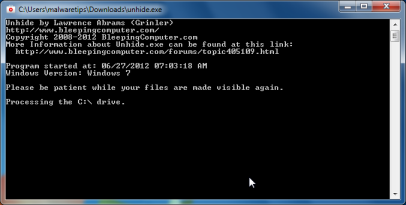
S.M.A.R.T Virus modifies your file system in such a way that all files and folders become hidden, to restore the default settings , you’ll need to run the below program.
- Download Unhide.exe, to unhide your files and folders.
- Double-click on the Unhide.exe icon on your desktop and allow the program to run.The whole process should not take more than 5 minutes to complete,and at the end this utility will generate a report.
STEP 7 : Restore your shortcuts and remove any left over malicious registry keys
S.M.A.R.T Virus has moved your shortcuts files in the Temporary Internet folder and added some malicious registry keys to your Windows installation , to restore your files we will need to perform a scan with RogueKiller.
- Please download the latest official version of RogueKiller.
- Double click on RogueKiller.exe to start this utility and then wait for the Prescan to complete.This should take only a few seconds and then you can click the Start button to perform a system scan.
![[Image: roguekiller-1.png]](//malwaretips.com/blogs/wp-content/uploads/2012/04/roguek-1.png "Click on the Start button to perform a system scan")
- After the scan has completed, press the Delete button to remove any malicious registry keys.
![[Image: roguekiller-2.png]](//malwaretips.com/blogs/wp-content/uploads/2012/04/roguek-2.png "Press Delete to remove the malicious registry keys")
- Next we will need to restore your shortcuts, so click on the ShortcutsFix button and allow the program to run.
![[Image: roguekiller-1.png]](//malwaretips.com/blogs/wp-content/uploads/2012/04/roguek-3.png "Click on the Start button to perform a system scan")
![[Image: roguekiller-1.png]](http://malwaretips.com/blogs/wp-content/uploads/2012/04/roguek-1.png "Click on the Start button to perform a system scan")
![[Image: roguekiller-2.png]](http://malwaretips.com/blogs/wp-content/uploads/2012/04/roguek-2.png "Press Delete to remove the malicious registry keys")
![[Image: roguekiller-1.png]](http://malwaretips.com/blogs/wp-content/uploads/2012/04/roguek-3.png "Click on the Start button to perform a system scan")
STEP 8: Get your desktop look back!
S.M.A.R.T Virus changes your desktop background to a solid black color,to change it back to default one follow the below instruction.
- Windows XP : Click on the Start button and then select Control Panel. When the Control Panel opens, please click on the Display icon. From this screen you can now change your Theme and desktop background.
- Windows 7 and Vista : Click on the Start button and then select Control Panel. When the Control Panel opens, please click on the Appearance and Personalization category. Then select Change the Theme or Change Desktop Background to revert back to your original Theme and colors.
What’s next? Join our amazing community and build up your malware defenses !









Tears of joy. My computer is back the way it was. Thank you so much for easy to follow instructions. What a life saver.
Stelian:
Using to the info you have posted I was able to get back my pc!!!
Thank you very much !
Davide
Hi there! I have managed to et the virus off completely except one small thing.. My background won’t change from black, I have run unhide 3 times and all my programs and icons are back but I can’t change my background! Please help! I have also done the tweaking
Hello,
Try this :
Download Windows Repair by Tweaking.com to your desktop. Use the direct download link for the Portable version of Windows Repair by Tweaking.com
Note: When asked if you would like to create a restore point. It is recommended just in-case something does not go as planned.
Note: Leave everything else unchecked
Have tried above, background still missing and notes left by repair windows says it failed :(
Lets try this:
Open the Start Menu and enter gpedit.msc into the Search box and hit Enter.
When Local Group Policy Editor opens, navigate to User Configuration \ Administrative Templates \ Control Panel \ Personalization. Then in the right column double-click onPrevent changing desktop background.
Now check the radio button next to Disable, then click OK.
I am using windows 7 and local group policy editor displays: MMC could not create the snap-in
Thank you so very much for you post. The smart check virus is gone. I finally have my computer back. But I still have missing icons and when I click on the windows button to open all programs my microsoft office, itunes and quick books are all empty. I ran the Roggue Killer shortcut fix. Did I do something wrong. Thank you for your help.
Hello Vicki,
Store and display recently opened programs in the start menu
Store and display recently opened items in the start menu and taskbar
C:\ProgramData\Microsoft\WindowsI have followed your instructions to the letter, yet the virus will not go away. I’ve followed guides from a million different websites and no matter what I do, the virus is still here. Is there anything else I can do?
OK,lets make some further check-ups:
1.Run a scan with Kaspersky Virus Removal Tool
Click here to download the Kaspersky Virus Removal Tool.
2.Run a scan with Eset Online Scanner.
ESET Online Scanner Download Link (This link will automatically download ESET Online Scanner on your computer.)
Waiting for your reply to tell me how everything is working.. :) Good luck!
okay, I actually think it’s completely gone now, thank you.
oops, I made my comment as a reply. Let me try again. I have followed the steps through using Hitman Pro, rebooted as instructed but still have the virus. What do I do now?
OK,lets make some further check-ups:
1.Run a scan with Kaspersky Virus Removal Tool
Click here to download the Kaspersky Virus Removal Tool.
2.Run a scan with Eset Online Scanner.
ESET Online Scanner Download Link (This link will automatically download ESET Online Scanner on your computer.)
Waiting for your reply to tell me how everything is working.. :)Good luck!
Wow! That seems to fix everything. You’re as lifesaver! One problem remains that I hope you can help me with. It won’t let me turn on the Windows firewall. Any ideas? Thanks.
Good to head that Phil,
Can you please run this utility:
Download Windows Repair by Tweaking.com to your desktop. Use the direct download link for the Portable version of Windows Repair by Tweaking.com
Note: When asked if you would like to create a restore point. It is recommended just in-case something does not go as planned.
Note: Leave everything else unchecked
Sure am glad I found you. That did the trick.
Thanks a million! Your thorough step-by-step illustrations have saved a student’s endless hours’ assignments. You ROCK!
Thanks for putting this info out there, I picked this virus up and these steps cleaned it all up perfectly, only thing different I did was run the tweaking.com file for the unhide files portion, the one above didn’t seem to be doing anything for me, but all is a go again, thanks!
I followed all the steps but once I booted in normal mode I could see the icons and files but things were still not working and it was super slow. So I followed your steps and ran hitmanpro in force breech and ran ikill which ran but gave me some messages saying installed failed. I tried to run it several times. Now I’m running malware scan but it taking forever, its been going for over 3 hours so I’m not sure if it’s working or if I need to do something else, please help.
I think the problem is with the rkill, I don’t think it’s working for me, I keep getting messages saying installation failed. I tried downloading the other versions of rkill and it does the same thing. In normal mode everything is super slow, what can I run in safe mode to stop the processes.
OK,lets make some further check-ups:
1.Run a scan with Kaspersky Virus Removal Tool
Click here to download the Kaspersky Virus Removal Tool.
2.Run a scan with Eset Online Scanner.
ESET Online Scanner Download Link (This link will automatically download ESET Online Scanner on your computer.)
I ran the Kaspersky tool and this is the log from it.
Status: Deleted (events: 32)
7/10/2012 10:05:49 PM Deleted Trojan program Trojan-FakeAV.Win32.FakeSysDef.adv C:\Documents and Settings\All Users\Lavasoft\AntiMalware\Quarantine\{5612F253-17AE-41DE-A00A-3A2C44C7EF17}_ENC2 High High
I also ran the ESET utility but it didn’t find anything.
After that I rebotted in normal mode and the same problem everything is super slow, I can’t do anything. What do I know now?
Ok..lets do a check:
Lets proceed as follows shall we…
StartUpLite:
Please download this small application from here.
It is very simple to use and quite effective and will advise about any unnecessary system startups that can be safely removed.
Hard-Drive Maintenance/Repair:
Note: for the CHKDSK portion you may refer to this tutorial of mine here and follow the instructions for Graphical Mode if you so wish.
Click on Start >> Run and type cleanmgr in the box and press OK.
Next:
Note: Upon Reboot(Restart) the CHKDSK(check-disk) will start and carry out the repairs required.
You should see a screen like this just after the Post(power on self test) screen:
Note: Do not touch either the keyboard or Mouse, otherwise the Check-Disk will be canceled and you computer will continue to boot-up as normal.
When I ran the defrag command nothing happened I got the c prompt back right away. The chkdsk came up when I restarted but also went away very quickly and I still have the same problems when I boot up in normal mode. Thanks for all your help so far. I’m wondering if I’m going to have to reformat my hard drive, nothing seems to be working, I was really hoping to avoid that.
Lets try to run a “scf /scannow” command – guide here: http://malwaretips.com/Thread-How-to-repair-corrupted-and-damaged-system-files-in-Windows-7-and-Vista . Make sure you insert you Windows Instalation CD before running the command.
What antivirus protection are you using?
I don’t have the windows installation CD since this is a work laptop. I have McAfee installed.
Can you please remove McAfee and see if this will fix the problem?I would also suggest to replace this antivirus with Avast 7 Free.
Try to run the “sfc /scannow” command even without the CD….
Is it ok if I run it in safe mode?
Yes,if Normal Mode is very slow then yes…
I finally got it working, I’m not sure exactly what did it but things are running fine. I can’t thank you enough for all your help, I was ready to send it in to get it reimaged but you saved me from the hassle. If you lived closer would definitely take you out to celebrate. Thanks a million!
I think I MAY have finally removed the virus, but there is still a problem! I followed this guide step by step, and at first I didn’t think anything was working at all until FINALLY HitmanPro popped up saying there was a malicious file that it found, that for some reason didn’t delete when it scanned initially. Anyway, HitmanPro deleted this malicious file and rebooted the computer, and after it rebooted, for this first time none of the Data Recovery windows popped up, nor any of its fake alert messages. After that I downloaded Unhide.exe, which worked perfectly. Then I downloaded RogueKiller which also worked and even brought my desktop background back. But now I’m worried because even though everything else seems fine- the Data Recovery shortcut is still on my desktop for some reason. Nothing from Data Recovery pops up anymore, but the fact that the icon is still on my desktop worries me. Any help or explanation for this would be greatly appreciated.
OK,lets make some further check-ups:
–
1.Run a scan with Kaspersky Virus Removal Tool
Click here to download the Kaspersky Virus Removal Tool.
2.Run a scan with Eset Online Scanner.
ESET Online Scanner Download Link (This link will automatically download ESET Online Scanner on your computer.)
Great writeup. All of the other sites that I tried on this virus lead me down the wrong path. Thanks for the screen shots and the links to the software that we needed. You are a true professional (and very patient).
I have a problem! I followed this guide step by step but when I ran Malearebytes’ Anti Malware it caused my laptop to crash after like 20 min. What does that mean now?
Any help you can offer would be greatly appreciated.
Hello,
It means that you have a really infected computer!:)
STEP 1. While in NORMAL MODE,download HitmanPro and then start this program in ForceBreach Mode
1.Here are the direct download links for HitmanPro,
– http://dl.surfright.nl/HitmanPro36.exe (For 32bit)
– http://dl.surfright.nl/HitmanPro36_x64.exe (For 64bit)
2.Hold down the left CTRL-key when you start HitmanPro and all non-essential processes are terminated, including this rogue malicious process
Here is a video that explains with graphic details how to do this : http://www.youtube.com/watch?v=m6eRWTv2STk
3. Let HitmanPro scan and remove all the detected threats.
Step 2: While in NORMAL MODE,download/Run Rkill and then run a scan with Malwarebytes
1.Download any re-named version of Rkill (direct download links bellow):
http://download.bleepingcomputer.com/grinler/WiNlOgOn.exe
http://download.bleepingcomputer.com/grinler/uSeRiNiT.exe
http://download.bleepingcomputer.com/grinler/rkill.scr
2.Next,please follow the guide starting with the Malwarebytes scan.
Let me know , how everything goes.
I did it! I spent the whole night long and finally did it :D Thank you! I really appreciate it.
But I’ve still got one question, the file Data Recovery is still on my desktop just next to the Start button. I once deleted it because I thought it might be nothing good but it appeared again in a few minutes. Is that normal?
Lets double check to see if everything is OK.
1.Run a scan with Kaspersky Virus Removal Tool
Click here to download the Kaspersky Virus Removal Tool.
2.Run a scan with Eset Online Scanner.
ESET Online Scanner Download Link (This link will automatically download ESET Online Scanner on your computer.)
Hopefully, I got that right Lol The only thing is that the content of kaslog.txt is in German but I hope you don’t mind.
Status: Desinfiziert (Ereignisse: 5)
10.07.2012 13:34:36 Desinfiziert Trojanisches Programm Exploit.Java.CVE-2012-0507.kf C:\Documents and Settings\samsung\AppData\LocalLow\Sun\Java\Deployment\cache\6.0\57\63f34b9-665d3ea6 Hoch
10.07.2012 13:34:36 Desinfiziert Trojanisches Programm Exploit.Java.CVE-2012-0507.kf C:\Documents and Settings\samsung\AppData\LocalLow\Sun\Java\Deployment\cache\6.0\57\63f34b9-665d3ea6/l_t_a/l_t_c.class Hoch
10.07.2012 19:02:23 Desinfiziert Trojanisches Programm Exploit.Java.CVE-2012-0507.kf D:\SAMSUNG-PC\Backup Set 2012-01-08 190000\Backup Files 2012-07-08 190001\Backup files 2.zip Hoch
10.07.2012 19:02:23 Desinfiziert Trojanisches Programm Exploit.Java.CVE-2012-0507.kf D:\SAMSUNG-PC\Backup Set 2012-01-08 190000\Backup Files 2012-07-08 190001\Backup files 2.zip/C\Users\samsung\AppData\LocalLow\Sun\Java\Deployment\cache\6.0\57\63f34b9-665d3ea6 Hoch
10.07.2012 19:01:14 Desinfiziert Trojanisches Programm Exploit.Java.CVE-2012-0507.kf D:\SAMSUNG-PC\Backup Set 2012-01-08 190000\Backup Files 2012-07-08 190001\Backup files 2.zip/C\Users\samsung\AppData\LocalLow\Sun\Java\Deployment\cache\6.0\57\63f34b9-665d3ea6/l_t_a/l_t_c.class Hoch
I’m now into running a scan with ESET online Scanner but shall both (Remove found threats and Scan archives) settings be checked or just Scan archives?
Both Remove found threats and Scan archives should be checked :)
Instructions worked great!
Hello, I followed this guide but my display is stuck on 640 x 480, in 4 bit color…help!
Forgot to mention changing the display settings via control panel doesn’t work.
Hello,
Please follow the below steps:
1.Run a scan with Eset Online Scanner.
ESET Online Scanner Download Link (This link will automatically download ESET Online Scanner on your computer.)
2.Download Windows Repair by Tweaking.com to your desktop. Use the direct download link for the Portable version of Windows Repair by Tweaking.com
Note: When asked if you would like to create a restore point. It is recommended just in-case something does not go as planned.
Note: Leave everything else unchecked
Thank you for the help. I can boot into safe mode and do this but I can’t do this in normal mode. My video gets all crazy after about 20 minutes and I have to reset. Also, my normal video is to corrupt and the graphics of the program you recommended cannot be accessed (the buttons are scrolling off the edge of the program..definitely not programmed for such a low resolution).
I’m wondering if I should just download and re-install my video drivers? I managed to scan the system fully with the viruscheckers you recommended, but it was in safe mode. The video is fine in safe mode for some reason.
Sorry, forgot to mention that I ran RKill before running the viruschecker and it said this:
Processes terminated by Rkill or while it was running:
C:\PROGRA~1\MICROS~4\rapimgr.exe
Isn’t that just the Microsoft ActiveSync Module?
RKILL is killing any process that aren’t need it in memory while we are performing the malware removal process….You don’t need to worry because this program didn’t uninstall/remove any files. :)
Lets try first to remove the malicious files and then we will see how we can fix the video problem…..
Did you run the HitmanPro (in ForceBreach mode) scan? Did you run the Rkill and Malwarebytes scan?
Hello Stelian,
First thanks very much for your gracious efforts here with your blog. I know you’ve saved many people quite a bit of misery. You’ve done so at great expense of your personal time. My appreciation.
I ran everything suggested in the guide, but I ran it in safe mode. For some reason when I try to run Malwarebytes in normal mode, it causes my screen to get crazy (the screen gets jittery and unreadable. I wish I could describe it better) and the only thing I can do is a hard restart to get it back to normal (while in normal mode)
While in safe mode, my screen is normal, and I have run all the virus checkers you mentioned. It picked up a great many things..all deleted now but for some reason while in normal mode the system will not let me adjust my screen settings back to 1024 x 768, or to a bit depth greater than 4.
Would the virus checkers I ran in safe mode not be able to detect something that is affecting my system in normal mode?
Thank You
It should be able to detect a infected file even if it’s Normal Mode…. If you don’t scan your PC , the screen looks ok in Normal Mode?
Thank you!! This helped me so much and I was struggling for hours! =)
multumesc foarte mult !
You are a lifesaver!!! Followed instructions and my laptop is back to normal. The only issue is the Data Recovery icon is still in my quick start menu. Thanks!
How Does Smat Repair Virus removal Get into the computer in the first place?
It depends … you can read this article to have an answer to your question: http://malwaretips.com/blogs/from-where-did-my-pc-got-infected/
Mr Pilici, please help! I have followed this blog to the letter , step by step, and the virus wont go away. I removed infected items in malwarebytes, then. In hitmanpro, and upon resetting when it asks me too during the scanning process, it resets with the virus still in place doing the same thing. I also read in your comments to try eset online scanner and that didnt work either! What am i doing wrong? Youve helped out many people alrdy and hopefully you can do the same for me… thank you in advance!
Hello,
Can you please re-scan with Malwarebytes?
Next,scan with Emsisoft Anti-Malware.
Make sure that everything is Checked (ticked) and click on the ‘Quarantine selected objects’ button.
If during the removal process Emsisoft will display a message stating that it needs to reboot, please allow this request.
If you are still experiencing problems , start a thread in our Malware Removal Support forum : http://malwaretips.com/Forum-Malware-Removal-Assistance
Shawn, have you resolved the problem? Because I’m in the same case..
Thank you!! Thank you!! THANK YOU!!! My laptop was infected slightly more than 36 hours ago, and I’ve been fighting the malware for the same number of hours. I’ve read other tutorials, watched countless youtube videos, and nothing worked, until I FOLLOWED YOUR INSTRUCTIONS. You are a lifesaver. And I would like to add that I’m running on Windows Vista, so for anyone who has the same malware attack to their Windows Vista, please follow these instructions closely, because they really work. Don’t waste time looking at youtube videos, especially when you’re very iffy about working on safe mode. I’m so, so thankful that I found your site. Thank you so much, once again!