


You check a voicemail between errands. A caller from Rencrest Capital says she is following up about a loan, but you cannot remember speaking to her.
It is the kind of message that makes you check your calendar before you check the caller.
Overview
Where the $41,453 offer came from
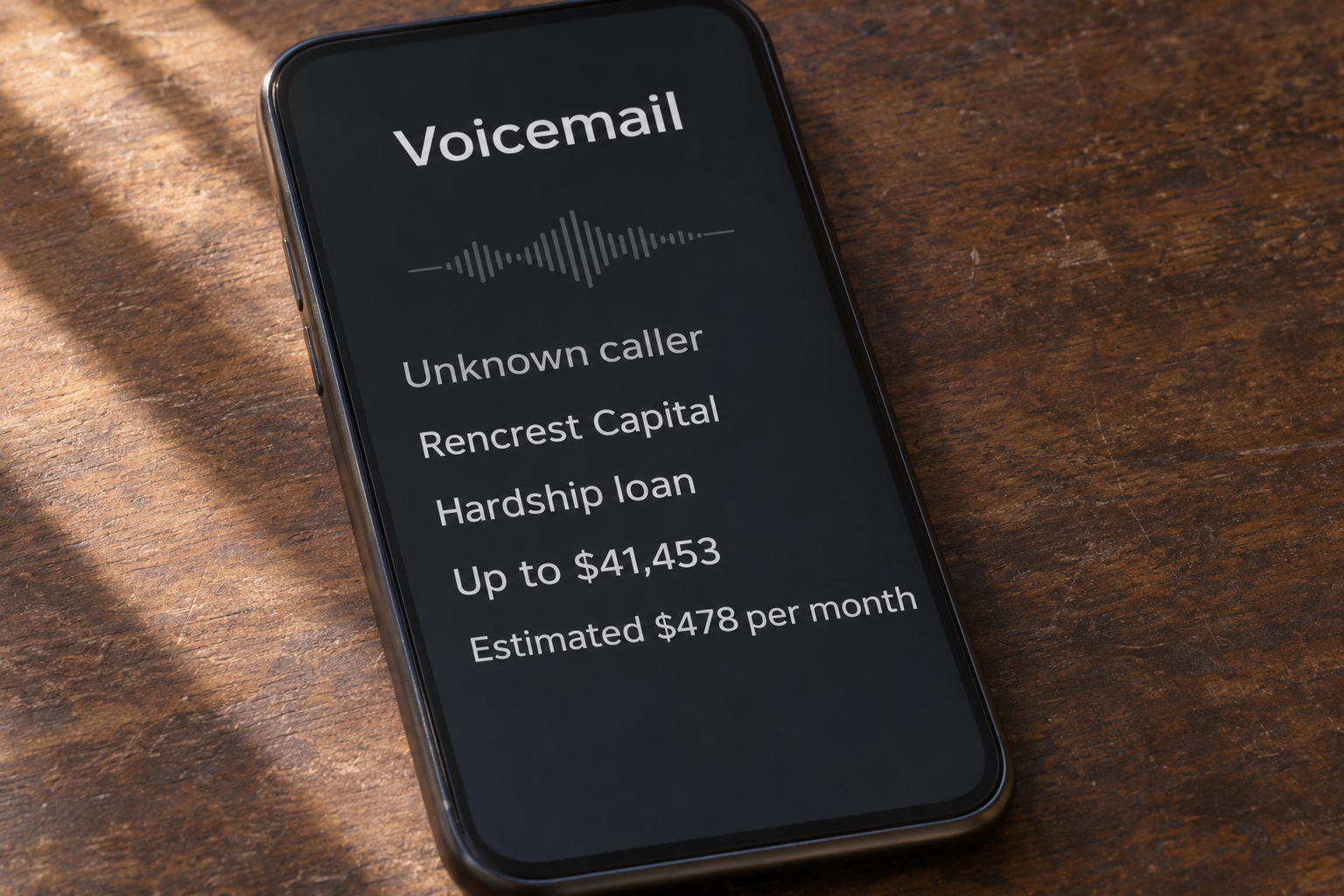
A South Dakota consumer report describes a November voicemail about a hardship loan of up to $41,453. The quoted payment was around $478 a month.
The message sounded like the end of an ongoing conversation. The recipient said they had neither applied for a loan nor dealt with the company before.
The caller asked for a return call before 3 on Saturday afternoon. The report records no payment or known disclosure of information by the recipient.
The image above illustrates the reported offer. It is not a screenshot supplied by the recipient or a recording of the call.
Why Rencrest Capital and Rencrest Capitol both turn up
The South Dakota report records the name as Rencrest Capitol and also mentions the Capital spelling. A separate Texas report includes another spelling, Runcrest Capital.
In the Texas account, the consumer remembered two similar calls that week. The names given by the callers and the callback numbers were different.
Those are reports of what recipients heard, not company registration records. Different spellings and numbers do not prove that every call came from a single operator.
Neither report identifies a verified lender website or email address for the call it describes. A similarly named business in a search result is not a match by itself.
What the voicemail does not prove
A promise of preselection is not a contract, a funded loan or proof that a credit inquiry took place. A detailed payment estimate does not change that.
The FTC warns about unexpected loan calls that use prequalification to start a conversation. Some are attempts to obtain personal information or get the recipient to pay.
- The reported messages give a reason to call back, but do not establish the caller’s authority to lend.
- The public accounts do not establish that callers obtained completed applications or collected advance fees.
- The reports also do not establish how the callers obtained any recipient’s phone number.
- The safe decision is to leave the callback number alone and arrange credit through a lender you choose independently.
How the Rencrest Capital Loan Call Works
Step 1: The call sounds like a follow-up you missed
Someone looking for a loan might expect to hear from a lender. The harder call to place is the one that refers to your file without explaining who opened it.
In the South Dakota voicemail, the caller presented the message as a final follow-up. That framing can make you wonder whether you forgot an earlier conversation.
Being referred to as a possible borrower does not show that an application exists. If the call catches you off guard, let the phone go to voicemail.
You might have compared credit cards or loans recently. That still does not give an unexpected caller permission to see your accounts, run your credit or take a payment.
Step 2: A low-looking monthly figure makes the offer feel specific
The $478 figure is easy to remember. Comparing it with what you already pay on several cards feels more concrete than evaluating an unfamiliar lender.
But that number gives you no way to see the full cost. You would also need the loan length, annual percentage rate, fees and total repayment.
A lender can lower the monthly payment by stretching out repayment. Without written terms, you cannot tell whether a quoted payment is even tied to the amount advertised.
In this case, the word estimated matters. It is not evidence that the advertised amount and the payment are available to the person who received the voicemail.
Step 3: The deadline pushes you toward the number in the message
The Saturday cutoff gives a decision that was not on your calendar a place on it. The caller asks for a conversation, which can sound like a harmless next step.
Compare that with what you would normally do. You would choose a lender, find its published contact details and decide whether it was worth putting in an application.
The Texas complaint is a reminder to save the number the caller supplied and the number your phone displayed separately. They are not necessarily the same.
The FTC notes that caller ID can be spoofed. Do not treat a familiar area code, a toll-free number or a business label as independent verification.
Step 4: A callback can turn an estimate into a request for details
The documented South Dakota account ends without the recipient paying or knowingly sharing information. It does not tell us what a representative would have asked for next.
In unsolicited loan scams generally, a caller can ask for information to confirm eligibility. A Social Security number, photo ID or bank details would be sensitive disclosures.
There is also a difference between an application fee and being told that paying guarantees release of the loan. The FTC’s advance-fee loan guidance explains that distinction.
If anyone asks for a fine, security deposit or insurance payment to unlock promised proceeds, end the call. Do not send money to see whether the offer is real.
These are risks to watch for, not demands established in the two Rencrest reports. There is already enough reason to avoid the callback without guessing what it would reveal.
Company and Phone Number Checks
Find out who would actually lend the money
When you compare legitimate offers, look for the legal creditor on the written disclosure. A broker or lead generator is not necessarily the company making the loan.
A lender, broker and marketer can each have a different name. You need to know which entity would ask for your records and which would sign the agreement.
Check the name and address with your state’s financial regulator where applicable. A matching registry record shows that the named entity exists, not that an unsolicited caller represents it.
If an institution looks like a match, use the number you found independently. Ask whether it recognizes the offer and how it verifies people acting on its behalf.
Look for a written offer that answers basic questions
Check whether the paperwork names the lender, describes the loan amount and shows the payment schedule. An estimate recited over the phone does not answer those questions.
Ask who is responsible for servicing the loan after funding. It should be possible to identify where your payments would go before you give anyone your bank details.
Do not let a similar name fill in missing details
It is tempting to pick the best-looking search result and treat it as the caller. That can lead you to an unrelated company with a similar name.
Save the spelling you actually heard, even if the transcription gives you something different. Manual notes help separate what the recording says from what the phone guessed.
Neither consumer report supplies a verified office address for the caller. That gap means the voicemail cannot authenticate the offer, not that every matching address is fake.
Keep the number on screen separate from the callback number
Document repeated calls as a pattern, not as a list of people to blame. The person who owns the number on your screen may not have made the call.
If the displayed number belongs to someone you know, ask them separately whether they called you. Do not send your loan details to a number just because it looks familiar.
What to Do If You Fell for the Rencrest Capital Loan Call
-
End the conversation and keep the message. Save the original audio or a screenshot of your call history. Note the amount, quoted payment, time and callback number.
Keep full numbers in your own records or a report to the relevant agency. You do not have to post them publicly for the report to be useful.
-
Write down everything you shared with the caller. A name and zip code call for a different response than your account password.
If you only listened and did not reply, there is no payment to reverse. Save what you need for your report, then block or label the calls.
-
Call your bank if payment or account details were involved. Use the number on your card or open the bank’s app directly.
If you sent money, give the bank or payment provider the transaction reference and ask about stopping or disputing it. Recovery depends on the payment method and timing.
If you shared checking information, ask about unauthorized debits and whether the bank recommends additional safeguards. If you shared card data, ask whether replacement is appropriate.
-
Act promptly if you gave out identity documents or your Social Security number. In the United States, IdentityTheft.gov can guide you through an appropriate recovery plan.
A credit freeze is free in the United States. Place it with each of the three major credit bureaus if you want to restrict new credit access.
A freeze does not stop charges on an existing account. Review current statements and contact the account provider separately about anything you did not authorize.
-
Protect any account you helped someone access. If you gave away a password or a one-time code, use the service’s own app or site to recover access.
Ask the provider to check for new devices, changed recovery information or unfamiliar activity. If you reused a compromised password, replace the other copies as well.
-
Report the calls and watch for a second approach. Send the details to FTC ReportFraud in the United States. Include the displayed number and the callback number separately.
If a new caller claims they can cancel the loan or recover a fee, verify the claim with your bank. Do not pay someone who contacts you unexpectedly.
If You Actually Need Help With Your Payments
Declining the callback does not mean giving up on a lower payment. It means keeping an unfamiliar voice out of a decision that can affect your finances for years.
Contact the bank or card provider on your existing account. Explain what you can afford now and ask whether it offers a hardship arrangement in writing.
If you compare consolidation offers, use the same starting balance and repayment period wherever possible. A smaller monthly number can hide a longer term or a larger overall cost.
Ask when the first payment would be due and what happens if you miss it. Check whether the loan pays creditors directly or leaves you to settle each balance.
Compare any proposed loan with keeping your existing accounts on a hardship plan. Whether consolidation helps can depend on the fees, how long you pay and whether rates change.
Keep the unsolicited voicemail separate from real negotiations. A written offer you requested and can verify through the lender should not depend on an unexplained Saturday deadline.
Frequently Asked Questions
Is the Rencrest Capital hardship loan voicemail legitimate?
Do not treat it as a verified offer. The public reports show unsolicited calls and callbacks, but do not name a confirmed lender behind the message.
Contact a lender you have independently chosen if you want financing. That removes the need to decide whether the person who left the message sounds convincing.
What if the message says $41,453 and $478 a month?
That combination matches one public complaint, not a verified price or guaranteed loan. Without the term, rate and fees, there is no basis for comparing the payment.
Other callers may quote different amounts. A different number should not make an unsolicited approval any more credible.
Does this mean someone applied for credit in my name?
The call alone does not show that anyone opened an account, applied for a loan or accessed your credit. A supposed file can be part of the pitch.
If your credit report or account shows something unfamiliar, contact the provider listed on the actual record using an independent number. Do not ask the caller to fix it.
Should I call back to make them remove my number?
Do not call the number in the message to opt out. If you recognize the company from an existing relationship, reach it through a verified contact instead.
Use the spam controls available from your phone or carrier. Blocking a single number may not stop calls showing a different number later.
Does listening to the voicemail compromise my phone?
Simply hearing it does not show your phone was compromised. The immediate concern is what you do next, including whether you disclose information or send a payment.
If a later message asks you to open a link or install something, leave it alone. Treat that request separately from the original call.
Is loan preselection always a scam?
Legitimate prescreened credit offers do exist in the United States. What you should not accept is an unexpected voicemail as proof that someone has verified or approved your application.
Use an official contact to check a known lender’s offer. If there is no independently identifiable lender, there is no offer you need to chase.
The Bottom Line
Do not call back, send money or share information in response to a Rencrest Capital hardship loan voicemail. The amount and deadline do not make the caller a lender.
If you already shared banking information, call your bank now. If you still need a loan, choose and verify the lender yourself before handing over any details.

Join the discussion
0 commentsShare your experience or ask a question about this article.
Community experiences
Did this happen to you?
Your experience could help someone recognize the same scam. Submit a private report for our team to review.
I experienced this tooReports are reviewed before publication. Sharing publicly is always your choice.
Discussion
Start the conversation
Have a question or something useful to share? Add the first comment.