

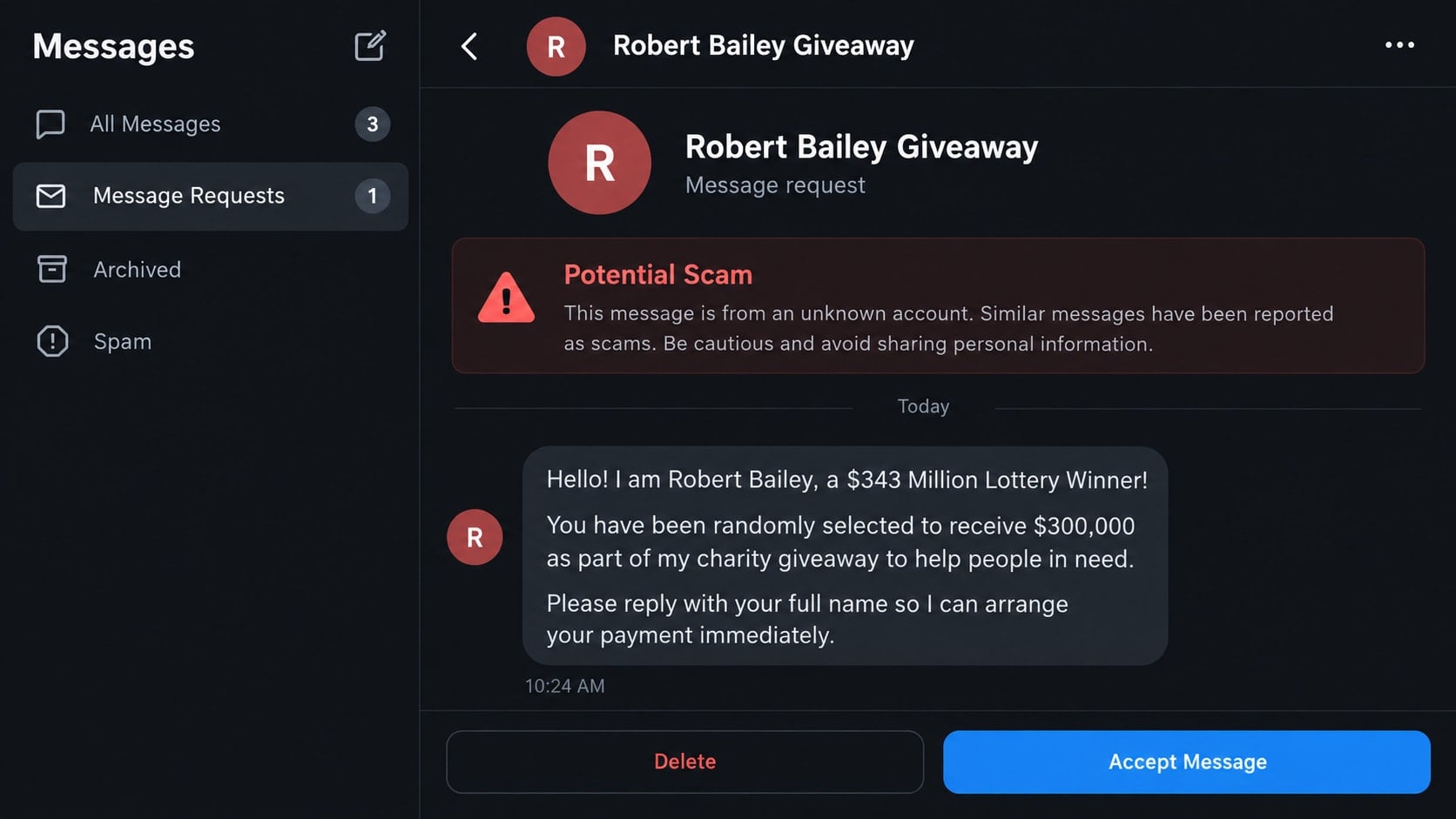
An Instagram message says Robert Bailey won a $343 million lottery and is giving some of it away. Your account has supposedly been selected to receive $300,000, even though you never entered anything or spoke to this person before.
It reads like a rare stroke of luck. The conversation that follows is designed to turn that excitement into personal information and payments.
Overview
A stranger claims to be a generous lottery winner
The account introduces Robert Bailey as a $343 million lottery winner who decided to help random people online. The recipient is told that their Instagram profile was chosen for a $300,000 donation or giveaway.
The story may use different totals, biographies, or photographs. Scammers often borrow a real person’s name or public lottery story because a searchable identity makes the invented generosity feel documented.
The winner’s account builds trust through conversation
Rather than immediately requesting money, the sender may ask how the recipient is doing, describe charitable goals, and offer reassurance. Screenshots of other supposed winners or delivery packages can appear as social proof.
The account may look established at a glance, but follower counts, posts, profile pictures, and comments can be copied, purchased, or assembled quickly. A profile is not proof of control by the person it names.
The free gift develops conditions and fees
To release the $300,000, the recipient may be asked for a name, address, telephone number, email, identification, and bank details. Then a delivery, tax, insurance, transfer, or processing fee appears.
A legitimate gift does not require a stranger to send gift cards, cryptocurrency, or payment-app transfers. When money must be paid to receive “free” money, the giveaway is functioning as advance-fee fraud.
- An unknown Instagram account says you were randomly selected.
- The sender claims a connection to a huge lottery jackpot.
- You never entered a contest or requested financial help.
- The account moves the chat to WhatsApp, Telegram, email, or text.
- Personal documents or bank information are required to claim the gift.
- Delivery, tax, or processing fees must be paid before the $300,000 arrives.
Why the Robert Bailey Story Can Feel More Credible Than a Typical Prize Scam
The message does not always call the money a contest prize. It may describe the payment as charity from someone who already won a legitimate lottery. That framing avoids the obvious question of when the recipient entered.
A real name adds searchability. If the recipient finds an article about a lottery winner with a similar name or sees other profiles repeating the story, the search can appear to confirm the account instead of exposing the impersonation.
Social platforms also feel personal. A direct message arrives beside conversations with friends, family, creators, and local businesses. That familiar setting can make an unsolicited financial offer feel less formal and less risky than an email.
The promised amount is transformative. Once a recipient pictures paying debts, buying a home, or helping relatives, a comparatively small fee can seem worth the gamble.
The scammer may even tell the recipient to keep the gift private until delivery. Secrecy prevents a skeptical friend or family member from interrupting the story before payment.
How the Robert Bailey Instagram Giveaway Scam Works
Step 1: A copied or fabricated profile sends the first message
The account follows the recipient, reacts to a post, or opens with a friendly greeting. Its bio may say “$343 Million Lottery Winner,” philanthropist, humanitarian, or official giveaway account.
Images and captions may have been copied from an unrelated person. A username can include extra underscores, periods, numbers, or words such as official and foundation to resemble a more established account.
Step 2: The recipient is offered $300,000 without entering
The sender says a random selection process chose the recipient for a donation. No ticket, application, or prior relationship is needed because the money supposedly comes from personal generosity.
This explanation is intentionally difficult to disprove inside the conversation. The scammer decides who receives the money, so every objection can be answered with another invented rule.
Step 3: The conversation moves to a more private channel
The recipient may be directed to WhatsApp, Telegram, text, or email to communicate with an agent, courier, attorney, or payment manager. Moving platforms separates the fraud from the original Instagram account.
The supposed agent requests a claim code and personal details. The handoff makes the operation look organized and gives scammers another account from which to continue if Instagram removes the first one.
Step 4: A claim form gathers identity information
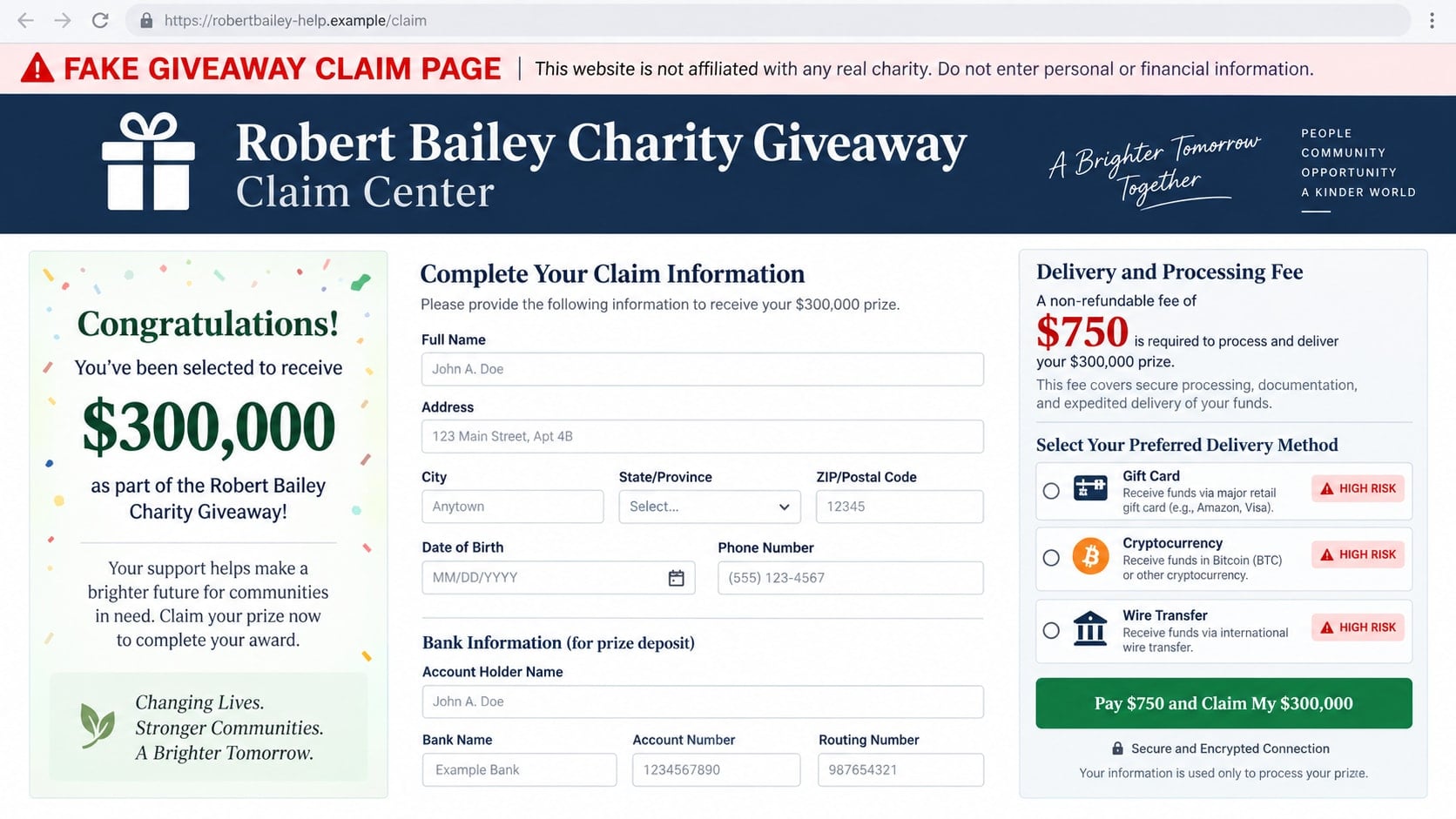
A form may request a full name, date of birth, address, telephone number, email, Social Security number, identification image, and bank details. Each item is described as necessary to verify the winner or arrange delivery.
The information can be used for identity theft and later impersonation. Even basic contact details can be sold or used to tailor additional prize, grant, loan, and recovery scams.
Step 5: A fee is required before the gift can be released
The courier or agent introduces a $750 delivery charge, insurance bond, tax certificate, anti-money-laundering fee, or account activation cost. The amount may be reduced if the recipient says they cannot pay.
Payment is requested through gift cards, cryptocurrency, wire transfer, cash app, or another method with limited recovery options. The scammer may provide stolen documents to make the recipient comfortable.
Step 6: New charges continue until the victim stops
After the first payment, the package is supposedly held by customs, a bank needs another certificate, or the transfer exceeded a limit. The $300,000 remains one fee away no matter how much has already been sent.
When the victim refuses, the scammers may threaten legal trouble for abandoning the claim or offer a smaller payout. Later, a recovery account may promise to retrieve the loss for one more advance payment.
Identity, Contact, and Payment Checks
Examine the Instagram account beyond its display name
Check the exact username, account creation clues, posting history, engagement quality, and whether photographs appear elsewhere. Sudden topic changes, copied captions, limited comments, and repeated giveaway pitches are warnings.
A verification badge can help identify a notable account, but no badge makes an unsolicited $300,000 offer safe. Compromised verified accounts can also be abused.
Verify the person outside the direct message
If the story references a public lottery winner, compare reliable reporting with the account’s exact name, location, jackpot, date, and official public statements. Do not rely on links provided in the chat.
Finding a real person with a similar story proves only that the impersonator selected a believable identity. It does not connect that person to the account messaging you.
Keep communication on the original platform
Do not move to WhatsApp, Telegram, email, or text at the sender’s request. Platform changes make reporting harder and give the operation new ways to reach you.
Never contact a courier, attorney, or agent whose details came only from the giveaway account. One scammer can play every role or coordinate with partners.
Refuse every payment tied to a free gift
Do not pay delivery, tax, insurance, transfer, or verification charges to receive unexpected money. A fee paid by gift card, cryptocurrency, wire, or person-to-person transfer is especially unsafe.
Do not accept a check and send part of it onward. A bank may show provisional funds before discovering that the check is fraudulent and reversing the deposit.
Photos, Testimonials, and Delivery Documents Do Not Prove the Giveaway
Scammers collect persuasive material from the internet. A photograph of cash, a check, a courier van, a lottery ticket, or a smiling recipient can be stolen from an unrelated post.
Testimonial screenshots are equally weak. The operator controls both sides of a fabricated conversation and can create comments from additional fake accounts.
A certificate with a seal or signature may look official because document templates are easy to obtain. Errors can expose a fake, but perfect spelling does not make a document authentic.
Tracking pages may also be invented. A fake courier portal can show a package moving between cities, then announce that it is held for a fee. The visual progress is part of the pressure, not evidence of a parcel.
Verification must occur through an independent organization. If every confirming detail leads back to the same Instagram conversation, the same agent, or the same supplied website, nothing has truly been verified.
What to Do if You Have Fallen Victim to This Scam
- Stop replying and do not pay another fee. Save the conversation before blocking the accounts. Do not believe claims that a final payment will release the $300,000 or prevent legal trouble.
- Report every involved profile. Use Instagram’s impersonation, scam, and hacked-account reporting options. Report WhatsApp, Telegram, email, or payment accounts used in the handoff as well.
- Contact the payment provider immediately. Tell the bank, card issuer, wire service, payment app, gift-card issuer, or crypto exchange that the transaction resulted from fraud. Ask about freezes, recalls, and disputes.
- Secure your Instagram and email accounts. Change passwords from a trusted device, enable multi-factor authentication, review login sessions, and remove unknown connected applications.
- Protect your identity. If you shared a Social Security number or identification, freeze credit with Equifax, Experian, and TransUnion. Review reports and use IdentityTheft.gov to create a recovery plan.
- Check your device. Remove anything the scammers asked you to install and run a full Malwarebytes scan. If remote access was granted, secure important accounts from a different trusted device.
- Block dangerous destinations. AdGuard can help prevent access to many known phishing and tracking domains, although it cannot determine whether an Instagram personality is genuine.
- Preserve and report evidence. Keep usernames, profile links, chats, phone numbers, email addresses, wallet addresses, receipts, and claim documents. Report at ReportFraud.ftc.gov and IC3.gov.
- Warn close contacts. If your account was compromised, tell friends not to trust recent giveaway messages from it. Ignore paid recovery offers from strangers who claim they can hack the money back.
How to Report the Account Without Losing Evidence
Take screenshots of the profile, exact username, bio, direct messages, payment instructions, and any links before blocking. Usernames and profile content can change quickly.
Copy the profile link when possible and note the date and time. Save transaction identifiers and wallet addresses exactly as shown.
Use Instagram’s in-app reporting tools to identify the account as a scam or impersonation. If a real person’s identity is being copied, that person or their representative may also use the platform’s impersonation form.
Report the payment destination to the relevant provider. A payment-app username, bank account, crypto-exchange deposit, or gift-card redemption trail may help providers identify connected activity.
Do not keep the account unblocked simply to watch it. Continued conversation exposes you to more persuasion and may reveal additional personal information.
Why the Scammer May Send You a Check or Bank Screenshot
A check can make the promised gift seem tangible, but deposited funds may appear before the bank finishes deciding whether the check is genuine. Availability is not the same as final clearance.
The sender then asks the recipient to pay a courier, donate a portion, buy equipment, or return an accidental excess. When the check is reversed, the money sent onward is still gone.
A screenshot of a transfer is even weaker evidence. It can be edited in minutes and does not show a completed transaction in your authenticated account.
Do not spend, forward, or withdraw money based on a stranger’s image or provisional deposit. Contact your bank independently and explain the entire giveaway story before acting.
If the sender objects to bank verification, that reaction is another warning. A genuine gift does not depend on keeping the receiving bank uninformed.
Frequently Asked Questions
Did Robert Bailey really win $343 million?
A scammer may borrow a real or invented lottery story, but that does not authenticate the Instagram account. The decisive issue is the unsolicited $300,000 promise and the later requests for data or fees.
Why would a lottery winner choose my Instagram account?
There is no credible selection process. The message is sent broadly to find people who respond. “Random selection” lets the scammer avoid explaining any prior relationship or contest entry.
Can I receive the money without paying the fee?
There is no verified $300,000 gift behind the scheme. Refusing the fee protects you from a loss; it does not cause you to miss a legitimate payout.
What if the profile has many followers and old posts?
Followers can be bought, content can be copied, and established accounts can be compromised. Verify the person through independent public channels and never treat profile age as proof of a financial offer.
Is it safe to send my address for delivery?
No. The address can be combined with other personal information for impersonation and future targeting. An unsolicited stranger does not need your identity documents or home address to give you money.
Can Instagram recover money I already sent?
Reporting helps remove accounts, but payment recovery depends on the method and provider. Contact the financial service immediately, preserve evidence, and report the fraud to official agencies.
The Bottom Line
The Robert Bailey Instagram giveaway scam uses a generous lottery-winner story to make an impossible $300,000 offer feel personal. The profile, agent, claim form, and courier can all be parts of the same operation.
Unexpected gifts do not require identity documents or advance payments. Save the evidence, report the accounts, and walk away the moment a stranger says free money depends on a fee.

Join the discussion
0 commentsShare your experience or ask a question about this article.
Discussion
Start the conversation
Have a question or something useful to share? Add the first comment.