


A subscription charge you don’t recognize can make a callback feel urgent. The refund scam case involving Ivan Wilbur Seales shows where that conversation can lead.
The story follows money beyond the person answering the phone, connecting familiar support impersonations with a defendant who helped move the proceeds.
Overview
A laundering conviction behind the refund calls
Seales, a New York resident, received a 121-month prison sentence for conspiracy to commit money laundering. The underlying fraud targeted older people nationwide, including Arizona.
False charges became demands for real money
Victims believed they were correcting an excessive refund or protecting compromised accounts. Their own money went to scammers, rather than back to a legitimate business.
A sentence and restitution serve different purposes
The court ordered approximately $855,000 in restitution. That obligation matters, but an order does not mean victims have already received payments.
- The nearly $1 million figure describes proceeds attributed to Seales’s laundering activity.
- The callers impersonated trusted companies while steering victims toward transfers.
- The immediate response depends on whether money or account access changed hands.
What Happened in the Seales Case
According to the DOJ sentencing announcement, Judge Scott H. Rash sentenced Ivan Wilbur Seales on November 6, 2026. Prosecutors announced the result November 10.
The punishment followed a jury verdict, rather than an unresolved accusation. The April verdict announcement described a six-day trial and victims losing substantial portions of their savings.
The earlier announcement listed a future sentencing date. The later account supplies the actual sentencing event, so the 121-month term is the relevant outcome.
The United States Postal Inspection Service and New York State Police investigated. Federal prosecutors in Tucson handled the case, with other state and local agencies providing support.
Seales’s role was moving the proceeds
Prosecutors described Seales keeping a portion of the money and helping launder the rest. They described other scammers answering the victims’ calls.
That distinction explains why a laundering defendant matters even when a victim remembers somebody else’s voice. Taking and moving proceeds supports the operation beyond its calls.
It also keeps responsibility precise: the announcements do not identify Seales as the author of every message or the speaker in every conversation.
A recipient name on a transfer record may therefore differ from a company named in a lure. Keep both names when explaining what happened.
The money figures answer separate questions
| Figure | What it describes | How to read it |
|---|---|---|
| Nearly $1 million | Proceeds Seales laundered for the fraud network. | This is not the amount he personally kept. |
| Approximately $855,000 | Restitution the court ordered him to pay victims. | This is not confirmation of money already distributed. |
| 121 months | The prison term imposed at his sentencing. | This is the actual sentence reported by prosecutors. |
Subtracting restitution from the laundering figure would not reveal his personal profit. One figure is approximate, and the announcements do not provide that accounting.
Similarly, those figures cannot tell a particular victim how much they will receive. Individual losses and any distributions require information from the actual case.
How the Network Turned False Charges into Transfers
Step 1: A familiar name supplied the opening
The organization used fraudulent emails, texts, websites, and pop-ups that borrowed the credibility of banks and technology companies. Individual victims encountered different versions of these openings.
Some messages claimed charges associated with Geek Squad, PayPal, or antivirus software. The charges described by prosecutors never occurred; the supposed billing problem was the lure.
Other victims saw pop-ups that froze their computers and directed them to support callers. A frightening screen gave the conversation an apparent reason to begin.
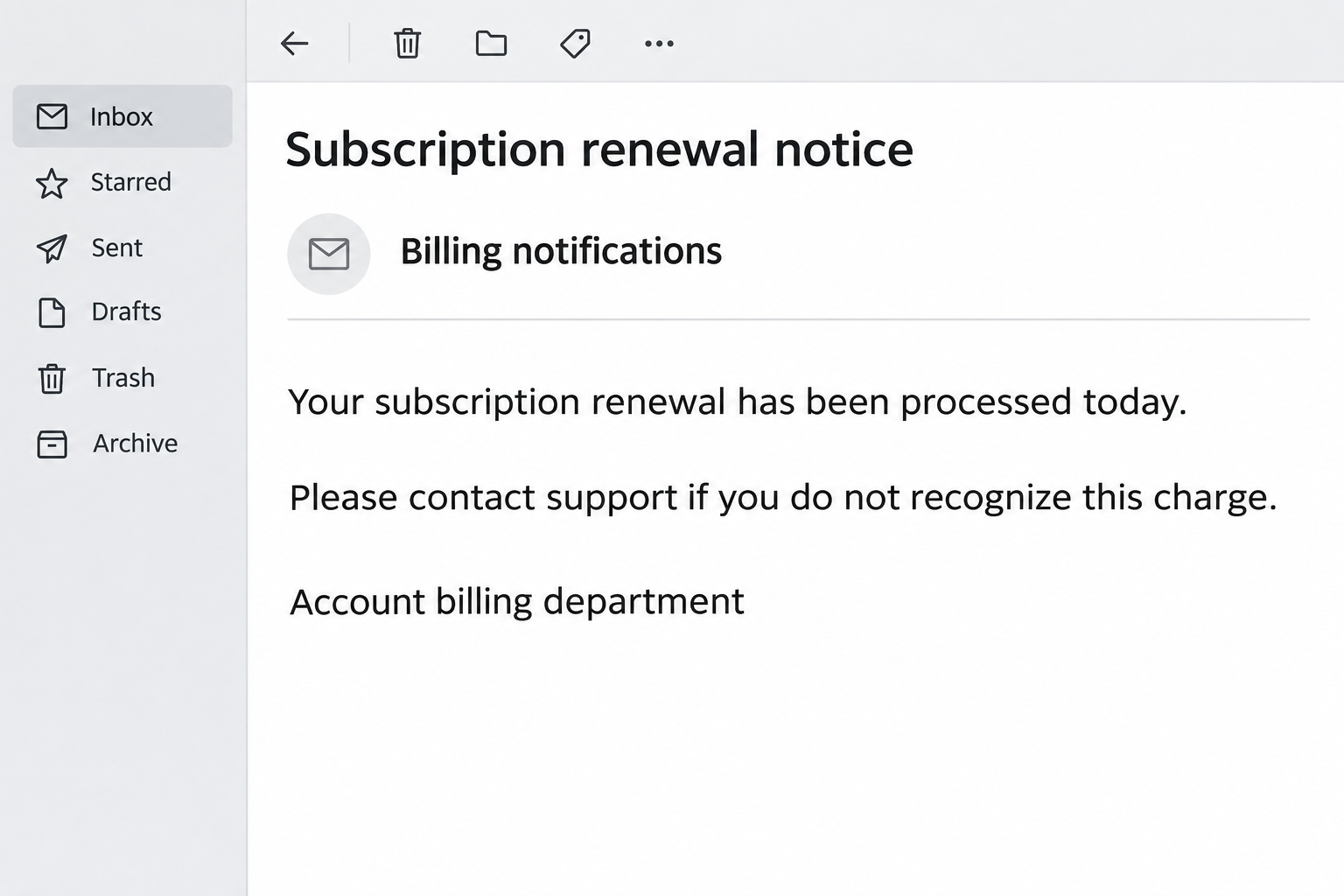
The lead image illustrates the charge-notice format using invented wording. It is a reconstruction, rather than an original victim message or a company account screenshot.
Step 2: The callback transferred trust to an impostor
Victims reached people falsely presenting themselves as representatives of legitimate companies, including Apple or Microsoft. Calling first did not make those representatives genuine.
The important switch was from seeing a familiar company name to accepting instructions from whoever answered. The notice supplied both the concern and the supposed solution.
A person trying to dispute a bill could enter the conversation believing they were protecting their finances. That starting intention helps explain the trap’s appeal.
Step 3: A refund or account emergency created the demand
In the refund version, callers persuaded victims that a legitimate company had accidentally credited too much money. Returning the supposed excess sounded like correcting an error.
The account-protection version used another explanation: accounts were supposedly hacked or compromised. Victims were directed to move money to protect it or help catch scammers.
Some accusations also invoked shame, including a false connection to illegal sexual material. Such an accusation was pressure for a transfer, not reliable evidence about the victim.
These were alternative pretexts within the described network. The accounts do not establish that every victim heard every story in a fixed order.
Step 4: Victims sent their own funds
The decisive loss occurred when victims transferred their money while believing they were returning a refund. The callers’ account of the transfer concealed its real purpose.
That changes the question worth asking during a call. A claimed refund error requires independent bank verification before any outgoing payment, regardless of the caller’s confidence.
A genuine balance should be checked through a bank channel you open yourself. A caller’s explanation cannot establish where a credit originated or who owns it.
Step 5: Seales helped move money beyond the deception
The sentencing account describes shell companies, cryptocurrency transfers, cash withdrawals, and offshore financial transfers. The verdict account specifically includes transfers to India.
Those are described laundering routes, rather than proof that every victim personally bought cryptocurrency. The announcements do not map each victim’s first payment through every later transaction.
That missing transaction detail matters when reporting a loss. Describe the method you actually used, even if a later criminal case mentions other financial channels.
From the lure to the money movement
- Impersonators presented false billing or account-security problems to the victims.
- Victims transferred money under refund or protection pretexts.
- Seales kept a portion and helped launder proceeds through several financial routes.
This summarizes roles across the case, without assigning one identical payment itinerary to every victim.
Why the Laundering Role Changes the Recovery Picture
The case reaches beyond the misleading message into the handling of money afterward. A successful prosecution can establish accountability at that later stage.
For a victim, however, a conviction and a reversed transfer remain separate outcomes. Learning that somebody was sentenced should not delay a bank’s fraud response.
The money trail also explains why seemingly minor details deserve preservation. A beneficiary name, transaction reference, or destination account can connect a payment with another record.
You do not need to determine the entire network yourself. Record what you personally saw, then let investigators compare it with information unavailable to you.
A matching brand name alone cannot link a new message to Seales. The companies impersonated in this case are also widely recognized names that other criminals can misuse.
Apple, Microsoft, Geek Squad, and PayPal were impersonated in the described conduct. Their appearance in the story does not make those legitimate businesses the laundering operation.
Restitution is an obligation, not an open refund offer
The DOJ’s restitution guidance explains that an order does not guarantee payment. Collection can depend on a defendant’s financial circumstances.
The Seales announcement reports the ordered amount, without announcing a public application portal, distribution date, or confirmation that the full amount has been collected.
If you believe your loss belongs to this case, use verified victim-service channels. Do not pay a stranger who promises to add you to a payout list.
What to Do After a False Refund or Account-Protection Demand
Start with what actually happened during your contact. The guide below helps prioritize the response while the detailed actions explain what information to preserve.
-
Leave the caller’s version of events behind
Hang up before checking the claimed charge. Use contact information from your card, an established account, or a company website you reach independently.
Do not accept another number supplied by the same caller as independent verification. That simply leaves the conversation inside the route you are trying to check.
If somebody says money must move to protect it, stop the transfer. The FBI’s IC3 guidance warns against such government-impersonation demands.
-
Tell the sending institution exactly what happened
The FTC advises contacting your bank or credit union immediately after a scam-induced transfer and asking for reversal and a refund.
Explain whether you initiated the payment under false instructions or someone moved funds without permission. Give the date, amount, destination, and transaction reference.
Ask what action remains possible and how to submit supporting records. Request written confirmation or a case number, without assuming recovery is guaranteed.
If you personally used another payment provider, notify that provider too. Describe your actual payment method rather than adopting the laundering methods mentioned in the prosecution.
-
Secure any access you actually disclosed
If you shared a password, change it through the genuine service and change reused passwords elsewhere. Enable multifactor authentication wherever the service offers it.
If you allowed device access, use a trusted device for sensitive account changes and seek help from a legitimate support provider you choose independently.
The FBI’s victim guidance addresses passwords and device checks after access was granted. Merely receiving the lure does not establish that exposure.
The Seales announcements do not identify a remote-access program or establish a malware infection. Your response should follow what you installed, disclosed, or permitted.
-
Preserve the evidence without continuing the conversation
Keep original messages and transaction records, along with your recollection of the call. Preserve them before deleting or blocking the suspicious contact.
Keep the details investigators can compare
- Save the original email or text and any visible sender information.
- Record the numbers you called and names the callers used.
- Keep payment confirmations showing receiving accounts and financial institutions.
- Write down the claimed refund error and instructions for moving money.
Separate remembered wording from exact quotations in your notes. If a detail is uncertain, say so rather than filling a gap from another person’s story.
Keep full financial records for verified institutions and investigators. Avoid posting account numbers or other people’s identifying details in public discussion threads.
-
Report the conduct and any possible case connection
File an internet-fraud report through IC3 and a consumer-fraud report through ReportFraud.ftc.gov. Include relevant communications and transaction information.
If you have a concrete reason to connect your loss with Seales, mention his name and case number. Similar wording by itself is insufficient.
The Postal Inspection Service’s reporting page provides routes for mail-related fraud and cybercrime. Choose the category matching your actual experience.
A report helps authorities assess information; it is not a promise that your individual payment will be located or returned.
-
Verify case contacts and reject recovery fees
For case-related assistance, start with the District of Arizona’s Victim Witness Section. Ask how to confirm whether your loss is associated with this prosecution.
The office also explains that victims owed restitution must notify the court when their address changes. Follow verified instructions rather than an unsolicited message’s directions.
The FBI warns about impostors offering to recover stolen funds. IC3 does not charge recovery fees or refer victims to fee-charging recovery companies.
Keep a trusted relative informed if the situation feels overwhelming. They can help organize calls and records without taking instructions from the original caller.
Frequently Asked Questions
Was Seales convicted, or was he only charged?
A jury found him guilty of conspiracy to commit money laundering. The later announcement reports his 121-month sentence and approximately $855,000 restitution order.
Did the claimed subscription charges actually occur?
The DOJ says the charges in the described lures never occurred. Independently check any message you receive rather than assuming it belongs to this case.
Did victims really receive an excessive refund?
They were led to believe they had received too much. Prosecutors say victims transferred their own money while believing they were returning the excess.
Does the nearly $1 million figure describe Seales’s profit?
No, it describes proceeds he laundered for the network. Prosecutors say he retained a portion, without specifying that portion in these announcements.
Does the restitution order guarantee my money back?
The order imposes a repayment obligation, rather than guaranteeing collection. Verify any case connection through official victim services and pursue your bank’s fraud process promptly.
Does seeing a similar pop-up mean my computer was infected?
A pop-up alone cannot establish infection or connect you with Seales. The case announcements identify no particular malware or remote-access application to remove.
The Bottom Line
The Seales case shows how a false refund story can feed a separate laundering operation. Do not return supposed excess funds on a caller’s instructions.
If you already transferred money, contact the sending institution immediately and preserve the records. Use verified reporting and victim-service routes, without paying anyone to unlock restitution.

Join the discussion
0 commentsShare your experience or ask a question about this article.
Community experiences
Did this happen to you?
Your experience could help someone recognize the same scam. Submit a private report for our team to review.
I experienced this tooReports are reviewed before publication. Sharing publicly is always your choice.
Discussion
Start the conversation
Have a question or something useful to share? Add the first comment.