


A familiar financial name, a London branch address, and carefully explained trading rules can make an unfamiliar website feel reassuringly established.
If you’re checking sterlingconsortium.co.uk before discussing financing or paying for a trading account, there are several details worth reading together.
Overview
A finance website with two different offers
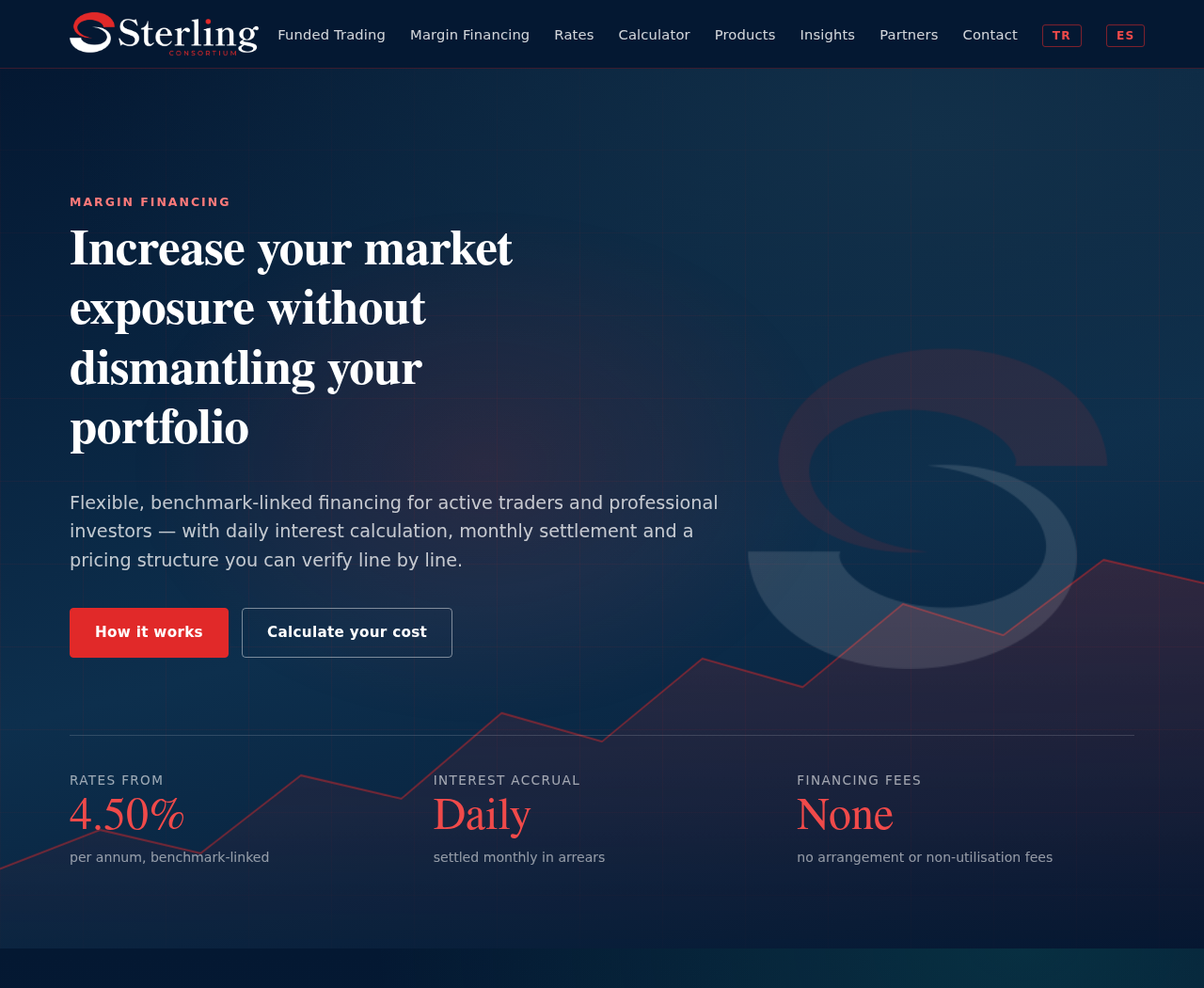
Sterlingconsortium.co.uk presents margin financing alongside funded trading programs. One concerns borrowing against a portfolio; the other advertises access to trading evaluations and potentially larger accounts.
The distinction matters because a financing rate, an evaluation fee, and an account size describe entirely different things. None should be mistaken for money already belonging to you.
The homepage advertises an annual financing rate starting at 4.50%, while the trading section promotes entry fees from US$19 and profit shares up to 90%.
Those figures are the website’s claims, not independently verified lending terms, available trading capital, or demonstrated customer payouts.
The warning that changes the decision
The Financial Conduct Authority identified this exact domain as a clone firm on November 12, 2026.
Its warning names the genuine business as Sterling Consortium Limited, reference 987941, and gives sterlingfx.co.uk as its website. The regulator says that business is unconnected with the clone.
The problem starts with whose business this appears to be. Attractive trading conditions cannot settle that identity question.
The details to separate before responding
- The domain you are visiting matters more than a familiar company name.
- A quoted financing rate measures a borrowing cost, not an investment return.
- A trading evaluation charge purchases access, not ownership of the displayed account balance.
- Copied branch details can belong to a genuine business without authenticating the website displaying them.
- Your response should match what happened: browsing, sharing information, or sending money.
Do not use this website to arrange financing, buy trading access, or provide portfolio information. The sections below explain where its presentation can mislead.
What the Sterling Consortium Website Actually Shows
Borrowing language rather than a simple investment pitch
The opening page describes financing linked to market benchmarks, with interest calculated daily and settled monthly. It emphasizes borrowing capacity, eligible assets, and collateral quality.
It also publishes indicative loan-to-value bands and margin thresholds. These details make the proposition look more technical and substantial than a bare promise of easy profits.
But financial terminology answers only how an offer is described. It does not identify who would hold your information, provide the facility, or receive a payment.
A calculator can produce internally consistent numbers even when the identity surrounding it is unreliable. Correct arithmetic cannot establish that an operator represents the firm it invokes.
A separate route into funded trading
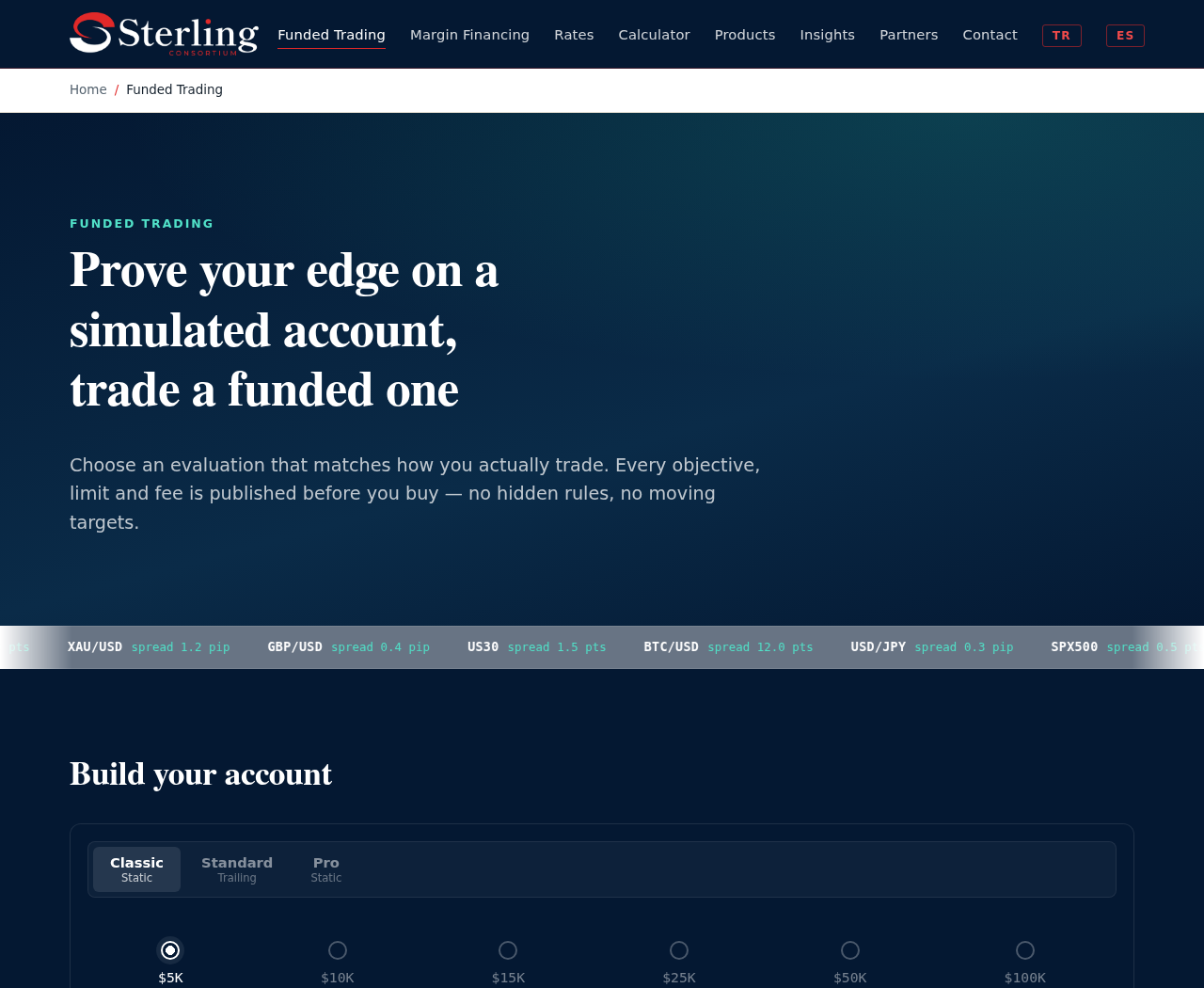
The trading area offers several evaluation structures, account sizes, loss limits, and profit targets. Its presentation encourages visitors to compare programs and choose a suitable starting point.
Importantly, its own explanatory text says evaluations use simulated accounts. It also describes program charges as access fees, rather than deposits or investments.
An evaluation fee and a deposit create different expectations: paying for a test does not mean the advertised account balance becomes your money.
The concern is being invited into a financial-looking relationship through a domain subject to a specific identity warning.
How the Sterling Consortium Clone Scam Works
Step 1: A recognizable identity makes the approach seem plausible
The website uses Sterling Consortium branding while repeatedly referring to a Sterling FX London branch. A visitor searching either name could easily assume these references settle the identity question.
The FCA describes the clone as contacting people while pretending to represent an authorized firm. It does not identify every advertisement, message, or introduction used.
Whether the link reached you through a message or a search, verify the domain before discussing a trading program or moving the conversation elsewhere.
Step 2: Detailed financing terms encourage you to evaluate the offer
Once on the landing page, you’re encouraged to think about pricing, collateral, and borrowing capacity. The page offers a financing explanation and a cost calculator.
That shifts attention toward whether the numbers suit your portfolio. The more useful question comes earlier: whether this particular website is entitled to speak for the business.
The advertised 4.50% starting figure is especially easy to misunderstand. It appears in financing context, so treating it as a promised annual investment gain would misread the page.
Neither a plausible rate nor a warning about trading losses resolves the domain’s identity problem.
Step 3: Trading choices provide another reason to continue
The funded trading route adds a different attraction: qualifying for a larger account after meeting evaluation objectives. The homepage also advertises an option without an evaluation.
Small starting fees can make an offer feel easier to try. Yet a low initial amount does not reduce the importance of knowing the actual contracting party.
A displayed profit-sharing percentage describes an advertised arrangement. It is not evidence that a particular trader passed, received funding, or successfully collected money.
Step 4: The contact page invites information about your finances
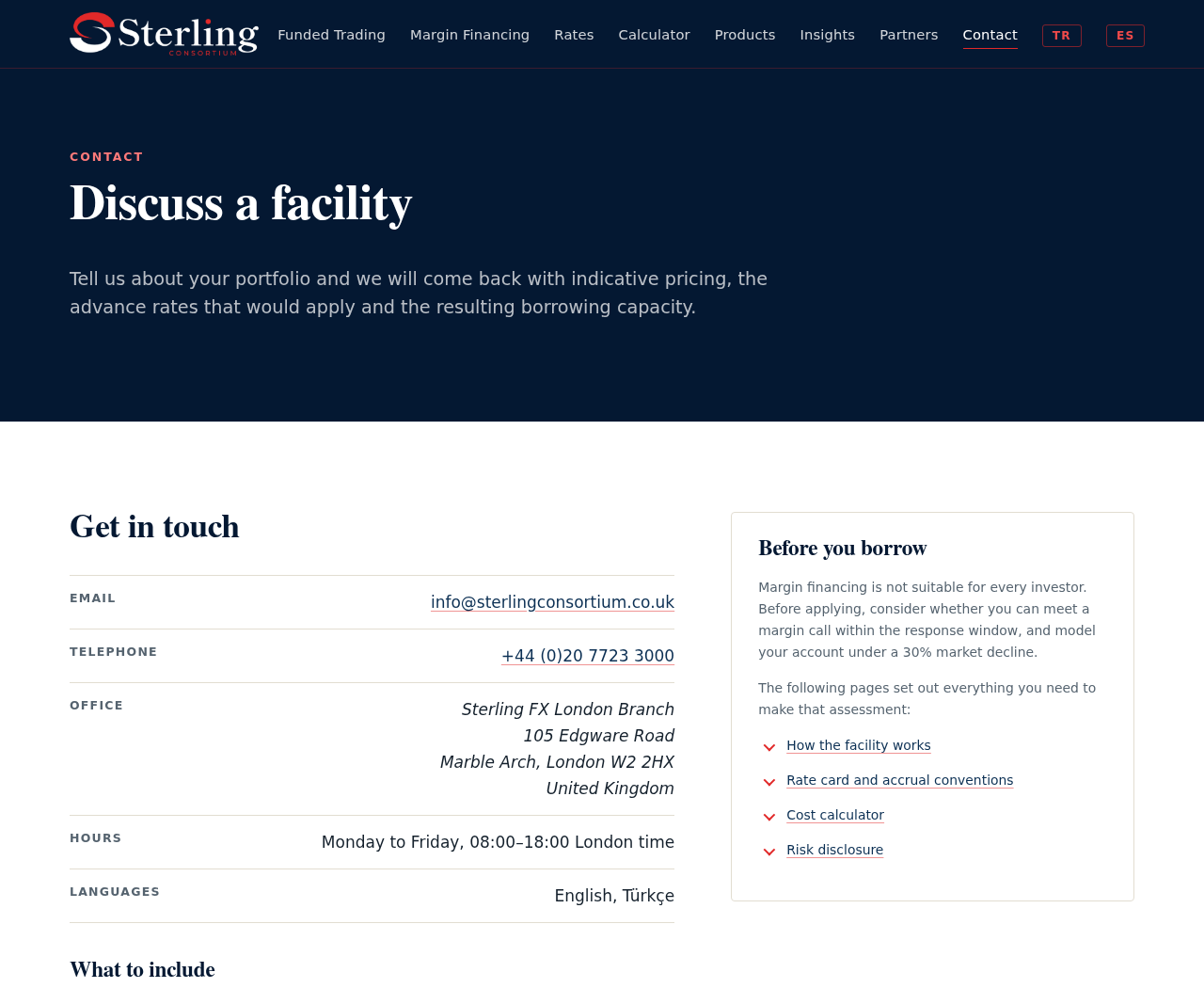
The contact area asks prospective borrowers to describe their portfolio value, currency, broad holdings, concentration, and intended borrowing amount.
These are commercially sensitive details even without an account password. They can reveal how much money you control and which financial conversation would hold your attention.
The same page advises against emailing credentials or identity documents. That is a visible precaution, but it does not make sending other financial information advisable here.
Before discussing a portfolio, establish who would receive the information and why it is needed. A seemingly careful email policy cannot supply that missing trust.
Step 5: Familiar legal details can feel like independent verification
The footer supplies a company number, a London address, and a published telephone number. Legal pages discuss risk, jurisdiction, and limits on website information.
Seeing those details together can feel like completing a background check. But you are still reading information supplied by the website asking for your trust.
A registered company number can be genuine while its use on another website is unauthorized. Matching an address cannot establish control of an email inbox or payment destination.
The visible route ends at program and contact invitations. No payment was made, and no withdrawal, collateral transfer, or post-payment demand was tested.
The Business Identity Behind the Branding
The genuine service has a different web address
The separate Sterling FX regulatory information page identifies its trading division with Sterling Consortium Limited and company number 05850613.
That page describes an authorized payments institution and foreign-exchange services. It also distinguishes travel money from the activities covered by FCA regulation.
A permission for one financial activity is not a blanket endorsement of every similarly named website or trading product.
The footer’s company number is real, but proves something narrower
The warned website instead displays Sterling FX Ltd and number 10536117. Companies House lists that company as active, with a dormant-company business classification.
This is not evidence that the registered company is fictitious. Nor does a public registration identify who controls the warned domain.
Sterling Consortium Limited has its own separate company record. Treating the two numbers as interchangeable would erase a distinction the documents actually preserve.
A branch address is not proof of website ownership
The contact page displays 105 Edgware Road in London. The genuine Sterling FX website also publishes that branch address.
Finding a real office at a listed address would therefore not clear this website. A clone can borrow a location precisely because an ordinary search makes it look credible.
Registered offices and trading branches can also differ legitimately. The useful check connects the exact firm, permissions, domain, and contact route, rather than treating one address as decisive.
Published contact information is not a tested relationship
The warned site’s email uses its own domain, while the genuine business publishes an address at sterlingfx.co.uk.
Both sites display the same main telephone number. That overlap should not be interpreted as proof that every contact detail on the warned page reaches its operators.
No call or email test was performed. Use a fresh official lookup to choose a contact channel, rather than replying inside an existing conversation.
Checks That Matter More Than a Polished Website
Start with the exact address in the browser, not the logo. Save that address before closing the page, particularly if another person supplied the link.
Next, use the FCA Firm Checker to inspect the business and relevant permissions. Follow its official contact information independently.
Do not ask the same salesperson to certify their own link. A screenshot of a registration entry can reproduce genuine information without connecting the sender to it.
If someone offers a trading evaluation, distinguish the access charge, simulated account size, trading rules, and any later agreement. These are separate questions, not one reassuring headline.
For financing, establish the actual lender, contractual counterparty, collateral arrangements, and service permissions before sharing documents. A website disclaimer is not a substitute for those checks.
Here, the specific domain warning already supplies a reason to stop. You do not need to send a small payment or disclose a portfolio to investigate further.
What to Do if You Have Fallen Victim to This Scam
-
Stop the relationship before providing anything further. Do not send additional money, financial statements, identity images, or account details through the warned website or its email address.
If you only browsed the pages, close them after saving the address. Merely viewing this finance presentation does not establish that your device became infected.
-
Build a clear record of the approach. Keep original emails, message histories, the exact domain, names used, application documents, receipts, and any payment instructions you received.
Save full messages where possible, rather than isolated screenshots that omit the sender or surrounding conversation. Keep sensitive documents private when sharing a report publicly.
-
Contact your bank promptly if money moved. Use its established app, your card, or a statement to reach the fraud team, not contact details supplied by the other party.
Explain whether you authorized the payment, the destination, the amount, and the deception involved. Ask the bank to record the report and consider available recovery routes.
For a card payment, ask which dispute options fit the transaction. Describe the real events accurately rather than labeling an authorized payment as unauthorized.
-
Ask about bank-transfer protection without assuming eligibility. UK Faster Payments and CHAPS scam payments can fall under reimbursement rules applying from October 7, 2024, subject to conditions.
Different rules can apply to overseas transfers, cryptocurrency, cards, and other arrangements. The FCA’s payment guidance explains why the payment route matters.
Protection against the clone itself and your bank’s response are separate issues. If your bank rejects a claim, ask for written reasons and its complaints procedure.
-
Secure any information you actually exposed. Tell your financial provider if you supplied account identifiers, statements, or identity documents, and explain exactly what was disclosed.
If you reused a password while registering anywhere connected with the approach, change it on the genuine service and review its sessions and security settings.
Portfolio information alone is not a password. However, it can make later approaches sound unusually knowledgeable, so verify unexpected financial requests through a separate trusted channel.
-
Report the domain and retain reference numbers. Use the FCA’s reporting route and your jurisdiction’s fraud-reporting service, providing the precise website and payment evidence where relevant.
The current UK reporting service is Report Fraud; people in Scotland should follow Police Scotland’s reporting route instead.
Keep the bank’s and reporting service’s references together. They help connect later correspondence with the original incident without resending your entire file repeatedly.
-
Reject any paid promise of guaranteed recovery. Someone who knows the domain, amount, or contact name has not thereby proved they can recover your funds.
Do not pay a new release charge or share banking codes with an unsolicited helper. Continue through your bank and independently verified official channels.
Frequently Asked Questions
Is sterlingconsortium.co.uk the genuine Sterling Consortium website?
No, the FCA identifies that domain as a clone. Its warning directs readers to sterlingfx.co.uk for the genuine firm’s website, rather than validating the similar-looking address.
Does a real Companies House number make the site safe?
A genuine registration establishes a company record, not control of every website displaying its number. Match the particular domain and service with independently sourced official details.
Is the advertised 4.50% a promised investment return?
The homepage presents it as a starting annual financing rate. That concerns borrowing costs, not money you are promised for investing or completing a trading challenge.
Does a funded trading account mean I can withdraw its displayed size?
No, an advertised account size is not a personal cash balance. This site’s evaluation wording describes simulated trading and access charges, rather than a deposit you own.
Should I call the number shown on the contact page?
Obtain contact information independently before calling or emailing anyone. A copied genuine number does not authenticate the website, its inbox, or a person who introduced the offer.
Can my bank still help after I sent money?
Potential options depend on the payment method and circumstances. Contact the fraud team immediately, preserve your evidence, and ask which recovery or reimbursement process applies.
The Bottom Line
Do not use sterlingconsortium.co.uk for financing or trading access. The exact-domain clone warning matters more than detailed rate tables, familiar branch information, or a genuine company number.
If you already paid or disclosed financial information, preserve the conversation and contact your bank through its normal channel. Verify any future approach independently before responding.

Join the discussion
0 commentsShare your experience or ask a question about this article.
Community experiences
Did this happen to you?
Your experience could help someone recognize the same scam. Submit a private report for our team to review.
I experienced this tooReports are reviewed before publication. Sharing publicly is always your choice.
Discussion
Start the conversation
Have a question or something useful to share? Add the first comment.