


Unmeterd.com advertises dedicated servers, managed VPS plans, fast delivery, and a British company behind the contract. For a business moving important workloads, that identity deserves checking.
The name in its legal paperwork leads to a serious warning from the company whose details appear there. Here is what that means before sending money or server credentials.

Overview
The legal identity is actively denied
Unmeterd’s current website identifies Euroga Servers Ltd, company number 11758050, as its supplier. EuroGA’s administrator has publicly warned that the hosting website uses EuroGA’s details without authorization.
That is not merely a low review score. It is a direct conflict over the identity presented to customers as the business responsible for their purchase.
Hosting promises do not resolve the impersonation
The site promotes quick provisioning, multiple locations, and money-back language. None authenticates its claimed connection with EuroGA or proves that your chosen server will be delivered.
Customer reviews also describe payment and delivery disputes. Those individual experiences require attribution; the independent company-identity warning already supplies a concrete reason not to pay.
The recommendation is to avoid this offer
Do not send Unmeterd money or production credentials while it presents a company identity publicly rejected by that company’s own administrator. A working website cannot cure that problem.
- Check the exact spelling: the investigated domain is unmeterd.com.
- Do not mistake copied registration details for verified ownership.
- Keep receipts and payment records if you already ordered.
- Do not send another payment to release an earlier one.
The EuroGA Warning Comes From Its Own Forum
On November 8, 2026, EuroGA administrator Peter posted a warning titled Fraud by unmeterd.com using EuroGA’s details on the aviation community’s own website.
He described the hosting site’s use of EuroGA information and said he learned about it when customers contacted him. Subsequent posts discussed reporting the impersonation.
The warning appears in the original EuroGA discussion, where the administrator describes the misuse and replies to suggestions about reporting it.
The warning identifies a specific misuse of company information, not merely an unfamiliar business name. Its relevance comes from the company confronting that claim on its own platform.
Do not direct anger or refund demands at an impersonated company merely because its details appear on an invoice. Preserve the document and report the actual transaction.
What Unmeterd’s Own Pages Claim
Unmeterd operates a substantial hosting storefront rather than an empty landing page. It advertises dedicated servers, managed VPS products, and numerous geographic locations.
The homepage displayed managed VPS offers from $8.49 monthly and dedicated servers from $69 monthly. These are advertised starting prices, not evidence of delivered hardware or tested performance.
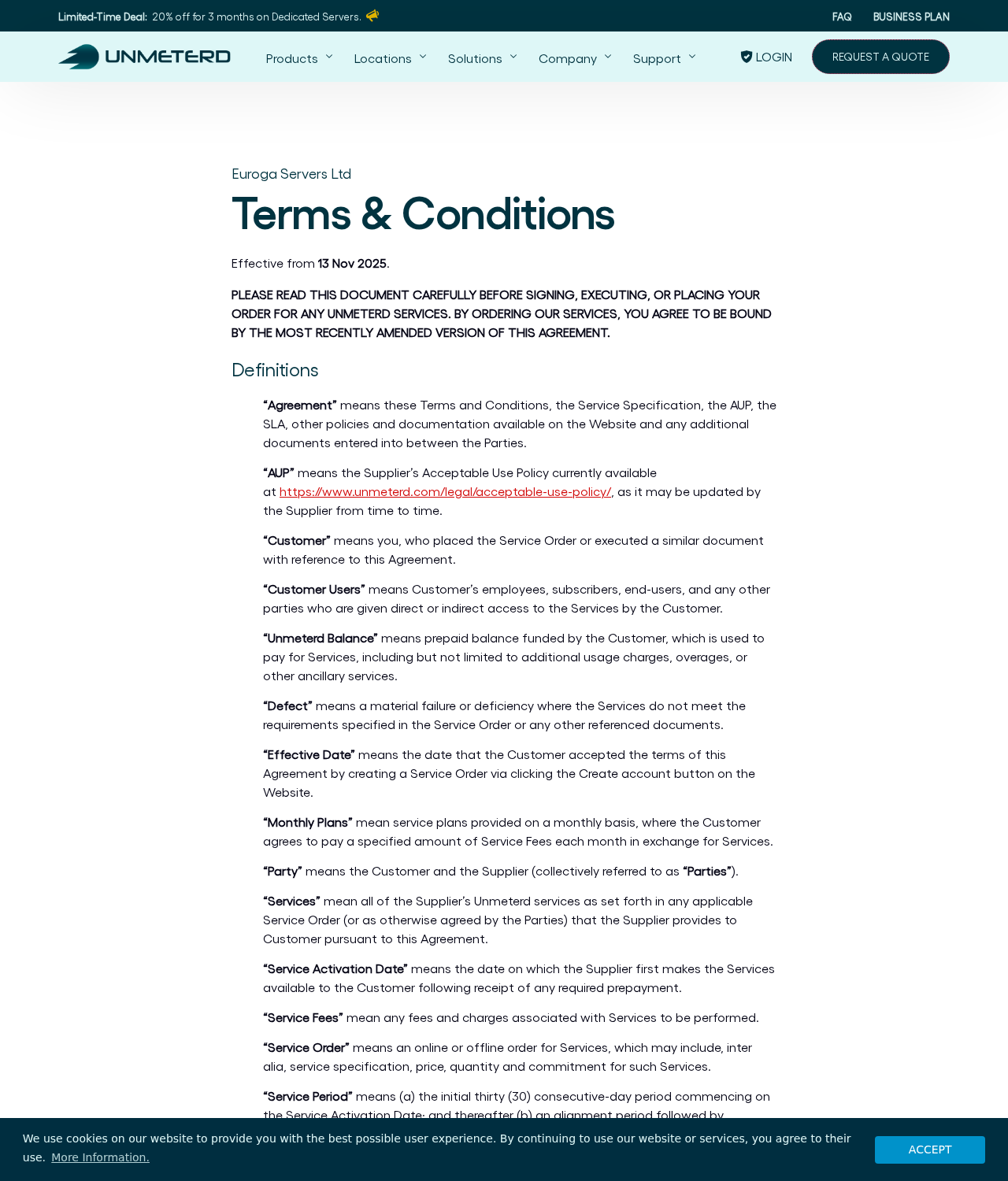
Its terms identify Euroga Servers Ltd as the supplier and reproduce a British company number and address. The same legal identity appears throughout other policy material.
The purchase therefore has a problem before any speed test matters. You need to know who receives the payment and who actually owes you the server.
A large catalogue, technical vocabulary, and polished service descriptions cannot substitute for that answer. They are things a website can publish without proving operational capacity.
The same applies to customer logos and testimonials displayed by the seller. Ask the named customer for independent confirmation before treating those graphics as authenticated business relationships.
An encrypted connection protects data in transit; it does not certify the merchant’s identity or honesty. A padlock therefore cannot settle the dispute raised by EuroGA.
A professional invoice has similar limits. Its layout may be genuine-looking while the legal details are copied, so keep it as transaction evidence rather than ownership proof.
How the Company-Identity Claim Can Mislead Buyers
Step 1: A plausible hosting offer gets attention
The site uses familiar server categories and specifications. A buyer looking for bandwidth, VPS capacity, or dedicated hardware can recognize the terminology and begin comparing prices.
Technical plausibility is not corporate verification. Even a carefully written hardware listing says nothing about whether the seller controls the equipment it advertises.
Step 2: British company details supply reassurance
A registration number creates something you can search independently. The trap is stopping after discovering that the company exists, without verifying the website’s claimed relationship.
A real company can have its details copied. Match the domain and commercial activity through the company’s own established channels, rather than accepting the seller’s footer.
Step 3: Policies make the transaction look protected
Terms, an SLA, and refund wording can resemble a complete commercial framework. Their usefulness depends on an identifiable, accountable supplier actually honoring the agreement.
Here, the identity conflict undermines that assumption. A promise to refund within a policy cannot repair the disputed name of the business supposedly making the promise.
Step 4: Payment leaves the buyer seeking delivery
Hosting buyers may pay before receiving access details. That exposes them to non-delivery risk and, for production projects, disruption when promised capacity never becomes available.
Some public reviews describe further payment demands after an initial transfer. Treat those as reported experiences, not a reason to send additional money yourself.
What Customer Complaints Establish and What They Do Not
The Trustpilot profile contains reports of paid orders not delivered and cryptocurrency payments disputed with support. One detailed reviewer describes being asked for another substantial payment.
These are first-person allegations, not our own completed purchases or audited payment records. Their practical relevance is the pattern buyers should document if their own order stalls.
We did not buy a server, send cryptocurrency, or test a paid account. There is no basis here to claim a measured benchmark or successful recovery attempt.
Nor can a low-cost plan alone prove fraud. The decision rests on the actual identity misrepresentation and supporting complaints, not on an arbitrary price threshold.
The Refund Promise Is Not a Recovery Guarantee
The separate refund page gives eligible transactions a 30-day cancellation window, including renewals. It lists dedicated servers and VPS as refundable, but excludes several additional services.
Cloud backup, SSL certificates, and server management are listed as nonrefundable. Crypto purchases are promised the same invoice amount in USDT or USDC.
The customer must pay any refund transaction fees.
If a refund to the original payment method is impossible, the policy offers Unmeterd balance credit as an alternative. That keeps money inside the service instead of returning cash.
The terms say deposited account balance expires after 365 days and unused funds are forfeited. Adding money before expiry carries the existing balance into a new expiration date.
Monthly-plan funds have a separate restriction: they are described as nonrefundable and cannot carry into later billing periods. Unused traffic is also nontransferable and nonrefundable.
Those restrictions sit beside the separate refund policy’s eligible-service promise. Preserve both documents and specify whether your request concerns a server purchase, monthly-plan funds, or unused account credit.
Do not add money merely to keep a disputed credit alive. Request return of the payment and pursue your provider’s dispute process before its deadline passes.
These are the seller’s published conditions, not demonstrated refunds. A money-back badge does not guarantee payment recovery or make internal account credit equivalent to money in your bank.
For cryptocurrency, an ordinary transfer cannot be reversed like editing a bank payment instruction. Save the transaction identifier, network, receiving address, amount, and invoice.
If somebody says another transfer is required to release the first one, stop. Ask your own payment provider or exchange about the actual transaction status through established channels.
A screenshot supplied by a seller is not an independent payment confirmation. Compare it with the records in your own account and the relevant transaction information.
Do not pay for a supposed refund, release, compliance check, or replacement payment merely because support insists. Each additional transfer can increase the loss.
For card payments, contact the issuer promptly about non-delivery or misleading merchant information. Explain exactly what happened rather than describing an authorized purchase as card theft.
Which Company and Website Are Actually Involved?
Unmeterd is the investigated hosting brand
The domain unmeterd.com and its www variant are the subject of this report. Similar words used by other hosting companies do not automatically identify the same operator.
Keep exact domains, invoice identifiers, and payment details in your records. A missing letter or a different subdomain can matter when you report the transaction.
EuroGA rejects the claimed connection
The original EuroGA thread directly challenges use of its company details. Readers should not interpret the hosting website’s footer as proof that EuroGA operates the service.
A legitimate business can become another victim when its details are copied. The warning should redirect your investigation toward the hosting transaction, not toward harassing the impersonated business.
A registry match is not domain authentication
Company registers describe registered entities and filings. They do not automatically certify that every website displaying a number is owned or authorized by that company.
Seek confirmation through an established company-controlled channel independent of the questioned seller. Do not use a contact supplied only by the site whose identity you are checking.
Similar hosting templates need separate verification
The EuroGA discussion mentions other hosting names and possible connections. A shared template, support number, or copied paragraph is a lead, not a complete ownership map.
Do not assume a newly named site is safe because it uses different branding. Equally, avoid accusing an unrelated host solely because its layout looks familiar.
Do Not Move Sensitive Workloads Into an Identity Dispute
For a business, the risk extends beyond the server fee. Deploying customer data or operational secrets can make a bad hosting purchase far more disruptive.
Do not provide an unknown operator with private SSH keys, production API tokens, wallet seed phrases, or credentials for unrelated services to prove you are a customer.
A normal server order should not require your cryptocurrency recovery phrase. Anyone asking for it would gain control beyond the hosting purchase itself.
If you already deployed a workload, inventory what you exposed before deciding your response. A server provider’s access and your own credential practices affect the risk.
Rotate credentials that were actually supplied or stored in the questioned environment. Use a separate trusted system for those changes and check connected accounts for unauthorized access.
Maintain independently controlled backups and test your migration plan. Do not delete the only copy of important data before you have verified a replacement.
Do not assume that every secret was stolen merely because the provider is questionable. Identify what the environment actually contained and prioritize credentials that could provide further access.
Preserve relevant access logs before moving services. They may help distinguish a failed purchase from an actual unauthorized login and support a more accurate incident report.
What to Do If You Ordered From Unmeterd
-
Stop further payments and preserve the order
Save the offer, invoice, support conversation, payment record, and promised delivery date. Do not send a second transfer to fix a disputed first payment.
If access remains available, download relevant account records without supplying additional sensitive information. Keep copies outside the seller’s portal in case the account closes.
-
Request delivery or cancellation in writing
State the order number and what remains undelivered. Give an accurate account of the purchase, then retain the response and any cancellation acknowledgement.
Do not let an informal support promise replace your payment-dispute deadline. You can preserve communication while also asking your provider about available remedies.
-
Contact the payment provider through your own account
For a card payment, ask the issuer about a non-delivery dispute. For crypto, notify the sending exchange and provide the transaction details and destination address.
Recovery is not guaranteed, especially after irreversible transfers. Prompt reporting can still preserve evidence and help providers identify associated accounts or repeated complaints.
-
Protect any credentials and report the actual website
Review secrets supplied to the seller or used on its infrastructure. Replace exposed credentials, preserve logs, and report the hosting domain with the company-identity evidence.
Ignore unsolicited recovery agents promising guaranteed reimbursement for an upfront fee. Losing money once can attract a second scam aimed at your effort to recover it.
The FTC’s recovery guidance separates payment remedies from protecting exposed information. Use the branch matching what happened rather than assuming one action resolves everything.
Frequently Asked Questions
Is Unmeterd.com the same business as EuroGA?
The hosting website claims that connection, but EuroGA’s own administrator publicly rejects it. Do not treat the copied company details as verified authorization.
Does a real British company number make the site safe?
A number can be copied from a genuine registry entry. Verify the website’s connection independently; the existence of an entity does not authenticate a seller using its name.
Were Unmeterd’s advertised servers benchmarked for this report?
We did not purchase or benchmark a server. The recommendation concerns the supplier-identity conflict and payment risk, not a measured claim about hardware performance.
Should I send another crypto payment if support requests one?
Do not send another transfer to unlock a disputed payment. Check the original transaction through your own exchange or payment provider and preserve the seller’s request.
Does the money-back policy guarantee a refund?
A seller’s policy cannot guarantee performance or recovery. Submit a documented request and contact your payment provider promptly if the service remains undelivered.
Should I move an existing workload immediately?
Plan a controlled migration to a provider you independently trust. Verify backups, preserve logs, and rotate exposed credentials without deleting the only copy of important data.
The Bottom Line
Avoid Unmeterd’s hosting offer while it relies on EuroGA company details that EuroGA publicly says are being used without authorization. That is a concrete trust failure before payment.
If you already ordered, preserve the transaction, stop further transfers, and pursue the relevant payment dispute. Protect any credentials actually exposed, and do not blame the impersonated company.

Reviews & discussion
0 commentsShare a firsthand experience, or ask a question.
Community reviews
unmeterd.com
Moderated reader experiences, not an editorial verdict.
Start the conversation
Have a question or something useful to share? Add the first comment.