


Cambridge Financial Advisors presented an investment story built around commodity trading, professional experience and online account statements showing returns. Those statements were not independent proof.
If your records mention Walter Dunning Larrick III or cambridgefinancials.com, there is now a federal judgment to check before answering another payment or recovery request.
Overview
The commodity pool was a fraud, not simply an unsuccessful trade
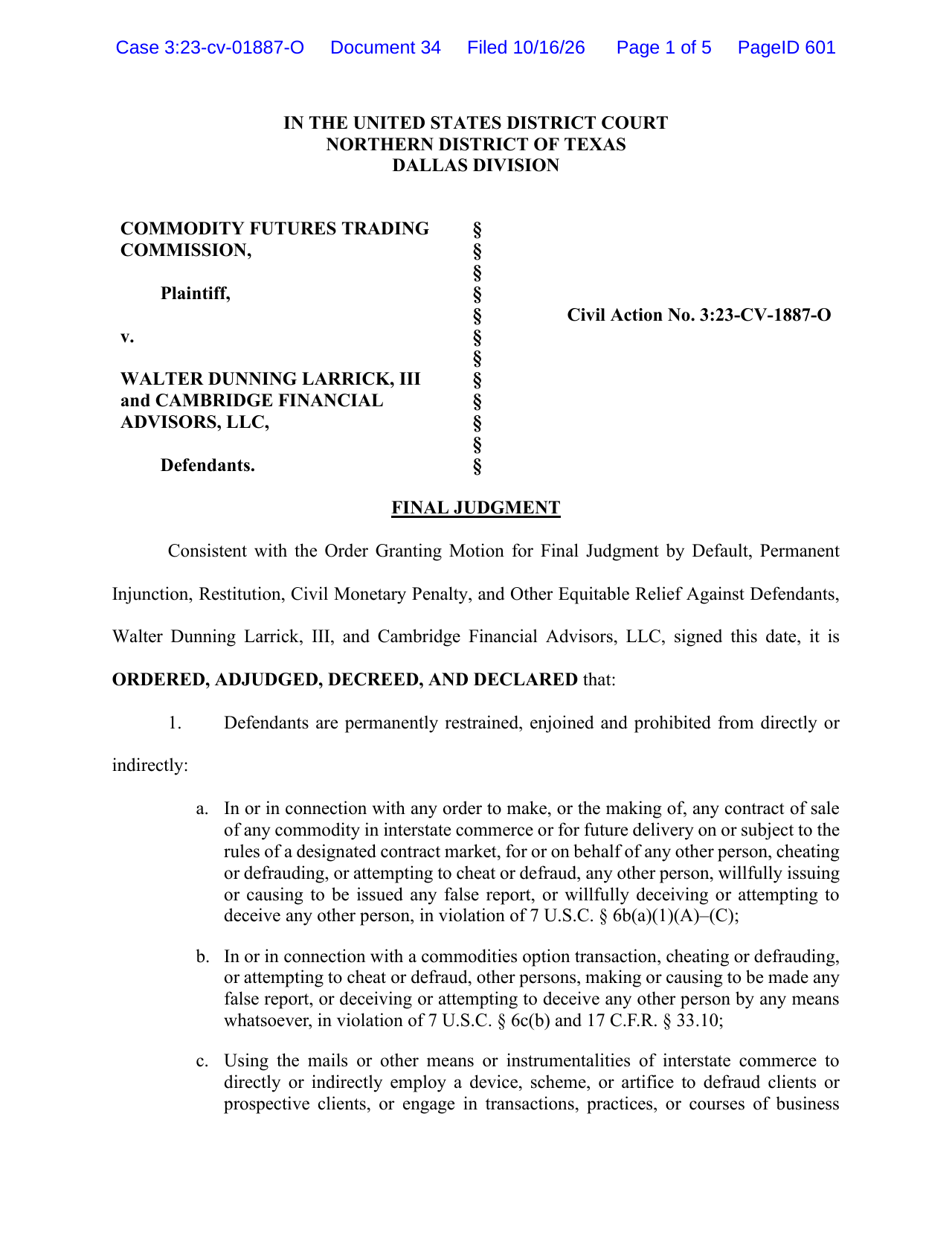
The CFTC announced a default judgment against Larrick and Cambridge Financial Advisors LLC on November 3, 2026, following the court’s October 16 judgment.
The court found misappropriation, false representations and fabricated account statements. The decision supports a firm fraud warning about this specific operation.
A large judgment is not money already recovered
The judgment orders $3,255,875 in restitution and a separate $9,767,625 civil penalty. Adding those figures does not create a $13 million payout fund for participants.
Match the identity before acting on the name
This case concerns the Texas company controlled by Larrick and associated with cambridgefinancials.com. It does not establish wrongdoing by every business using Cambridge in its name.
- Do not send further funds to this operation.
- Preserve bank records separately from portal balances.
- Keep withdrawal requests and replies as evidence.
- Verify recovery communications through independent official contacts.
- Do not pay someone to unlock supposed restitution.
What Changed With the Federal Judgment?
The CFTC’s November announcement reports a concluded civil default judgment, not merely a new accusation or an unnamed investment warning.
The defendants failed to appear or answer. The court accepted well-pleaded allegations as true and entered findings, permanent restrictions and monetary relief.
That procedural description matters without weakening the outcome: this is an entered civil judgment. It is not a criminal conviction or a contested trial verdict.
The final judgment imposes permanent commodity-trading and registration restrictions, alongside restitution and the civil penalty.
There is no sensible investment reason to send fresh trading funds to the operation described in that judgment. A new sales explanation does not undo the court record.
If you receive a proposal using these identities, preserve it rather than debating the salesperson. Compare the claimed business and payment destination with your existing records.
How the Cambridge Financial Advisors Scheme Drew People In
Step 1: A trading representative established contact
The court record describes telephone solicitations, including cold calls, from people presenting themselves as Cambridge trading representatives. The presentation aimed to establish a professional investment relationship.
A confident caller can sound knowledgeable without controlling a legitimate trading account. Treat the ability to discuss commodities as separate from authority to receive your money.
Step 2: A profitable strategy made the deposit attractive
The earlier complaint described promises involving discounted commodity-contract blocks, profitable hedging and access to withdrawals. These were sales representations, not dependable safeguards.
The important question was not whether oil or gold prices could move. It was whether this operator would actually use participants’ funds as represented.
Step 3: Funding instructions moved money into the operation
Participants received emailed instructions for checks or wires to Cambridge bank accounts. The records identify Larrick as controlling those accounts.
A business-named bank account can make a transfer feel established and domestic. Its existence does not verify the promised trading or the final use of deposited funds.
Step 4: Online statements supplied apparent confirmation
The complaint describes emailed login details and an online portal displaying purported trade activity. The court found that the displayed trading and earnings were fabricated.
Detailed financial fields can create confidence because they resemble familiar brokerage paperwork. A convincing layout is still only information supplied by the operator.
Step 5: Withdrawal requests met delay instead of access
The record describes pressure to reinvest and delayed or unanswered withdrawal requests. A growing displayed balance did not mean participants could recover the corresponding money.
When that happens, another promised trading opportunity is not an answer to a withdrawal instruction. Record the request, response and actual payment separately.
Why the Online Statements Are Central to This Case
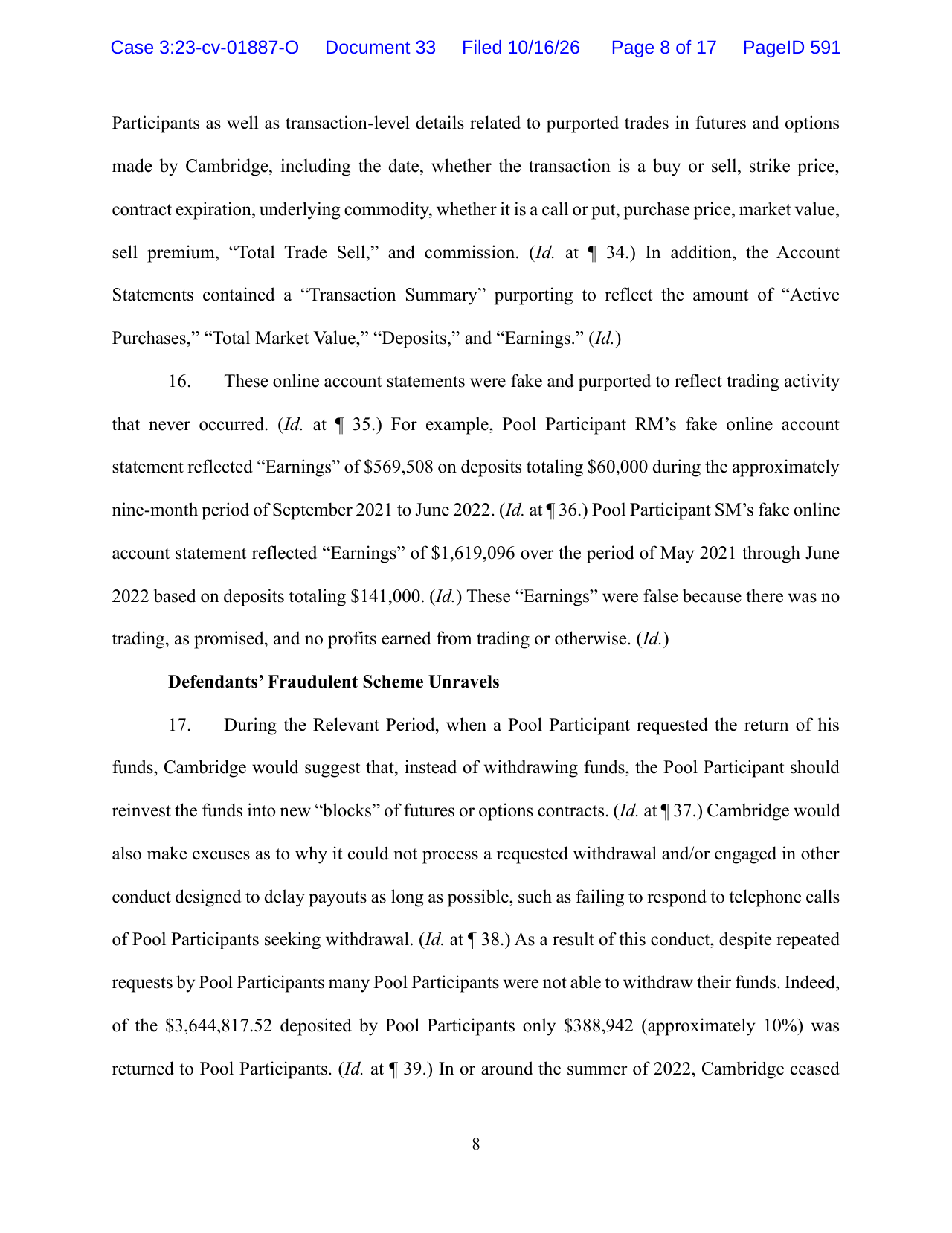
The court’s factual order addresses account statements that purported to show transactions and investment earnings, despite the promised trading not taking place.
This is more than an argument over investment performance. It concerns records used to make participants believe their money was producing trading results.
For anyone reconstructing a loss, the distinction changes how documents should be organized. Keep the operator’s statements, but do not treat their earnings as verified cash.
Start with independently recorded money movements: what you paid, when it left your account, who received it and what money actually came back.
Then keep the claimed account performance in a separate folder. That preserves evidence of the representation without confusing it with a confirmed transaction history.
If a statement includes a contract reference or trading date, preserve it exactly. Investigators can compare those details with other evidence without your altering the original.
Do not discard statements just because they are false. Their value is evidentiary: they can show what you were told and why you made a later decision.
Equally, do not add the portal’s claimed profits to a loss total as if they were independently earned funds. Identify claimed profits separately from your actual deposits.
If you are unsure how to calculate a formal claim, seek guidance for the specific proceeding. A clear record is more useful than an inflated or ambiguous figure.
Who Was Behind This Cambridge Operation?
The relevant company is a specific Texas LLC
The case identifies Cambridge Financial Advisors LLC as a Texas entity formed in 2020. Its corporate existence did not establish registration as a commodity pool operator.
When matching your documents, use the full legal name alongside the individual and domain. A partial name alone is not enough to identify another business.
Larrick controlled the company and its bank accounts
The findings identify Walter Dunning Larrick III as the controlling owner and account signatory. This is a documented connection, not an inference from a shared website template.
Keep any representative names from your own communications too. Explain which identity appeared on a call, email, funding instruction or receipt rather than assuming they were interchangeable.
The historical domain helps distinguish similarly named advisers
The court record identifies cambridgefinancials.com as the operation’s website. It is a historical case identifier here, not a recommended place to log in or submit documents.
If a different website claims continuity or offers to take over an account, verify that assertion independently. A copied name or logo does not prove a connection.
An apparent regulator contact is not independent verification
The earlier complaint describes an approach posing as an SEC representative to reassure a prospective participant. A caller’s claimed official role therefore needs its own verification.
End an unexpected verification call and locate the agency through its official website. Do not let the original salesperson select the person supposedly confirming its legitimacy.
What the Restitution Order Does, and Does Not, Mean
Restitution and a civil penalty serve different roles. The judgment’s restitution figure concerns participant losses; the penalty is a separate obligation imposed on the defendants.
The combined obligations total $13,023,500, before applicable interest. That arithmetic should not be described as money already collected or available for distribution.
The final judgment expressly recognizes harmed pool participants as intended beneficiaries who may seek enforcement. That is not the same as an automatic payment notification.
The documents do not establish that every participant has already received repayment. Do not budget around an expected recovery merely because the court ordered an amount.
If you participated, retain the case number, 3:23-CV-1887-O, with your evidence. It helps distinguish a genuine inquiry about this proceeding from an unrelated recovery pitch.
For questions about enforcing an individual entitlement, consider qualified legal advice. Ask about the proposed work and costs before authorizing representation or sharing a large document package.
Do not interpret instructions telling the defendants how to pay their penalty as instructions for victims to send money. The identity of the payer is crucial.
A court document can be genuine while a message attaching it is fraudulent. Verify the sender and requested action, not just the existence of the attachment.
What to Do if You Sent Money to Larrick or Cambridge Financial Advisors
- Stop additional deposits or reinvestment payments.
Keep new demands, proposed rollovers and payment instructions. Do not send more money to preserve a supposed opportunity or to make a displayed balance withdrawable.
- Build a deposit and repayment ledger.
List dates, amounts, recipient names and bank references. Record actual repayments separately from statement earnings, using your bank’s records where available.
- Preserve the representations and withdrawal history.
Save account statements, marketing material, emails and requests for funds back. Keep original files and note approximate dates for calls you can remember.
- Contact your financial institution about relevant transfers.
Describe the transaction accurately and ask what options remain. Older wires or checks may not be recoverable; do not assume a complaint guarantees reversal.
- Report through independently located official channels.
Identify the defendants and case number, then provide a concise chronology. Use the CFTC’s official complaint route rather than a form sent by an unknown recovery agent.
- Verify any proposed recovery before paying or sharing data.
Check the sender independently and ask what authority supports the request. Keep unexpected messages offering immediate repayment, especially when another payment is demanded first.
The CFTC’s fraud-response guidance provides further information about evidence, reporting and protecting accounts according to the information exposed.
If you reused the investment portal’s password elsewhere, change those other accounts to unique passwords. Sharing an email address alone is not evidence that every account was compromised.
If you disclosed banking access or identity documents, tell the appropriate institution what was shared. Choose protective steps for that exposure rather than replacing everything automatically.
Do Not Let a Recovery Pitch Become a Second Loss
The CFTC warns about recovery fraud targeting people who have already lost money, including demands for upfront payments and government impersonation.
Someone quoting your original loss or naming this judgment may sound informed. Those details do not prove that the person controls recovered assets.
Ask what the proposed payment is for, who receives it and which official process requires it. Check the answer outside the conversation.
Do not install remote-access software or disclose account credentials to someone who says this is necessary for restitution. Keep control of your financial accounts.
A genuine lawyer’s defined professional service is different from an unsolicited promise of guaranteed recovered funds. Verify credentials and obtain the engagement terms before deciding.
Be cautious about public posts listing your full loss, phone number or account identifiers. You can warn others without publishing a ready-made targeting profile.
What This Case Teaches About Future Commodity-Pool Offers
A name, an LLC and a polished statement answer different questions from regulatory registration and custody of investment funds. Check each rather than accepting the package.
The NFA’s free BASIC service supports searches for firms, individuals and pools. Match the full identity rather than stopping at a similar-looking name.
Registration is a check, not a profit guarantee. Review the firm’s background and disciplinary information alongside the actual investment terms and how money is held.
The CFTC’s commodity-pool fraud advisory highlights high-profit, low-risk pitches and recommends asking for independent trading statements, disclosures and fee information.
For a future offer, ask who provides statements independently of the seller. Ask how withdrawals operate before transferring money, not after a dispute starts.
If you cannot verify the answers, leave the investment alone. You do not need to prove a new pitch fraudulent before declining to fund it.
Frequently Asked Questions
Was Cambridge Financial Advisors a scam or just a losing investment?
The court found fraud involving this specific Larrick-controlled operation, including diverted participant funds and fabricated statements. It was not characterized simply as ordinary trading losses.
Does this concern every company called Cambridge Financial Advisors?
The report concerns the named Texas LLC, Larrick and the historical domain identified in the case. A similar business name does not establish shared ownership or misconduct.
Was Larrick convicted in a criminal trial?
The documents discussed here establish a civil default judgment. That is not a criminal conviction, and this report does not claim a criminal sentence.
Will the $13 million judgment automatically repay participants?
The total combines restitution and a separate civil penalty. An obligation to pay does not establish that funds have been collected or that an individual payment is imminent.
Should I trust the balance shown on an old portal statement?
Keep it as evidence of what the operation represented. Reconstruct actual deposits and repayments from independent records rather than treating displayed earnings as verified money.
What should I do about someone offering to recover my loss?
Verify the person’s identity and authority independently. Do not pay an unexpected caller merely because they cite the case or promise access to restitution.
If the person claims to represent an agency or court, use that institution’s independently located official contact details to check the request.
The Bottom Line
The Cambridge Financial Advisors operation controlled by Walter Dunning Larrick III was the subject of an entered fraud judgment, not just skeptical online commentary.
Do not send it further investment money. Preserve independent payment records, retain the false statements as evidence and verify every claimed recovery route before acting.
The most useful next step is a clear record of your own transaction. Another attractive balance or confident promise is not a substitute for actual repayment.

Join the discussion
0 commentsShare your experience or ask a question about this article.
Community experiences
Did this happen to you?
Your experience could help someone recognize the same scam. Submit a private report for our team to review.
I experienced this tooReports are reviewed before publication. Sharing publicly is always your choice.
Discussion
Start the conversation
Have a question or something useful to share? Add the first comment.