


A diamond in secure storage sounds more reassuring than another number on a screen. STIG Group builds its pitch around that feeling.
But before choosing a diamond plan, follow the paperwork behind the ownership, monthly payments, and eventual exit. Those details deserve a much closer look.
Overview
A diamond purchase with an ongoing payment story
STIG ROCK presents a structured diamond purchase, combining ownership documents, storage, a dashboard, and ongoing benefits. It belongs to the publicly presented STIG GROUP brand family.
This matters because the attraction extends beyond buying a gemstone. Buyers also need to understand the arrangements surrounding it, particularly the route back to spendable money.
An Austrian warning names a specific STIG company
Austria’s Financial Market Authority issued an October 1, 2026 warning about STIG International Trading & Gemstone FZCO and stig-international.com.
The FMA notice says that provider lacks authorization for banking services requiring a license in Austria, including the specified deposit-taking activity.
That is a concrete regulatory concern. It is not a court finding that every STIG-branded sale is fraudulent or that every customer has lost money.
Several different protections need separate answers
Don’t let one reassuring document stand in for the entire arrangement. The important questions concern different people, assets, and obligations:
- Which legal company takes your payment and signs your agreement?
- Which particular diamond belongs to you, and who controls its release?
- Who owes the ongoing payments and eventual repurchase money?
- What happens if that company cannot perform?
A gemstone report can help identify a stone. It cannot answer all four questions, and neither can an attractive account dashboard.
What the FMA Warning Actually Changes
The warning identifies a Dubai address at Silicon Oasis A1 and the contact office@stig-international.com. Keep that exact identity when comparing an offer with the notice.
Its scope is Austrian authorization. A foreign business address or a diamond-trading description does not, by itself, answer the activity identified by Austria’s regulator.
For someone approached in Austria, that changes the decision before any discussion of gemstone grades. Do not transfer money into the arrangement covered by the warning.
If a representative says the warning concerns a different company, ask for the actual contracting entity and a written explanation matching the proposed agreement.
A changed logo, website, or sales label is not enough to resolve that question. The recipient of your payment and its contractual obligations matter.
STIG ROCK advertises a Vienna event for November 10, 2026. Anyone attending should read the FMA warning before signing an agreement or transferring money.
Bring the notice and ask how the proposed contract addresses it. A presentation in Austria should make that question easier to answer, not easier to overlook.
How the STIG ROCK Diamond Arrangement Works
Step 1: Join a managed diamond system
The STIG ROCK system page describes registration and a personal introduction before choosing diamond carats. This is a relationship managed through the platform.
Before proceeding, separate an introduction from a binding offer. A presentation can describe possibilities while leaving the signed agreement to define your actual rights.
Keep the version you receive, including attachments. If the promised protection appears only in a message from a representative, ask where the company accepts it contractually.
Step 2: Receive ownership paperwork and storage arrangements
STIG ROCK says the purchase agreement and invoice establish immediate ownership, followed by professional management and a digital overview.
Ownership on paper still needs an identifiable object. Ask for the stone’s report number, its specifications, and the record connecting that stone to your agreement.
If your paperwork refers to carats rather than one individually identified stone, clarify whether you own a whole stone, a fractional interest, or another contractual entitlement.
Those alternatives are not interchangeable when you need delivery. The release procedure should work for the asset you actually own.
Step 3: Understand the separate source of monthly discounts
The site’s FAQ says the buyer’s own diamond stays untraded. A separate diamond is traded to fund monthly contractual purchase-price discounts.
It calls the arrangement a purchase rather than a financial investment. That is the company’s description, not a substitute for a regulator’s assessment.
The practical issue is straightforward: possessing one asset does not automatically finance someone else’s continuing payment obligation. That obligation depends on a separate business activity.
Ask what happens if those trading margins fall short. A fixed contractual amount tells you what is owed; it doesn’t show how payment remains affordable.
Step 4: Choose delivery or the company’s buyback
STIG ROCK describes 12- or 24-month terms, with a choice four weeks before expiry between diamond delivery and a company repurchase at the original price.
These exits involve different risks. Delivery leaves you finding a buyer. Repurchase depends on the company having both an enforceable obligation and available money.
Write down the election deadline now, rather than relying on a future reminder. Ask what happens if you miss it or disagree with a proposed extension.
Also request the complete cost of taking possession, including any applicable shipping, insurance, handling, or import charges. Don’t assume a quoted purchase price includes those costs.
Who Signs, Stores, and Pays?
The legal notice uses a different company wording
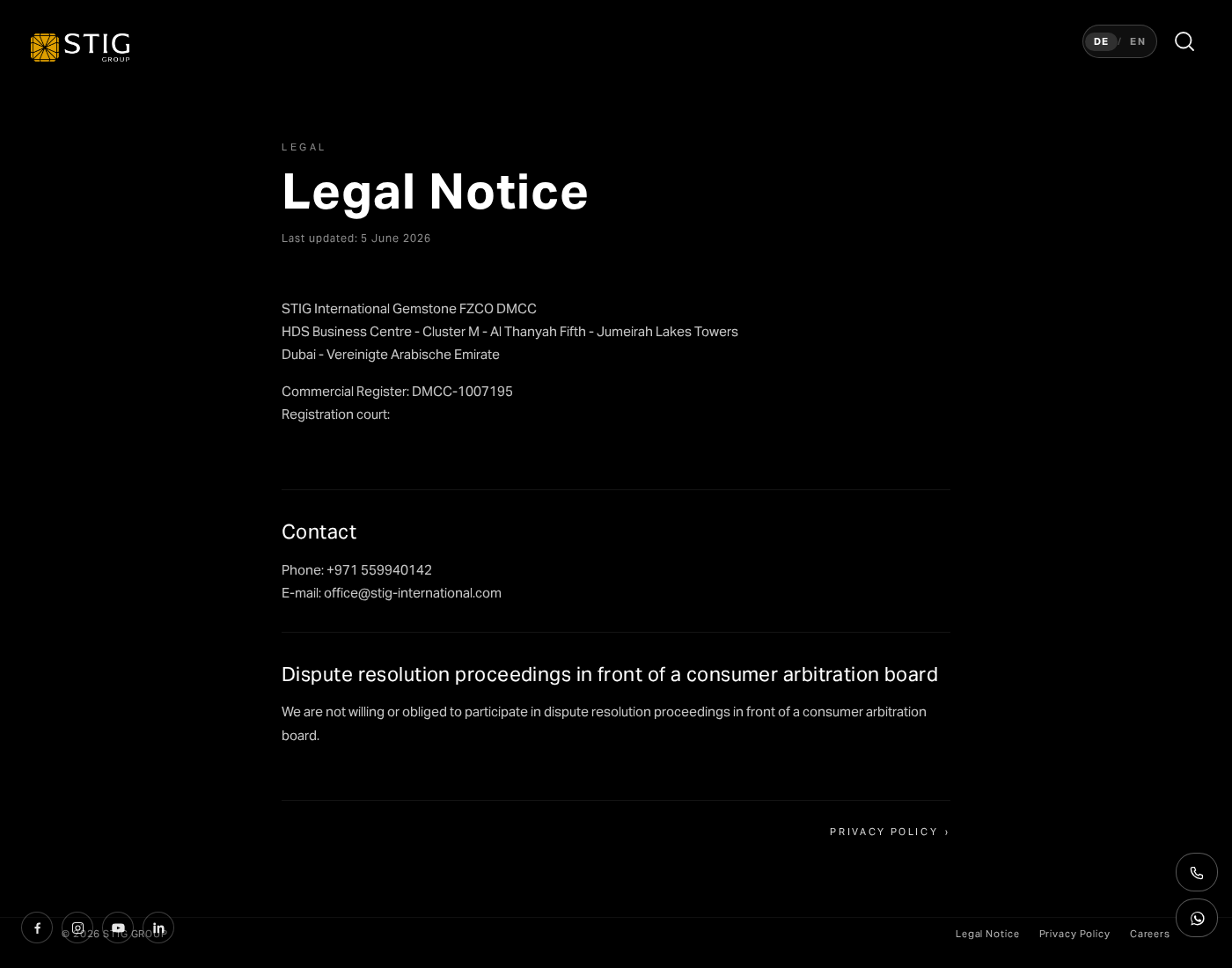
The STIG GROUP imprint names STIG International Gemstone FZCO DMCC, gives DMCC-1007195, and lists an address in Dubai’s HDS Business Centre.
That wording differs from the company name and address in the FMA warning. The imprint also uses office@stig-international.com, linking its contact presentation to the warned domain.
Shared branding and contact details establish a relevant connection to investigate. They don’t justify treating every similarly named company as legally identical.
Your agreement should resolve the identity before payment. If the invoice, beneficiary, and contract name different entities, request each entity’s role in writing.
The imprint also says the company is unwilling or not obliged to participate in consumer arbitration proceedings. Don’t assume that particular dispute route will be available.
Find the agreement’s actual complaint and dispute provisions before purchase. A representative’s promise to sort things out personally is not a defined process.
For a cross-border dispute, an adviser will need the contracting name, payment recipient, agreement, and communications. Collecting those details early can prevent avoidable confusion later.
A trading license answers a limited question
The public pitch invokes Dubai trading and security credentials. Ask for their numbers, issuing bodies, current validity, and the activities each credential actually covers.
A document permitting one business activity cannot be assumed to authorize another. In particular, it does not erase an Austrian warning about Austrian banking authorization.
A representative should explain the proposed transaction’s treatment, rather than simply supplying a collection of official-looking logos.
The storage promise needs a release procedure
For a stored diamond, ask who the custodian is, which document acknowledges your rights, and whether you can contact that custodian through independently verified details.
Then ask who can instruct release. If the seller must approve every delivery, your practical access may still depend on that seller remaining available.
Request confirmation addressed to you, identifying your particular asset and the custodian’s obligation. A brochure describing the vault generally does not establish your individual claim.
Check whether the storage agreement permits substitution or mixing with other stock. If it does, ask how your allocation remains identifiable when you request possession.
Keep the custodian’s verified contact details outside the platform account. The place holding the stone and the website showing its balance may be different services.
Insurance also needs its own questions: whose losses are insured, against which events, and who receives the payout? Stored-property cover is different from a repayment guarantee.
A repurchase promise needs a solvent buyer
A company agreeing to buy something later has created a future obligation. The promise becomes useful when it can be enforced and funded.
Ask whether repurchase funds are separately secured or simply owed by the operating company. Request the actual contract clause rather than a verbal assurance.
If a representative describes the original purchase price as protected, ask exactly which independent party must pay if the company cannot.
A GIA Report Does Not Guarantee Your Purchase Price
STIG’s emphasis on graded diamonds can make the entire arrangement feel independently approved. Gemstone grading has a narrower purpose.
GIA explains that its reports describe a diamond’s dimensions, quality, and identifying characteristics. GIA does not certify or appraise the material.
In particular, the report does not state an appraisal value. It cannot promise that another buyer will pay what you originally paid.
Imagine a buyer paying $5,000 for a stored stone. That is an illustration, not a quoted STIG price or an estimate of any particular diamond.
A matching grading report would help identify that stone. It would not establish a ready buyer offering $5,000 when the owner wants to sell.
Before buying, obtain an independent resale assessment tied to the exact specifications. Ask for a realistic purchase offer, not just an insurance replacement estimate.
The difference matters if company repurchase becomes unavailable. The alternative exit must stand on its own, including the time and costs needed to use it.
Nor should a genuine report be confused with proof of allocation. First verify the report through GIA, then separately confirm that its stone is assigned to you.
The Questions a Monthly Payment Cannot Settle
A successful payment answers whether one payment arrived. It doesn’t reveal the condition of the whole business or secure all future obligations.
Consider three records: the asset-allocation record, the trading accounts supporting ongoing discounts, and the money available for buybacks. Each answers a different question.
An inventory inspection may support the first. It cannot, without additional work, establish the other two.
For the trading explanation, useful information includes realized proceeds, purchase costs, expenses, and the amount remaining after obligations to other customers.
Turnover alone is insufficient. Repeatedly selling an asset can generate large sales figures while leaving much smaller margins after acquisition and operating costs.
Likewise, a dashboard balance records an entitlement within a system. Compare it with withdrawals that actually reach an account or wallet you control.
Don’t respond to uncertainty by buying a larger plan. More money exposed to the same unresolved obligations does not improve the protection of your original purchase.
What to Do If You Have Already Paid STIG
-
Pause additional purchases. Separate your existing position from any new offer. Don’t extend the term merely because a representative says waiting will improve your outcome.
If an election deadline is approaching, request the delivery or repurchase instructions immediately and keep proof of when you asked.
-
Collect the complete agreement. Save your invoice, payment receipt, plan terms, stone-allocation documents, and messages describing monthly discounts or repurchase.
Export account records while available. Keep original files alongside screenshots, and record which company and representative supplied each document.
-
Ask for a written account of your asset. Request the exact diamond identifier, custodian, release conditions, and any outstanding charges.
For a repurchase request, ask for the amount, due date, paying entity, and contractual basis. A clear request is easier to follow than repeated informal conversations.
-
Contact the payment provider promptly. Explain the actual transaction and any missed obligation. Ask what dispute, recall, or other assistance applies to your payment method.
Recovery depends on the circumstances and deadlines. Don’t describe an authorized payment as unauthorized, and don’t assume a crypto transfer can be reversed like a card charge.
-
Use the warning when seeking appropriate help. Austrian customers can bring the FMA notice, contract, and payment details to a qualified adviser or relevant authority.
Describe precisely what happened: an unpaid amount, an undelivered asset, a disputed term, or a misleading statement. Those facts matter more than repeating an online label.
-
Protect the records from recovery pitches. Don’t publish identity documents, bank statements, or complete account credentials while looking for help.
If someone promises guaranteed recovery for a new upfront payment, verify their identity and authority independently before sharing anything or paying again.
Frequently Asked Questions
Is STIG Group a confirmed scam?
The documented finding is an Austrian authorization warning against a named STIG company. It does not establish a criminal verdict against every STIG-branded diamond transaction.
What does the Austrian warning say?
It says STIG International Trading & Gemstone FZCO is not authorized for banking services requiring a license in Austria, including the identified deposit-taking business.
Does owning a real diamond protect every payment?
No. Rights to a stone, ongoing contractual payments, and a future buyer’s ability to repurchase it are separate matters with separate supporting documents.
Does GIA grading prove the diamond’s resale value?
No. GIA describes identifying and quality characteristics. Its report does not supply an appraisal or guarantee a price from a future buyer.
Can a Dubai company registration answer the FMA warning?
Registration and activity-specific authorization serve different purposes. A claimed foreign registration does not establish permission for the Austrian banking activity identified in the notice.
Should I wait for the term to finish before asking questions?
No. Obtain your asset records and exit conditions now. A documented election window is a reason to act early, especially if you already want delivery or repurchase.
The Bottom Line
Do not put money into the STIG Group arrangement covered by the FMA warning. The diamond presentation does not resolve that authorization problem.
For other STIG-branded offers, don’t pay while the contracting entity, asset control, and exit protection remain unresolved. A grading report cannot secure the entire deal.
If you already paid, stop adding funds, preserve the agreement, and request your specific asset and exit records in writing. Escalate missed obligations promptly.

Join the discussion
0 commentsShare your experience or ask a question about this article.
Discussion
Start the conversation
Have a question or something useful to share? Add the first comment.