

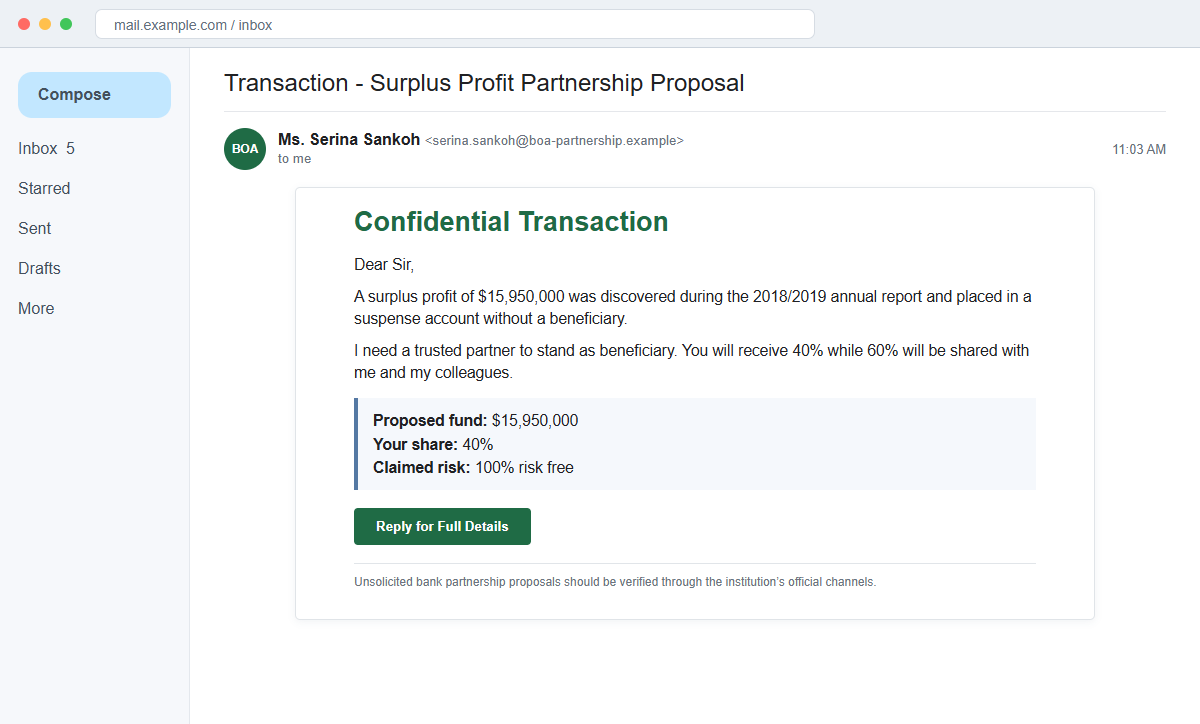
An unexpected email says a bank manager discovered $15,950,000 in surplus profit with no beneficiary. Because her position prevents her from claiming it, she wants a trusted stranger to receive the transfer and keep 40%.
The Surplus Profit email scam is an advance-fee fraud. There is no hidden suspense account, lawful partnership, or multimillion payment waiting for the recipient.
The first message asks only for a reply, which makes the risk feel small. Once a conversation begins, supposed bankers, lawyers, and transfer officers can introduce identity documents, official-looking forms, and a growing list of fees.
Do not respond or send identification. A real bank does not recruit an unknown email recipient to pose as a beneficiary and secretly divide unclaimed funds with employees.
Overview
A confidential bank opportunity promises life-changing money
The sender calls herself Ms. Serina Sankoh and claims to manage a BOA Bank office in Abidjan, Côte d'Ivoire.
She says a 2018/2019 annual report revealed $15,950,000 placed in a suspense account without a beneficiary.
The recipient is offered 40%, while the sender and supposed colleagues keep 60%. The email describes the arrangement as legal, risk free, and suitable for investment in the recipient's country.
The first reply begins a longer confidence scheme
The opening message usually does not ask for a large payment. It asks whether the recipient is interested, allowing the scammer to identify someone willing to continue and tailor the next stage.
Follow-up messages can introduce a bank director, lawyer, auditor, government office, courier, or transfer desk. Each new role adds apparent structure while every participant remains controlled by the same criminal group.
Fees and personal documents become the real objective
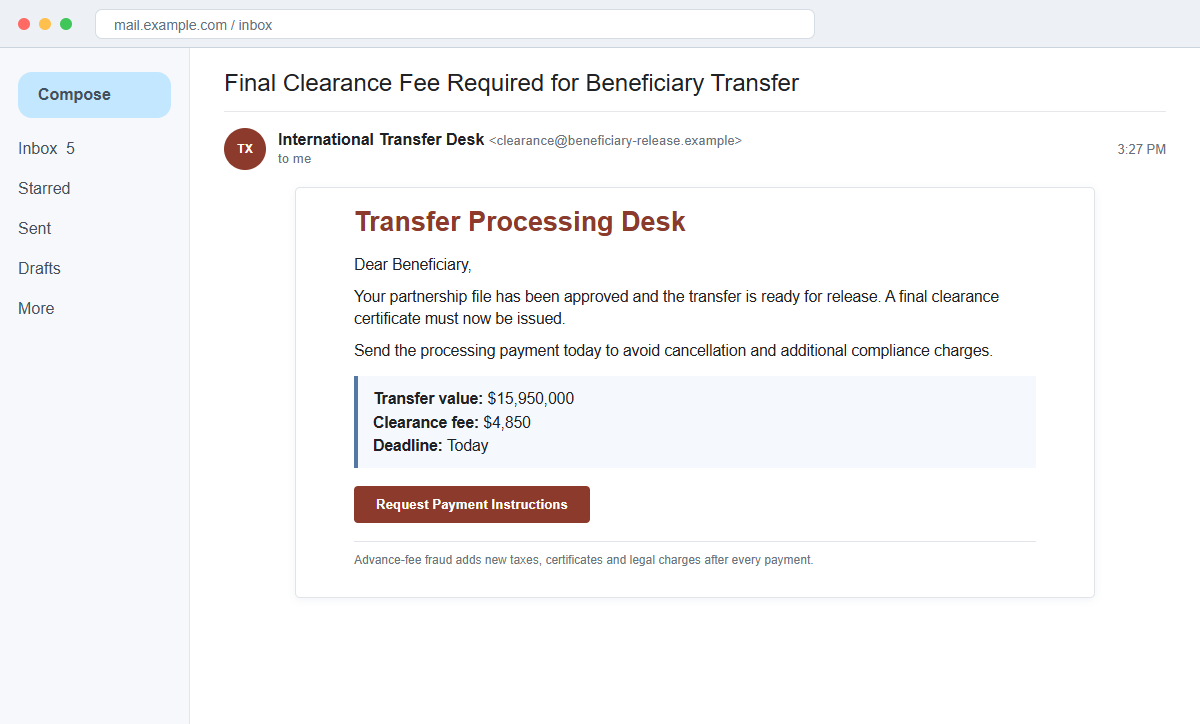
Before the imaginary transfer can arrive, the victim may be told to pay for clearance, tax, insurance, anti-money-laundering certificates, legal stamps, account activation, or international wire processing.
Scammers may also request passport scans, bank details, signatures, addresses, and proof of income. These materials can support identity theft, account fraud, forged documents, and future scams directed at the victim.
- The email is unsolicited and addressed generically.
- A supposed bank manager claims access to unclaimed money.
- The stated fund is $15,950,000.
- The recipient is promised a 40% share.
- Bank employees supposedly keep the remaining 60%.
- The stranger is asked to act as the official beneficiary.
- The arrangement is falsely described as 100% risk free.
- Secrecy is treated as necessary for the transfer.
- Follow-up contacts introduce lawyers and clearance officers.
- Processing fees and identity documents become the real demands.
Why This Is a Classic Advance-Fee Fraud
Advance-fee fraud offers a large reward that can be released only after the victim pays a smaller amount. The promised fund may be an inheritance, lottery, contract overpayment, government grant, dormant account, or surplus profit.
The story changes, but the financial structure remains the same. The victim is asked to send real money now in exchange for access to much more money later, with no independent evidence that the larger fund exists.
Official FTC guidance warns that unexpected unclaimed-fund offers become scams when they request personal information or an upfront processing payment. Legitimate programs do not pressure people to pay before verifying a lawful claim.
A genuine bank cannot quietly assign another customer's money to a stranger because an employee proposes it. Beneficiary status, probate, corporate ownership, account records, and anti-money-laundering controls cannot be replaced by an email partnership.
The promise that the arrangement is risk free is itself a warning. A transaction involving hidden funds, false beneficiary status, secret employee profit, and cross-border transfers would create substantial legal and financial risk even if the story were true.
The scammer relies on the reward being much larger than every individual fee. A $2,000 or $5,000 demand may feel recoverable when compared with a promised multimillion share, so victims continue paying to protect what they already invested.
How the $15.95 Million Story Is Built to Survive Doubt
The use of a precise amount makes the fund sound as though it came from an audit. No verifiable account statement, case number, independent auditor, court record, or authenticated bank notice proves that the balance exists.
The sender explains in advance why she cannot claim the money herself. That detail makes the stranger seem necessary, but it also prevents the victim from asking why a senior employee would involve an unknown person.
A 40% reward is far beyond any legitimate finder's fee or administrative payment. It is calibrated to outweigh suspicion and keep the recipient engaged when paperwork becomes confusing.
The bank name supplies borrowed authority, yet the sender's display name and email signature are not evidence of employment. A real institution must be contacted through details found on its official website, not through the proposed deal.
Follow-up documents may contain seals, signatures, passport images, reference numbers, and banking terminology. Criminals can create, copy, or alter all of those elements. A document is not self-authenticating simply because it looks formal.
The scheme remains profitable when most recipients ignore it. Sending email costs little, and one person who pays several escalating fees can justify a large campaign.
How the Surplus Profit Email Scam Works
Step 1: A bank manager supposedly discovers unclaimed profit
The email claims that an annual financial report uncovered $15,950,000 in a suspense account with no beneficiary. The sender says the money will remain inaccessible without a trusted outside partner.
This narrative creates both scarcity and secrecy. The recipient is made to feel selected for information that ordinary customers do not possess.
Step 2: The recipient is offered 40% for using an account
The sender proposes that the victim become the official beneficiary and receive the transfer for investment. A large share is offered in exchange for cooperation and discretion.
The role is described as simple and legal even though it would require falsely claiming ownership of money. That contradiction is hidden beneath the promised reward.
Step 3: A reply confirms that the target is willing to engage
The scammer asks the recipient to respond for full details. Anyone who replies can be moved from a bulk email list into a personal conversation.
The criminal may ask about occupation, citizenship, banking access, family, and financial needs. These details help customize pressure and determine how much money the target might send.
Step 4: Fake officials and documents create a transfer process
A lawyer, transfer officer, compliance department, or bank director may join the thread. The victim receives forms, certificates, identity documents, and reference numbers that appear to confirm progress.
Every contact should be considered unverified until reached through independent institutional channels. Multiple email addresses do not necessarily represent multiple real organizations.
Step 5: Personal and financial information is collected
The victim may be asked for a passport, utility bill, signature, bank statement, account details, telephone number, and proof of address. The request is framed as beneficiary registration or compliance.
Those documents can be reused for identity theft, fraudulent account applications, social engineering, and convincing scams aimed at the victim's bank or contacts.
Step 6: A clearance fee blocks the imaginary payment
Just before release, a tax, insurance premium, legal charge, transfer fee, or anti-money-laundering certificate becomes necessary. Payment may be requested by wire transfer, cryptocurrency, money-transfer service, or gift card.
After one fee is paid, another obstacle appears. The victim is told that abandoning the process would forfeit both the promised share and every amount already sent.
Step 7: The criminals disappear or continue with recovery fraud
No $15.95 million transfer arrives. The scammers may stop responding when the victim refuses another payment or continue inventing emergencies as long as money is available.
Later, another person may claim that investigators recovered the fund and need one final release fee. This follow-up uses the original loss and documents to make a second advance-fee scheme feel credible.
Company and Checkout Checks
Contact the bank through its official website
Find the institution's genuine domain and telephone number independently. Ask its fraud department whether the employee, account, and transaction reference exist without using any address supplied in the email.
Do not forward sensitive documents to the proposed manager merely because a switchboard confirms that the bank itself is real.
Ask for a lawful basis for beneficiary status
A real claim requires a documented relationship to the account holder, estate, contract, or property. An unknown recipient cannot become entitled to funds through a private arrangement with an employee.
If the proposal depends on pretending to be a beneficiary, stop. The requested act is neither safe nor legitimate.
Verify every fee with an independent authority
Do not send tax, clearance, insurance, legal, or transfer payments to an individual or intermediary. Contact the relevant bank, regulator, court, or tax authority through published details.
A fee that must be paid before an unverified reward is released is the central pattern of advance-fee fraud.
Protect identity documents as carefully as money
A passport scan, bank statement, signature, and utility bill can have long-term value to criminals. Do not send them merely to prove readiness for a secret transaction.
Ask how the organization verified the claim, why each field is needed, how the data is protected, and what legal process authorizes collection.
Warning Signs to Check Before You Act
- A bank employee contacts a complete stranger about hidden money.
- The fund supposedly has no beneficiary or lawful owner.
- The recipient is asked to pose as the beneficiary.
- A 40% share is offered for minimal work.
- Employees plan to divide the remaining 60%.
- The transaction is called 100% risk free.
- Secrecy is emphasized as a condition of payment.
- The sender's role is not confirmed through the bank.
- Official-looking documents arrive only after the victim replies.
- Passport and bank details are requested before any verified claim.
- Clearance, tax, legal, or insurance fees appear before release.
- Every payment creates another final obstacle.
A legitimate institution does not need an unknown person to conceal employee involvement, falsify beneficiary status, or pay private fees before receiving unverified funds. Delete the proposal even if the paperwork looks convincing.
What to Do if You Have Fallen Victim to This Scam
- Stop communicating and do not send another payment. Block the addresses and telephone numbers after preserving evidence. Do not argue with the scammers or warn them which details revealed the fraud, because that information helps them revise the story.
- Contact the payment provider immediately. Tell the bank, card issuer, wire service, money-transfer company, cryptocurrency exchange, or gift-card issuer that the payment supported a scam. Ask whether a recall, freeze, dispute, or destination alert is still possible.
- Preserve the entire conversation and payment trail. Save original emails with headers, chat logs, telephone numbers, voice messages, documents, receipts, beneficiary names, account numbers, wallet addresses, and transaction hashes. Keep copies outside the compromised mailbox.
- Report exposed identity documents. If a passport, driver's license, tax identifier, bank statement, or utility bill was sent, contact the issuing authority and follow its identity-theft process. Consider a credit freeze or fraud alert where available.
- Protect bank and email accounts. Change any password shared or reused, enable strong multi-factor authentication, revoke unknown sessions, and tell the bank which account details the criminals received. Monitor for new payees, transfers, and password resets.
- Check for unauthorized accounts and applications. Review credit reports, bank notifications, mobile accounts, and government-benefit records for activity you did not initiate. Continue monitoring because identity information may be used months later.
- Warn family members and workplace contacts. Scammers may impersonate the victim, claim an emergency, or reuse the supposed investment story. Give close contacts a separate channel for confirming unusual requests.
- Scan files received during the negotiation. Run a full Malwarebytes scan or use another trusted security product if any attachment, archive, document, or remote-support application was opened. Remove unfamiliar software and update the device.
- Block repeat scam pages and malicious advertising. AdGuard or another reputable DNS and content blocker can stop some known fraudulent domains and advertisements. It cannot validate every email, so continue checking senders, links, and payment demands manually.
- Report the advance-fee scheme. Notify the national fraud authority, local police when money or identity documents were lost, the impersonated bank, and the platforms used for email or payment. Include the amount, dates, accounts, and preserved messages.
- Ignore recovery agents who request a fee. A person who guarantees the return of the $15.95 million or the money already lost may be the same group using a new identity. Do not pay for private access, tracing codes, certificates, or hacker services.
Frequently Asked Questions
Is the Surplus Profit email legitimate?
No. It is an advance-fee scam built around imaginary unclaimed bank funds. The recipient has no lawful claim to $15,950,000 and will not receive the promised 40% share.
Why does the sender claim to be a bank manager?
The role provides authority and explains supposed access to confidential records. A title and signature are easy to invent and must be verified through the bank's independently obtained contact details.
What happens if I reply without sending money?
The scammers learn that the address is active and may begin a tailored conversation. Stop responding, preserve the messages, block the sender, and expect additional approaches under new identities.
Why do the fees keep changing?
The promised fund does not exist, so every payment is the objective. New taxes, certificates, penalties, and emergencies are invented to extract more while the victim hopes to recover earlier payments.
Can official-looking bank documents be trusted?
Not by appearance alone. Seals, letterheads, signatures, and identity cards can be copied or fabricated. Verify the claim through the real institution, regulator, court, or other authority.
Can a recovery company get the payments back?
A bank or payment provider may sometimes recall or freeze a recent transfer, but no private stranger can guarantee recovery. Never pay an unsolicited agent an advance fee.
The Bottom Line
The Surplus Profit email scam promises a 40% share of $15.95 million to make identity requests and later clearance fees appear small.
There is no lawful suspense-account partnership. A real bank does not ask a stranger to pose as a beneficiary, hide employee involvement, or pay private charges before an unverified transfer.
If money or documents were sent, stop immediately, contact every payment and identity provider, secure accounts, preserve the evidence, report the fraud, and reject anyone who promises recovery for another fee.

Join the discussion
0 commentsShare your experience or ask a question about this article.
Discussion
Start the conversation
Have a question or something useful to share? Add the first comment.