


Team50K7 invites visitors to join a private crypto community with a free enrollment and a $19 first entry, so we read its public rules and tested the payout arithmetic ourselves.
The numbers are harder than the pitch: payouts need crowds of new entrants, most of each payment is locked for upgrades, and no company or contract is named.
Overview
What Team50K7 Sells
We opened team50k7.com and found a staged board system: enroll free, pay $19 in USDC on the Polygon network, and climb six paid stages up to a $10,000 entry.
Each stage is a board of seats. When enough newcomers fill the seats beneath a member, the board closes, pays out and moves that member up.
The site calls this a community participation platform with seven activity streams, and it repeats that participation does not guarantee earnings.
What the Checks Found
The site publishes its own stage rules as data, and our arithmetic on them shows that one completed $19 board leaves $40.20 after fees and reserves.
Completing the top board needs 46,656 entries at the bottom, which is $886,464 of $19 payments, while the live site counts 300 members.
The site promises a ledger that anyone can verify, yet its own ledger page admits that older signatures can only be checked by its server.
No company, address or smart contract is named, and the team’s earlier site put its size at 2,500 members and $2.5M contributed.
What We Could and Could Not Verify
Here is where the evidence stands after our checks:
- Verified by us: the entry prices, the stage rules, the board counts, the ledger notice, the domain dates and the earlier brand.
- Not found: a named legal entity, a postal address, governing law, a smart contract or a public deposit wallet.
- Not verified: where members’ USDC actually lands, whether any member has withdrawn money, and who owns the platform.
Our advice is not to join, and to read the section on what to do if you already paid.
What the Home Page Offers
We started where a visitor starts, on the home page, which announces a Global Community Participation Platform and a private, decentralized community leveraging seven activity streams.
The same page offers three buttons: Get Started for Free, Fund Your V2 for $19, and Watch 3-Minute Overview, beside an embedded video that runs 2:26.
The video’s opening frame shows a man in a suit with a small AI label in the corner. We did not play it, so we draw no conclusion.
Membership is billed as invitation or reviewed application only, yet the public status endpoint shows registration open, and the free button is offered to everyone.
No figure for member earnings appears. The slogan is Plug, Play, Profit, and smaller type adds that participation does not guarantee earnings.
Below the headline sit seven streams named Financial, Health, Tokenization, Trading, NFT, Travel and Education, but the board system, not these streams, is what the entry fee funds.
The Payout Rules Behind the Pitch
The page loads its stage rules from a public data address, so we read them as a buyer’s calculator would, without logging in or entering anything.
That data is stamped with the version BOARD-COMPLETION-2026-08-29, five weeks after the first boards were opened on July 23, which suggests the payout rules changed once the boards were live.
It lists six paid stages, each with a fixed entry and a board that closes when its payline seats are full. These are the figures we read:
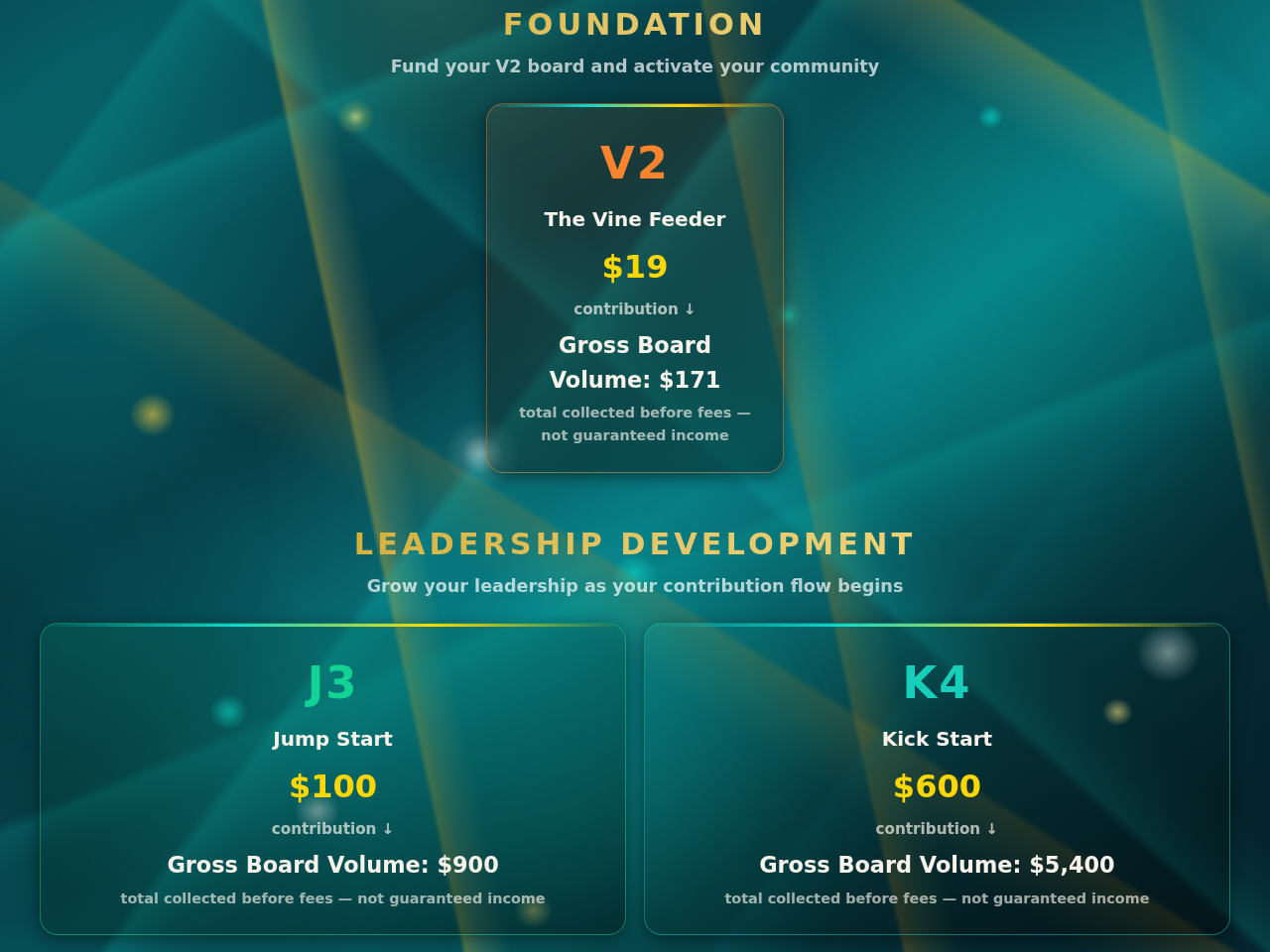
- V2, $19 entry: a 13-seat board with nine payline seats, closing on $171 of contributions.
- J3, $100 entry: the same 13-seat shape, nine payline seats, closing on $900.
- K4, $600 entry: the same shape again, closing on $5,400.
- S5, $2,500 entry: a smaller board with four payline seats, closing on $10,000.
- C6, $5,000 entry, named C7 in other places: four seats, closing on $20,000.
- G7, $10,000 entry: four seats, closing on $40,000.
Every contribution loses a 5% operations fee, and each closing board also pays a 2% sponsor share to whoever enrolled the member.
Two further slices are held back before the member sees anything: a re-entry seat in the same stage, and a reserve that pays for the next stage.
The V2 board shows how this works. The nine entries bring $171, and the data lists $8.55 for operations and $3.25 for the sponsor.
It then sets aside $19 for re-entry and $100 for the J3 entry, which leaves $40.20, labeled in the data as $38.17 of return and $2.03 spendable.
So the member who waited for nine people to join behind them is left with $40.20, and $119 of the $171 stays inside the system as future entries.
Our Arithmetic: Entrants Needed per Payout
We then asked how many people must pay in at the bottom for one member to be paid at each stage, using only the site’s own board sizes.
If every upper-stage entry is funded by the reserve from the stage below, as the stage data intends, outside money enters only at the $19 level, and the counts multiply.
A V2 board needs nine entries. A J3 board needs nine J3 entries, each one a finished V2 board, so it rests on 81 entries at $19.
Climbing further, K4 rests on 729 entries, S5 on 2,916, C6 on 11,664, and one completed G7 board rests on 46,656 entries at the bottom.
Those 46,656 entries add up to $886,464 of $19 payments, to produce one board that leaves its top member $32,840 after fees and reserves.
The live site counts 300 members, which is 0.6% of the entries one top board needs, and we found one closed board in total.
The same rules cap how many people can ever be paid. With nine payers per board, at most one entrant in nine, or 11.1%, can complete a V2 board.
The re-entry seat lets each finished board supply one of the nine payers for the next, so the ceiling rises to one in eight, or 12.5%.
That leaves at least 87.5% of $19 entrants without a completed board, and at the top the odds fall to one entry in 46,656, about 0.002%.
This is a simplification, because a placement agent can fill seats from a holding tank, but it uses the site’s own board sizes and reserves.
Members who buy Fast Track or a step-up package pay for upper-stage seats directly, so real boards may fill with fewer people paying more.
Advertised Vaults Against Cash Left After Fees
The Terms of Service advertise a reward vault for each stage, up to $150 for V2, $900 for J3, $5,400 for K4 and $40,000 for G7.
Those headline amounts are close to the gross board volume that the Levels page labels as total collected before fees, and not income.
We compared them with the money left after fees, re-entry and the next-stage reserve, and the gap is wide, as these figures from the stage data show:
- V2: $171 collected, $119 reinvested, $40.20 left, which is 27% of the $150 vault.
- J3: $900 collected, $700 reinvested, $129.35 left, which is 14% of the $900 vault.
- K4: $5,400 collected, $3,100 reinvested, $1,670.90 left, which is 31% of the $5,400 vault.
- S5: $10,000 collected, $7,500 reinvested, $1,335 left, which is 13% of the $10,000 vault.
Spread across the nine entrants who fund a V2 board, each $19 payment splits into $0.95 of operations fee and $0.36 of sponsor share.
The rest is $11.11 toward the J3 reserve, $2.11 toward re-entry and $4.47 of potential cash, so a buyer’s best average cash return on $19 is 23.5%.
That average assumes every board closes. A buyer sitting in a board that stalls gets none of it, and the stalled boards are the next thing we counted.
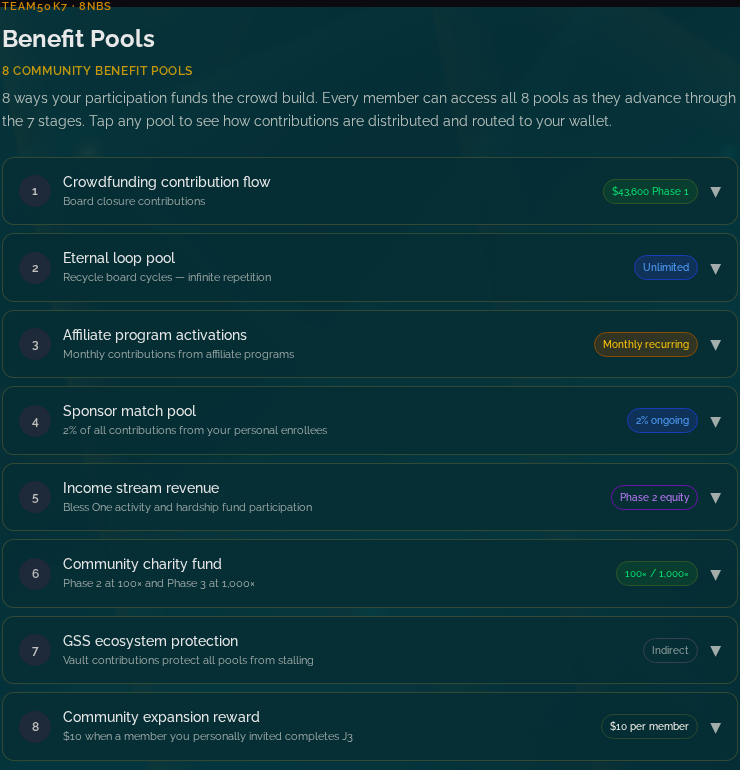
The Benefit Pools page stretches the story further, with a Phase 2 total of $4,360,000 and a three-phase total of $47,999,600 labeled full potential.
It also lists an eternal loop pool with no ceiling and no expiration, but we found no rule in the stage data that could pay such amounts.
What the Live Boards Show
The site publishes a count of its boards, so we pulled the public list and counted the seats ourselves, once and without refreshing.
The statistics address showed 300 members, 274 of them active and 26 waiting in a holding tank, with 203 open boards and one closed board.
The board list returned 200 boards, and 172 of them were empty, which leaves 28 boards with any member in them, mostly at the V2 and J3 stages.
The page code counts a board’s seats as the listed number minus one, and by that rule 12 boards sit at 11 of 12 seats.
Seven of them are V2 boards and five are J3 boards, each one seat from closing, and they were opened between July 23 and July 30.
At least seven boards were created within the same six seconds on July 30, which looks like a bulk load, and the site mentions that earlier members are being migrated.
The Community Impact fund, which the site presents as growing from every board close, showed $0 raised against a $1,000 goal when we looked.
Growth looks slow too. Among the 100 newest ledger blocks, covering two weeks, one recorded a new member, and the activity counter showed one new member that week.
A Ledger That Outsiders Cannot Verify
The home page promises a tamper-evident ledger signed with HMAC-SHA256 that anyone can verify, so we opened the public ledger and tried to check it.
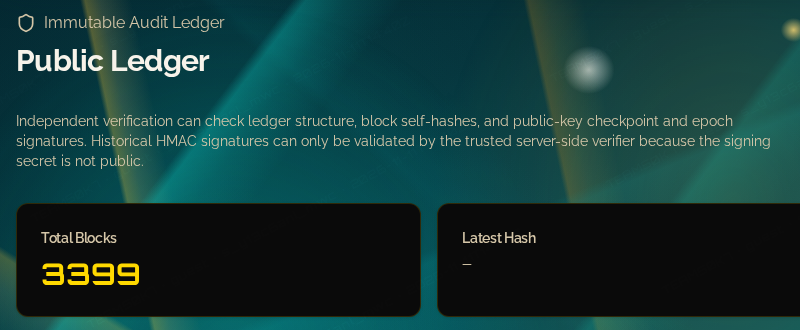
The ledger page itself contradicts the promise: historical signatures can only be validated by the trusted server-side verifier, because the signing secret is not public.
An HMAC is a keyed code, so only the holder of that key can confirm it. That makes the ledger a record the operator checks, not one anyone can audit.
The recent-blocks address we read returns five fields per block: number, event type, block hash, a pseudonymous actor code and a time. It returns no previous hash and no signature.
From that data we could not recompute a single hash. The page counts 3,399 blocks while the newest number is 3,419, and we did not press Run Verification.
The events are revealing. In the 100 newest blocks, 71 are logins, and the rest include two administrator repositionings and one legacy paid recovery in November.
The same window holds three refresh-token reuse alerts, one brute-force alert and one impossible-travel alert, plus two failed backup restore checks and one red offsite snapshot alert.
An administrator action that moves positions inside a ledger sold as immutable, and failed backup checks on an operator’s own security feed, are facts a member should weigh.
Locked Funds, Refunds and Withdrawals
We read the Terms, the Contribution and Refund Policy and the Risk Disclosure as a buyer would before sending USDC.
The contribution rules call every payment peer-to-peer, and the Terms add that the platform does not pool funds, yet the stage data takes a 5% operations fee on each one.
Other rules point the same way: the team verifies each payment before placement, and approved withdrawals are processed within five business days of a request.
A purely peer-to-peer system would not need an operator to approve withdrawals, so we read these rules as describing an operator that handles the money.
Only reward-vault balances can be withdrawn. Progression funding is permanently locked, and a milestone release at S5 waits until the next-stage vault reaches $5,000.
The refund rule is narrow: a full refund minus fees only within 24 hours of entry and before placement is confirmed, and none after placement.
Starting a chargeback after placement counts as a breach of the Terms and can bring suspension and recovery action, a clause that stops no card issuer from reviewing your dispute.
USDC sent on Polygon cannot be reversed by anyone, and the Terms leave the governing law blank until verified legal information is available.
The Risk Disclosure adds that contributions may be lost entirely, and that stage releases may be delayed indefinitely with no committed timeline.
Where the Money Goes
The FAQ names one rail: the only accepted method is USDC on the Polygon network, with no other coins, networks or payment methods.
The Risk Disclosure instead speaks of optional cryptocurrency rails alongside conventional contribution methods, so the two documents disagree on what the platform accepts.
The member screens in the site’s code disagree with both.
The automatic payment panel offers five routes: USDC on Polygon, USDT on TRON, USDT on BNB Smart Chain, BNB and BTC.
For each payment, the panel creates a quote with a deposit address and locks the amount at the current exchange rate.
Its error names refer to a provider key and a provider notification secret, which points to an outside payment processor.
We read that as payments passing through a processor’s addresses, which is not the member-to-member transfer that the Contribution Policy promises.
The status messages show staff reviewing underpaid, overpaid and late payments by hand, with extra amounts held for review.
The withdraw screen asks for a distribution request, shows earnings only after admin approval, and pays out only in USDT on BNB Smart Chain or USDC on Polygon.
We looked for the smart contract the pitch hints at. The page code calls the system smart-contract inspired, and we found no contract address anywhere in it.
We also found no public deposit wallet, since addresses appear only after sign-in and we created no account. So no explorer view of balances or flows was possible.
If the money sat in an audited contract, anyone could read the balances and the rules. Here the rules live in a database that the operator controls.
Code and Predecessors
We read the site’s JavaScript as plain text, and it holds more than a landing page. It is a multi-tenant platform, and Team50K7 is tenant number one.
A public branding address returns the tenant record with the slug team50k7, and a sign-up page offers other teams a Starter, Growth or Enterprise workspace.
The same branding record lists a support email on 8nbsteam50k.com, a domain registered on June 21, 2023, almost three years before team50k7.com existed.
The domain team50k7.com was registered on April 29, 2026, with GoDaddy, and it is served from Google’s cloud. Its home page file was updated on the day we looked.
An administrator tool bundled into the public code carries a pre-filled list of nine personal email addresses, which we have not reproduced here.
We then opened an archived copy of the earlier 8nbsteam50k.com page from April 30, 2024. It was a WordPress site for home-based entrepreneurs.
That page put the group at a crowdfunding community of over 2,500 members who contributed over $2.5M, and it lists two business numbers that appear on today’s site too.
The old page also priced paying members at $9.95 a month plus a one-time $40 fee, so the brand has changed products while keeping its contacts.
The old domain now answers with a server error, and a third domain, team50kcard.com, was registered in 2024 and shows only a near-empty Team $50K Card page.
How the Cycle Works
Step 1: A free seat and a $19 entry
You enroll free at the C1 stage, then send $19 in USDC and submit a transaction hash for the team to verify before placement.
The Fast Track option costs $119 and pre-funds the J3 seat. The step-up packages start at $719, which is exactly the V2, J3 and K4 entries added together.
Step 2: Two referrals before you advance
Before moving up, a member is told to bring two people, and a placement agent may fill the third lane from the holding tank.
That rule makes recruiting the engine of progress, because a board closes only when new entrants keep filling the seats below.
Step 3: Waiting for the board to fill
Seats fill strictly left to right, so a member’s board waits for newcomers one at a time, and our count found boards parked one seat short for months.
No page gives the time a typical V2 board takes to close, and the only closed board we could find is a single case.
Step 4: Reserves pay for your next entry
When a board closes, $100 of the V2 payout goes to the J3 reserve and $19 to re-entry, so most of the first payout is spent before you see it.
Step 5: Only the vault can be withdrawn
The remainder is small beside the headline vault, and the Terms lock progression funding permanently and delay milestone releases until the next vault fills.
Step 6: Higher stages need far bigger crowds
The $600 and higher stages multiply the crowd required, and our table shows 729 bottom entries for K4 and 46,656 for G7, which no 300-member network can supply.
Who Runs Team50K7?
The company named in the documents
The Terms of Service, Privacy Policy and Risk Disclosure all use the name TEAM50K7 and never name a legal entity, a postal address or a jurisdiction.
The home page presents Michael Irvin as Master Trainer and Yahsmine Enoch as Chief Strategist, both co-founders, but no page connects either name to a registered company.
Where the address and registration lead
The only contact in the policies is support@team50k7.com, and the Terms promise to name the governing law later. We found no address to send a written notice to.
The earlier site carried the 8 New Beginnings name, and we could not confirm a registration under it.
The one registry aggregator we tried returned a bot check, which we did not work around.
The domain, platform and reviews
RDAP shows team50k7.com registered on April 29, 2026 with GoDaddy name servers, and the oldest board in the public list opened 85 days later, on July 23.
The platform is a shared multi-tenant system, so the code tells us who built the software, not who controls the member funds.
Shared phone numbers and a support email tie the new site to the earlier brand, which shows a common setup but not proven common ownership.
What we could not confirm
We did not register, pay, call a number or play the video, so we cannot judge support, withdrawals or what members actually received.
We also found no regulator order about this program or the earlier brand, which means only that we found none, not that none exists.
What to Do Before You Join or After You Paid
-
Do not send more USDC. Pause every upgrade, re-entry and gift purchase until you have the written rules and a named company.
-
Save proof now. Keep your member code, ledger references, transaction hashes, wallet address and screenshots of the Terms and refund rule.
-
Ask for a refund in writing. If you paid within the last 24 hours and are not placed yet, email support@team50k7.com and quote the refund rule.
-
Request what is withdrawable. Ask the platform for any reward-vault balance, then record the date, amount and reply for every request.
-
Stop recruiting. Do not invite friends or relatives, because the board needs new entrants and you would be asking them to risk money.
-
Ask the sponsor questions. Ask the person who invited you how much they withdrew in cash, as the FTC suggests, and get the answer in writing.
-
Report it. File at ReportFraud.ftc.gov, and also tell your state securities regulator, naming the domain and the promises you relied on.
-
Protect your accounts. Change passwords used on the platform, and never share your seed phrase or approve a wallet connection to recover money.
Frequently Asked Questions
Is Team50K7 a scam?
We cannot call it one as fact. It offers no named owner and no verifiable ledger, and our arithmetic shows that few entrants can ever be paid.
How much does Team50K7 cost?
Enrollment is free, the first paid entry is $19 in USDC, the Fast Track bundle is $119, and the stages climb to $10,000.
Can I get my money back?
Only within 24 hours of entry and before placement is confirmed. After placement, the rules refuse refunds, and a USDC transfer on Polygon cannot be reversed.
How many members can be paid?
By our arithmetic on the site’s own boards, at most one entrant in eight can complete a V2 board, and about one in 46,656 can complete the top board.
Is there a smart contract?
We found none. The code calls the engine smart-contract inspired, the ledger is a database record, and no public wallet or contract address is shown.
Is Team50K7 a pyramid scheme?
We cannot rule on that. Payouts depend on new entrants filling seats, which is the pattern the FTC asks buyers to test, and a regulator or court would decide.
The Bottom Line
Do not join Team50K7: a completed $19 board leaves $40.20, most payments are locked for upgrades, and no company, contract or checkable ledger stands behind it.
If you want an online income, choose a business with a named owner, real customers and a public income disclosure, and read those documents before you pay anything.
If you already joined, stop sending USDC, save your proof, request any withdrawable balance and any eligible refund in writing, and report it to the FTC and your state regulator.

Join the discussion
0 commentsShare your experience or ask a question about this article.
Discussion
Start the conversation
Have a question or something useful to share? Add the first comment.