


Delta One AI tells visitors that an automated trading engine will earn them a little every day, and that every contract ends once their money has doubled.
We read what the site publishes about how it works, followed its domain records, and found a second website that calls the first one an unauthorized copy.
Overview
What Delta One AI sells
The site, deltaoneai.com, presents Delta One as a multi-strategy trading engine that runs arbitrage, high-frequency and leveraged strategies across nine exchanges around the clock.
Visitors register, buy a Module with USDT, and are told the engine will credit rewards every day until the Module has delivered twice what was paid.
A separate Ambassador back office pays commissions on the Modules held by the people you invite, and its login describes access as private and by invitation.
What the code and the records show
The landing page starts the offer at $1,000, calls a 200% cap the finish line, and adds that earnings are never guaranteed.
The back office says credits cannot be withdrawn and the purchase price is not refundable, so rewards are the only way a buyer’s money can return.
The domain was registered on September 17, 2026, and we found no company, owner, address, license or audit named anywhere on the site.
A second site, delta-one.app, calls deltaoneai.com an unauthorized copy and says all Delta One business is paused, yet deltaoneai.com was still updating its files in November.
What we could and could not verify
Here is where the evidence stands after our checks:
- Verified by us: the offer text, the 2x cap, the no-refund rule, the recruiting commissions, the domain dates and the rival site’s notice.
- Not found: a company name, an owner, a license, an audit, a smart-contract address or any record of trading performance.
- Not verified: whether the engine trades at all, whether any member has been paid, and which of the two sites came first.
Our advice is not to register, deposit or recruit anyone until an identifiable company shows verifiable results, and the response section below covers anyone who already deposited.
What the Landing Page Promises
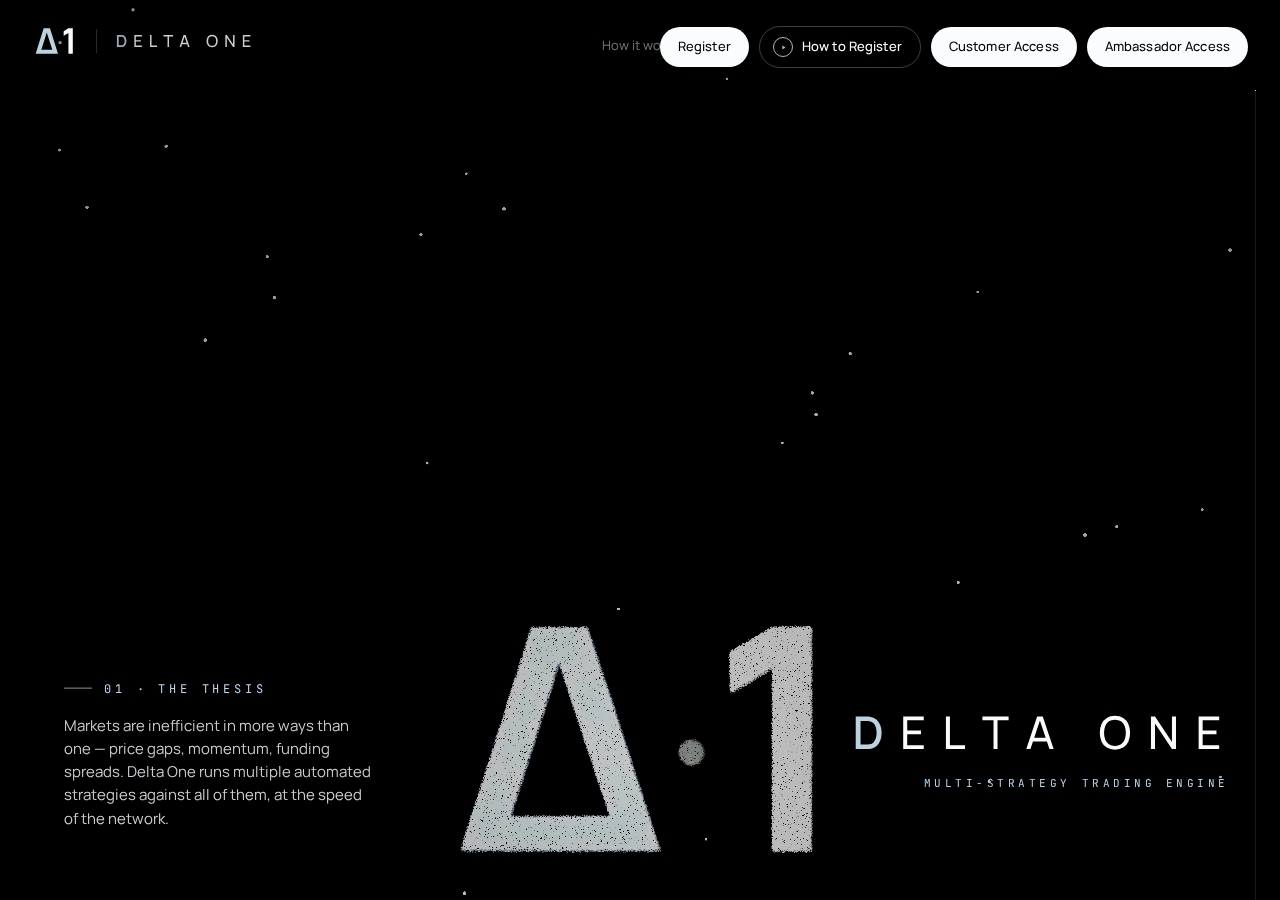
The home page is a scroll animation: a speckled Delta One logo floats among stars while a panel explains that markets are inefficient in more ways than one.
Scrolling plays one example trade: bitcoin costs $67,328 on Exchange B and $67,420 on Exchange A, so the bot buys low and sells high at once.
The gap is $92, or about 0.14% of the buying price, so combined trading fees above that figure would turn this example trade into a loss.
The page says the same engine watches nine exchanges in parallel but never names them, so a visitor cannot check the prices, volumes or fees behind the example.
Three strategies follow: arbitrage, high-frequency trading and leverage, the last of which can amplify a position inside limits for position size, stop-loss, take-profit and maximum drawdown.
The closing scene makes the offer itself: your money rides the engine, it earns a little every day, and you can start from $1,000.
It then adds that every contract has one finish line, a 200% cap, and that once you have doubled your money the contract is complete.
A last line says a team of specialized agents runs the engine around the clock and that earnings are never guaranteed.
Four buttons lead onward: Register, How to Register, Customer Access and Ambassador Access, the last two opening customer.deltaoneai.com and ambassador.deltaoneai.com.
The landing code passes a ref value from a promoter’s link on to the sign-up page, and that sign-up asks for an invite code.
A sign-up can therefore be tied to a sponsor from the first click, which matters because the Ambassador side pays sponsors, as the sections below show.
The landing page’s text never mentions USDT, Modules, commissions, refunds or Auto-Rebuy, so every one of those terms first appears behind the sign-in.
What a Module Actually Is
To a visitor, the customer and ambassador addresses are sign-in pages, but the files that build them contain the help text for every screen.
We read those files as text without signing in, connecting a wallet or running an account, so what follows is the product as its own screens describe it.
Its answer to what you purchased is a Module, described as AI trading software, and whatever you pay becomes that Module’s Module Credits.
The Module uses up its credits as it delivers AI Module Rewards, and it completes once it has delivered 2 times its credits, or 2.2 times for a Believer.
Module Credits cannot be withdrawn, so by the back office’s own rules the only way money returns to you is through the daily rewards.
The same screens say the purchase price is not refundable and tell buyers to purchase only with money they can afford to lose.
Rewards follow trading results, and the pages repeat that some days pay a lot and some days pay nothing.
Settlement runs every day at 12:00 UTC and pays the previous UTC day, so a buyer sees one result a day.
The Arithmetic Behind the 2x Cap
A 2x cap limits what a Module can pay, but it does not promise that the Module will pay anything, so it says little about the risk of a deposit.
A buyer who pays $1,000 can therefore receive at most $2,000 in rewards on that purchase, and the $1,000 itself becomes credits that cannot be withdrawn.
The Ambassador projector illustrates a daily result of 0.50%, and its example of a 10,000 USDT Module paying 50 USDT in a day matches that rate.
At 0.50% of the purchase a day, with no zero days, a Module would take 200 days to return its price.
Reaching the 2x cap at that pace would take 400 days, which is about 13 months.
Every zero-profit day, which the pages say will happen, adds a day to both figures, so these are best-case schedules built on the plan’s own illustration.
For comparison, the landing page’s own example trade earns 0.14% before fees, so reaching 0.50% a day would take nearly four such trades a day on the whole balance.
Nobody outside the operators can check whether such trades happen, because the pages we read publish no exchange account, trading statement or audit.
Behind the sign-in, the dashboard has a results panel with last week’s and last month’s averages, but we could not see those figures.
Auto-Rebuy, Believer and Rewards You Cannot Withdraw
During a Module’s first 10 days every daily reward is added straight back into the Module as a new Auto-Rebuy module, so nothing is paid out.
From day 11 an Auto-Rebuy switch decides, and the pages say it is on by default, so rewards keep going back in unless the member turns it off.
Each Auto-Rebuy module has its own 2x cap, and a Module completes only when every module inside it has delivered its share.
The landing page’s promise that the contract is complete once you have doubled your money therefore appears to describe only the original purchase, not the rewards added back.
Believer is a one-time choice, open during a Module’s first 11 days, that raises the cap from 2x to 2.2x and cannot be undone.
It also locks Auto-Rebuy on until what you bought has earned 2.2 times its price, so the daily rewards keep returning to the Module instead of reaching the Rewards Wallet.
A reward added back is not money in hand: withdrawals draw only on the Rewards Wallet and, for ranked ambassadors, Matrix Rewards.
The pages also mention gifted Modules and activation by a grant, without saying who can give them or how many exist.
The Ambassador Matrix
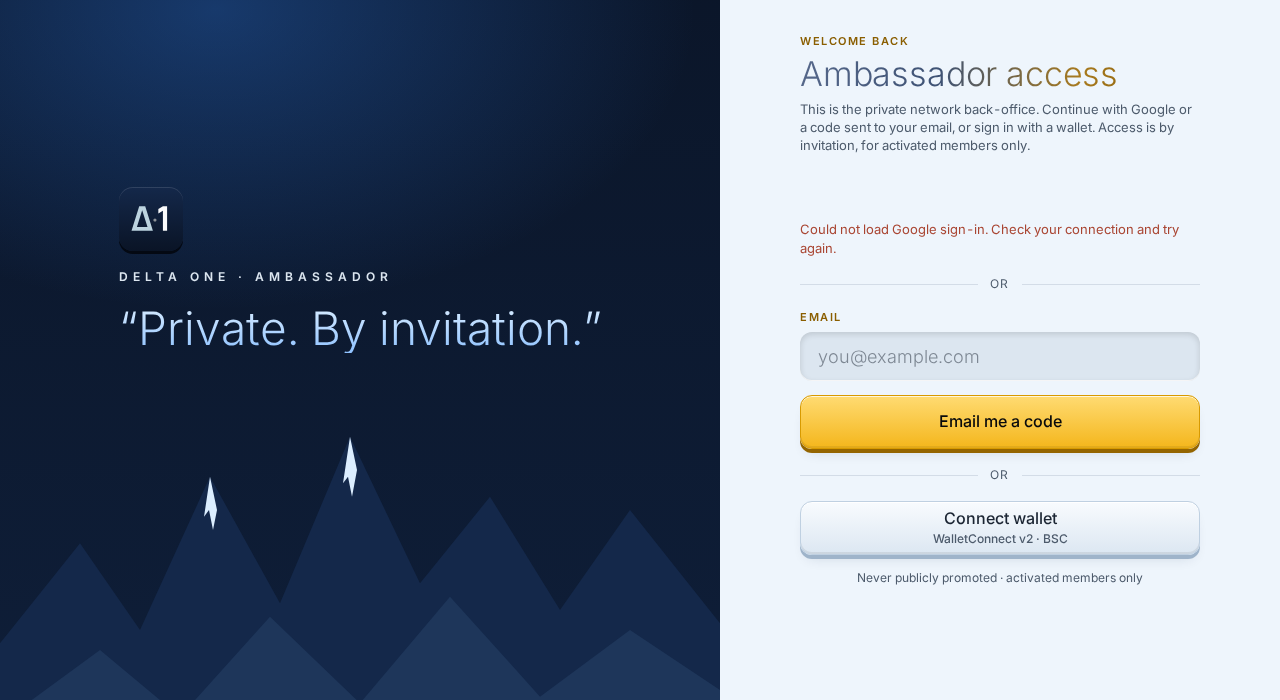
The Ambassador login says Private. By invitation., describes a private network back office open to activated members only, and adds that it is never publicly promoted.
Inside, an ambassador’s invite link adds people to the team, and they join the matrix structure after their first purchased Module.
A member must be activated to earn matrix commissions: a set amount of their own active Modules, plus two personally enrolled members holding the same.
Commissions come in two kinds, base matrix and breakage differential, and the pages say both are paid only from trading profit and never from a purchase.
The projector explains that a member’s share of a person’s daily result is 2% for each level the member’s rank pays, minus what ranked members in between already take.
On its example of a 10,000 USDT Module with a 50 USDT day, that rule would pay each qualifying upline about 1 USDT by our arithmetic.
Rank follows seven summits named Fuji, Kilimanjaro, Matterhorn, Denali, Rainier, K-2 and Everest, and each needs own Modules, personal enrollees and team volume.
A line balance rule limits how much one line of recruits can count toward a summit, and the pages advise members to build wide.
Higher ranks raise the daily cap on base matrix commission and the daily limit for withdrawing Matrix Rewards, which cannot be withdrawn at all without a rank.
Until a member reaches a rank, the pages say Matrix Rewards can only be used to purchase another Module.
Almost every commission screen carries the warning that most members earn no commission at all.
That warning and the no-refund rule sit inside the back office, while the landing page a prospect sees first carries only a short earnings caveat.
The FTC’s consumer advice says a legitimate multi-level business pays mainly for sales to outside retail customers, while pyramid schemes pay mainly for recruiting.
In the files we read, the only customers are members buying Modules, and the commission rules tie income to the Modules that recruits hold.
We cannot say which category the plan fits, because regulators and courts decide that, but the pay structure is the part to examine before anyone joins.
The ambassador screens also describe Position 01, a root account that collects commissions from the whole network plus any unclaimed budget.
The screen says that pool is divided between its owners, who are not named, and that any unassigned share is paid to the Position 01 account.
Founder Seats, Boosters and Prizes
A Founder Seat is a numbered purchase in one of six tiers, described as a Module of the seat’s price plus a percentage share of a founder pool.
The pages say how the founder pool is distributed will be announced, so a buyer pays for a share of a pool whose rules have not been published.
The on-screen guide says there are 260 numbered seats, while the seat screen counts seats out of 350, and unsold seats’ share stays with Delta One.
The Module Booster lets a member spin a reel for bonus credits on a top-up, and the bonus holds only if the member pays before a 10-minute timer ends.
Each Module gets 10 boosters in its lifetime, and the top-up a booster buys is, like every purchase here, not refundable.
A separate Spin to Win promotion hands out grand draw tickets, badges, courses and USDT prizes that the pages say come from Delta One’s marketing budget, not from trading.
Spins are earned by logging in, finishing a lesson or joining a founders’ call, and the rules say purchases never earn them.
Delta One VIP supplies the lessons, and one ambassador card tells members to learn the Momentum Plan in three steps, then explain it to a friend.
Where Your USDT Goes
Sign-in works with a Google account, an emailed code or a wallet signature, and the pages say no wallet or seed phrase is needed.
To deposit, the app asks for an amount and a network, issues an address for that request, and credits the USDT to a Purchase Wallet on the platform.
USDT is accepted on BEP-20 or ERC-20, and the pages say a transfer of the wrong amount or token is not credited automatically and stays with support.
Wallets, Modules and rewards therefore appear to be balances kept by the back office, and we found no contract address, audit or custody statement explaining who controls the pooled funds.
Each activity row offers a proof link to a block explorer, which can confirm a transfer but not whether the engine earned the reward shown beside it.
Withdrawals go only to a BNB Smart Chain address, one request a day, and the pages say they usually arrive in about 30 minutes.
A new payout address waits 24 hours, every withdrawal needs a two-factor code, and the pages add that there are no backup codes if a phone is lost.
The pages also mention accounts whose withdrawals are on hold, without saying what triggers a hold.
The app’s configuration lists deltavip24.com as its support address, a domain registered on September 12, 2026 that forwards visitors to a Zoom meeting instead of a help page.
How the Pitch Works
Step 1: A trade you can follow
The animation reduces trading to one trade with one visible gap, which makes the engine feel simple and checkable even though no real account or date appears.
A buyer who accepts that picture is no longer asking what the engine trades, where, or with whose money.
Step 2: A small start and a clear ceiling
A start from $1,000 and a finish at a doubling give a promoter an offer that fits in one sentence.
The cap also reads as a safety feature, although it limits what the Module can pay and says nothing about how likely any payment is.
Step 3: Rewards that stay inside
Because the first 10 days and every Believer reward are added back, the dashboard can show growing balances while the Rewards Wallet stays empty.
A member who wants cash must wait past day 10 and switch the default off, which is a step the landing page never mentions.
Step 4: Commissions for bringing others
Ranks named after mountains, a line balance rule and the advice to build wide all push members toward recruiting rather than toward trading results.
The matrix pays uplines a share of each recruit’s Module results, so income depends on how many people below you hold active Modules.
Step 5: Timers, seats and prizes
A 10-minute booster timer, numbered founder seats and monthly prize draws give members reasons to add money soon rather than after checking the results.
None of these extras is refundable, and the prizes are paid from a marketing budget, so they say nothing about whether the engine earns.
Who Runs Delta One AI?
No company is named
Neither the landing page nor the back-office files we read name a company, director, registration number or street address, and no license appears either.
The files mention the founders, founders’ calls and video messages from the founders, plus owners of Position 01, yet no one is named.
The only personal name we found is a first name, on a daily series called Ricky’s Daily Mind Vitamin, which does not identify anyone.
That leaves a buyer with nobody to hold to the promises, no registry to search and no regulator to ask about the business.
A new domain and an earlier brand
The domain deltaoneai.com was registered through Namecheap on September 17, 2026 for one year, and the registry record shows no owner.
Its name servers and email are Namecheap’s standard services, and certificate logs list customer, ambassador, backend, admin and landing subdomains, with the first certificate dated the same day.
The Internet Archive saved the host twice that day, and the second copy, taken at 20:34 UTC, carried the page title Alpha Infinity – Admin.
That points to an earlier brand name on the same server, which we could not trace to any company or product.
The server’s headers show the landing page last changed on September 27 and the customer and ambassador apps on November 8, the day before we checked.
The rival site that calls it a copy
A second domain, delta-one.app, was registered on July 23, 2026, 56 days before deltaoneai.com, and now shows a single notice headed Official notice.

Dated October 2, 2026, the notice says deltaoneai.com falsely impersonates Delta One, copied its name, logo and design, and should get no money or wallet details.
It adds that the Delta One trading bots were not taken, that the copy’s returns, ranks and bonuses will not be honored, and that all Delta One business is paused.
A later update disowns a third party’s email, and the page asks anyone who dealt with deltaoneai.com to report the wallet address, amount and payment date.
The notice is signed only The Delta One Team and names no company, so it is one anonymous operator’s claim about another, not a verified statement.
We cannot tell which site came first as a business, only that delta-one.app’s domain is the older of the two.
One fact still matters to a buyer: only deltaoneai.com sells Modules, and it is the site the other one tells people to send nothing to.
What we could not confirm
We could not confirm who owns either site, whether the engine trades, whether any member has been paid, or what the unseen results panel shows.
We did not register, sign in, connect a wallet or send funds, and we read the site’s files as text without running them.
We also did not play the How it works and How to Register videos, or check review sites and social channels for member reports.
What to Do Before You Register or After You Deposit
-
Do not deposit. Send no USDT to any address the back office generates until a named company shows independent results and a clear custody arrangement.
-
Do not recruit. Inviting friends or family earns commissions only if they buy Modules, and the FTC advises caution when pay depends on recruiting.
-
Ask in writing. Ask your sponsor for the company name, registration, custody statement and payout records you can check independently, and treat a refusal as your answer.
-
Save the evidence. Keep screenshots of your Modules, balances, deposit addresses, transaction hashes, sponsor chats and sign-up date before anything changes.
-
Stop topping up. Ignore booster timers, seat offers and prize draws, because a top-up is not refundable and a new deposit does not recover an earlier one.
-
Withdraw what the account allows. If the Rewards Wallet holds a balance and withdrawals work, request one now, and expect a 24-hour wait for any new payout address.
-
Report it. File at ReportFraud.ftc.gov and with the FBI’s IC3, listing the domain, deposit addresses and transaction hashes.
-
Be wary of recovery offers. The FTC says cryptocurrency payments typically cannot be reversed, so anyone promising to retrieve USDT for a fee deserves suspicion.
Frequently Asked Questions
Is Delta One AI a scam?
We cannot call it one as a fact, because no regulator or court has ruled, but it names no owner, offers no audit and pays commissions on recruits’ Modules.
How much does Delta One AI cost?
The landing page says to start from $1,000, the back office takes whole USDT amounts for Modules, and Founder Seat prices vary by tier.
Can I get my money back from Delta One AI?
The back office says the purchase price is not refundable and Module Credits cannot be withdrawn, so a deposit returns only as rewards, if any arrive.
Which site is the real Delta One?
We could not tell: delta-one.app says it is official and that business is paused, deltaoneai.com is the one selling Modules, and neither names a company.
Is Delta One AI a pyramid scheme?
We cannot say, because only a regulator or court can, but the FTC’s test is whether pay depends on recruiting, and ambassador commissions here follow the Modules recruits hold.
Can you make money with Delta One AI?
The pages themselves say rewards are not guaranteed, some days pay nothing and most members earn no commission, so assume you could lose the whole deposit.
The Bottom Line
Do not deposit into Delta One AI or recruit anyone for it: it names no owner, shows no audit, and its own pages say purchases are not refundable.
If you want exposure to crypto trading, use a regulated exchange where you hold the assets, and get any promoter’s company details, results and custody terms in writing first.
If you already deposited, save your records, withdraw what the account allows, stop adding money, and report the deposit address and transaction hashes to ReportFraud.ftc.gov and IC3.

Join the discussion
0 commentsShare your experience or ask a question about this article.
Discussion
Start the conversation
Have a question or something useful to share? Add the first comment.