


TurboLoop tells visitors that their USDT will earn a fixed 3% to 54% inside a transparent loop on BNB Smart Chain, with 20 referral levels stacked on top.
We read its smart contract, its audit page and its hub site, then compared what the code actually does with what the pages promise.

Overview
What TurboLoop offers
The app at turboloop.net invites you to deposit USDT into four fixed plans of 7, 14, 30 or 60 days, paying 3%, 10%, 24% and 54% on the full deposit.
There is no early exit and the minimum deposit is 1 USDT, while a 20-level referral network, seven leadership ranks and a $TURBO token sit on top.
The site says every deposit goes into a stablecoin liquidity pool and that the yield comes from real revenue that does not depend on new deposits.
What we found behind the pitch
The contract is public and paints a different picture: the position behind the plans held about $4.15M with no trading fees collected, while the ledger recorded $13.7M of unsettled deposits.
A 6% fee leaves the pool on every deposit and on all yield, which none of the site’s pages we read mention, although its audit page does.
That audit page also rates the ROI design as high risk and says dividends are paid from deposits of other users, which contradicts the site’s own FAQ.
Separately, the hub site served scripts that record typed fields, request wallet signatures and show a fake security prompt, and we could not tell who added them.
What we could and could not verify
Here is where the evidence stands after our checks:
- Verified by us: the plans, fee and referral rules in the contract, the pool and position balances on November 9, 2026, the domain dates and the hub scripts.
- Not found: a company name, an address, officers, working Terms and Privacy links on the app, or any mention of the 6% fee on the site’s own pages.
- Not verified: where any off-chain revenue comes from, how the token and bonus contracts work, who controls the hub, and what happens to the data its scripts send.
Our advice is not to deposit, not to connect a wallet on the hub, and to read the response section below if you already joined.
What the Loop Plans Promise
The contract fixes four plans: 3% after 7 days, 10% after 14 days, 24% after 30 days and 54% after 60 days, always calculated on the full deposit.
Stretched over a year and without compounding, the plans equal roughly 156%, 261%, 292% and 329%, and reinvesting each cycle pushes them far higher.
After six 60-day cycles, $1,000 would grow to about $13,300 on paper, before the 6% fee and assuming every single payment arrives on time.
A podcast blurb on the home page calls the top plan 54% APY, but 54% is the return for 60 days, not a year.
Returns of that size from a stablecoin pair deserve scrutiny, because stablecoins in a pool earn small trading fees, and the contract’s own position shows how small.
Your money stays locked until the plan ends. The contract has no function that returns principal early, and it releases a deposit’s yield only when that plan matures.
That conflicts with the hub FAQ, which says daily earnings can be claimed at any time, because only referral and leadership credits can be withdrawn before maturity.
Each wallet must register with a sponsor’s username before depositing, and a sponsor needs at least 25 USDT of active deposits unless it is the house account TurboLoop.
Where the Yield Comes From
The About page says the yield comes from the liquidity pool itself, and the hub FAQ names three revenue streams: pool rewards, Turbo Swap trading fees and fiat gateway fees.
The same FAQ adds that none of it depends on new deposits and that 100% of your deposit goes into the pool.
The contract tells a more limited story. Its source is verified on Sourcify as an exact match for the deployed code, so we could read exactly what a deposit does.
A deposit moves your USDT into a single PancakeSwap V3 position on the USDT and USDC pair, which the hub itself describes as a V3 position.
The contract adds only USDT to that position, and a one-sided USDT deposit can only sit in a price range above where the two coins trade today.
That is what we found on the chain. The position covers prices from 1.105 to 1.221 USDC per USDT, while the pair traded at about 0.9986 on November 9, 2026.
Because the market sits outside that band, the position collects no swap fees, and the uncollected fees we read were zero.
USDT would have to climb more than 10% against USDC before the position earned anything.
Even in range the arithmetic is harsh: at a 0.05% fee tier, paying the 60-day plan’s 0.9% daily needs the position’s value to trade about 18 times a day.
The contract has no function that receives Turbo Swap or gateway income, so any revenue would have to be sent in from outside, and the contract held only $176.
The 6% Cut and the Gap Between Ledger and Cash
The code charges a 6% service fee on three events: each new deposit, each compounded reward, and the yield credited to depositors.
The fee is withdrawn from the pool and sent to a hard-coded wallet, which is also the account registered as TurboLoop at the top of every referral chain.
On the $23.68M of deposits recorded so far, 6% of deposits alone comes to about $1.42M, and the fees on yield and compounding come on top of that.
None of the app, About, Docs or hub FAQ pages we read mentions a 6% fee, and the FAQ says that 100% of your deposit goes into the pool.
The home page uses the phrase admin fees only when it explains the token buyback, so a reader would never learn who takes a cut of each deposit.
The audit page the site links to lists a 6% deposit fee and a 6% fee on yield, so the cost is public for anyone who goes and reads it.
The bigger issue is the gap between what the ledger owes and what the position holds. At our snapshot the contract recorded about $13.7M of deposits not yet settled.
The position backing them held about $4.15M, so the ledger was roughly 3.3 times the cash before counting any yield that those deposits are owed.
On a recent day the contract credited about $103,000 of yield, roughly 2.5% of the position’s cash, so the position covers about 40 days of yield and no principal.
Fresh deposits close that gap. In eight months the contract took in $23.68M of new money and paid out $16.85M, which is 71% of everything deposited.
A $1,000 deposit in the 60-day plan shows the scale, because if every referral level qualifies it can create claims of about $1,960.
Those claims are your $1,000 back, $540 of yield, up to $329 for your upline and about $92 in fees.
Only $1,000 came in, so about $960 of those claims has to come from later deposits or from income that we could not find.
A Network That Pays 20 Levels Deep
Referral rewards run 20 levels deep: 12% at level 1, 8% at level 2, 5% at level 3, then smaller shares down to 1% for levels 11 to 20.
The home page presents these as commissions without saying what they are a share of. In the contract they are shares of your downline’s daily yield, not of their deposits.
Added together, the levels give 51% of the yield earned by everyone below you, and leadership ranks add up to 10% more once a team reaches set thresholds.
The hub describes the same 51% as a share of protocol fees distributed to the community, while the contract pays it out of members’ own yield.
Deeper levels need more active direct referrals, from one for level 1 up to seven for levels 11 to 20, plus 100 to 500 USDT of your own active deposit.
The ranks begin at Turbo Partner, which needs 250 team members and $10,000 in deposits, and end at Turbo Legend with 10,000 members and $1,000,000.
The FTC’s guidance on multi-level marketing says legitimate plans pay from sales to real customers, and TurboLoop sells nothing except the deposit itself.
Whether that makes it a pyramid scheme is a legal finding we cannot make, but the structure raises the question, and our guide to an MLM scam explains the pattern.
Our look at Bull Protocol covers another platform that pairs USDT deposits on BNB Smart Chain with a multi-level referral matrix.
The site also advertises onboarding bonuses of $3 to $100 and extra $TURBO tokens for 30-day and 60-day deposits, with 30% of the token reward going to the referrer.
Neither feature appears in the contract we read, so they run through other contracts or systems that we did not review.
Numbers on the Site That Mean Less Than They Say
The About page shows 49,832 Active Investors and $39.8M Total Value Locked, and it labels both as live from the smart contract.
The user count is real but oddly named, because the contract’s active-users counter rises when a wallet makes its first deposit and the code never lowers it.
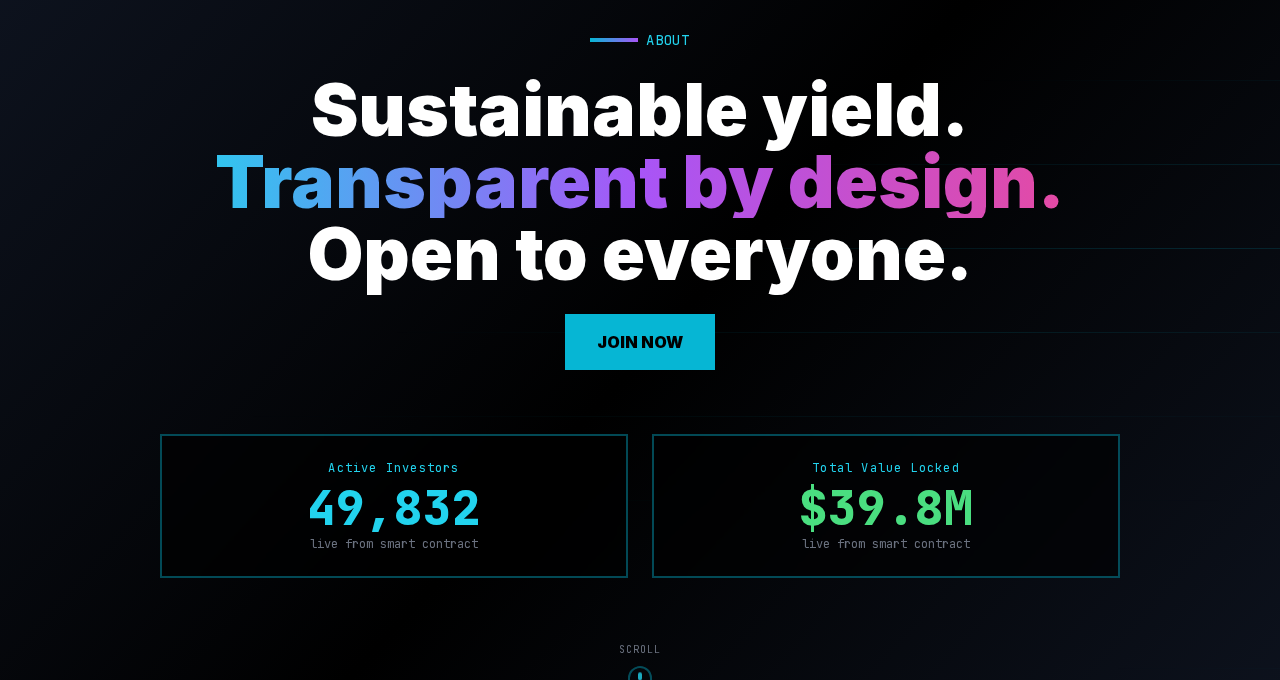
That makes it a count of everyone who has ever deposited, whether or not they still have money in a plan today.
The $39.8M figure matches the combined balances of the entire PancakeSwap pool, $24.2M in USDT and $15.6M in USDC, which belong to every liquidity provider in it.
TurboLoop’s own position held about $4.15M, roughly 10% of that figure.
Hub video descriptions call a $34.7M position in range and fully active, which we could not match to the contract.
One claim does hold up: the contract itself owns the liquidity position and has no function to transfer it, so liquidity leaves only through its own payouts and fee withdrawals.
Ownership is also genuinely renounced, because the owner address reads as zero, although the code has no owner-only function besides renouncing and the fee wallet is hard-coded.
What the Audits Say and What They Skip
The site leans on two audits: HazeCrypto, labeled Excellent Rating, and SolidityScan, shown as 99.99 out of 100 on an automated scan card.
We could read the HazeCrypto page, whose conclusion says the contract is safe and has no backdoors or scam scripts, which matches the code we read.
The same page, dated March 13, 2026, three days after launch, shows a 3.5-star rating rather than a perfect one, plus a separate High issue about the ROI design.
That issue says the system must be considered high risk, that principal is locked until the lock time ends, and that “Dividends are paid from deposits of other users.”
The page also says the return is payable only if the contract balance has enough funds, and it names a 6% deposit fee and a 6% fee on yield.
An audit like this checks whether code can be abused, not whether promised returns are sustainable, so a clean code review and a high-risk finding can both be true.
The SolidityScan score comes from an automated scanner, and its report page needs JavaScript that we could not read as text, so we cannot confirm what the scan card shows.
Both reviews also cover one contract at one moment, while the token, bonus and auto-compound contracts are separate, and the HazeCrypto page says auto-compounding relies on an operator.
Scripts on the Hub Site
The app links to a hub at turboloop.tech, which hosts films, articles, FAQ pages and signup forms. On November 9, its pages loaded three scripts that the app does not.
We read them as plain text and never ran them in a normal browser, and a second fetch from a different network returned identical script files.
The first script sits inline in each hub page and watches your typing.
For password fields, or fields named with pass, email, user, code, otp or token, it sends the value to the hub’s server once you pause.
On any form submission it also sends every named field, although the hub’s privacy page says it has no login system and lists only analytics, emails, stories and logs.
The second script, p.js, looks for a browser wallet, may ask it to connect, fetches a message from the server and asks you to sign it, then posts the signature.
It can send your wallet address, browser details, page address, referrer, cookies and up to 40 stored browser items from each storage area along with that signature.
It also hijacks clicks. Pressing Launch App or Connect Wallet, or following links to turboloop.org or app.bnbg.world, pauses your navigation for up to 20 seconds while this routine runs.
The third script, w.js, waits 3.5 seconds on desktop-sized screens and shows a Session security check that claims an unusual sign-in location was detected for your TurboLoop workspace.
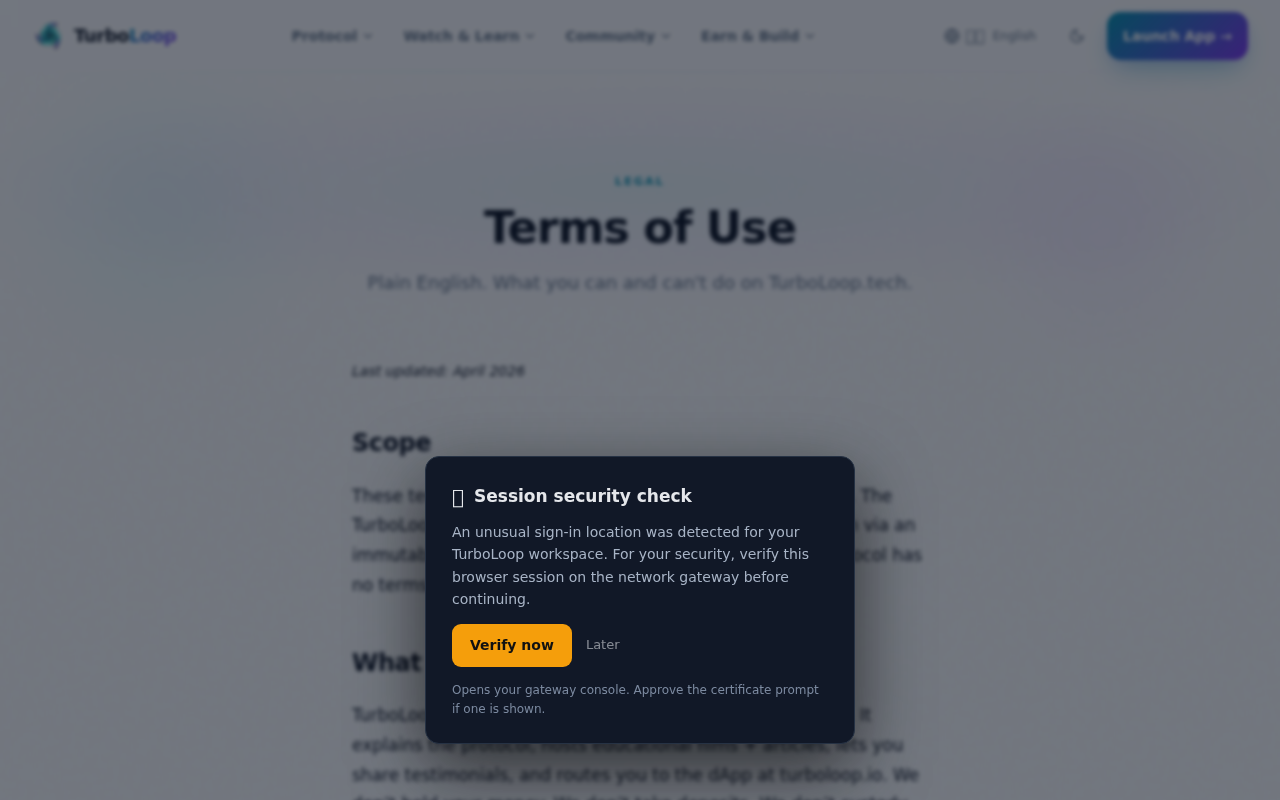
The Verify now button sends you to gw.turboloop.tech/admin/login/, and the fine print tells you to approve a certificate prompt, an unusual instruction for a login check.
No such workspace is described anywhere on the hub, whose privacy page says there are no user accounts to compromise.
We did not open the gateway page or call any script endpoint, and the pop-up appeared when our isolated screenshot service rendered the Terms and FAQ pages.
That browser had no wallet, cookies or saved logins, and nothing in it was clicked.
We cannot tell whether the TurboLoop team added these scripts or someone with access to the hub’s hosting or DNS did, or what the server does with the data.
Later that morning the hub began answering our requests with a Cloudflare block page, so we could not recheck whether the scripts are still there.
Either way, the hub is not a place to type an email, connect a wallet or sign a message, and a certificate prompt is not something to approve.
How the Pitch Works
Step 1: A 1 USDT door into four plans
The minimum deposit is 1 USDT, so anyone can try the platform with pocket change, and a plan as short as 7 days makes the first payout feel close.
A low entry price also makes recruiting easier, which matters because referral rewards pay members who bring in friends.
Step 2: A position that earns nothing
Your USDT goes into one PancakeSwap position that, on our check, sat outside the trading range and collected no swap fees.
On that evidence, liquidity rewards are not what funds the plans, even though the About page and the hub FAQ present them as a source of yield.
Step 3: Yield on paper, cash at the end
The ledger credits yield every day, but the contract releases it only when the plan matures, together with your principal, and only if the position holds enough cash.
A claim fails with an insufficient liquidity error when the position cannot cover it, and the contract offers no fallback or reserve.
Step 4: A cut at every turn
The 6% fee applies when you deposit, when your yield is credited and when you compound, so staying inside the system costs more than leaving it.
The wallet that receives the fee is the same house account that sponsors anyone who arrives without a referrer.
Step 5: Referral and leadership rewards
Uplines collect up to 51% of your yield across 20 levels, plus up to 10% more through ranks, which turns every new depositor into income for someone above them.
That gives members a strong reason to recruit, and recruits a strong reason to recruit in turn, because the rewards scale with the size of the team.
Step 6: Compounding keeps the money inside
When a plan ends, the site’s FAQ suggests re-depositing principal and earnings into a new plan, and its example grows $1,000 to $1,538 in two 30-day cycles.
Compounding moves no cash. It only adds new ledger entries against the same pool, while the 6% fee still leaves the position each time.
Step 7: A hub that builds trust
The hub supplies films, a presenter introduced as Global Ambassador Dave, daily community calls in many languages and a $100,000 bounty for proof of centralization.
It also repeats claims we could not confirm, such as a $34.7M position in range, and it is the same site that served the scripts described above.
Who Runs TurboLoop?
The company the documents name
No page we read names a company, an owner, officers or an address. The Terms and Privacy links on the app’s footer both lead to #, which means nowhere.
The hub publishes its own Terms and Privacy pages, but they cover only the hub, and the Terms say the protocol has no terms because it has no operator.
That sits oddly beside a hard-coded fee wallet, an audit listing an owner’s fee and a daily server-side bot, and a presenter known only by a first name.
Where the address and registration lead
The only contact routes are a support@turboloop.tech address, Telegram groups and the hub’s forms, so a depositor cannot send a legal notice or a written complaint to anyone.
Events in New Delhi, Lagos and Port Harcourt are mentioned, but we found no company or registry entry behind them, and we did not search business registers.
On the chain, one wallet deployed the contract on March 10, 2026 and another hard-coded wallet receives the fees, but neither is tied to a named person.
Domains, hosting and the public face
The domains turboloop.net and turboloop.io were both registered at Namecheap on February 17, 2026 within one second of each other, and the .io record sits behind a privacy service.
The hub domain turboloop.tech followed on March 20, 2026, and turboloop.app was registered on November 8, 2026, the day before our check, and already serves the same site.
The .net and .app domains share one Cloudflare name server pair, turboloop.org resolves to the same host as the app, and the app runs on Vercel.
We did not check Trustpilot, the BBB, Telegram, X or YouTube, and a shared setup of this kind would not prove common ownership anyway.
What we could not confirm
We could not confirm who owns the platform, who controls the hub’s hosting, what the whitepaper says, or what the token and onboarding contracts do.
We also did not deposit, connect a wallet, call any script endpoint or open the gateway login page, so we cannot describe how withdrawals feel in practice.
What to Do Before You Deposit or After You Joined
-
Do not deposit. The returns appear to depend on later deposits, the fee is not disclosed on the pages we read, and no operator can be held to account.
-
Stay off the hub. Do not type an email, connect a wallet or sign a message on turboloop.tech, and close the Verify now pop-up without clicking it.
-
Check what you gave. If you typed a password or code on the hub, change it everywhere you reuse it, and treat any email you entered as a phishing target.
-
Clean up wallet access. Disconnect the hub and the app from your wallet’s connected sites, and revoke any USDT spending approval you gave the contract.
-
Claim what has matured. If a plan has ended, withdraw it instead of compounding, because the position’s cash covers only part of the recorded deposits.
-
Do not recruit anyone. Referral rewards come out of other people’s yield, so bringing in friends or family exposes them to the same gap.
-
Save your records. Keep transaction hashes, wallet addresses, dates, amounts and screenshots of the pages, since they are the evidence any complaint will need.
-
Report it. File at ReportFraud.ftc.gov, and remember the FTC says crypto payments typically are not reversible.
Frequently Asked Questions
Is TurboLoop a scam?
We cannot prove it: the code is public and no owner can change it, but returns appear to rely on new deposits and the hub carries risky scripts.
Where does TurboLoop’s yield come from?
The contract’s position earned no swap fees when we checked, so payouts come from the pool’s deposits, and we found no sign of the three revenue streams the site names.
Can I get my money out early?
No. The contract keeps your principal until the plan ends, and a claim fails if the position does not hold enough liquidity at that moment.
Is the contract audited and safe?
The audit found no hidden admin control, but the same page flags the ROI design as high risk and says it depends on other users’ deposits.
Does TurboLoop charge fees?
Yes: 6% on each deposit, each compounded reward and the yield credited, paid to a fixed wallet, a charge that the site pages we read never list.
Is the hub site safe to use?
We would not use it: when we checked, it loaded scripts that capture typed form fields, request wallet signatures and show a fake security check with a certificate prompt.
The Bottom Line
Do not deposit into TurboLoop: its returns of up to 54% in 60 days are not explained by the position we found, and its pages omit the 6% fee.
If you want yield on stablecoins, pick a regulated platform that names its revenue, and treat any promise of fixed returns as a red flag, as the FTC warns.
If you already deposited, claim what has matured, stop compounding, stay off the hub, revoke wallet approvals and report it.

Join the discussion
0 commentsShare your experience or ask a question about this article.
Discussion
Start the conversation
Have a question or something useful to share? Add the first comment.