


A small entry payment, a mining dashboard, and daily rewards can make a crypto opportunity feel approachable. Bull Protocol packages all three into one polished offer.
Its terminology sounds familiar if you have used a crypto wallet before. The important details appear when you follow what goes in and what comes back.
Overview
You put in USDT, but the rewards are a different token
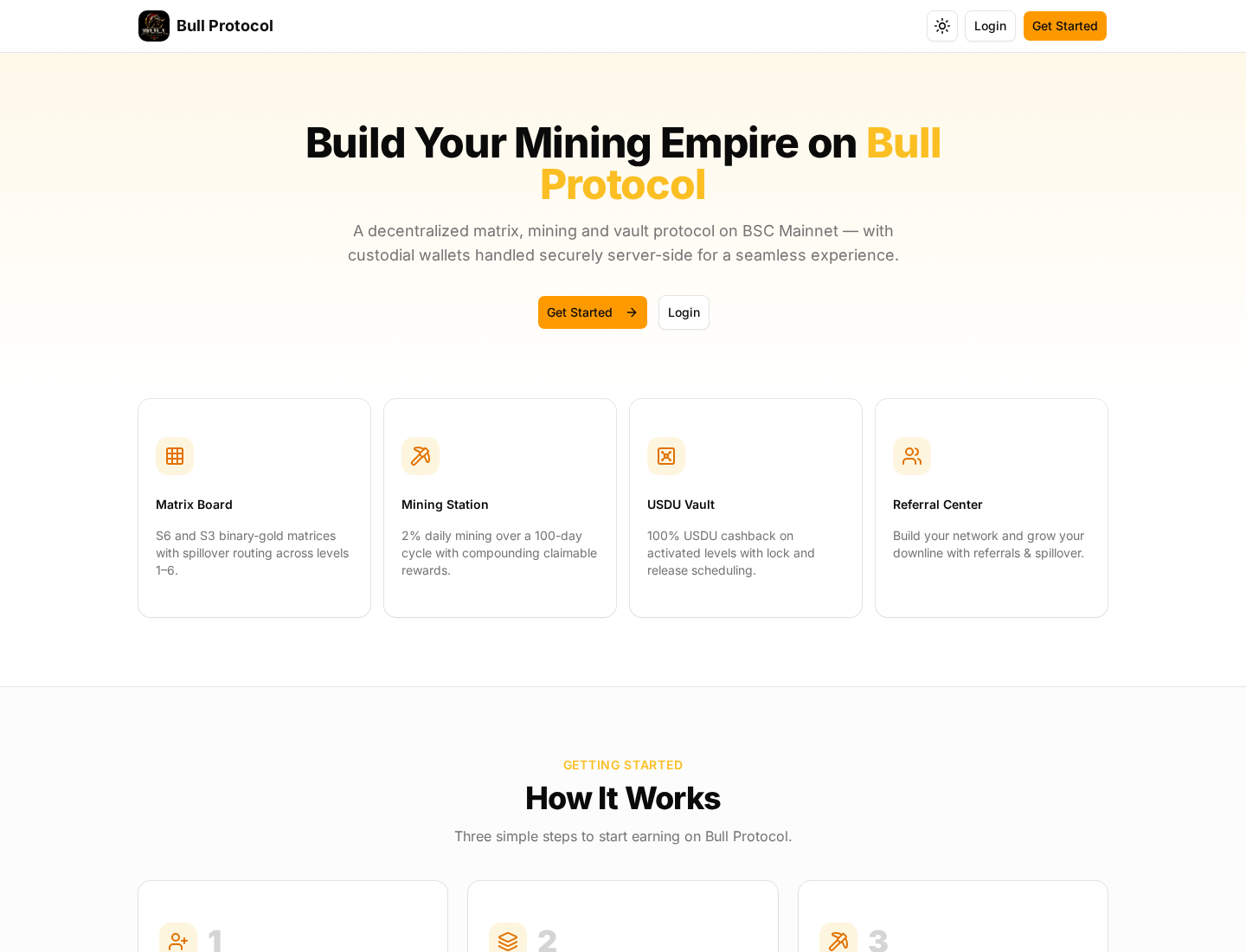
Bull Protocol promotes a six-level referral matrix alongside a daily-yield feature called mining. Its public documentation links the project to the Unrugpad ecosystem.
Participants are asked to activate levels using USDT on BNB Smart Chain. Advertised rewards and cashback are denominated in USDU, the ecosystem’s own token.
That distinction is not cosmetic. A reward balance in USDU is not automatically a recoverable USDT balance, even when a page assigns both a similar face value.
The attractive headline comes with several different clocks
The homepage advertises 2% daily mining over a 100-day cycle. The whitepaper separately describes a 90-day cliff for matrix-minted USDU, followed by release over 12 months.
It also lists a 5% fee on matrix earnings transferred to an external wallet. Those conditions matter more than the phrase 100% cashback.
Mining rewards and matrix cashback have different stated rules. Combining them into one simple promise of immediate access would misdescribe the offer.
The main risks to understand before activating anything
- A platform-issued reward token needs credible redemption and liquidity, not merely a claimed $1 utility value.
- The website says wallets are custodial and keys remain on its server, despite using decentralized branding.
- Higher matrix levels unlock higher mining eligibility, encouraging payments beyond the lowest advertised entry.
- Referral payouts and circle allocations need incoming participants; they are not evidence of independently profitable trading or mining.
Do not deposit into Bull Protocol on the strength of its daily-yield and cashback promises. The published model leaves you taking substantial token, custody, and recruitment risk.
What the Public Whitepaper Actually Says
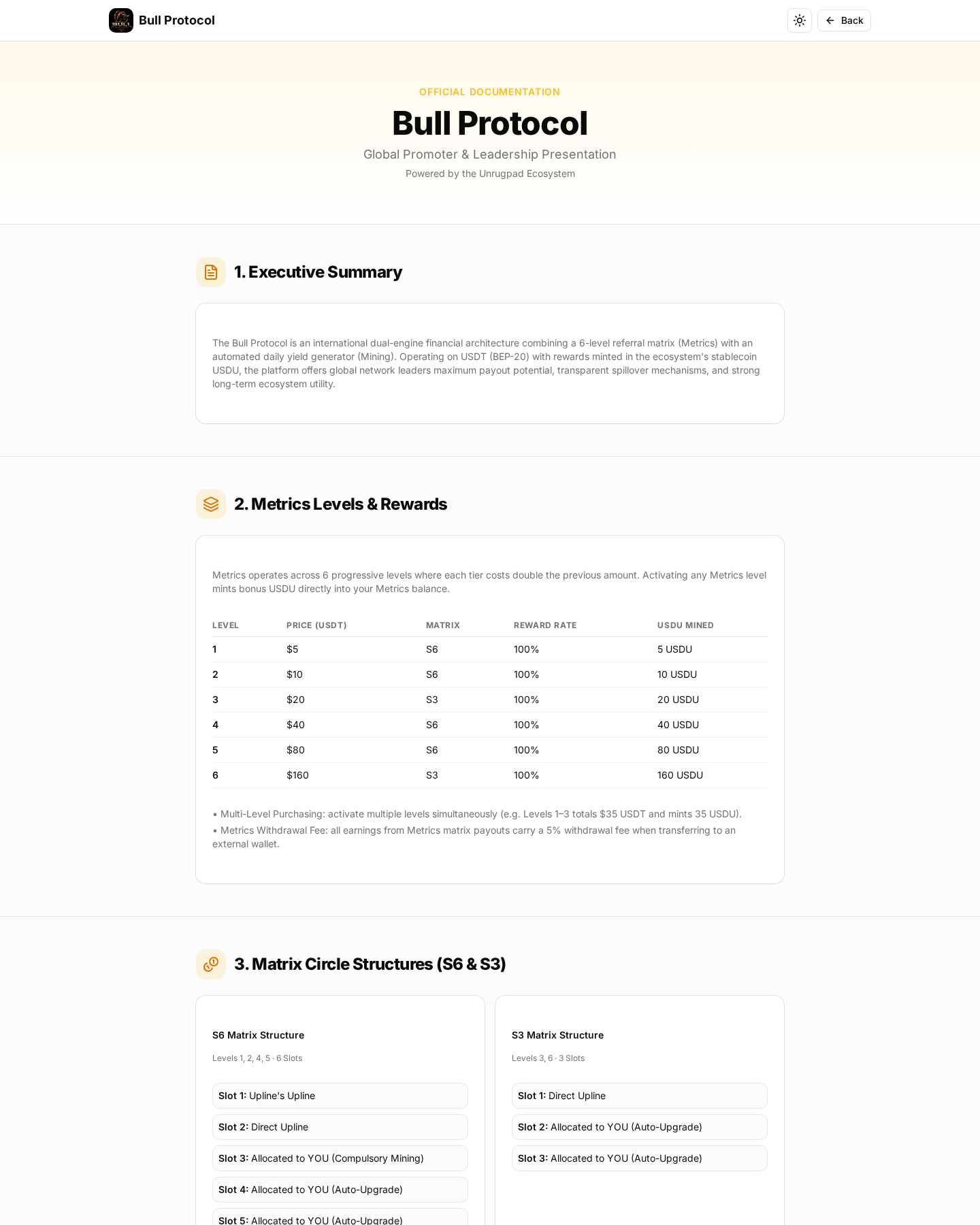
The six activation prices are 5, 10, 20, 40, 80, and 160 USDT. Buying all six therefore commits 315 USDT before considering other activity.
Activating the first three levels would total 35 USDT. The documentation uses that example to explain how corresponding USDU is credited to the matrix balance.
This is an accounting credit in another asset, not proof that the original payment was refunded. You still need a way to turn the reward into usable money.
The whitepaper calls USDU a stablecoin with a $1 pegged utility value. A price assigned inside an ecosystem is different from independently demonstrated cash redemption.
The listed uses include partial marketplace payments, advertising, learning products, trading-bot access, and a future peer-to-peer marketplace. A future feature cannot provide liquidity today.
A token can be transferable between wallet addresses while remaining difficult to sell. Transferability answers where it can move, not who will buy it.
For that reason, ask about reserves, the redemption counterparty, actual market depth, withdrawal conditions, and the exact token contract before treating a reward as cash.
No wallet connection, account opening, or payment was used for this article. The assessment concerns the publicly advertised structure, not a completed withdrawal test.
How the Bull Protocol Offer Works
Step 1: An account places you inside a referral structure
The documentation describes email registration that establishes an upline relationship before capital is committed. A personal referral link becomes active after Level 1 activation.
That makes recruitment part of the architecture, not just an optional sharing feature beside an unrelated investment product.
Someone explaining the opportunity may benefit when new members activate levels. Their enthusiasm therefore needs to be considered alongside that financial incentive.
A recommendation from a friend can be sincere and still be influenced by a compensation structure the friend does not fully understand.
Step 2: Level activation turns a small entry into a ladder
The lowest level costs 5 USDT. Successive levels double in price, ending at 160 USDT for Level 6.
The homepage links mining eligibility to the highest activated level. Moving up is therefore presented as a way to expand the opportunity rather than a separate expense.
Before paying, total the entire path you are being encouraged to follow. A low starting price can hide how much a participant plans to commit later.
Do not count a USDU credit as reducing that outlay unless it can actually be redeemed under clear, enforceable conditions.
Step 3: Circle payments are divided among several destinations
The S6 and S3 matrices allocate incoming slots between uplines, participant-related positions, and automatic activity. These are distribution rules, not proof of new economic value.
The S6 description includes compulsory mining, automatic upgrades, and a circle restart. The S3 structure likewise assigns slots to an upline and automatic upgrades.
That means a filled position does not necessarily result in an immediately spendable payment to you. Part of the allocation can remain inside another platform feature.
Read the destination of each allocation. A dashboard showing activity can look rewarding even while your recoverable balance is much smaller.
Step 4: Mining promises daily USDU over a defined cycle
The mining feature is described as accepting USDT and accruing 2% daily in USDU for 100 days. The whitepaper labels that 200% total gross return.
Separately, the homepage promotes compounding unclaimed rewards. Readers should not assume a simple percentage total and a compounded calculation produce the same amount.
More importantly, an increasing number of USDU does not solve the redemption question. The token’s realizable value is as important as its rate of accumulation.
The public material does not supply an independently audited explanation of how external earnings reliably fund that advertised daily yield.
Step 5: Cashback sits behind release rules and fees
Matrix-minted USDU is advertised with a 90-day lock followed by gradual release across 12 months. That is a long commitment for something described as cashback.
The whitepaper distinguishes mining yields, saying they do not have that three-month lock. Apply the correct rule to the correct balance.
There is also the stated 5% fee on external matrix withdrawals. A nominal reward amount is not the same as what reaches a usable external destination.
Do not increase your payment simply to chase an earlier balance. An upgrade can add fresh exposure without making existing tokens more liquid.
Bull Protocol Operator, Custody, Support, and Redemption Checks
A project brand is not an accountable investment counterparty
The public landing page and whitepaper present Bull Protocol and Unrugpad branding. They do not identify a complete accountable management team in the material examined.
Before entrusting funds, you need the contracting entity, its jurisdiction, the services it is authorized to provide, and a clear complaint route.
A project logo or ecosystem name does not tell you who must repay a claim. Neither does calling a system a protocol remove that practical question.
Server-held keys are not personal control of the wallet
The site expressly describes custodial wallets, server-side signing, and private keys stored on its server. This is a material dependency on the service operator.
Encryption claims address how keys are said to be stored. They do not mean you personally control signing, withdrawals, or access if the platform stops responding.
Decentralized terminology should not blur that distinction. A service using a public blockchain can still control the wallet and its own internal account records.
Community channels do not replace formal support
The page links to Unrugpad-branded community channels on WhatsApp, Telegram, and X. Those links establish the project’s public presentation, not a completed support test.
A chat administrator may explain a feature without having authority to honor a refund or resolve a custody dispute. Ask which legal entity answers the complaint.
Never send a seed phrase or private key to a person claiming to provide support. Someone who needs secret access is not safely verifying a balance.
A utility peg needs a real route back out
A usable redemption policy should specify who exchanges USDU, at what rate, under which limits, and using what reserve or market.
The advertised ecosystem uses do not demonstrate those protections. Spending a token inside the issuer’s network differs from exchanging it freely for a widely usable asset.
No conclusion about the administrators’ nationality follows from their social accounts or the software’s appearance. The buying decision rests on the actual financial dependencies.
Why the Word Mining Needs an Explanation Here
In everyday crypto discussions, mining can refer to a network-security process with identifiable technical work and rewards. Bull Protocol uses the word for its advertised yield feature.
The public description does not, by itself, demonstrate mining equipment, a measurable contribution to network security, or outside revenue supporting the promised payments.
A label is not a business model. Before accepting a fixed daily return, the participant needs to understand where the value comes from.
Likewise, a public blockchain record can show that a token moved without proving the token is adequately backed or that an advertised investment strategy exists.
Be careful with screenshots of successful withdrawals. A transfer made to one participant does not establish that every balance can be redeemed when recruitment slows.
These concerns justify refusing the offer without claiming a court has decided the project is fraudulent. You do not need a criminal judgment to decline unreasonable risk.
What to Do If You Deposited Into Bull Protocol
-
Stop adding funds and stop recruiting others. Separate what you have already paid from any new activation or mining deposit being proposed.
A promised upgrade is another transaction. It should not be treated as a necessary rescue simply because a balance is already displayed.
-
Record each type of balance separately. Save the USDT sent, USDU credited, matrix earnings, mining rewards, locked amounts, and stated release dates.
This helps prevent a large combined dashboard figure from obscuring which part is actually available and in which token.
-
Preserve your transaction evidence. Keep sending and receiving addresses, network names, transaction hashes, dates, and the exchange account used to send funds.
Save copies of the relevant terms and support messages. Do not publish recovery phrases, identification documents, or account credentials when asking for assistance.
-
Ask for a written explanation of withdrawal conditions. Specify which balance you want withdrawn and which destination asset you expect.
Do not send a new tax, activation, or verification payment on the promise that it will release earlier funds. Escalate unexpected demands instead.
-
Notify the service that sent your funds. Give its fraud or compliance team the transaction references and a clear account of the offer.
Ask whether it can flag a receiving destination or provide further reporting instructions. A completed blockchain transfer usually cannot simply be canceled like a pending card payment.
-
Protect any reused credentials. If you used the same password on another service, replace it there, especially on your email account.
If you separately connected a personal wallet, review permissions through a trusted wallet interface. Do not connect it to an unsolicited recovery website.
-
Report the solicitation to the appropriate authorities. Describe the actual promised rate, payment asset, reward token, fees, and release schedule.
For suspected online fraud in the US, IC3 accepts reports. Elsewhere, use your police and financial regulator’s genuine reporting channels.
What a Useful Answer From the Promoter Would Contain
A useful explanation would identify the operator, actual outside revenue, redemption reserves, and the rights attached to each token balance.
It would distinguish a fee from a deposit, a marketing credit from cash, and a scheduled token release from an immediately available withdrawal.
It would also explain why a participant must purchase levels to expand mining eligibility and which payouts depend on other people activating positions.
Answers consisting only of screenshots, community testimonials, or claims that everyone will benefit later do not resolve those questions.
Keep the decision practical. If recovering your principal depends on unexplained token demand and continued platform cooperation, the advertised yield is not sufficient compensation.
Frequently Asked Questions
Is Bull Protocol guaranteed to pay 2% every day?
The platform advertises that rate in USDU. The claim is not an independent guarantee of a cash-equivalent payment or a verified sustainable source of earnings.
Are USDT and USDU the same thing?
No. The offer takes USDT and credits its own USDU token. Similar names and a claimed utility peg do not make their redemption rights equivalent.
Does 100% cashback mean I get my payment back immediately?
No. The matrix credit is in USDU and has a stated 90-day cliff followed by a 12-month release. It is not an immediate USDT refund.
Do I control the wallet’s private keys?
The website describes server-held custodial keys and server-side signing. Do not confuse that arrangement with a personal wallet whose keys only you control.
Is every Bull Protocol balance subject to the same lock?
No. The whitepaper distinguishes matrix-minted USDU from mining yields. Keep the two rules separate when reviewing a statement or asking about a withdrawal.
Should I buy a higher level to recover my deposit?
No. Avoid sending fresh money to pursue an existing balance. Preserve records, seek a written withdrawal explanation, and contact the sending service if something is wrong.
The Bottom Line
Do not fund Bull Protocol based on its cashback and daily-yield pitch. You would be exchanging a usable payment asset for substantial custody and internal-token risk.
If you already participated, stop upgrading, separate your balances, and retain transaction evidence. Seek help through your sending provider and legitimate authorities, not a recovery stranger.

Join the discussion
0 commentsShare your experience or ask a question about this article.
Discussion
Start the conversation
Have a question or something useful to share? Add the first comment.