


A message from someone who says they’re a country singer might feel like a lucky surprise. A private conversation can make the attention feel more personal.
That is how a case in Pennsylvania began. It offers a practical lesson about what to do when a new online relationship starts to involve money.
Overview
A relationship began on TikTok and moved to Telegram
In September 2026, WGAL reported that Pennsylvania State Police were investigating a romance scam involving a woman in Lebanon County. The contact started on TikTok and moved to Telegram.
The person claimed to be an up-and-coming country singer and asked for financial help with his career. Police said the person was an impostor.
The public reporting does not identify a real artist whose name you should search for. The warning is about the way the claimed identity was used, not a particular singer.
This case is different from a scam that pitches a fake investment app. The alleged reason for the payments was personal support for a supposed career, not an investment return.
The reported loss was at least $384,000
The investigation described money sent and purchases of hundreds of Apple gift cards. The available reporting does not provide an itemized total that lets you calculate a separate gift-card loss.
It would be misleading to put another figure on top of the reported minimum. The key fact for readers is that both money and gift cards featured in the account.
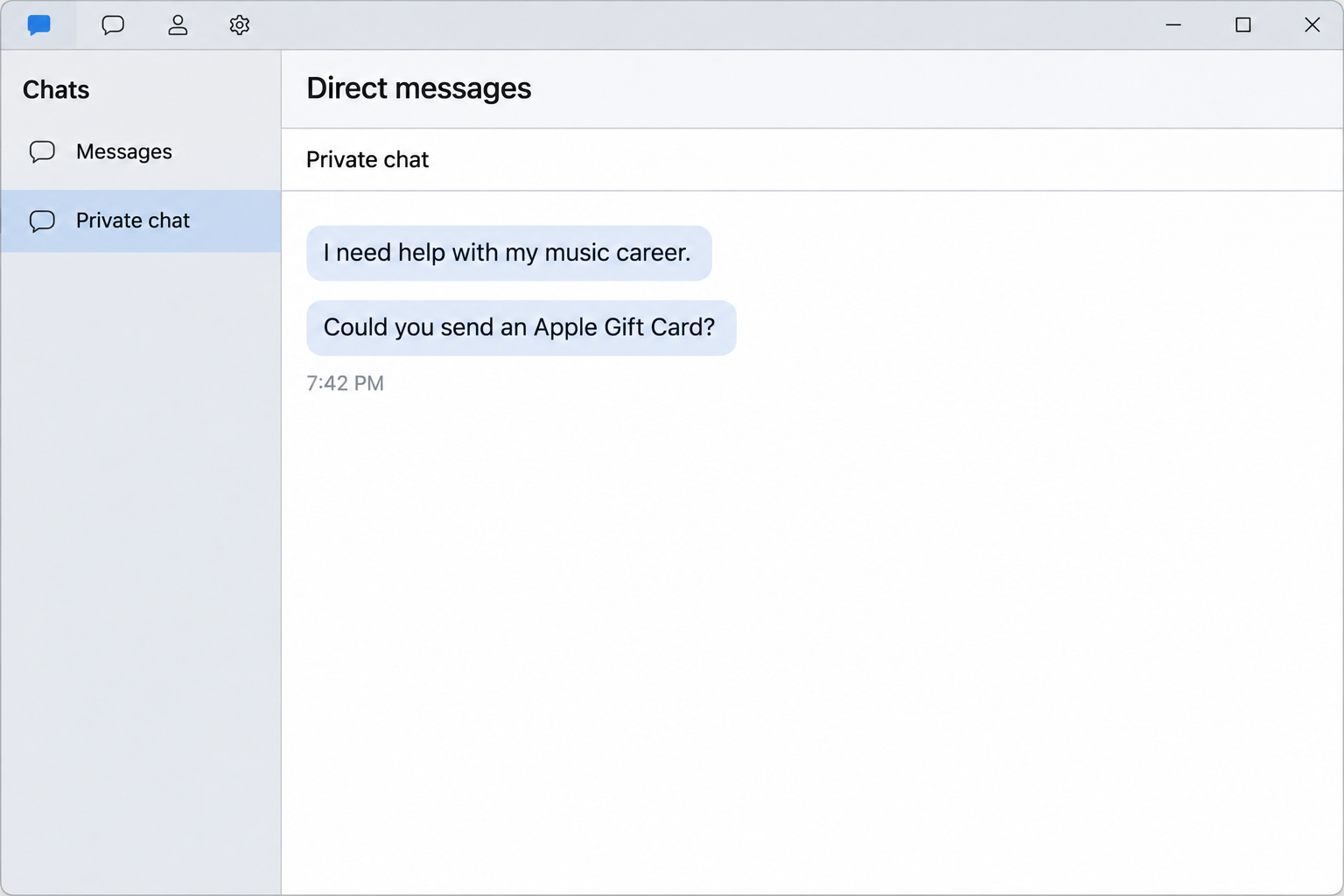
The private chat illustrated above is a reconstruction of the way the requests were described, not an excerpt from the woman’s messages.
The scam also asked her to keep the relationship secret
WGAL reported that the person repeatedly told the woman not to tell her family. Her children eventually discovered what had happened.
Privacy and secrecy can sound similar in a relationship, but they aren’t the same. Asking you not to discuss a payment with anyone you trust removes a useful safety check.
Here is the sequence to pay attention to, even if the name or profession changes:
- A social media contact starts giving you unusually personal attention.
- They ask to continue privately on a different messaging service.
- Their career becomes the reason you should help financially.
- The favor involves store-bought gift cards rather than a normal way to pay a business.
- Talking to family or friends is framed as a betrayal of trust.
Any one detail can look ordinary on its own. A move to another app does not prove fraud; what matters is the unverified identity, financial request, and pressure that follow.
How the TikTok Country Singer Romance Scam Works
Step 1: A public profile becomes a private relationship
On TikTok, people already feel familiar with creators they follow. They know the person’s voice, work, or mannerisms before they’ve ever spoken privately.
That’s part of what makes a supposed artist’s message powerful. It feels like an interaction with someone you recognize rather than a cold message from a stranger.
There are legitimate ways musicians interact with fans. The mistake is assuming that familiarity with a public page proves the identity of whoever approaches you in a private chat.
Go to the artist’s official website or verified accounts by a route you choose. Check whether the profile that contacted you is actually listed by the artist or their management.
Step 2: The conversation moves to Telegram
The Pennsylvania reporting puts the contact on TikTok first and Telegram afterward. The apps themselves aren’t accused of sending the messages or organizing the fraud.
Switch apps and you’re looking at a different account with separate reporting tools. A familiar picture or username doesn’t verify who’s using both accounts.
Even if the messages feel continuous, save the profile details from both services if money comes up. A report covering only the second chat can miss where the contact started.
You don’t have to follow anyone to a different app to prove you trust them. If a new friend won’t accept ordinary boundaries about where you chat, you can leave.
Step 3: The singer’s career becomes a reason to send money
The person did not have to sell a product or explain an investment. According to the reporting, he asked for help supporting his music career.
That pitch makes sending money feel like a personal favor. You might not expect a receipt, a contract, or proof of where the money went.
Bring those two questions back into the conversation with yourself: who would actually receive this money, and why is a stranger’s private chat the only route to them?
A real tour, recording session, or release is not proof that the person asking belongs to it. Look up the work independently without following links offered as proof.
Step 4: Apple gift cards turn a favor into a payment
A gift card sounds less formal than a transfer. But if you share the redemption code, the recipient can use the value without ever receiving the physical card.
Apple says its gift cards are for purchases from Apple. An Apple gift card isn’t a payment for studio time or a way to settle an artist’s travel bill.
If you’ve bought a card and nobody has received the code yet, stop there. Don’t photograph the back to prove that you bought it or scratch it off on camera.
The Pennsylvania account shows why you should count gift-card purchases as money spent when reviewing the relationship, even if there isn’t a bank transfer beside every request.
Step 5: Secrecy makes each new request harder to question
Asking someone to keep a romance quiet can be presented as a desire for privacy. Asking them to hide money requests goes much further.
By then, a person may feel torn between their doubts and wanting to defend a relationship that matters to them. That doesn’t mean they ignored an obvious warning.
An outsider can ask a simpler question: if the artist’s problem is real, what would go wrong if you took time to check it with someone you trust?
You don’t need the sender to admit anything before you stop paying. You can set that boundary, keep the records, and step away without issuing an ultimatum.
How to Check a Supposed Artist Without Feeding the Conversation
Verify the contact, not whether the singer exists
A real musician may have a website, music on streaming services, and a published tour schedule. Finding those things only confirms the musician exists, not that they’re talking to you.
Start with the account that approached you. Match its handle and contact route to information the artist publishes independently, rather than to screenshots the person sends inside the chat.
A reverse image search may reveal that a profile picture was taken from a public page. A search that finds nothing doesn’t prove the person using the photo owns it.
Don’t change the verification task into a demand for another selfie or a video. Your immediate decision is whether to send money, and you can decline without further proof.
Ask what a legitimate payment would accomplish
If you’d like to support a performer as a fan, buying a ticket or music through an independently verified channel is different from sending a private gift card.
An invoice, crowdfunding link, or payment screenshot forwarded by a stranger can still be part of the pitch. Don’t use it to bypass the identity and relationship questions.
If someone insists only a gift card code will solve the problem, there is nothing useful to verify with them about the card. Keep the code to yourself.
Help someone without asking them to defend the whole relationship
Start with the next payment. Ask if they’ll put it on hold while you both look at the last request, rather than asking them to relive every message.
Offer one specific form of help: sit with them while they call the bank, find the gift-card receipt, or save the profile before it’s blocked.
Don’t post the person’s pictures or chat history publicly to crowdsource an answer. It can make recovery more humiliating and expose payment or identity details to another stranger.
If they don’t want to discuss it immediately, give them a way to reach you later. Saving a report or getting a second opinion should not depend on an argument.
Use the purchase records to see what the chat obscured
Pull together the actual dates you paid, rather than the dates the sender promised to repay you. A running timeline can reveal how many separate favors the story became.
If several cards were bought in one store visit, keep the purchase receipt with the cards. The total on a bank statement may not show which individual codes were shared.
If you still have an unused card, hold on to it while you ask the retailer or issuer about your options. Don’t test its balance on links supplied by strangers.
When the conversation mixes cash and cards, compare bank records with store receipts. A routine store charge may turn out to be a gift card you bought for the sender.
Ask whoever helps you to keep codes private, too. They can sort dates and amounts with you without copying the redeemable part into a group chat or shared spreadsheet.
If a receipt is missing, check whether the store can find the purchase using the date and payment method. Let the store tell you what information is safe to provide.
Mark which records you still need instead of filling gaps from memory. When an investigator asks about one transfer, an exact receipt is more useful than an estimated running total.
What to Do if You Have Fallen Victim to This Scam
- Stop the next payment. Don’t send any more gift-card photos or bank transfers. Do not send one final payment in exchange for a promised repayment.
- Act quickly if you shared an Apple gift card code. Keep the card and receipt. Use Apple’s gift-card scam guidance to contact support and ask what can be done.
- Call your bank or payment provider about any money sent. Give the date, amount, and recipient. Describe what happened rather than guessing which payment category the provider uses.
- Save the records before blocking the accounts. Keep both profile handles, relevant message history, receipts, and transaction references. Save original records instead of relying on screenshots forwarded by the scammer.
- Report each account on the platform where it appeared. Share evidence of impersonation or payment requests through official reporting. Avoid including gift-card codes in a public post.
- Tell investigators if you lost money. In the US, report online fraud to the FBI’s Internet Crime Complaint Center. Local police can also take a report.
- Secure any exposed account. Change an email password you shared or investigate a sign-in you approved. A gift-card code alone doesn’t reveal your Apple Account password.
- Don’t pay someone who promises to recover the loss. Follow up through the bank, issuer, platform, or investigator you contacted independently, not through a new private message.
If there were many payments, start a simple list using the receipts you have. Separate money transferred, cards purchased, and codes shared rather than treating them as identical.
If you don’t know the full total yet, report the payments you can confirm now. You don’t have to finish reconstructing every chat before alerting a bank or card issuer.
If the contact returns under a new profile, save the handle with your report. Someone claiming to be the singer’s manager might be the same person or an accomplice.
If relatives helped fund any of the payments, quietly tell them which transactions to look for. They may have a receipt or transfer reference missing from your own records.
Frequently Asked Questions
Did TikTok or Telegram send the money request?
No. The reporting describes someone making contact on TikTok and moving a private conversation to Telegram. It does not attribute the payment request to either service.
Was a particular country singer identified?
No artist is named in the reporting used here. Be wary of anyone who claims the story proves a particular musician contacted the woman or participated in the fraud.
Does the reported $384,000 include every gift card?
The public account doesn’t provide a complete transaction breakdown. Treat $384,000 as the reported minimum, not a starting point for adding an estimated value for each card.
Is sending a photo of a gift card the same as sending its code?
If the image shows the redemption code clearly, the recipient can use it. Don’t share the back of a card or show the number in a video call.
Can I recover a gift-card payment after sharing the code?
Recovery is not guaranteed. Contact the issuer promptly, keep the card and purchase receipt, and ask whether any remaining value can be protected.
What should I say to someone who’s already sent money?
Tell them you’re there to help stop the next payment. Offer to keep them company while they contact the provider, save receipts, or report the account.
The Bottom Line
Don’t send money or Apple gift-card codes to a person who claims to be a singer in a private chat. Verify the contact independently and decline the request.
If you already paid, contact the bank or gift-card issuer now. Keep the details from both apps and ask someone you trust to help.

Join the discussion
0 commentsShare your experience or ask a question about this article.
Discussion
Start the conversation
Have a question or something useful to share? Add the first comment.