

A free box of Halloween decorations sounds like a welcome surprise, especially when the season is nearly here. The email wears a retailer’s familiar name.
Its invitation is simple: answer a short survey and claim the kit. Before giving that message your time or details, take a closer look.
Overview
The Free Kit Message Is Not a Tractor Supply Offer
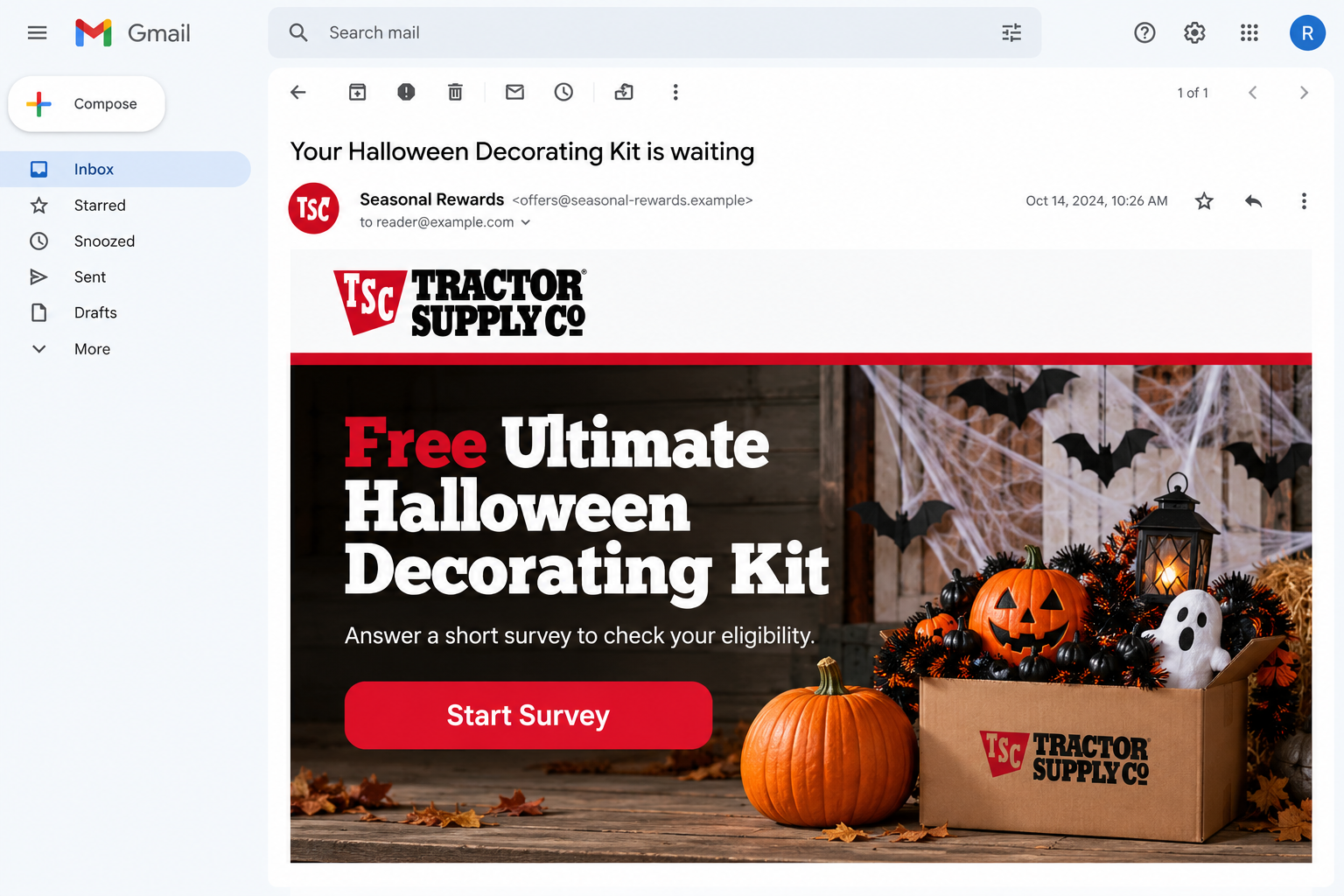
The Free Ultimate Halloween Decorating Kit email is a retailer-impersonation lure. Security researchers identified messages misusing Tractor Supply branding during the Halloween season.
Tractor Supply is not associated with that reported campaign. The scam concerns the message and its linked journey, not ordinary shopping with the genuine retailer.
The email picture above is a nonfunctional illustration with fictional addresses. It shows the type of hook, not an original message or a verified delivery date.
Why the Survey Is the Point of Risk
A few shopping questions can seem like a reasonable exchange for a free decoration kit. That appearance makes the first click easier to justify.
- The message borrows a real retailer’s identity to introduce an unverified promotion.
- The promised kit encourages people to continue through a survey or entry form.
- A copied logo does not identify the operator collecting answers.
- Later shipping or verification fees are warning signs, not proof that the prize exists.
- Any subscription or charge must be checked against the actual form and receipt.
What to Do With the Invitation
Do not claim the kit through the unsolicited message. Check the genuine retailer independently if you want to know whether it has a real seasonal promotion.
A retailer can run legitimate surveys and contests while scammers imitate it. The existence of a real competition does not authorize an unrelated email.
The useful distinction is between the verified organizer and the person controlling the link in front of you.
Why This Particular Gift Works as Bait
Halloween decorations are seasonal, visual, and easy to imagine using immediately. A box of them feels like a tangible reward rather than an abstract promise.
The timing also gives a reason to act quickly. Someone planning a display may concentrate on whether the parcel could arrive before the holiday.
The scam takes advantage of that shopping mindset. Instead of asking whether the sender is authorized, the reader starts considering where the decorations will go.
A survey provides a plausible explanation for the free gift. Retailers ask for feedback, so the request can feel like a normal customer-research exchange.
But the story about why you qualify is not authentication. Neither a recent purchase nor a familiar product category proves the message came from the retailer.
Even if you have never shopped there, the promotion may frame you as specially selected. That claim is part of the approach, not independent evidence.
How the Tractor Supply Halloween Kit Email Scam Works
Step 1: A Seasonal Message Uses the Retailer’s Reputation
The email presents a free ultimate decorating kit under Tractor Supply branding. The familiar name gives an otherwise unexpected invitation a ready-made explanation.
Recipients may recognize the retailer without knowing what its actual promotional messages look like. That gap helps an imitation pass a quick visual check.
Names, logos, product pictures, and copyright lines can all be copied. Their presence tells you whose reputation is being borrowed, not who sent the message.
Read the actual sender information, but do not treat a convincing display name as sufficient. When in doubt, leave the email route entirely.
Step 2: A Survey Makes the Exchange Seem Fair
The invitation asks for a small action before the reward. Answering questions feels less risky than transferring money or sharing an account password.
It can also create momentum. After several answers, a final request may feel like finishing a process rather than starting a different transaction.
Watch for that shift. Questions about shopping preferences do not justify asking for banking access, identity documents, or a login code.
The reported kit message establishes the bait. It does not establish that every recipient sees exactly the same questions or later screen.
Step 3: The Linked Page Collects More Than Your Opinion
Survey and prize funnels can request a name, contact information, or delivery address after the questions. Each field expands what the operator knows.
Giving a shipping address may seem logical for a physical kit. The missing piece is whether this particular operator has any authority to send one.
A professional-looking form cannot answer that. Look for the actual organizer and independently check its relationship with the retailer before disclosing anything.
Do not enter false test details to explore the funnel. You do not need to complete a suspicious form to decide against it.
Step 4: A Small Charge Can Turn the Prize Into a Payment
In prize scams, a later page may describe a charge as postage, handling, verification, or the last requirement for release.
The amount can be deliberately modest. A person imagining a large box of decorations may see a small payment as a reasonable delivery expense.
The FTC’s prize warning identifies requests to pay for a prize as a scam signal.
This is a possible extension of the survey pattern, not a finding that every kit email led to an identical charge.
If your version introduces payment, stop there. Do not let a card form or bank prompt redefine the transaction without reading what it actually authorizes.
Step 5: Follow-Up Messages Can Keep the Story Going
After an entry, the operator may have enough information to send more personalized contact. A later delivery problem or winner-verification message can sound connected and credible.
That connection is not proof of legitimacy. It may simply reflect information you supplied during the first interaction.
If you paid, inspect the real receipt for the merchant, product, amount, and any recurring terms. The statement may not use the retailer’s name.
Do not assume an unwanted charge is a genuine Tractor Supply transaction because that name appeared in the original email.
Any claim of automatic membership needs to be checked against your actual records. This report does not establish that every recipient was subscribed.
Real Surveys and This Fake Kit Are Different Things
Tractor Supply publishes official rules for genuine events and sweepstakes. Those documents can identify dates, eligibility, an organizer, and entry conditions.
That makes independent checking possible. It does not mean a message with a similar design inherits the rules or becomes part of the real event.
For example, a genuine feedback competition may concern a different prize or participation route. Matching the word survey is not enough.
Use the retailer’s known app or type its official address yourself. Locate support there if the promotion remains unclear.
Do not rely on the kit message’s own contact button to confirm its authenticity. The same operator can control both the invitation and the answer.
Keep the check specific: does the retailer authorize this exact free Halloween kit message, sender, and entry destination?
Warning Signs Worth Checking Before Any Entry
The Hostname Does Not Match the Claimed Organizer
A retailer name can appear inside a page title or a long URL without being the website’s real domain. Read the host, not only the recognizable words.
A redirect through another service is not automatically fraudulent, but it increases the need to verify the final destination and organizer.
The Prize Seems Available Only Through This Message
If the sender insists the offer cannot be checked elsewhere, that is a reason to stop. An exclusive claim should not require blind trust.
A deadline does not remove your right to verify. Missing a supposed free kit is preferable to approving an unrecognized payment.
The Form Changes the Deal Midway
An entry that turns into a paid membership, product trial, or unrelated purchase is no longer the simple free-kit offer you first considered.
Read the amount and terms before proceeding. Do not assume a low introductory figure is the complete cost or that a checkbox is harmless.
A Bank Code Is Presented as Survey Verification
A bank’s approval screen describes a financial action. The survey page cannot turn that action into a harmless identity check merely by calling it verification.
Never read a one-time code to an unknown caller who contacts you about the prize. That may authorize a payment or account access.
What to Do If You Followed the Halloween Kit Email
-
End the claim process now. Stop answering questions, close the linked page, and refuse requests for a final payment or additional verification.
-
Write down your actual exposure. Note whether you submitted only contact details, entered a password, approved a charge, downloaded a file, or installed an application.
-
Preserve the transaction evidence. Keep the email, full URL, order confirmation, payment amount, and merchant name. A retailer logo alone will not identify the recipient of money.
-
Speak to the issuer if payment details were shared. Explain the prize impersonation and any charge. Ask about protecting the card and disputing the particular transaction.
-
Cancel any unwanted plan you actually find. Check the receipt and account terms. Save a cancellation confirmation and monitor for later charges instead of assuming one small payment ended it.
-
Change a disclosed password through the genuine service. Review account access and secure reused credentials elsewhere. Do not return to the prize page to update them.
-
Report the fake promotion. Use independently located Tractor Supply support and your mail provider’s phishing controls. In the US, report a financial scam through official consumer-reporting channels.
-
Check software exposure if needed. Malwarebytes is relevant if you installed something suspicious. AdGuard may reduce malicious ads, but neither action reverses a payment or cancels a subscription.
Use the existing MalwareTips link for Malwarebytes on Windows rather than a download recommended inside the supposed prize flow.
The AdGuard download information on MalwareTips is a separate prevention option. You do not need to buy software merely for receiving this email.
If no file was run and no information was entered, reporting and closing the lure may be all that is needed. A full device reset is not justified.
If the Charge Appears Under an Unfamiliar Name
Start with the statement date and amount, then compare them with the time you followed the kit offer. Preserve the descriptor exactly.
Do not search that name and call the first sponsored support number. Fake support advertisements can create another opportunity to take money.
Contact the card issuer through the number on your card or the genuine banking app. Let it identify the payment route and explain available protections.
If the payment was authorized because of a false prize, say that. If you never authorized the transaction, explain that distinction too.
A later recurring charge may require both cancellation of a plan and a dispute about how it was sold. Keep those requests separate in correspondence.
Ask the provider how to prevent future billing. Simply replacing a card is not a universal substitute for ending a merchant agreement.
Do Not Let the First Contact Become a Recovery Scam
After a loss, another message may claim that a refund is ready. It can use the original prize details to make the new approach sound official.
A demand to pay before receiving that refund should end the conversation. You do not need to purchase gift cards or send cryptocurrency to reverse a card charge.
Keep genuine bank communication inside its established channels. An incoming caller knowing your name and the kit description has not proved control of your account.
If someone else in the household paid, help them gather the records without blame. Embarrassment can delay the call that preserves recovery options.
The goal is to interrupt the process, not to win an argument with the sender. Blocking contact is sensible after the necessary evidence has been saved.
Frequently Asked Questions
Is Tractor Supply Giving Away This Halloween Decorating Kit?
The reported Free Ultimate Halloween Decorating Kit email is an impersonation campaign, not an authorized retailer offer. Check any different promotion directly with the genuine business.
Are All Tractor Supply Surveys Fake?
No. Genuine survey competitions exist. Their existence does not authenticate this kit invitation or a payment request from an unrelated page.
Why Would a Free Kit Ask for a Card?
A supposed postage or verification payment can be the real objective of a prize scam. Do not provide a card to make this unverified free gift proceed.
Will Everyone Who Clicks Be Put on a Subscription?
That was not established. If you paid or completed a trial form, inspect the specific receipt, consent terms, and statements for any recurring arrangement.
Should I Contact My Local Tractor Supply Store for a Refund?
The fake message does not establish a genuine retailer sale. Use the actual payment records to identify the transaction, and ask your issuer about an unresolved charge.
What If I Only Gave My Address?
Be alert to targeted follow-up and fake delivery messages. Do not send more information to correct the entry or pay a later fee to release the kit.
The Bottom Line
Do not complete the free Tractor Supply Halloween kit survey or pay to claim its prize. The reported message misuses the retailer’s identity to draw people into an unverified process.
If you engaged, preserve the records and respond to the specific exposure. Contact the bank for payment problems, protect disclosed logins, and cancel only unwanted plans you actually identify.

Join the discussion
0 commentsShare your experience or ask a question about this article.
Discussion
Start the conversation
Have a question or something useful to share? Add the first comment.