

Ever since Donald Trump announced on November 17, 2025, that he intends to send Americans two thousand dollar “tariff dividend” checks starting sometime around mid-2026, millions of people have searched online for details about the plan. That sudden surge in demand has created the perfect opening for scammers. Within days of the announcement, dozens of websites appeared claiming to help Americans apply for these checks or verify eligibility. They use professional graphics, patriotic colors, and persuasive language to appear legitimate. They often position themselves as government portals offering early registration or official application support. In reality, none of these websites are connected to the federal government. They exist only to harvest personal data, redirect users into advertising funnels, or collect affiliate commissions.
This comprehensive guide explains how these scam sites work, which tactics they use, why they pose serious risks, and how to protect yourself. It also places the scams in context by summarizing what reputable news outlets have reported about Trump’s proposal. By the end, you will have a complete understanding of why no online portal can legitimately help you register for tariff dividend checks and why any website claiming otherwise should be treated as a clear warning sign.
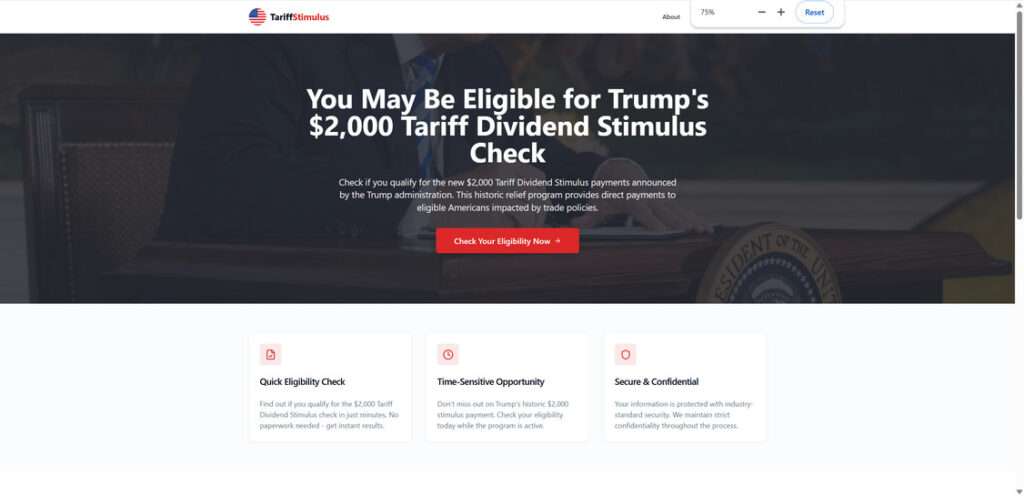
Scam Overview
To understand why these websites are scams, it helps to first understand exactly what Trump announced and what reputable news outlets confirmed. On November 17, 2025, Trump stated that he intends to deliver two thousand dollar annual payments to Americans funded by tariff revenue. He framed the program as a way to redirect trade penalties into the pockets of ordinary citizens. Axios, New York Post, Reuters, and other outlets quickly reported on the announcement, explaining that the idea is a policy plan rather than a finalized government program. The White House later confirmed that Trump is committed to pursuing these payments but that the details require planning, legislation, and significant financial review.
Multiple news organizations highlighted substantial obstacles. FingerLakes1.com and The Economic Times noted that no federal agency has been assigned to run such a program and that no system exists to deliver tariff-funded checks. Experts questioned the legal authority for such payments and pointed out that Congress would need to approve any large-scale distribution. Analysts from various outlets highlighted a more fundamental issue: tariff revenue appears too small to cover such a program. Al Jazeera provided an example showing that if about 150 million Americans qualified, the total cost could approach 300 billion dollars. Recent tariff revenues fall far below that figure, which means the program might be financially impossible without major structural changes.
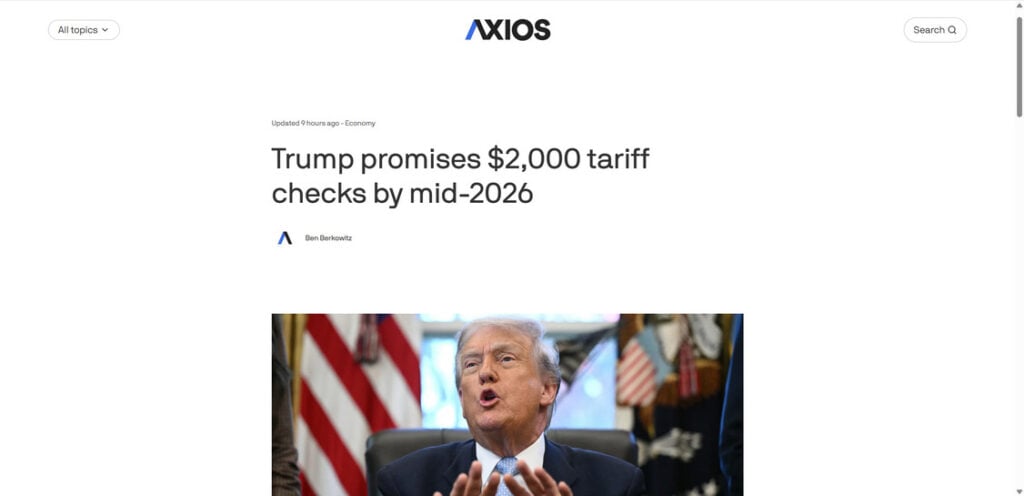
Amid these uncertainties, scammers saw an opportunity. When millions of Americans search online for “Trump tariff dividend check,” “2,000 dollar tariff stimulus,” or “tariff dividend application,” scammers buy ads or build search-optimized websites to intercept traffic. These sites promise early access, pre-registration, or instant eligibility verification. They often include countdown timers to create urgency, pop-up notifications showing fictional people receiving payments, and official-sounding text describing a nonexistent application process.
In reality, these websites provide no valid service. They do not help with government benefits, because no such benefits exist yet. They do not have access to government databases. They are constructed solely to collect data or redirect users into lead-generation networks. Some sites attempt to generate revenue through ads, while others may attempt more serious fraud involving identity theft.
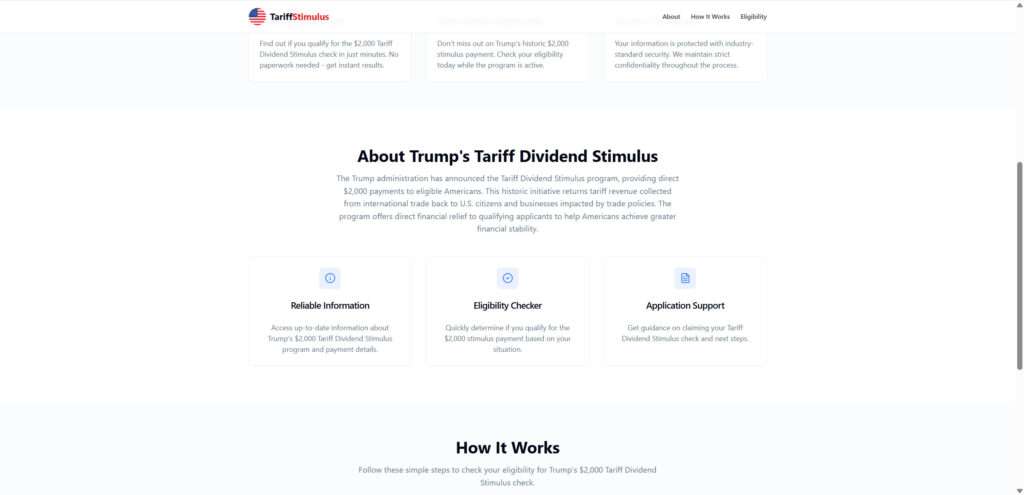
A typical scam website will present itself as a government portal with claims like:
“Check your eligibility for Trump’s 2,000 dollar Tariff Dividend now.”
“Official Tariff Dividend Stimulus check application center.”
“Free eligibility verification for the Trump Tariff Dividend Program.”
These statements are misleading. There is no official application process. No federal agency is collecting applicant information. No system exists that would allow early registration. Any website stating otherwise is attempting to exploit public interest in the proposal.
These scams are designed around a simple reality. Scammers know that millions of Americans want financial assistance. They understand that a presidential announcement can create instant demand. They know that most users are not experts on government processes and may be tempted by the promise of simple eligibility checks or early sign-up access. They exploit this demand by constructing websites that look authoritative even though they provide nothing. Their goal is to gather personal details and push users toward pages that generate revenue for the scammers.
The problem is not limited to one or two domains. There are dozens of them. Each uses slightly different branding, but they rely on the same underlying structure. They offer vague descriptions of Trump’s proposal, mix in official-sounding language, and provide a big button labeled “Check Eligibility Now.” As soon as a user clicks it, the data-harvesting process begins. Many websites even include tiny legal disclaimers acknowledging that they are not part of the government, but those disclaimers are placed at the bottom of the page in small print. The prominence of claims at the top and the visual styling of the website give the opposite impression.
Ultimately, the biggest red flag is this: Trump’s tariff dividend proposal has not been turned into an actual government program. No application system has been built. No agency is handling registration. No checks exist yet. Payments, if they materialize at all, are not expected until at least mid-2026. Any site suggesting otherwise is automatically deceptive.
How the Scam Works
Although the appearance of scam sites varies, their underlying mechanics are nearly identical. They follow a predictable multi-step structure designed to create trust, gather data, and generate revenue. Below is a breakdown of the typical process, step by step.
Step 1: They Hijack Search Traffic
Scammers begin by targeting people who search online for information about Trump’s two thousand dollar tariff dividend checks. They use paid ads, search engine optimization, and social media posts to attract clicks. A user who searches for “tariff dividend stimulus check,” “Trump two thousand dollar tariff payment,” or “new stimulus program” might see one of these scam sites appear at the top of the results. Because many people do not analyze URLs closely, they assume the site is legitimate when it uses patriotic colors or language that resembles government messaging.
Step 2: They Present a Fake Government-Style Landing Page
Once a user clicks the link, they see a professionally designed landing page with official-looking images, serif fonts, and a layout similar to government portals. The site may include photos of podiums, flags, or government buildings. It often contains headings like “You may be eligible for Trump’s 2,000 dollar Tariff Dividend Stimulus Check.”
These pages are designed to signal authority. Scam sites rely heavily on familiar visual cues. They use phrases such as “government verified,” “secure application,” or “official eligibility check.” Though they include disclaimers stating they are independent, the overall design makes many visitors believe they are interacting with a legitimate program.
Step 3: They Create Urgency
Urgency is a key part of the scam. These sites frequently include countdown timers that claim the application window is closing soon. They might also show pop-ups indicating that fictional people have just claimed their checks. This tactic plays on basic psychology. When a visitor thinks that time is running out, they are less likely to question the legitimacy of what they are seeing. The site might claim that funding is limited or that only early applicants will receive priority status.
Step 4: They Offer a Fake Eligibility Check
The next step is always the eligibility form. The user is asked to provide a zip code, income range, employment status, age, or citizenship. None of this information is actually used to verify anything, because the underlying program does not exist. The form is a simple lead capture tool. Regardless of what information the user enters, the site always concludes that the user is “eligible.”
Step 5: They Request Personal Information
After telling the user they are eligible, the site asks for more sensitive data. This usually includes an email address or phone number. Some sites ask for more personal details, such as home address, income brackets, or marital status. A few sites even attempt to gather Social Security numbers, which is a much more serious threat since SSN theft can lead to identity fraud. Many scam sites push users into long funnels where they are asked questions that appear harmless but are designed to build a detailed profile.
Step 6: They Redirect to Advertising Funnels or Paid Offers
After collecting data, the site sends users to unrelated pages. These pages might include:
Survey sites
Free trial product pages
Credit repair advertisements
Insurance quote forms
Sweepstake entries
Loan offers
The websites that operate these funnels pay the scammers each time a user enters information or clicks through the offers. The scam is not about helping people get stimulus checks. It is about generating revenue by pushing users into advertising networks. Some more malicious versions attempt to install malware or push fake browser updates.
Step 7: They Sell or Share the Collected Data
The information harvested from visitors is stored and potentially sold to third-party marketers. These details may be used for spam emails, robocalls, targeted scams, or phishing attempts. A person who interacts with one of these scam sites often starts receiving suspicious calls or messages claiming to offer government grants, debt relief, or similar benefits. The original scam site acts as a data acquisition point that feeds larger networks of scam operations.
Step 8: They Repeat the Cycle With New Domains
Scammers constantly rotate domains to avoid detection. As soon as one site is flagged or loses visibility, they register a new one. The process repeats with:
New names
New branding
New landing page images
This is why dozens of websites appear within days of any major government announcement. When demand spikes, scammers rush to capitalize on the moment.
What to Do if You Have Fallen Victim to This Scam
- Stop interacting with the website immediately. Close the page and do not return. Scammers often use tracking scripts or repeated redirects to keep you within their funnel.
- Change your passwords for any account connected to the email or phone number you used. Even if you provided only basic information, scammers may attempt to guess passwords or link your identity to other online accounts.
- Enable two factor authentication wherever possible. This reduces the risk of unauthorized account access using the information you entered.
- Monitor your email carefully for phishing attempts. Scammers may pretend to be government agencies, loan officers, or grant administrators.
- Block or report scam-related phone calls. You can use your carrier’s tools or a reputable call filtering app to reduce unwanted contacts.
- Freeze your credit if you provided sensitive personal information. A freeze prevents new accounts from being opened under your name without authorization.
- Report the scam to the Federal Trade Commission at ReportFraud.ftc.gov. These reports help authorities track and shut down fraudulent websites.
- File an Internet Crime Complaint Center report at IC3.gov. The FBI uses these reports as part of their online fraud investigations.
- Inform your bank if you entered financial data anywhere during the process. Even if you did not provide bank details directly, it is wise to warn your institution to watch for suspicious activity.
- Warn others by sharing accurate information on social media. Scammers depend on confusion and misinformation. Educating friends and family helps reduce the number of victims.
Frequently Asked Questions
What is the Trump 2,000 dollar Tariff Dividend payment?
The 2,000 dollar Tariff Dividend is a proposed plan announced by Donald Trump on November 17, 2025. He said he intends to distribute annual payments funded by tariff revenue beginning around mid-2026. At this stage, it is a policy idea, not an official program. It has not been approved by Congress, and no federal agency has created a system for applications or registration.
Are the tariff dividend checks available right now?
No. The checks do not exist yet. There is no official rollout, no portal, and no sign-up process. Reputable news outlets such as Axios, Reuters, New York Post, and The Economic Times reported that the plan is still under review and requires legislation. Any site claiming that you can apply now is misleading you.
Why are websites offering early eligibility checks or applications?
These websites are scams designed to exploit public interest. They use political news as bait to attract visitors. Once you click through, they collect your personal information, redirect you to advertising funnels, or attempt more dangerous fraud. They do not help you obtain government benefits and they have no connection to the federal government.
How do I know if a website is legitimate?
A legitimate government website will always:
Use a dot gov domain
State clearly which agency operates it
Link to official government resources
Avoid asking for sensitive personal data without clear purpose
Never offer early access to benefits that do not exist
Any site with a dot com, dot us, dot org, or similar extension that claims to offer tariff dividend applications should be considered suspicious.
Why are scammers using Trump’s tariff dividend announcement?
Whenever a large-scale benefits program is announced or discussed, scammers attempt to capitalize on public interest. The tariff dividend proposal created a surge in online searches. Scammers know millions of Americans are eager for financial assistance, so they build convincing sites to intercept that traffic and profit from it.
What information do scam sites try to collect?
These sites commonly ask for:
Email addresses
Phone numbers
Home addresses
Income brackets
Age and household size
Employment status
Some more malicious sites may request Social Security numbers or bank information. Providing this data puts you at risk of identity theft, phishing, and unauthorized account activity.
What happens after I enter my information?
After entering your details, most scam sites will redirect you to unrelated advertising pages. These funnels generate revenue for the scammers each time you click or sign up. Others may sell your information to marketing networks or use it for targeted scam attempts. In the worst cases, your data could be used for identity fraud.
Is there any official government registration for tariff dividend checks?
No. There is no official application process. There is no portal. There is no government registration system. Payments cannot be issued until the program is formally created, approved by Congress, funded, and organized by a federal agency. This process has not occurred.
When will the checks be available if the program becomes real?
Trump stated that payments would begin around mid-2026. Even this timeline is uncertain, because the program requires legislative approval, funding authorization, and administrative planning. Government benefits programs often take much longer to implement. Anyone promising faster access is not telling the truth.
How can I avoid falling victim to these scams?
Always verify sources before providing personal information. Ignore any website claiming to offer early access to a program that does not exist. Avoid clicking on ads that promise instant eligibility checks. Bookmark official government websites, especially IRS and Treasury pages, so you can check accurate information without searching.
What should I do if I already used one of these scam sites?
If you already submitted your information, take action immediately. Change your passwords, enable two factor authentication, report the scam to the FTC, and monitor your accounts. Consider freezing your credit if you shared sensitive data. Stay alert for suspicious calls or emails pretending to be government agencies.
Will the government ever contact me by email or text to apply for tariff dividend checks?
No. Government agencies do not contact citizens randomly to request applications for financial benefits. Any unsolicited message claiming you must confirm your eligibility or verify information for tariff dividend checks is a scam.
Why are countdown timers and pop-up alerts used on these scam pages?
Scammers use pressure tactics to create urgency. Countdown timers are fake. Pop-up messages showing other people receiving money are fabricated. These features are designed to make visitors act quickly without thinking. Urgency is one of the most common psychological tools used in online fraud.
Are these scam sites illegal?
Yes. Misrepresenting a non-existent government program, collecting personal data under false pretenses, and impersonating government services all violate consumer protection laws. These sites often operate anonymously and change domains frequently to evade enforcement.
Where can I find accurate updates about the tariff dividend program?
The only reliable sources are official government websites and credible news outlets. When and if the program becomes real, agencies such as the IRS or U.S. Treasury will publish clear, accessible information. No third-party site can provide earlier or more accurate updates.
The Bottom Line
Trump’s two thousand dollar tariff dividend proposal generated intense interest across the country. News outlets reported accurately that the plan is in its early stages, requires congressional approval, and cannot begin before mid-2026. No application process has been created. No agency has been assigned to manage payments. No website is authorized to enroll citizens in the program.
Any site claiming to offer early access, application support, or eligibility checks is a scam. These websites imitate government branding to mislead users. They promise benefits that do not yet exist. They collect personal information, redirect users into advertising funnels, and potentially expose victims to additional fraud.

Join the discussion
2 commentsShare your experience or ask a question about this article.
Discussion
excellent
thank you
America strong
In reply to j.n.c.f
Thank you, and glad it was useful. If you spot the same scam advertised somewhere else, reporting it on that platform genuinely helps – these operations get shut down on complaint volume rather than on anything we write.