

The Froplay ZoomerPup looks impressive in ads: a soft, adorable robot puppy that walks, wags, barks, responds to touch, and teaches kids empathy. The promotional videos show a lifelike “AI-powered” pet that seems like the toy of the year. But does Froplay ZoomerPup actually deliver what is advertised, or is this another deceptive dropshipping operation designed to take advantage of parents before the holidays?
This investigation breaks down the Froplay ZoomerPup operation, exposes the tactics behind the marketing, and shows you exactly what customers actually receive. If you are considering buying Froplay ZoomerPup, read this before spending your money.
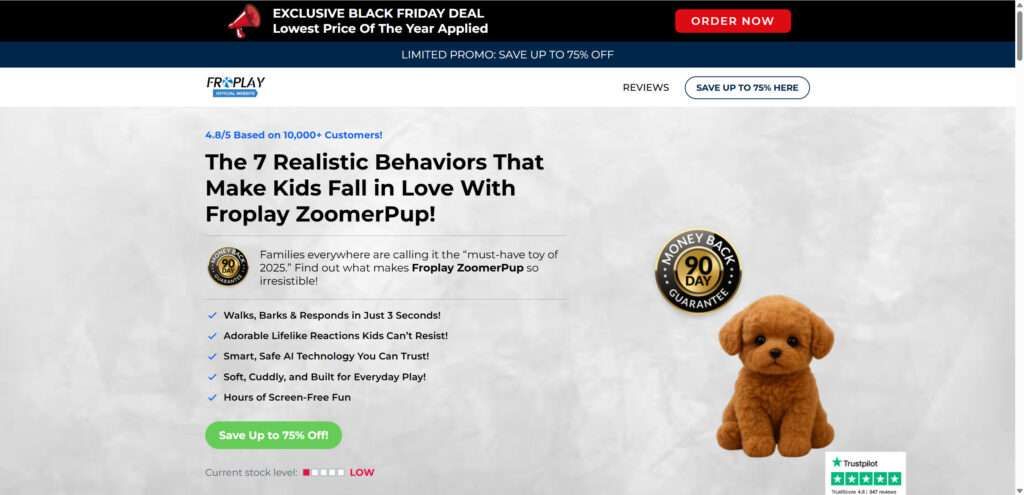
Overview: What Is Froplay ZoomerPup?
Froplay ZoomerPup is promoted through highly polished, emotionally targeted advertisements across Facebook, Instagram, TikTok, and YouTube. These ads claim that ZoomerPup is an AI-powered robot puppy that can:
- Walk, bark, and respond to voice
- Wag its tail realistically
- React with lifelike facial expressions
- “Learn” from children
- Provide emotional comfort and reduce stress
- Encourage creativity and empathy
The website promises a magical, interactive pet that reacts in real time. It displays fake awards such as “Toy of the Year,” fabricated reviews, and staged images of kids bonding with the puppy. Countdowns, “low stock” alerts, and “exclusive Black Friday pricing” create urgency to purchase immediately.
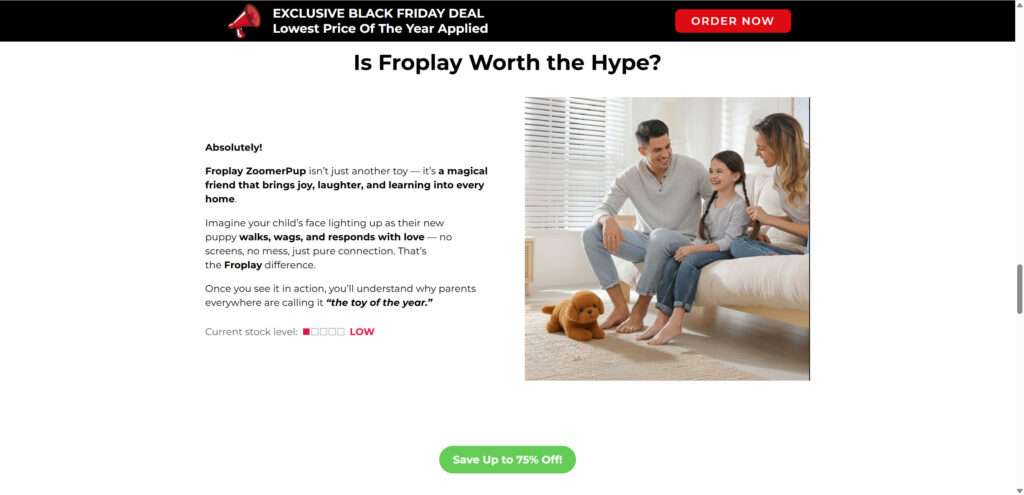
However, every element of the website—images, videos, reviews, award logos, testimonials, expert quotes—is either AI-generated, stolen from stock photography, or fabricated.
Customers who purchased Froplay ZoomerPup consistently report receiving a cheap plush toy with a simple battery-powered sound box inside. No movement. No AI. No walking. No reacting. No sensors. Nothing resembling a robot.
The entire business model relies on misleading customers into believing they are buying a high-tech smart toy when they are actually buying a $2–$4 wholesale plush from China.
Signs Froplay ZoomerPup Is Not a Real Robotic Toy
- The product in videos does not exist in real life.
The videos show smooth movement, facial animations, and reactions impossible for a toy with no visible mechanics. - Every “award badge” and “expert review” is fabricated.
There is no record of these awards, and the quoted experts do not exist. - The website uses stock images and AI-generated photos of children and families.
- The ads show a dog design that does not match the toy being shipped.
- The price is unrealistic.
True robotic pets cost $60–$150+. The ZoomerPup price of $29–$39 signals a bait-and-switch. - The company provides no physical address, no real phone number, and no verifiable business registration.
- The same product is sold under multiple scam site names.
Froplay ZoomerPup is simply the next version after scams like Dachy 2.0 and Wuffy Robot Puppy.
These alone should be enough to avoid the product, but the operation goes much deeper.
How the Froplay ZoomerPup Operation Works
The ZoomerPup scam is a textbook example of a modern dropshipping operation. Here is the full step-by-step breakdown.
Step 1: Create a convincing homepage
The scammers build a professional website using Shopify or ClickFunnels templates. They fill it with:
- AI-generated pictures of kids holding the toy
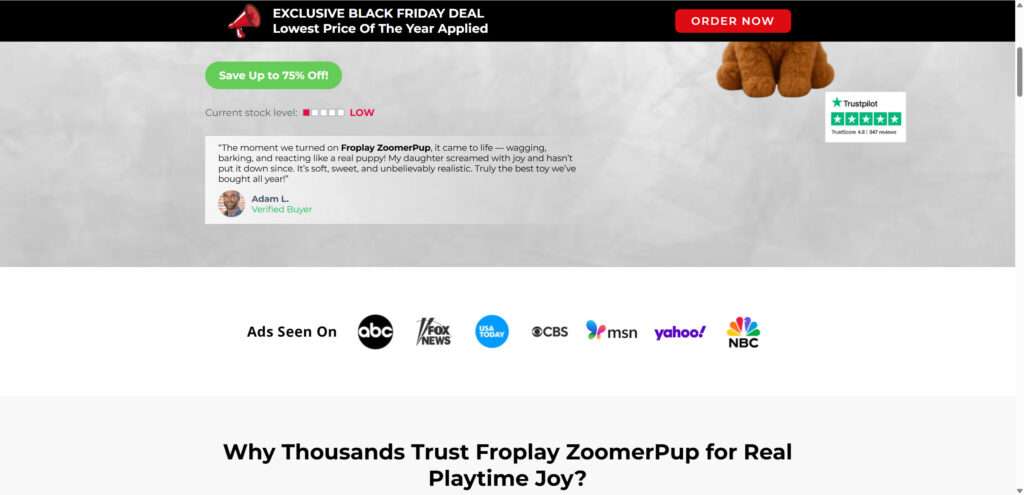
- Fake Trustpilot badges
- Fabricated 5-star reviews
- A “90-day money-back guarantee” that is not actually honored
- Stolen logos from ABC, CBS, NBC, Fox, and Yahoo claiming media coverage
- Fake stock counters
- Fake best-seller labels
- Urgency timers and discounts
The goal is to build instant trust and push buyers to checkout quickly.
Step 2: Run aggressive social media ads
They use Meta Ads and TikTok Ads to target:
- Parents
- Grandparents
- Gift shoppers
- People searching for children’s toys
- People who previously bought pet toys
The ads show the puppy walking, barking, wagging, and reacting. These animations are created using CGI, AI video generation, and digital puppeteering. None of these actions can be performed by the real toy.
Step 3: Collect payment upfront
The scammers offer:
- 50–75% discounts
- “Buy 2, get 1 free” deals
- Free shipping
- Limited-time only pricing
Many customers report being charged for 2 or 3 units even when they selected only 1. This upsell trick is built directly into the checkout flow.
Step 4: Ship a cheap plush toy from China
Once payment is received, the order is forwarded to a low-cost supplier on:
- AliExpress
- Alibaba
- DHGate
These suppliers sell nearly identical plush dogs for $1.80–$4.00.
The scammers ship it to buyers using economy Chinese shipping, taking 2–4 weeks to arrive. When it arrives, customers discover it is:
- A basic stuffed dog
- No robotics
- No artificial intelligence
- No motion
- No sensors
- No touch response
- No lifelike behavior
It is nothing like the advertised product.
Step 5: Block refunds and returns
Although the website claims a “90-day money-back guarantee,” the return policy is engineered to ensure no one receives a refund.
Customers must:
- Ship returns to China at their own expense
- Use trackable international postage
- Pay $25–$40 shipping to return a $2 toy
Most victims give up because return shipping costs more than the item itself.
The company frequently stops responding to emails once a refund is requested.
Step 6: Shut down and rebrand
Once enough bad reviews accumulate, the scammers:
- Shut down the website
- Rebrand using a new domain
- Upload the same content with a new logo
- Relaunch the same ads under different product names
This cycle repeats indefinitely.
Froplay ZoomerPup is simply the next version of earlier deception campaigns such as:
- Wuffy Robot Puppy
- Dachy 2.0
- ZoomerDog AI
- KoalyBear AI Pet
The same fake dog. The same misleading ads. The same Chinese plush. The same scam.
What To Do If You Bought Froplay ZoomerPup
If you already purchased this product, take these steps immediately.
1. Request a chargeback from your bank or credit card provider
State clearly:
- The product was misrepresented.
- The item received is not as advertised.
- The seller’s refund process is fraudulent.
- The website used deceptive marketing.
Banks frequently approve chargebacks for deceptive online purchases.
2. Do not waste money returning the toy to China
Unless your bank specifically requires proof of attempted return, do not ship it. The cost will be higher than the original purchase.
3. Document everything
Take screenshots of:
- Ads
- Website claims
- Product description
- Emails
- What you received
This evidence strengthens your chargeback case.
4. Report the scam
You can file complaints with:
- FTC (United States)
- Action Fraud (UK)
- Europol Internet Crime Reporting (EU)
- Better Business Bureau
- Your country’s consumer protection agency
5. Warn others
Leave reviews on:
- Trustpilot
- Facebook Scam Groups
- Ripoff Report
This helps prevent more victims.
Frequently Asked Questions
What is Froplay ZoomerPup?
Froplay ZoomerPup is advertised as an AI-powered robot puppy that walks, wags its tail, barks, and reacts to kids with lifelike behavior. The website claims it uses “smart AI technology,” “realistic reactions,” and “interactive play features.” However, customers report receiving a basic plush toy with no robotic features, no AI, and no movement. The toy delivered is nothing like the one shown in ads.
Is Froplay ZoomerPup a scam?
Yes. Froplay ZoomerPup is considered a scam because the product delivered does not match what is advertised. The company uses AI-generated images, fake videos, fabricated reviews, and misleading claims to convince buyers they’re purchasing a high-tech robotic dog. Instead, customers receive a low-quality stuffed toy worth only a few dollars from China.
What do customers actually receive?
Buyers receive a cheap plush dog, usually with a small battery-powered sound module. It does not walk, bark, respond to touch, or perform any AI-driven actions. It is identical to plush toys sold on Alibaba, AliExpress, or DHGate for around $2–$4.
Why does the Froplay ZoomerPup website look professional?
Scam operations often use polished Shopify or ClickFunnels templates to appear legitimate. They include:
- Fake awards
- Fake expert endorsements
- AI-generated customer reviews
- Photos of children taken from stock websites
- Stolen media logos from ABC, CBS, NBC, FOX
Professional design is used to quickly gain trust and push buyers to checkout.
Why is Froplay ZoomerPup heavily discounted?
The large discounts (50–75% off) are used to create urgency and distract shoppers from researching the product. Since the real item costs only a few dollars to produce, scammers can sell it at any “discount” while still turning a large profit.
Why do some buyers get charged for multiple units?
Many victims report that even when selecting one item, the checkout system automatically adds additional units or bundles. This is done to increase profit and is a common tactic in deceptive dropshipping scams.
Can I get a refund for Froplay ZoomerPup?
Getting a refund is extremely difficult. The website claims a “90-day money-back guarantee,” but customers are required to return the toy to China at their own expense. International tracked shipping often costs more than the toy itself, meaning most buyers give up. In many cases, the seller stops responding entirely when a refund is requested.
How long does shipping take?
Most orders take 2–4 weeks to arrive because the item is shipped directly from a low-cost warehouse in China. The company rarely discloses this during checkout.
Who runs Froplay ZoomerPup?
There is no verifiable company information. The website lists no physical address, no real phone number, and no legitimate business registration. The operators hide behind privacy services, making it impossible to identify who is behind the scam.
Are the videos showing Froplay ZoomerPup real?
No. The videos used in ads and on the website are digitally created using CGI and AI tools. The movements shown—walking, wagging, blinking, reacting—are not physically possible with the actual product shipped to customers.
Is Froplay ZoomerPup part of a larger scam network?
Yes. The same exact plush toy has been sold under many different names, including:
- Wuffy Robot Puppy
- Dachy 2.0
- ZoomerPup AI
- Koaly Bear
Each version uses identical scripts, ads, AI videos, and fake reviews. When one website gets too many complaints, it shuts down and reappears under a new name.
What should I do if I already bought Froplay ZoomerPup?
Immediately:
- Contact your bank or credit card provider and request a chargeback.
- Provide screenshots showing the misleading ads and the toy you received.
- Avoid paying to return the item to China unless your bank requires proof of return.
- Report the website to your local consumer protection authority.
- Warn others by posting honest reviews online.
How can I avoid scams like this in the future?
- Always search the product name + “scam” before buying.
- Check when the domain was registered. New domains are a red flag.
- Be skeptical of massive discounts on “advanced tech toys.”
- Ignore websites with fake awards or repeated stock photos.
- Stick to reputable, established retailers.
The Bottom Line
Froplay ZoomerPup is not a smart robot dog, it is not AI-powered, and it does not walk, wag, bark, or respond. The product shown in ads does not exist. The website uses AI-generated images, fake testimonials, stolen media logos, and fabricated awards. Customers receive a cheap plush toy worth a few dollars, not an advanced robotic pet.
Froplay ZoomerPup is simply another dropshipping scam designed to trick parents and grandparents into buying a toy that dramatically differs from what was advertised.
If you are considering purchasing Froplay ZoomerPup, the safest choice is to avoid it entirely.

Join the discussion
2 commentsShare your experience or ask a question about this article.
Discussion
None of what was claimed on this ad was accurate in the least. It is a total scam and they steal your money leaving absolutely no way to contact or get it back. I ordered four of them for older grandkids, but it could have only served for maybe a two year old. So frustrating they can lie like this and get away with it. Don’t buy it or you’ll be stuck with a stupid little yappy battery operated 4-5″ stiff toy that looks like it came from the dollar store. What a joke and A huge lie!
In reply to S
Four of them for grandchildren makes this worse than the usual complaint, and I am sorry – a gift that turns out to be nothing like the advertisement is not something a refund really fixes.
The absence of any way to make contact is deliberate rather than an oversight: the support address and phone number on these sites exist to satisfy the payment processor and are never monitored. So do not spend more time hunting for a working one – the search results for “customer service” numbers for these brands are themselves full of scam call centres.
Go to your card issuer instead. Dispute the charge as not as described, ideally with a screenshot of the advert next to a photo of what arrived, and mention that the seller provides no functioning contact route. You generally have up to 120 days per charge, and one dispute covers all four items if they were on one order. Ask them in the same call to block the merchant and issue a new card number, since these sellers frequently bill again.
Then file at reportfraud.ftc.gov and with your state Attorney General. And one safety note, since these were for children: if the items are battery-powered, especially with lithium cells or button batteries, I would not let the grandchildren use them – goods from these sellers do not go through safety certification, and button batteries are a genuine hazard for small children. Anything unsafe can be reported to the CPSC at saferproducts.gov.