

A recruiter offers remote interview work instead of a conventional job. The explanation sounds specialized, and a recognizable agency name makes the arrangement seem worth hearing out.
The profile renting scam can hide inside that conversation. Before agreeing to the assignment, ask whose identity the interview would actually represent.
Overview
Understanding Recruitment has confirmed the impersonation
Understanding Recruitment is a legitimate recruitment organization. Its name, staff identities, and brands are being misused by people promoting fraudulent recruiting arrangements.
The firm’s Official Fraud & Impersonation Notice explicitly rejects roles involving impersonation or profile renting.
It also describes contacts asking candidates to attend interviews using another person’s identity. That request is the central deception, not an ordinary agency placing an applicant.
Do not participate in a hiring process that conceals who is being interviewed. Verify the contact with the genuine agency and preserve the approach for reporting.
The supposed role can turn an applicant into a stand-in
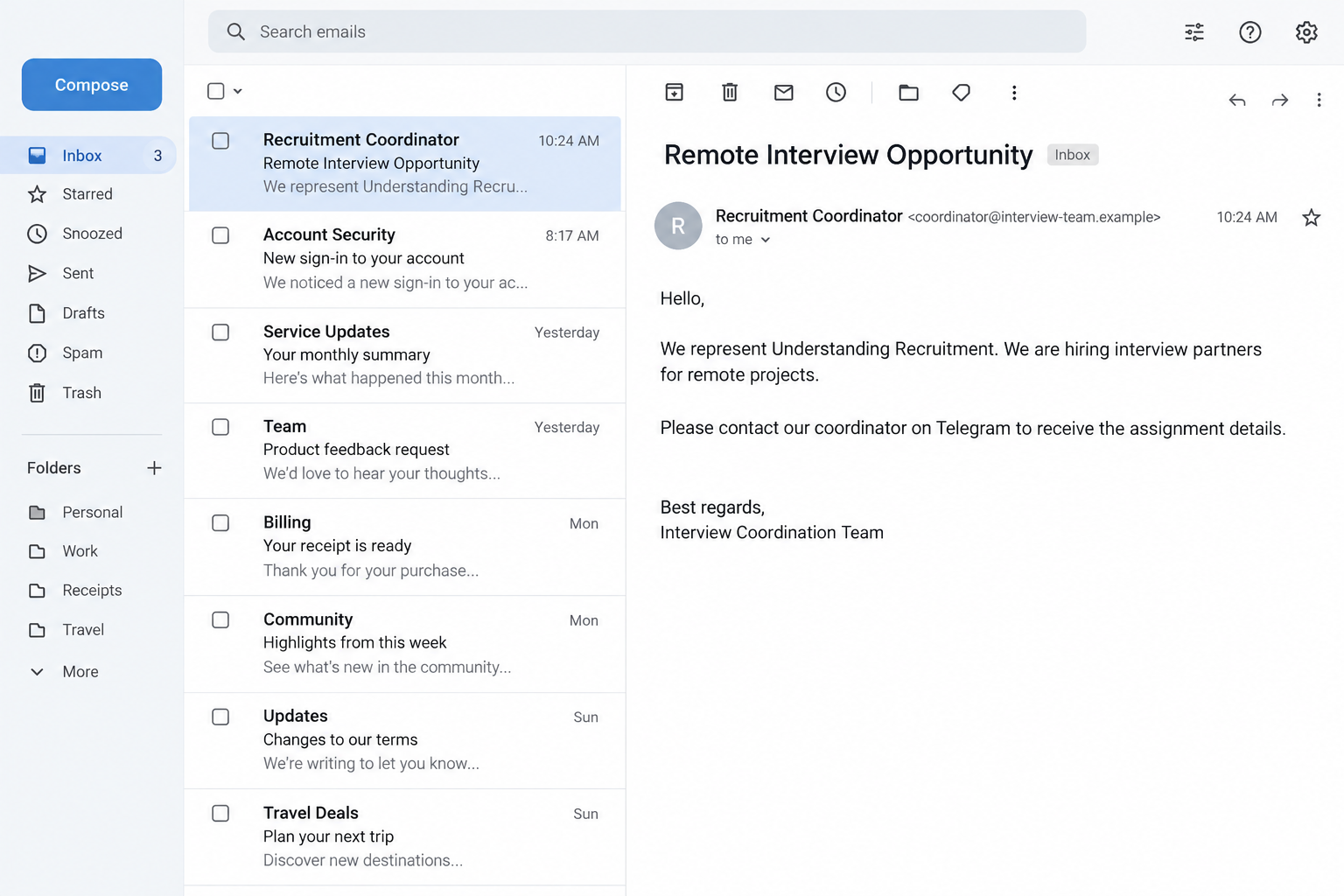
The agency’s notice describes false job descriptions delivered through email and Telegram. The contacts claim to represent its employees and introduce another identity for an interview.
References to Wise or cryptocurrency payments also appear in the warning. The notice does not establish one payment amount, direction, or transaction outcome for every approach.
Wise and Telegram are legitimate services. Their presence in the contact does not make them responsible for an impostor’s identity instructions.
- A stranger presents a recruiting arrangement under a real agency’s name.
- Job details are supplied through an unverified conversation.
- The work involves someone else’s profile or professional identity.
- An interview is meant to represent a person other than the participant.
- The arrangement references financial transfers or unusual payment instructions.
- The real agency expressly disclaims these activities.
The confirmed warning has important limits
The notice was published in December 2025 and updated in February 2026. We checked it live; it is not presented here as a newly disclosed October incident.
It does not identify every operator, establish a particular nationality, or prove the losses of an individual applicant. Those details should not be guessed.
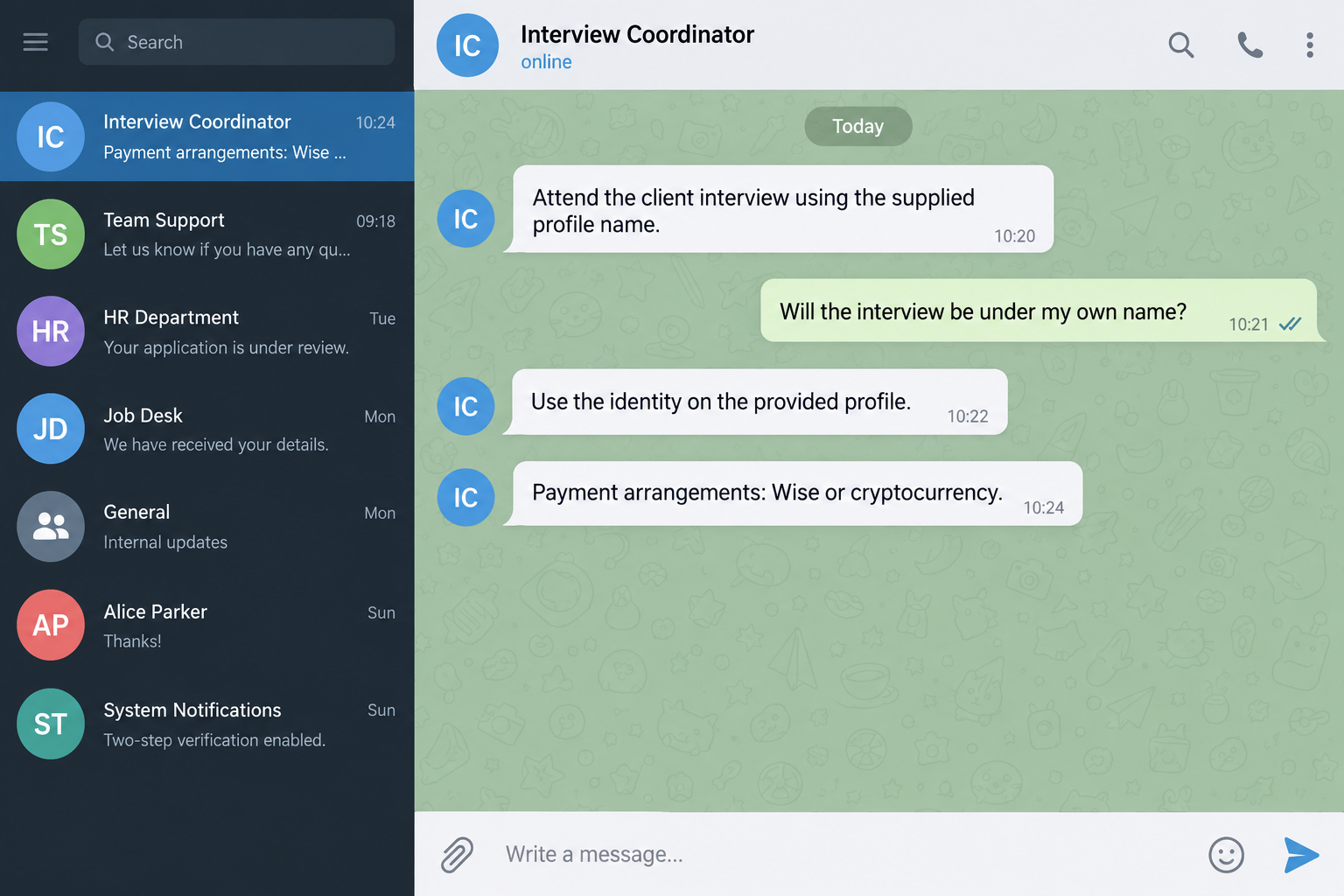
Our example email and chat use invented contacts and reconstructed wording. They show the invitation and identity-switching request, not a captured exchange with a named employee.
The finding is specific: impersonating this agency to recruit people into concealed-identity interviews is fraudulent. Genuine agency services and ordinary contract work are not the target.
The Question a Conventional Job Offer Does Not Need to Hide
Normal recruiting connects an employer with a candidate’s actual qualifications. The interviewer needs to know who is applying and whose experience they are evaluating.
An arrangement that asks you to appear as another person changes that purpose. Your performance can be used to create confidence in someone else’s application.
Calling the work interview support does not resolve the deception. The important question is whether the interviewer understands the participant’s real identity and role.
Interview coaching, practice sessions, accessibility support, and disclosed assistance can be legitimate. They are different from hiding who is speaking or presenting another person’s qualifications.
A recruiter may use polished terms to blur that distinction. Profile rental sounds like a service until you ask what the profile is being used to represent.
Do not rely on the contact’s assurance that everybody does it. The genuine agency specifically says it does not recruit for these impersonation arrangements.
A promised payment can make the request feel transactional rather than consequential. Being paid does not authenticate the recruiter or establish that the interview is honest.
You do not have to complete a demonstration to see the problem. The identity instructions themselves are enough reason to refuse the proposed assignment.
How the Profile Renting Scam Works
Step 1: A contact borrows the agency’s recruiting identity
The approach claims a connection with Understanding Recruitment or one of its employees. That identity provides a ready explanation for why you are being offered work.
An agency name can be found online, and staff profiles may also be public. Accurate background information can be copied without the organization’s permission.
Do not mistake a genuine biography for a verified sender. Someone naming an actual consultant may be impersonating them rather than working alongside them.
Save the sender address, username, claimed role, and proposed assignment. These details help the agency check the particular approach through an independent channel.
A contact that cannot be confirmed should not receive your account access or personal records. Recruiting terminology does not remove the need for identity checks.
Step 2: A private conversation supplies a false job description
The official notice identifies email and Telegram approaches carrying fraudulent descriptions. The contact can make an unusual assignment feel like part of a professional workflow.
You may be asked to discuss experience or availability first. Ordinary interview questions do not establish that the later role description is genuine.
The firm’s warning says it does not conduct recruitment solely through Telegram or similar platforms. A private chat is not sufficient authentication for this arrangement.
If the role is real, the agency should be able to verify it through its published channels. Ask about the job without relying on the alleged coordinator.
Be especially cautious when verification is redirected to another person inside the same conversation. A second unconfirmed contact does not provide independent approval.
Step 3: The assignment substitutes another person’s identity
The contact asks the candidate to attend an interview using somebody else’s identity. The real agency identifies that behavior directly in its fraud notice.
This is not simply helping someone prepare. An undisclosed stand-in can lead the interviewer to evaluate the wrong person and attach that performance to another application.
Do not assume a profile owner consented to its use. Even claimed consent would not establish that the employer or interviewer understands the substitution.
Questions about disclosure should be answered before participation, not after an interview begins. If the plan depends on concealing identity, decline it.
Our example chat illustrates that turning point. Its invented coordinator is not a finding about any real person listed on the agency’s website.
Step 4: Payment language makes the arrangement appear settled
The official warning references Wise or cryptocurrency. Those mentions are evidence of the described approach, not proof of a specific deposit or payout.
A payment service’s existence cannot validate the assignment behind it. Likewise, a transfer receipt would not make a concealed-identity interview legitimate.
Understanding Recruitment says it never requests payment, cryptocurrency, or financial transfers during recruitment. A request for those under its name should be checked directly with the agency.
If the contact asks you to forward funds, lend payment access, or receive money on someone else’s behalf, do not proceed without qualified independent advice.
These are conditional risks, not stages established for every reported contact. Keep your decision tied to the actual instruction and the firm’s published warning.
Step 5: Cooperation can create exposure beyond the first interview
Participating may disclose personal records, professional details, accounts, or communications to an unverified operator. The consequences depend on what you supplied or agreed to do.
A person can also reuse your recorded answers or work history in ways you did not expect. We did not establish that outcome in every case.
Do not complete another assignment to settle a dispute with the contact. Continuing under a false identity can increase the problem rather than resolve it.
If you already participated, preserve the instructions and seek appropriate advice. Be accurate about your own actions when speaking with the agency or relevant institution.
Do not erase the conversation to make the situation less embarrassing. A clear record is useful for understanding what was represented and who requested it.
Four Checks Before You Trust a Recruiting Identity
Confirm the domain through the current official notice
The firm’s warning lists understandingrecruitment.com, understandingnfp.com, understandingsolutions.com, and acceler8talent.com. Read the current notice rather than guessing which similar names belong to the organization.
A matching display name is not a matching email domain. Examine the actual address, including anything after the familiar company words.
Domain checking is one layer, not a complete guarantee. The agency should confirm the specific recruiter and role even when an address looks plausible.
Verify the person, conversation, and vacancy together
Ask whether the named consultant authorized the approach, whether the job is genuine, and whether the channel is part of its established process.
A real staff member can exist without owning the chat profile contacting you. The role and communication must connect to the person through verified channels.
Do not send identity documents just to prove your interest during this check. Explain the contact and proposed assignment using the minimum necessary information.
Ask what the interviewer will be told
Who is appearing, whose application is involved, and what will the interviewer understand about the arrangement? These are practical questions, not technicalities.
A legitimate support role should not depend on someone believing you are a different candidate. Refuse instructions to conceal the participant’s real identity.
If the contact says disclosure would ruin the opportunity, take that seriously. The opportunity is being built around the very misunderstanding you are being asked to create.
Keep your accounts separate from the assignment
Your email, professional profile, authentication codes, bank account, and payment access should not become resources for an unknown coordinator to borrow.
Giving access can create problems even if no fee was demanded. You may lose control of information or actions associated with your own name.
Neither an invoice nor a promising contract summary supplies independent authorization. Verify before accepting paperwork that would expand the contact’s control.
What to Do if You Have Fallen Victim to This Scam
-
Decline further identity-switching assignments. Stop attending interviews, supplying profiles, or following concealment instructions from the unverified contact.
You can disengage without negotiating another payment or demonstration. Preserve the conversation before blocking accounts so you retain a record of the proposal.
-
Notify Understanding Recruitment through its real channel. The official fraud notice publishes info@understandingrecruitment.com for suspicious approaches.
Find the address on the genuine website and describe the claimed consultant, sender, username, role, and instructions. Avoid unnecessary sensitive attachments.
-
Secure any account you shared. Change exposed credentials through the authentic service and remove access or sessions that you no longer recognize.
Include your email and professional accounts if they were involved. Do not give the coordinator your replacement passwords, recovery codes, or login approvals.
-
Review documents and representations already supplied. List the resumes, identity records, profile links, recordings, or forms the contact received.
If a real employer or account was affected, seek guidance through verified channels. Do not invent an explanation or hide what happened from an investigator.
-
Contact financial services about relevant transactions. If you sent funds or disclosed payment access, tell the bank or provider promptly and accurately.
Ask which safeguards and recovery options apply. A legitimate payment platform cannot automatically undo every transfer made under a deceptive recruiting story.
-
Address exposed identification proportionately. A shared profile link is different from a passport image or government identifier. Match the response to the information actually disclosed.
US readers can consult IdentityTheft.gov when identity information is at risk. Follow relevant issuing-authority guidance elsewhere.
-
Get a device check after untrusted software exposure. If a recruiting contact introduced downloads or remote access, pause sensitive activity until the device is assessed.
Malwarebytes can help inspect supported systems. AdGuard can reduce known malicious-site exposure, but neither tool makes an impersonation assignment legitimate or settles its consequences.
-
Keep reporting and advice independent. Report internet-related financial fraud to appropriate authorities, including IC3 where relevant in the United States.
For legal or professional consequences, use qualified advisers you locate yourself. Reject anyone offering guaranteed recovery or silence in exchange for a new payment.
Frequently Asked Questions
Is Understanding Recruitment itself fraudulent?
No. The legitimate agency has published a fraud notice about people misusing its identity. The scam is the impersonating contact and concealed-identity recruiting arrangement.
What does profile renting mean in this warning?
The agency rejects impersonation arrangements and describes candidates asked to interview using another person’s identity. Do not treat that as an ordinary, disclosed recruiting service.
Are interview coaching and accessibility assistance also scams?
No. Legitimate, disclosed assistance is different from secretly substituting the candidate. The key issue is whether the interviewer understands who is participating and in what capacity.
Do Wise or Telegram confirm that the contact is genuine?
No. Real services can be used in deceptive conversations. Their names do not establish the recruiter’s relationship with the agency or authorize identity substitution.
Was a particular payment amount or loss verified?
No. The official notice references payment methods but does not establish one amount or result for every case. This article does not invent a universal financial sequence.
What if I already attended an interview under another identity?
Stop further participation, preserve the instructions, and obtain appropriate independent advice. Notify affected organizations through verified channels and explain your actions accurately.
The Bottom Line
The profile renting scam dresses a concealed-identity interview in a real agency’s recruiting language. Understanding Recruitment explicitly rejects that arrangement and the impersonating contacts behind it.
Do not lend your identity, accounts, or interview performance to an unverified coordinator. Confirm any real opportunity with the agency before taking another step.








