


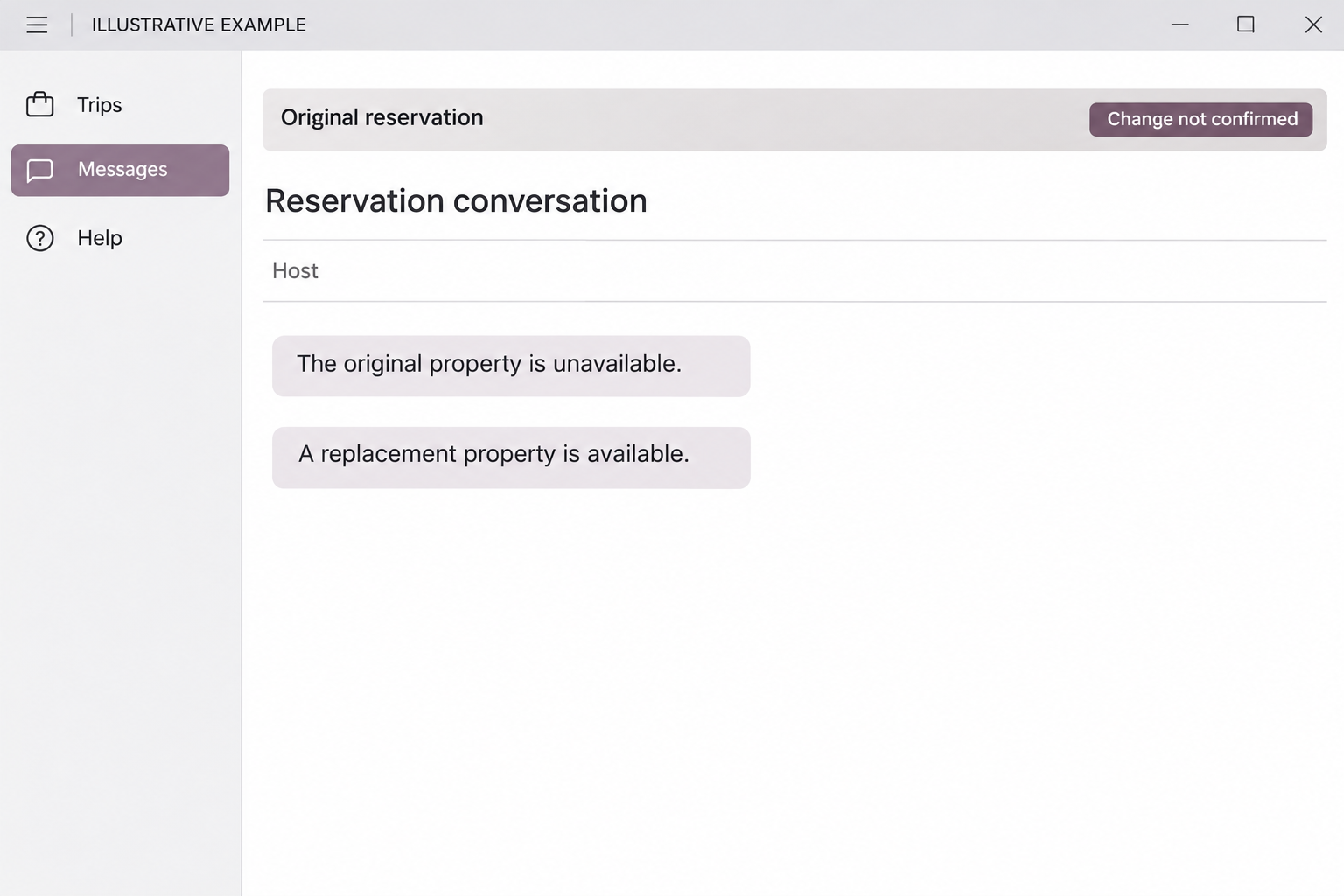
You booked the place months ago. Then, just before check-in, the host says the property isn’t available and offers another address.
You need somewhere to sleep. But the choice you make in the next few minutes can also affect what happens to your original booking.
Overview
The booking can be real while the offer is deceptive
The vacation rental bait-and-switch scam doesn’t need a fake booking website. You can reserve and pay through a real platform and still be misled about where you’ll stay.
The property may exist, the host may respond promptly, and your reservation may show as confirmed. The trouble starts when the host can’t deliver the place you reserved.
Sometimes a genuine maintenance issue or calendar mistake explains a replacement.
Don’t accuse a host just because a pipe burst. Focus on whether the original booking is honored and who records the change.
What matters practically is whether you want the substitute, whether support has reviewed it, and whether you would lose useful options by canceling the original stay yourself.
The Goel and Raheja case shows what deliberate double-booking looks like
The Justice Department’s April 2026 announcement says Shray Goel pleaded guilty to wire fraud and Shaunik Raheja pleaded guilty to obstruction of justice. They entered pleas to different offenses.
Prosecutors described a nationwide short-term rental operation that used several business names, including Abbot Pacific LLC and Jet Set Work LLC.
The scheme operated across multiple cities. It used overlapping reservations and inferior replacement rentals, and sometimes sent guests looking for new accommodation at the last minute.
The plea announcement covers conduct from October 2017 through November 2019. It describes a proven historical scheme, not an allegation that all disappointing bookings today are connected to it.
Your first decisions should happen inside the real booking account
- Open the reservation yourself and check its status, dates and total. A message from the host isn’t necessarily a recorded change.
- Save the original listing details that mattered, including bedrooms, location and accessibility. Those details let support compare the substitute with what you paid for.
- Don’t cancel on the host’s behalf before checking your options. The platform may treat a voluntary guest cancellation differently.
- Don’t follow a payment link or send a new deposit to save the stay. Ask what support can arrange inside the platform.
- If you are stranded or feel unsafe, move somewhere secure first. Keep receipts and ask the platform what costs it can consider.
How the Vacation Rental Bait-and-Switch Scam Works
Step 1: The listing gets you to commit to a specific place
You choose a rental for reasons that aren’t interchangeable. It may be close to the venue, have an elevator, or contain enough real beds for the whole group.
The receipts and dates give the stay a feeling of certainty. That certainty makes it easier to book a flight, reserve a car or turn down another property.
In the federal case, prosecutors said the operation used false host names and fabricated positive reviews. A profile that looked established wasn’t necessarily telling guests who was behind the listing.
Step 2: The original property isn’t available to everyone who booked it
Several reservations can compete for one property. A guest cannot normally see whose booking the host also controls, so a confirmation doesn’t expose that overlap.
The case involved deliberate double-booking. That is different from an honest host promptly reporting an accidental clash, canceling through the platform and cooperating with refunds.
Don’t judge by how apologetic the host sounds. Check what they’re actually offering to do about your paid reservation. You don’t need to establish their intent to request help.
Step 3: A last-minute explanation makes the substitute feel like your only choice
You’ll usually hear the bad news when it matters most, such as after you land or when arriving guests are counting on you to send the check-in details.
A host may give a plausible explanation and describe another property as equivalent. Without a listing, address or photographs, you don’t have enough information to make that comparison.
Ask for the details in the reservation thread. A real alternative can be described there, even if the host first reached you by phone.
Step 4: The replacement takes away features you already paid for
A building farther from downtown might be fine for some groups and unworkable for others. A smaller place can mean separate rooms, transport costs or inaccessible entrances.
Compare the replacement against the features you relied on, not just its nightly price. A substitute with a similar sticker price can still leave you without the stay you chose.
If you do consider taking it, ask support to confirm the change and full price in the official reservation.
Don’t let the original booking disappear before you understand what replaces it.
Step 5: The dispute becomes harder if the change wasn’t recorded
At the end of a long travel day, it can be tempting to accept the new keys and sort it out in the morning. Keep a record before details change.
The federal case involved harm to guests who had to find other accommodation on short notice.
Extra lodging bills aren’t always reimbursed, so ask about coverage before committing when you can.
If support asks what happened, describe the sequence. Say which property you booked, when the host told you it was unavailable, and whether you accepted or stayed in the alternative.
Who Cancels Matters More Than the Explanation
On Airbnb, the guidance for host cancellations says that if the host cannot honor the reservation, you should not cancel for them. Contact Airbnb if the host pressures you.
Airbnb’s home rebooking policy provides for a full refund if a host cancels before check-in. Rebooking assistance depends on availability and pricing for a comparable place.
If the stay is significantly different from the listing or another qualifying issue occurs, report it within 72 hours of discovery. That is different from the check-in date.
Report promptly even if you haven’t finished gathering evidence. Include the host’s message, then add photographs or documents as you get them. Don’t wait simply to send everything together.
Some guests may receive a travel credit for immediate rebooking. The policy also allows a refund to the original payment method. Ask which option you’re being offered before selecting it.
Vrbo’s program terms separately address eligible misrepresentation and wrongful host cancellations. Don’t carry Airbnb’s exact timing or refund rules over to another service.
If you booked directly, look at the written reservation terms and official contact for the merchant. A marketplace’s promise won’t cover an unrelated direct booking.
If part of the vacation was a separate flight or event, ask whether anything besides the lodging can be considered. Don’t assume a reservation policy will reimburse a whole itinerary.
What to Do if You Have Fallen Victim to This Scam
- Get somewhere safe. Don’t enter an unfamiliar property or wait at an address where you feel unsafe. Tell support if you need immediate accommodation.
- Open the real reservation. Screenshot the status, the amount paid and the original listing features. Keep the reservation number private except when contacting legitimate support.
- Move the conversation into the platform. If the host calls, summarize the issue in the booking thread and ask them to confirm the original stay cannot be provided.
- Contact booking support yourself. Ask who needs to cancel, what alternative stays are available, and whether rebooking or a refund is being offered.
- Document differences you can check safely. Note the address, access problems and specific missing features. Save photos or written confirmation when possible.
- Don’t send an extra off-platform payment. If the host says a separate deposit is needed for the substitute, check with support before doing anything.
- Save replacement costs. Keep receipts for lodging or transport and ask what information the platform needs. If payment isn’t resolved, ask your issuer which dispute options apply.
- Report confirmed deception. Give the platform the host profile, listing and message records. If there was a fraud loss, consider reporting it to the appropriate consumer authority.
If the host wants you to leave a review before discussing reimbursement, keep those requests separate.
A report to support is about what happened to your stay, not polishing anybody’s profile.
Your first written report can be three sentences. State that you reserved one property, were told the host couldn’t provide it, and want the platform to confirm your options.
If someone else booked for your group, get that person involved promptly. The booking holder can provide the reservation details and use the official support thread.
How to Assess a Replacement Without Losing the Original
Ask for a map location and the full listing before deciding. A host’s description such as nearby or better doesn’t tell you what your group needs to know.
Compare travel time door to door.
A property technically in the same city may leave you a long ride from the airport, wedding, work site or accessible transit you planned around.
Check the sleeping arrangements. A spare room, sofa bed and third bedroom serve different needs. A replacement that fits two guests might not fit six, even if everyone can enter.
Ask about any deposit, parking charge and check-in restrictions. A no-cost upgrade shouldn’t quietly introduce a new fee or leave you negotiating about a refund after arrival.
If you can’t assess the substitute in time, tell support that. You aren’t obliged to pretend two properties are equivalent because the host gave you a brief description.
If the host addresses the issue fairly and support confirms a documented change you want, the substitution itself isn’t the problem.
The danger is being pressured into accepting something materially different.
Keep personal needs specific without over-sharing. Saying the original property was step-free and the substitute isn’t gives support something concrete to act on without exposing anybody’s medical history.
A decent backup plan helps on busy weekends.
Save a few independently verified options before traveling. Don’t assume the host offering an unrecorded replacement is the only person who can help.
If the Host Says the Change Was Already Approved
Check for a real modification in your booking history. A message saying that support approved something is not the same as a notice from support in your own account.
If support has already made an update, read it before accepting anything.
Look for the exact address, check-in date and name of the booking holder. An edit can affect only one of these.
If the replacement covers only some of your nights, make sure support knows which dates are still unresolved. Don’t assume that acceptance fills the entire gap.
Ask whether the replacement is a modification, a new booking or an informal offer.
That tells you which reservation should show payment and where to look later if a problem arises.
Take a screenshot of what the platform is showing now.
Also keep earlier messages. If the property’s description changes later, you’ll still have a record of the deal you paid for.
If you accepted a change while stranded, tell support that. Don’t describe it as a cancellation you requested if the original place was unavailable. The timeline makes the distinction clearer.
After resolving the stay, check the refund amount against the individual charges on the reservation. A replacement or partial refund may cover accommodation without settling a separate charge you paid.
If the host says a refund is coming, ask where it will appear and when.
Track it in the booking account and your payment statement rather than clicking a second confirmation link.
Frequently Asked Questions
Is every double-booked rental a scam?
No. Calendar mistakes happen. The documented case involved deliberate deception. For a current stay, ask the platform to record the cancellation or resolve the substitution before you agree.
Should I cancel if the Airbnb host asks me to?
Airbnb tells guests not to cancel on the host’s behalf when the host can’t accommodate them. Keep that request in the reservation thread and contact Airbnb if you’re pressured.
Can I accept a different property and still ask questions about the price?
Yes. Before accepting, ask the platform to confirm the property, total price and effect on the original booking. After accepting, report an unresolved issue quickly and keep the correspondence.
Does an in-app reservation make a host’s claims true?
No. It confirms a record exists on the platform. The federal case shows that real bookings can still be backed by misleading listings or overbooked properties.
When does Airbnb’s 72-hour reporting window start?
Its policy says to report qualifying reservation issues within 72 hours of discovering the problem. Don’t confuse that deadline with the separate treatment of unused rebooking credit.
Will I automatically get back what I paid for an emergency hotel?
No. Ask support before booking when possible and save the receipt. A refund for the original stay and reimbursement for replacement lodging are separate matters.
The Bottom Line
Don’t cancel or pay again just because the host says the original rental is unavailable. Open your reservation and have the platform record what changed before accepting a substitute.
If you already arrived or paid for somewhere else, report the problem promptly. Save the original listing, the host’s request and your receipts so support can assess what happened.

Join the discussion
0 commentsShare your experience or ask a question about this article.
Discussion
Start the conversation
Have a question or something useful to share? Add the first comment.