


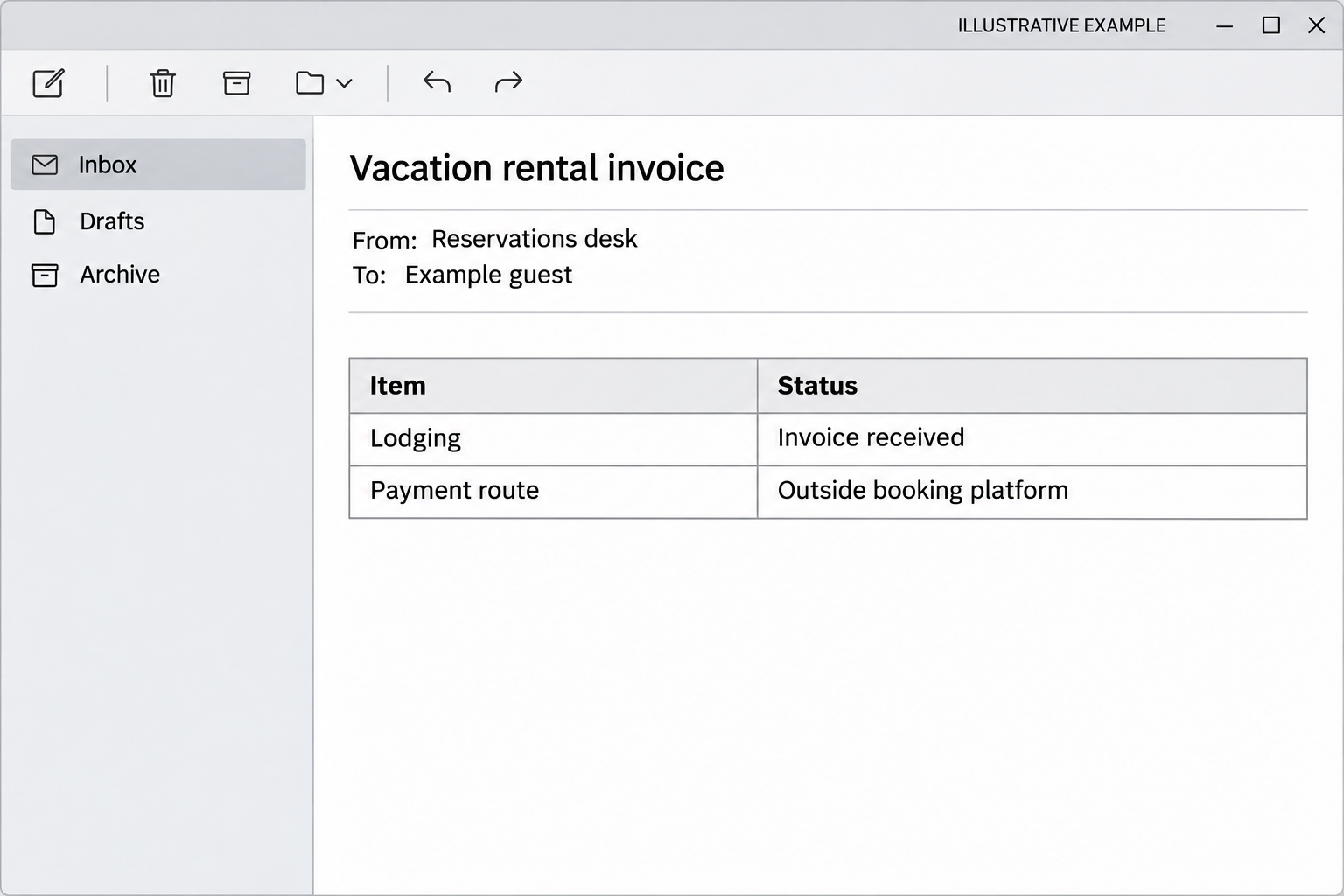
You find a vacation rental on a site you recognize. An email arrives with the same property and dates, plus an invoice to finish the reservation.
Before you pay, look for that invoice in the account where you found the rental. The resemblance between two pages doesn’t tell you where your money will go.
Overview
The first website can be genuine
A fake vacation rental invoice scam can begin on an established listing platform. The dangerous handoff happens when the person answering your inquiry sends you elsewhere to finish the booking.
The second page may show the same photos, dates and price.
Those details tie it to the conversation, not necessarily to the booking platform or the person who controls the property.
This is distinct from a host changing a confirmed stay. Here, the reservation on the new page may never exist, even though the invoice and the payment are real enough.
A federal case documents what happened after the handoff
The U.S. Justice Department’s sentencing announcement says Liviu Mihai Dumitru was sentenced to 48 months in prison in July 2026 for conspiracy to commit money laundering.
Dumitru operated a service that supported fake rentals and online auction fraud.
The department reported at least 14,000 victims across use of the service, not 14,000 vacation renters alone.
The case page for potential victims describes people redirected from legitimate rental sites to imitations that collected payments for properties that did not exist or weren’t available from that seller.
The case provides an example of the scheme. It doesn’t establish that today’s messages came from the same operation or that every private rental is fraudulent.
Check that the booking, payee and checkout match
- Find the reservation by opening the real platform yourself. Don’t use the email’s button to decide which account or website to check.
- Compare the final amount with the reservation details. Separate deposits and taxes should be explained by the booking service, not by an invoice from a stranger.
- Ask which party will receive your payment. A familiar name in the email doesn’t prove that the named company controls the payment account.
- Verify the property manager independently if you’re booking direct. Call a contact you found through an established source, not a number supplied alongside the invoice.
- Stop if the only way to reserve is a wire, gift card or cryptocurrency payment to an unfamiliar recipient.
How the Fake Vacation Rental Invoice Scam Works
Step 1: A listing puts a real trip in motion
You compare places, decide which location suits the trip, and ask about dates. A reply that knows those details doesn’t feel like spam. It feels like part of planning.
The listing isn’t necessarily for a nonexistent building. In the documented scheme, some purported rentals existed, but the people seeking payment did not have authority to rent them.
That is why matching photos to an address is only one check. The harder question is whether the person sending instructions controls the advertised stay.
Step 2: The payment conversation moves away from the original platform
The next message offers an invoice instead of a booking you can verify in your account.
It may be described as the usual process for a deposit or a special rate.
A move away from the platform can be especially convincing after you’ve spent time asking questions. You may not want to lose the dates and start the search again.
If you started on a marketplace, return to its own app or website. Ask its support team whether the payment route was authorized for that particular listing.
Step 3: The second page looks as though it already knows your reservation
The false checkout may show the name of the property, your dates and a realistic breakdown. A confirmation page can add another layer of reassurance without creating a real reservation.
Use your own booking account as the independent record. If the invoice is missing there, don’t enter more information just to see whether the external page accepts it.
For direct bookings, an independent check still exists. Find the property’s established reservation desk or management company and ask it to confirm the invoice number, stay and payee.
Step 4: The invoice channels payment to someone outside the booking
In the Kentucky case, prosecutors reported victims were directed to pay using methods that included bank wires, gift cards and cryptocurrency. The position of the invoice didn’t authenticate the destination.
An external payee with a plausible business name isn’t enough. The booking service or verified property manager needs to confirm it, and you should know what record the payment creates.
Do not pay a second time if the first transfer doesn’t appear in the official account. Contact the payment provider before the person who sent the invoice offers another workaround.
Step 5: The traveler finds out that no stay was secured
Sometimes the problem emerges when you try to confirm check-in. In other cases, the property is real, but the manager has no idea what reservation you’re talking about.
If you’re already at the location, treat the lack of access as a lodging problem as well as a payment problem.
Don’t argue with an occupant who didn’t take the booking.
Save the invoice and the account history even if the listing disappears. The provider needs to know whether you sent payment outside the marketplace or used its own checkout.
What an Invoice Proves and What It Doesn’t
An invoice records a request for money. It isn’t a receipt. A receipt records a payment. It doesn’t necessarily show that a property was reserved for you.
A booking confirmation matters when it comes from the system or company that can actually provide the stay. The message on its own doesn’t settle that question.
If you paid through a platform and someone requests more, ask support to identify the balance due and the reason.
Don’t let the new request override the record you already have.
If several administrators can take reservations at a hotel, ask for a written confirmation from the public front desk or reservations line.
Give the dates and property, not your card number.
For a private vacation home, identify the management company first. Check the address and contract independently. If the manager can’t establish authority to rent, choose a different property.
The FTC’s rental scam guidance recommends checking the address and the person or company offering it. Search for the address with the manager’s name rather than trusting one listing.
Some marketplaces allow certain disclosed charges or verified exceptions. Check the platform’s rules before deciding. A surprise payment request through a new message deserves a separate confirmation.
Compare a request to pay with the contract’s payment schedule. If the traveler is told to pay in an unrelated person’s name without explanation, don’t settle it informally.
What to Do if You Have Fallen Victim to This Scam
- Stop further payments. Don’t send a replacement deposit just because someone says the first didn’t land or that check-in details are about to expire.
- Find immediate lodging if necessary. Use an independently verified provider and save receipts. Do not send another payment through the same conversation.
- Preserve the source listing and invoice. Save the profile, messages, destination address, payment instructions and the place where you first found the rental.
- Contact your payment provider. Say how you paid, whether you approved the transfer, and what the seller misrepresented. Ask promptly about any reversal or dispute options.
- Report to the booking service. Open the official app or website and identify the listing, account and message thread. Explain that the payment was directed elsewhere.
- Secure details you entered on the lookalike. Change any exposed password on the real service and check for account changes. Contact your issuer if you entered card information.
- Use official fraud reporting. If the details appear connected to the Kentucky case, start with the Justice Department case page rather than a message offering to file for you.
- Keep a record of each report. Note the dates, reference numbers and responses. Keep sensitive identity and payment details out of public comments.
For a wire, report it to the sender’s bank as soon as you can. For cryptocurrency, preserve the transaction hash and network. Recovery options can vary and are never guaranteed.
If you paid with a gift card, keep the receipt and the card.
Contact its issuer directly. Don’t share a redemption code with a caller who promises to restore the balance.
If a relative paid on your behalf, let them know.
They may need to open the dispute themselves and provide a record from their account, even though the listing was yours.
Three Things to Save Before the Listing Changes
First, save the original listing address or listing ID. An invoice alone won’t show which website introduced you to the property or which account handled the first contact.
Second, keep the request that changed where you were supposed to pay. If it came by phone, write down the date and what the caller said while it’s still fresh.
Third, retain the payment confirmation from your own provider. Save the exact amount, date and destination shown by the provider, not only the details the person advertised.
Those records help separate a failed payment from a false booking. A transaction can complete exactly as requested and still fail to buy the stay you expected.
When you report, use ordinary language. A short chronology is worth more than a label: where you found the place, where you paid and what happened at check-in.
If the card statement shows a different merchant than the invoice, save both. Don’t assume an unfamiliar descriptor alone proves fraud, but flag the discrepancy for the issuer.
If a company offers to locate your money for an advance fee, decline.
Verify any real case administrator through the court or agency. Keep your evidence with the people investigating it.
If the Rental Exists but the Manager Denies the Booking
Start with a neutral question: is there a reservation for these dates? A legitimate manager may be as surprised as you are that somebody has offered their property.
Ask what detail will identify the stay. A date range and the name on the booking are often a useful start. Don’t send a copy of your payment card.
If the manager cannot confirm a match, ask for a short written note or keep a record of the call.
Give that information to the platform or card issuer as needed.
You may see several listings for the same place. That can happen legitimately across booking services. An unresolved difference in the manager’s identity or payment instructions is the important part.
If the apparent owner requests a wire, pause even if you can verify they own the property. Ownership alone doesn’t show that the message or bank destination came from them.
If you expect an official receipt after paying, ask where it will appear before you send funds. Some confirmation screens only acknowledge that you’ve submitted a request.
When a booking is for several households, appoint one person to communicate with support. Give everyone else a clear update so nobody pays a duplicate invoice to protect the trip.
You may need to book a replacement before the loss is resolved.
Confirm the substitute in a separate account or at an independently reached property. Don’t accept referrals from the suspect seller.
Tell your traveling companions what happened while there is time to change plans. Share the verified replacement details privately, not the original links or any personal information from the invoice.
Frequently Asked Questions
Can a scam start on a real booking site?
Yes. A fake listing or a deceptive follow-up can send you outside a genuine service. Open your account independently and see where the platform expects you to finish.
Does a matching address prove I have a place to stay?
No. A location may exist even if the person who invoiced you isn’t entitled to rent it. Verify the manager and dates through a separate channel.
What if I entered my card but wasn’t charged?
Contact the card issuer and explain where you entered it. A page doesn’t have to complete a visible purchase for the card details to be exposed.
Does the Kentucky case cover every fake rental invoice?
No. It concerns a particular operation. Report other incidents through the platform and the appropriate authorities instead of assuming they belong to that case.
Should I use a contact number on the invoice to verify it?
No. Find the platform or manager’s established contact independently. The address and phone number printed on the invoice are part of the claim you’re trying to check.
What if the host says I have to pay today or lose the dates?
Don’t send an external payment to meet the deadline. Look for the booking in the real service and ask it to confirm the amount, payee and checkout route.
The Bottom Line
Don’t pay a vacation rental invoice that takes you away from the booking route you verified. A familiar property photo or convincing payment page doesn’t reserve a place.
If you’ve already paid, stop, save the listing and payment record, and contact the provider and booking service promptly. Arrange replacement lodging through a separate, verified channel if needed.

Join the discussion
0 commentsShare your experience or ask a question about this article.
Discussion
Start the conversation
Have a question or something useful to share? Add the first comment.