


Someone calls about the money you lost when a timeshare sale fell through. They know the resort and say a settlement has already been arranged.
You weren’t expecting good news. Then they tell you what it will cost to receive it.
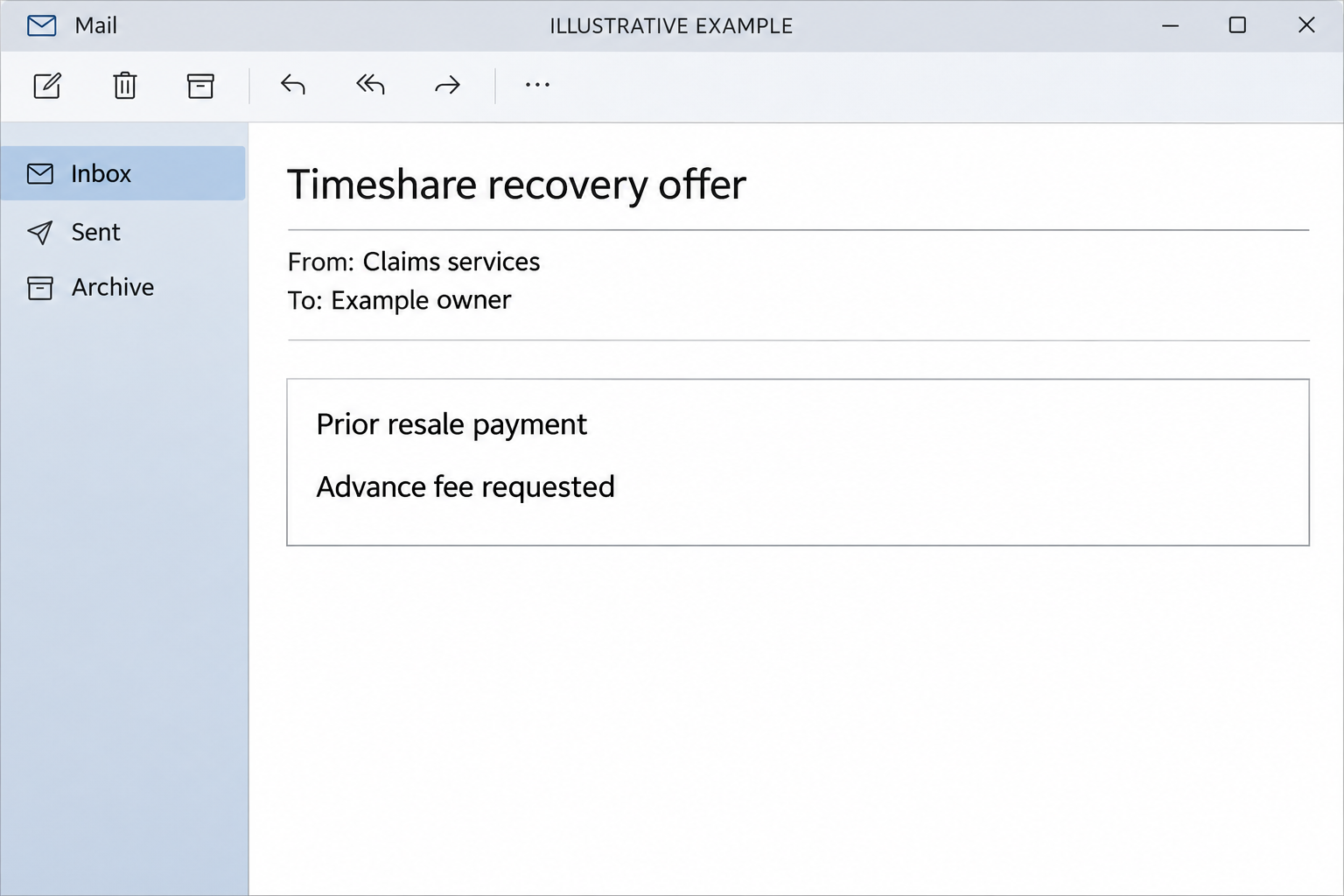
Overview
This offer targets a loss that has already happened
A timeshare recovery scam isn’t trying to sell you a vacation. It offers to return money you already lost to a fake broker, exit company or another advance-fee scheme.
An unsolicited caller may pose as a lawyer, court worker or government official. They might say a refund, restitution award or settlement is ready once you pay a fee.
If you remember the first loss clearly, hearing the right details can be reassuring. Those details don’t tell you who is calling or whether a refund exists.
Investigators have documented a second and sometimes a third approach
The FBI’s timeshare fraud guidance describes follow-up contacts posing as law firms and, separately, as government officials. The excuse for payment can change while the victim stays the same.
The U.S. Attorney’s Office in southern Illinois describes how people who had already lost money received calls and emails about supposed court awards.
Officials documented one advance payment being collected in an undercover investigation.
That older investigation doesn’t mean the same people are calling now. It shows why a real earlier prosecution, or a name you can look up, doesn’t authenticate a new demand.
Check the claim, not the quality of the letter
- Find the court or agency through its own website. An official-looking letter can’t establish that the callback number belongs to the agency.
- Ask whether the case and notice exist and whether the office sent them. A real case number can be included in an unrelated message.
- Don’t send a fee or tax to get the refund. If the payout is real, verify its process separately rather than paying the person who called.
- Keep the first fraud and the recovery pitch in your records. Report both, but distinguish the amounts and dates.
- Don’t sign an unexpected power of attorney or send identity documents. Verify who would receive them and whether they are needed at all.
How the Timeshare Recovery Scam Works
Step 1: Someone approaches you about an old transaction
You may have spent months trying to get out of a timeshare or sell it.
The second caller doesn’t have to explain your goal. They say they’re following up on it.
Knowing your resort, the broker’s name or the amount is not the same as having authority to act. You can’t tell from that knowledge who passed along your information.
You also don’t have to confirm additional details to find out whether an award exists. Write down the claim, end the call and verify the office separately.
Step 2: The caller offers a legal or official explanation
Sometimes the person says they represent a law firm recovering fees. Sometimes they say a regulator or court has created an award for victims of a named fraud.
These words refer to different things in real cases. A lawyer’s offer to take a case isn’t a judgment. A judgment isn’t proof that collected money has reached victims.
The U.S. Attorney’s historical alert describes messages that referred to real prosecutions. That makes independently checking the caller more important, not less.
Step 3: Paperwork makes the payout look ready
An email may contain official-looking letterhead or a notice with the recipient’s name. Treat the document as something to verify, not as instructions you must follow.
Ask which agency or court can confirm the claim. Locate the publicly listed office yourself and tell them what you received. Do not forward identity documents to an unverified address.
If you really are represented by a lawyer, speak to them through your established contact. A stranger can’t demonstrate that they joined your case merely by naming another lawyer.
Step 4: A fee appears before the money can be released
The supposed organizer says you need to cover a legal charge, processing fee or tax. It may sound small beside the amount you were promised.
Paying doesn’t make the award real. The FBI says people targeted by follow-up approaches are asked for more money under different explanations. Stop before sending even a small amount.
In some versions described by the FBI, the new caller drops the reassuring tone and threatens legal trouble instead.
A demand for immediate payment still isn’t proof of an official action.
Step 5: Further demands can follow the first payment
The person may claim a payment went to the wrong department or that a different office has to clear it. A second request is not evidence that the first succeeded.
Don’t ask the same number to unwind the transaction. Call your own bank, card issuer or transfer service and explain both the promise and how the payment was made.
Avoid warning a stranger how you plan to report them. You can preserve the conversation and stop communication without negotiating or agreeing to another deadline.
Real Case Notices and Fake Refund Offers
Start with the notice’s central claim. If it says a court has entered an order, ask the court or prosecutor’s public office whether such an order exists.
Use the case number as a reference, not as a password. Don’t assume that finding a genuine case online means your name is included or a particular payment is owed.
If the letter names a law firm, verify its public contact and the lawyer separately. A real firm can be impersonated, and a professional-looking website isn’t a complete identity check.
The FBI’s questionnaire for a separate timeshare investigation gives an example of a reporting route you can reach from an official agency. It’s not a general payout application.
For an ordinary restitution question, the prosecutor’s victim services office or the court is a better starting point than a caller who says the offer is confidential.
A report, an award and a payment are separate events. Don’t assume a case number on your fraud complaint means an agency has approved reimbursement.
If someone asks you to sign a broad authorization, pause. A document that lets somebody act for you can have consequences beyond the one payment they promised.
Keep original messages but don’t open unfamiliar attachments merely to inspect their design. You can usually describe the claim and verify the agency before interacting with the file.
What to Do if You Have Fallen Victim to This Scam
- Stop sending fees. Don’t pay to close the file, cancel the transfer or make the previous payment refundable.
- Contact the payment provider directly. Explain that you paid based on a false recovery claim. Ask what can still be held, recalled or disputed.
- Keep the old and new transactions separate. Save the original timeshare receipt, later messages, amounts, dates and the proof of every payment you made.
- Verify any real case independently. Contact the court, prosecutor or agency through published channels. Ask whether the office knows about the notice and sent it.
- Report the fraud. Use the FBI’s timeshare victim resources for the relevant U.S. reporting routes. Tell investigators who contacted you, not just what they promised.
- Act on any information you shared. If you disclosed financial details or signed authorization documents, alert the relevant institution and seek advice about the actual document.
- Tell someone you trust if the pressure continues. Let them help you keep track of requests and case numbers. Don’t use a recovery provider referred by the caller.
If the first transfer came from a shared account, tell the other account holder which payment to flag. Make clear that nobody should send a new fee to protect it.
If you reported the resale earlier, look up the original reference from your own files.
Tell the agency a new person is using the old loss as the reason for contact.
When you describe the loss, separate the money that left your account from the refund you were promised. The second figure isn’t an amount you actually received.
Handling the Original Timeshare Separately
Whether you still own the timeshare is a separate question.
A fake recovery company can’t erase a valid contract or make a current balance disappear by saying it has opened a claim.
Find the owner services contact in paperwork you already trust. Ask about the current account and direct exit options. Don’t give a stranger remote access or a new authorization.
Keep any genuine bill separate from the suspicious recovery offer. Don’t stop payments on a real obligation based only on a statement made by an unverified company.
If you need legal help, choose your own adviser and agree on the scope and cost.
That is not the same as paying an unsolicited fee to release an alleged award.
Warn relatives without forwarding the full letter. A name, resort and transaction amount may already be enough for another convincing attempt. Keep those details private.
Expect new messages after you stop replying. You don’t need to answer just to rule out a possible refund. Use the official case channel to ask that question.
Write Down the Claim Before You Try to Verify It
Capture the date, the name the caller used and the organization they claimed to represent. Record the promised amount separately from the fee they wanted you to pay.
If the story involves a specific legal notice, write down who supposedly signed it. A court, regulator, victim services office and private lawyer are not interchangeable sources.
Ask the contacted office whether it has issued a public warning about impersonation.
Even if an employee can’t discuss a private case, the office may have advice on forwarding the notice.
Keep security questions out of the initial contact. You don’t need to state your entire financial history to ask whether a letter from an alleged government office appears genuine.
If a second caller contradicts the first, don’t ask them to resolve each other’s claims. They could be unrelated, or both could be exploiting the same information about your loss.
An unsolicited offer made through a messaging app deserves the same checks as a call. Changing the way the claim reached you doesn’t give it any more weight.
If you already sent paperwork with a signature, preserve a copy of what went out.
A bank or lawyer may need to see the actual document to assess what it could authorize.
If there was a real settlement in an earlier case, check what information it asks for and how it accepts it. Use the administrator listed by the issuing authority.
Do not give an unknown caller access to your bank app to check whether money arrived. You can confirm deposits yourself, and your provider can help with an unfamiliar transaction.
Be precise if you help someone else report it.
A person can be genuinely owed money in one matter and targeted by a fake offer in another. Record both without mixing them.
If your bank asks why you authorized the transfer, explain the false claim instead of describing the transfer as one you never approved. That distinction can change how it’s handled.
If an official notice is mailed to your home, the delivery method alone proves little. Verify the office independently before you reply, even when the sender knows your address.
Never pay a second intermediary to confirm the first one’s identity. The court or agency that supposedly issued the award is where to start.
Frequently Asked Questions
Can someone know my exact earlier loss and still be a scammer?
Yes. Knowledge of a transaction doesn’t establish a caller’s identity or their authority to release funds. Check both through a source independent of the message.
Is a real court case number enough to trust an award notice?
No. Ask the clerk or relevant victim services office whether the notice is theirs and what it means. Don’t rely on a callback printed in the letter.
Is a legal consultation fee the same as a release fee?
No. Hiring your own independently chosen lawyer is different from paying an unexpected caller to release a supposed award. Verify the claim rather than paying for access to it.
What if the caller says the IRS or another government office wants tax first?
Stop and contact the authority directly. Don’t use the bank account or number the caller supplied. A threatening deadline does not make the instruction official.
Should I report a recovery pitch if I didn’t pay?
Yes. Preserve the message and explain that you received a follow-up solicitation after a prior loss. Make clear that you did not send the requested second payment.
Does reporting mean I’ll receive restitution?
No. Reporting helps document the fraud. Whether money is recovered or distributed depends on the actual case, and nobody can guarantee it from a cold call.
The Bottom Line
Don’t pay someone who contacts you about recovering an earlier timeshare loss. Verify the alleged court action directly and keep the refund claim separate from the original contract.
If you’ve paid, contact your provider promptly and preserve evidence of both transactions. Report the follow-up through official channels, not through the person who offered to recover the money.

Join the discussion
0 commentsShare your experience or ask a question about this article.
Discussion
Start the conversation
Have a question or something useful to share? Add the first comment.