

VelvaFlow Lung Cleansing Spray is promoted as a fast, natural answer for coughing, mucus, tightness, wheezing, and difficult breathing. The offer is built to look reassuring, especially to smokers, former smokers, and people worried about persistent respiratory symptoms.
Before placing an order, shoppers need to look beyond the polished advertising. The purchase options, recurring-payment policy, health claims, testimonials, and return conditions contain details that can substantially change what appears to be a simple $34.95 purchase.
Overview
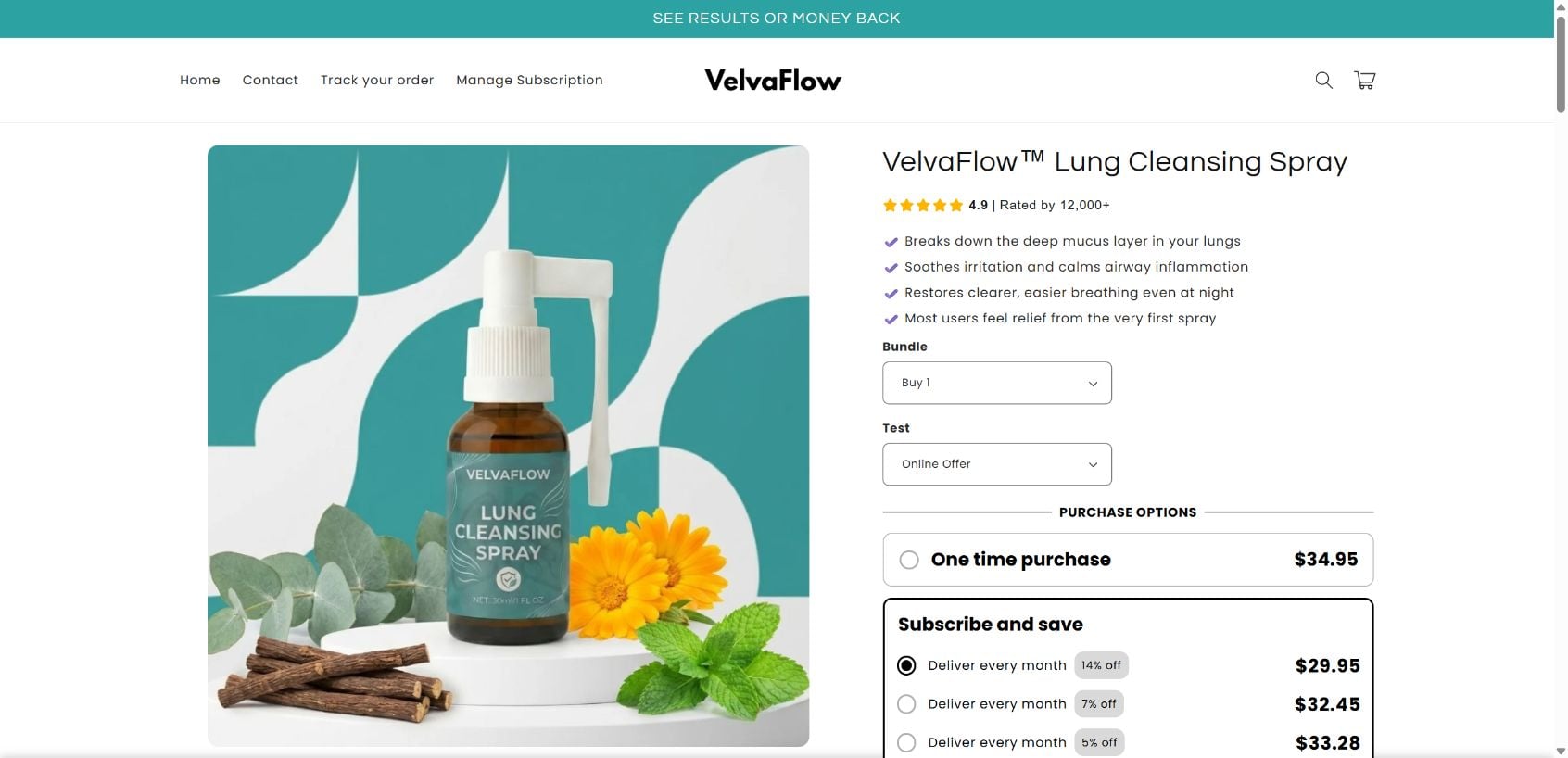
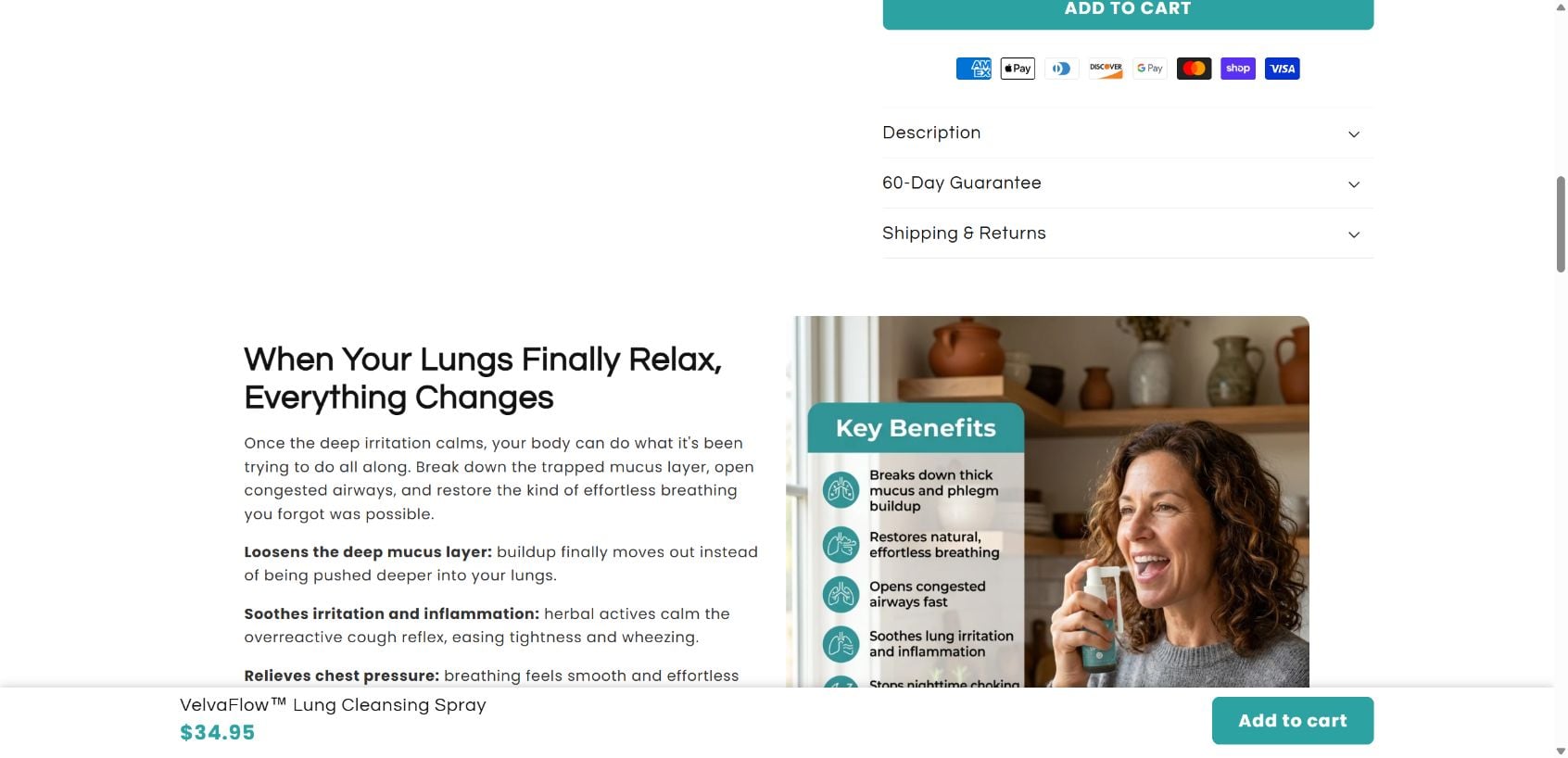
VelvaFlow Lung Cleansing Spray is an oral botanical spray sold through VelvaFlow.com and promoted through online advertising. The product page says two sprays can reach a deep mucus layer, calm airway inflammation, relieve chest pressure, reduce coughing and wheezing, and make breathing feel easier.
Those are not modest wellness promises. They describe effects involving the lungs, airways, inflammation, mucus, sleep, and respiratory symptoms. The sales page also tells visitors that many users feel relief from the first spray and describes the formula as having no side effects.
When MalwareTips reviewed the offer on August 8, 2026, the product page showed a one-time price of $34.95. Directly below it was a “Subscribe and save” option starting at $29.95 with delivery every month. The monthly subscription was visibly selected on the page we inspected.
That difference matters. A shopper who assumes the cheaper price is simply a discount may authorize an automatic refill rather than a single bottle. The lower initial price can therefore turn into repeated monthly charges until the subscription is cancelled.
VelvaFlow’s own Automatic Refill Policy confirms that subscribers are charged automatically on a recurring basis. It says charges continue unless and until the customer cancels, each refill creates a new order, and cancellation must occur at least 24 hours before the next billing date.
The same policy says that once a refill order has been created, it cannot be cancelled because it is immediately prepared for processing and shipment. It further says orders generated after subscription registration are considered valid and final.
MalwareTips does not recommend ordering VelvaFlow Lung Cleansing Spray. The combination of extraordinary respiratory claims, seller-controlled ratings, copied-looking testimonial language, a preselected recurring option, and conflicting refund conditions creates too much risk for shoppers.
The health claims go far beyond ordinary herbal freshness
The VelvaFlow sales page describes four botanicals: eucalyptus, peppermint, licorice root, and calendula. It says these ingredients work together to break down hardened mucus, open congested airways, calm inflammation, restore cilia, and help the lungs clear buildup that has supposedly remained trapped for years.
The page also compares the spray with Mucinex, mullein tea, water, pills, and prescriptions. It presents the oral spray as a different delivery method that reaches deeper than those alternatives.
However, the page does not link to a randomized controlled trial of the finished VelvaFlow formula. It does not provide a study showing that two oral sprays travel to a specific deep layer in the lungs, measure mucus removal, improve airway inflammation, reduce wheezing, or outperform established treatments.
It also does not explain the delivery mechanism with the level of detail expected for a product claiming direct action in the lower airways. There is no aerosol particle-size data, lung-deposition study, dose-response information, or comparison with a regulated inhaler or nebulizer.
The Federal Trade Commission’s health-products guidance says objective health and safety claims require competent and reliable scientific evidence. For many health benefits, properly designed human clinical testing is generally the appropriate form of support.
The FTC also explains that testimonials and individual experiences are not enough to prove that a health product works. A customer story may be sincere, invented, edited, or influenced by unrelated changes. None of those stories replaces controlled evidence for the exact formula being sold.
The FDA warns that herbs and dietary supplements are not approved to treat or prevent disease. The agency advises consumers to be skeptical when a supplement is promoted as a cure or quick fix for a health problem.
The American Lung Association similarly advises people not to trust quick lung-detox fixes. It explains that lungs are self-cleaning organs and that avoiding smoke, vaping, and pollution is more important than buying unproven cleanse products.
None of this proves that every ingredient in VelvaFlow is useless. It means the seller’s specific claims about deep delivery, rapid symptom relief, inflammation, wheezing, and mucus removal require direct evidence. General research about an herb cannot automatically prove that a particular blend, dose, and spray method produces the advertised result.
“Natural” does not mean risk-free
The sales page describes the spray as completely safe and says it has no side effects. That is an unusually absolute statement for any ingestible botanical product.
People can have allergies, sensitivities, medical conditions, or interactions with medicines. Licorice root, for example, is not appropriate for everyone, and the practical risk depends on the form, concentration, dose, frequency, and other ingredients in the bottle.
A responsible product page should provide a clear ingredient list with quantities, safety warnings, contraindications, manufacturing details, and instructions for people who are pregnant, taking medication, or living with heart, blood-pressure, kidney, or respiratory conditions.
The most serious danger is not always the spray itself. A person with shortness of breath, chest pressure, persistent wheezing, coughing blood, or rapidly worsening symptoms may delay medical evaluation because an ad suggests a simple herbal product can address the underlying problem.
VelvaFlow should not be used as a substitute for prescribed inhalers, antibiotics, smoking-cessation treatment, or medical assessment. Anyone experiencing severe breathing difficulty, bluish lips, confusion, or significant chest pain should seek urgent medical help instead of waiting for an online spray to work.
The rating and testimonials are not independent evidence
The VelvaFlow page displayed a 4.9 rating and said the product was rated by more than 12,000 people. Yet the visible testimonials are hosted and selected by the seller. The page does not link the large rating count to a recognized independent review platform where buyers can inspect all submissions.
The stories describe dramatic changes after only days or two weeks. They include smokers who supposedly stop coughing, people whose chest tightness improves, and customers who begin sleeping without nighttime wheezing.
MalwareTips found closely matching testimonial language on a separate sales page operated under another store name. The wording, family details, respiratory symptoms, and rapid-results narrative overlap enough that shoppers should not treat these stories as independently verified customer evidence.
The issue is not whether one named person could have had a positive experience. The issue is that reusable marketing copy can be moved between stores, products, names, and images. When the same emotional story appears in another funnel, it loses credibility as proof of a specific customer’s purchase.
AI-generated and heavily edited advertising can manufacture trust
VelvaFlow and similar products are promoted through polished social media creatives featuring healthy-looking models, smooth product renderings, medical-style graphics, testimonial narration, and fast before-and-after storytelling. Some material may be AI-generated, composited, or heavily edited.
MalwareTips cannot confirm the production method of every image or video in every campaign. More importantly, a realistic person, convincing voice, anatomical graphic, or attractive bottle shot does not demonstrate that the retail formula has been clinically tested.
AI tools make it inexpensive to create dozens of ads for different ages, countries, symptoms, and social platforms. A marketer can generate a smoker story, a worried spouse, a doctor-like narrator, or an animation of mucus leaving the lungs without filming a real patient or conducting a medical study.
Shoppers should separate presentation from evidence. Useful proof would include the complete label, manufacturer identity, batch information, independent laboratory results, relevant human trials, safety data, and a transparent record of ordinary verified customers.
The cheaper price is a recurring subscription
The subscription is one of the clearest reasons to slow down before ordering. The page presents a $34.95 one-time purchase and a cheaper monthly option beginning at $29.95. On the version captured by MalwareTips, the subscription radio button was active.
The policy calls this an optional service and says it can be removed before or during checkout. Even so, an optional plan can still be overlooked when it is preselected, priced lower, placed inside a busy product page, or surrounded by discounts and health promises.
A monthly payment of $29.95 becomes $359.40 over 12 months before any taxes or shipping. That is very different from the single $34.95 purchase a visitor may believe they are making.
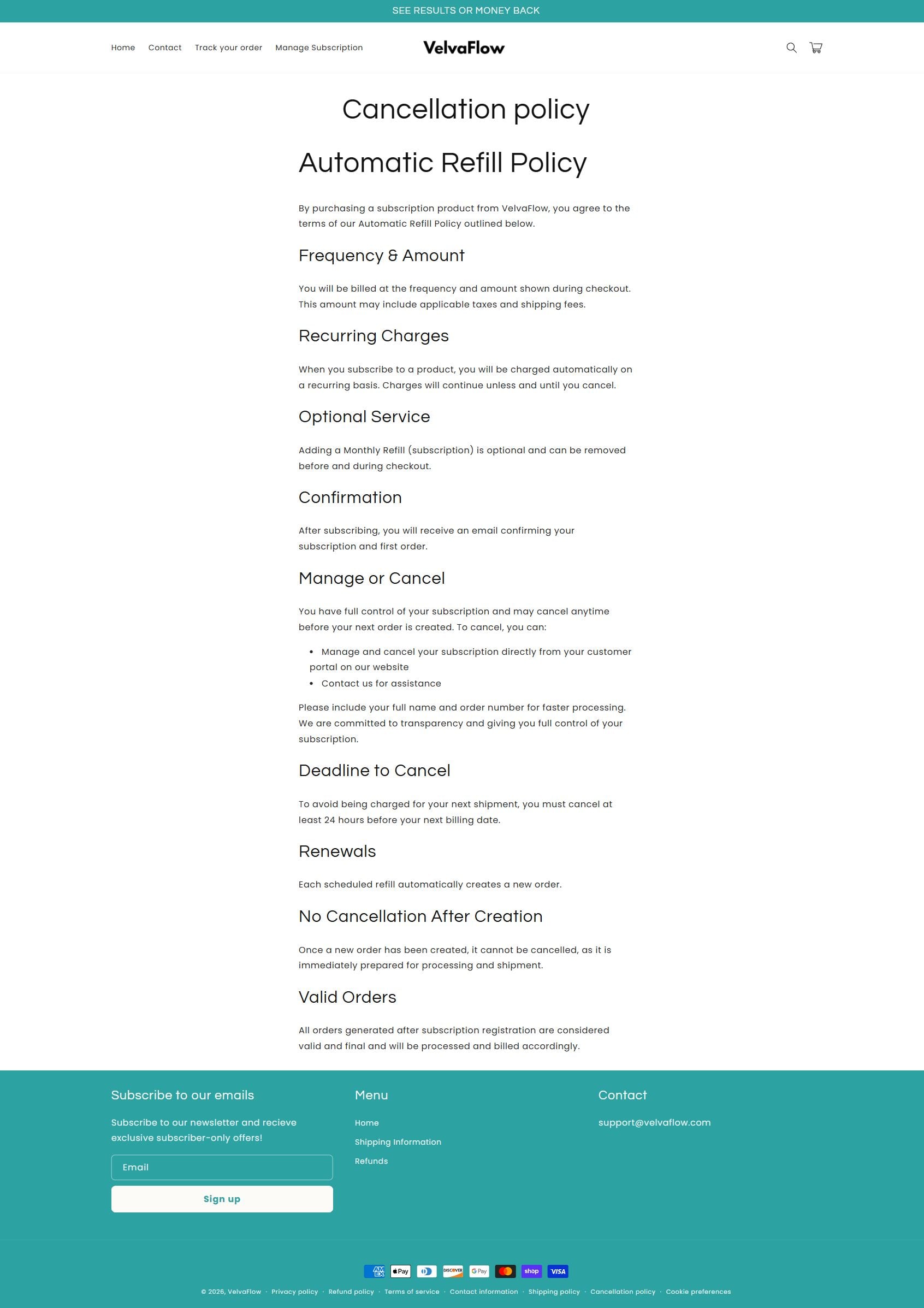
The store does provide a Manage Subscription link and says customers may use their portal or contact support. That is useful, but shoppers must still act before the 24-hour deadline and keep evidence that cancellation was completed.
Do not rely only on removing a product from the cart or closing the website. Before paying, confirm whether the final checkout says one-time purchase or subscription, how often the card will be charged, the price of future refills, shipping fees, and the next billing date.
The 60-day guarantee conflicts with the refund policy
The product page advertises a 60-day guarantee and says dissatisfied customers can obtain a full refund without questions. That sounds unusually simple and helps remove hesitation at checkout.
The formal refund policy is much narrower. It says an item must be unused, in the same condition received, and in its original packaging. It also lists personal-care goods as potentially non-returnable and says sale items are not accepted.
The product page displays a 50% discount from a crossed-out price of $69.95 to $34.95. If that makes the bottle a sale item under the written policy, the broad guarantee and the sale-item exclusion point in opposite directions.
There is another practical conflict. A customer normally has to open and use a lung spray to discover whether it causes irritation, tastes unacceptable, arrives with a defective nozzle, or fails to provide the advertised benefit. Using it may then conflict with the unused-condition requirement.
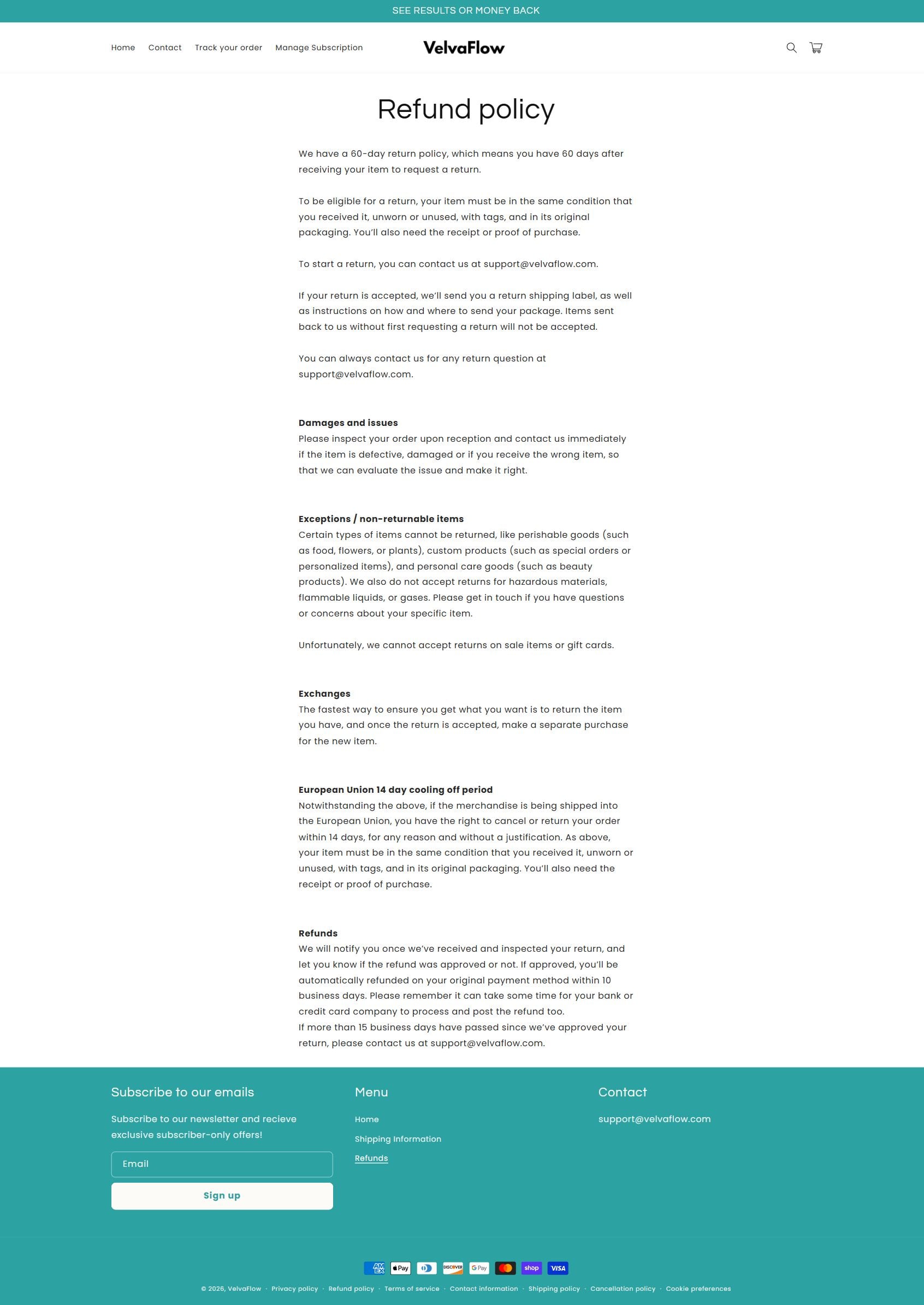
The policy says customers must contact support before returning anything. Unapproved packages are not accepted, and the return address is supplied only after approval. This means buyers cannot calculate the destination or shipping cost before starting the process.
The terms of service add more seller protections. They say product appearance or quality may not meet expectations, cancellation may not be possible after acceptance, and products are generally provided as available without broad warranties. The page also contains leftover template text such as merchant notes and missing policy-link placeholders, which makes the legal documentation look incompletely customized.
The contact details add another inconsistency. VelvaFlow’s main Contact Information page lists support@velvaflow.com, which is a domain-based address. However, the store’s Track Your Order page lists the generic Gmail address velvaflow.help@gmail.com.
More importantly, neither page identifies a verifiable physical business address for the operator. This makes it harder for buyers to establish who is responsible for the sale, verify the seller’s jurisdiction, estimate a possible return destination, or send formal correspondence when email support does not resolve a billing or refund problem.
Quick VelvaFlow warning signs
- The product is promoted for mucus, inflammation, chest pressure, wheezing, sleep, and easier breathing.
- The sales page says some users feel relief from the first spray.
- The store describes the product as completely safe and free from side effects.
- No controlled clinical trial of the finished formula is linked from the product page.
- No lung-deposition or delivery data is provided for the oral spray.
- A seller-controlled 4.9 rating is paired with a claim of more than 12,000 ratings.
- Closely matching testimonial language appears on another sales website.
- AI-style visuals and emotional videos can create credibility without demonstrating results.
- The lower $29.95 price is tied to monthly delivery.
- The monthly subscription was selected on the page MalwareTips captured.
- Recurring charges continue until the customer cancels.
- Cancellation must be completed at least 24 hours before the next billing date.
- Once a refill order is created, VelvaFlow says it cannot be cancelled.
- The product page promises a simple 60-day refund.
- The formal policy requires unused original condition and original packaging.
- The same policy excludes some personal-care goods and sale items.
- Different support pages list support@velvaflow.com and velvaflow.help@gmail.com.
- The operator does not publish a verifiable physical business address on its contact pages.
How The Operation Works
The VelvaFlow sales funnel combines health anxiety with a familiar subscription model. Each step reduces hesitation while making it easier to overlook the recurring charge and harder to evaluate the evidence.
1. A social media ad targets a frightening symptom
The campaign begins with coughing, chest tightness, poor sleep, smoking history, pollution, or the fear that mucus has been trapped in the lungs for years. These are emotional problems, and viewers naturally want a quick, private solution.
Short videos may present a confident narrator, medical-style animation, or relieved customer. The viewer is encouraged to identify with the story before asking whether the product has been independently tested.
2. Polished visuals make the bottle look clinically advanced
A professionally rendered bottle is placed beside botanicals, healthy models, airway illustrations, and benefit labels. Whether these images are photographed, AI-generated, or digitally assembled, they make the product feel more established than the supporting documentation shows.
The ad shows an outcome, not a controlled test. No continuous demonstration can prove that the depicted mist reached the lungs or caused the changes shown in an animation.
3. Familiar ingredients are turned into a deep-delivery story
Eucalyptus, peppermint, licorice root, and calendula sound recognizable and comforting. The page assigns each ingredient a precise respiratory role, then says the combination reaches a layer that other approaches miss.
This narrative bridges the gap between an ordinary herbal oral spray and a product that appears capable of treating meaningful respiratory symptoms. The mechanism is described confidently, but direct evidence for the retail formula is not displayed.
4. Comparisons make established options seem inferior
The sales copy contrasts VelvaFlow with medicine, tea, water, pills, and prescriptions. These comparisons encourage shoppers to view the spray as a breakthrough rather than one more unverified wellness product.
A fair comparison would require equivalent doses, defined outcomes, human participants, a control group, and transparent results. Marketing statements alone cannot establish superiority.
5. Ratings and testimonials create social proof
A 4.9 score, more than 12,000 claimed ratings, five-star icons, and emotional customer stories tell the visitor that thousands of people have already tested the product.
Because the material is controlled by the seller and similar wording appears elsewhere, the shopper cannot assume it represents a complete or independently verified review record.
6. A large discount makes immediate action feel sensible
The $34.95 price is shown against a crossed-out $69.95 reference price. A 50% saving makes the decision feel low-risk, especially when paired with a 60-day guarantee.
The discount also frames the product as premium. Shoppers may focus on the amount supposedly saved instead of asking what the formula costs elsewhere or whether the reference price reflects genuine prior sales.
7. The monthly option becomes the easiest-looking choice
The subscription costs less than the one-time purchase and may already be selected. The user sees “save” language, a lower price, and monthly delivery while concentrating on the health promise above it.
If the customer clicks Add to cart without changing the purchase option, the checkout can authorize recurring billing. The first confirmation email may be the only obvious indication that an automatic refill was created.
8. Refill rules turn one mistake into repeated charges
The policy allows charges to continue until cancellation. Customers who miss the email, do not recognize the merchant descriptor, or expect the bottle to arrive less frequently may discover the plan after a second charge.
The 24-hour cutoff is important. Once the next order exists, VelvaFlow says it is final and cannot be cancelled, even if the customer contacts support immediately after noticing the payment.
9. Return conditions narrow the headline promise
The customer remembers the prominent 60-day guarantee. Support can instead point to the formal rules requiring unused original condition, prior approval, and original packaging.
The personal-care and sale-item exclusions create additional uncertainty. A customer may spend time exchanging emails while a return deadline, billing date, or card-dispute window approaches.
10. New creatives can keep the same funnel running
AI tools and reusable ecommerce templates make it easy to replace a model, voice, product name, testimonial, or domain. The underlying bottle and subscription structure can remain the same while the advertisement looks completely new.
This is why consumers should research the exact merchant, policy, billing descriptor, and formula rather than trusting the appearance of one social media video.
If You Have Bought This
If you ordered VelvaFlow or discovered a recurring charge, stay calm and act in a documented sequence. A clear record is far more useful than several informal messages sent through different channels.
- Check whether you bought once or subscribed. Open the order confirmation and search for words such as subscription, automatic refill, monthly, recurring, next order, or manage subscription. Record the next billing date and expected amount.
- Cancel through the customer portal immediately. Use the Manage Subscription link on VelvaFlow.com or the link in the confirmation email. Complete every step until the portal shows a cancelled status. Take a screenshot that includes the date and plan name.
- Send a written cancellation request. Email support@velvaflow.com with your full name, order number, subscription email, and a direct statement that you revoke authorization for future recurring charges. Ask for confirmation that both the subscription and any unshipped refill have been cancelled.
- Act before the 24-hour cutoff. VelvaFlow’s policy says cancellation must happen at least 24 hours before the next billing date. Do not wait for the final day. If the deadline has passed, contact support anyway and clearly request that an unshipped order be stopped.
- Preserve the advertisement and checkout evidence. Save the social media ad, product page, selected purchase option, claimed 60-day guarantee, refund policy, cancellation policy, receipt, emails, tracking, and card statement. Websites can change after complaints appear.
- Do not open a bottle you plan to return. The formal policy requires unused original condition. Keep the shipping box, seals, bottle, label, and inserts intact while requesting approval. Photograph the parcel and contents when they arrive.
- Request return authorization within 60 days. Ask support for written approval, the exact destination, any authorization number, a prepaid label, and the amount to be refunded. Do not mail the product to an address found on a forum or unrelated package.
- Point out conflicting promises calmly. If support cites the unused, personal-care, or sale-item restriction, provide your screenshot of the advertised 60-day guarantee and ask which term controls the purchase. Keep the conversation factual and in writing.
- Use tracked shipping only. If you return the product, photograph it inside the parcel, keep the postal receipt, and use delivery confirmation. Save the tracking page after delivery because carriers may remove older tracking records.
- Monitor the payment method. A cancelled subscription should not generate new charges. Review the account for at least several months and enable transaction alerts if your bank offers them.
- Contact the card issuer about unauthorized renewals. Explain that you cancelled a recurring plan but were billed again, or that the recurring nature was not clear when you paid. Provide the cancellation screenshot, emails, policy, and dates. Ask whether the issuer can block future recurring payments from the merchant.
- Dispute a product that was materially misrepresented. If the seller refuses a promised refund, sends something different, or continues billing, ask your card issuer or payment service about its dispute process. Use accurate language and do not describe an authorized first purchase as card theft.
- Replace the card only when advised. A new card number does not always stop recurring merchant tokens. Ask the issuer specifically about automatic account-updater services and recurring-payment blocks.
- Stop using the spray if you feel unwell. Seek advice from a pharmacist or doctor if you experience irritation, swelling, rash, dizziness, breathing changes, or another unexpected reaction. Bring the bottle and ingredient label with you.
- Do not delay care for respiratory symptoms. Persistent or worsening cough, wheezing, chest pressure, or shortness of breath deserves medical evaluation. Severe breathing difficulty or significant chest pain can be an emergency.
- Report the experience. U.S. consumers can submit a report to the FTC at ReportFraud.ftc.gov. Health-related adverse events can also be reported through the FDA Safety Reporting Portal. Include the website, amount, dates, and evidence.
If you are in the European Union
VelvaFlow’s refund policy acknowledges a 14-day cooling-off period for merchandise shipped into the European Union. Product-seal and health-goods exceptions can be fact-specific, so preserve the unopened condition and send written notice promptly.
Your card issuer or national consumer-protection authority can explain local rights. Do not assume that a store’s general policy removes mandatory protections available in your country.
If you only saw the ad and have not ordered
Do not enter card details until you have verified the complete formula, seller identity, subscription status, future price, return destination, and medical evidence. Take persistent breathing symptoms to a qualified healthcare professional rather than a social media checkout.
If you still consider purchasing, select the one-time option, capture the final checkout, and use a payment method with meaningful dispute protection. A debit card tied directly to essential household funds offers less breathing room when a billing dispute occurs.
The Bottom Line
VelvaFlow Lung Cleansing Spray is marketed with claims that are much stronger than the evidence presented on its sales page. The seller promises deep mucus removal, calmer airways, easier breathing, quick results, and no side effects, yet does not show clinical testing of the finished spray that supports those outcomes.
The purchase structure adds a separate financial risk. The lower price is a monthly subscription, recurring charges continue until cancellation, and the formal return conditions conflict with the broad 60-day guarantee.
Skip this offer. If you already ordered, cancel the refill immediately, preserve every screenshot, request written return instructions, monitor your statements, and contact your payment provider if the seller continues charging you.








