

The Voltax V57 Hi-Tech Stun Flashlight Car Key has been promoted across social media as a compact self-defense gadget that looks like a car key but allegedly delivers 57 million volts of stopping power along with a 150-lumen tactical flashlight. It’s marketed as the ultimate tool for late-night safety, promising peace of mind for women, travelers, and anyone concerned about personal security.
But here’s the big question: is the Voltax V57 stun flashlight car key really the revolutionary safety tool it claims to be—or is it just another online scam with exaggerated promises?
In this in-depth review, we’ll examine everything about the Voltax V57: its claims, red flags, how the operation works, what customers report, and what to do if you’ve already purchased one. By the end, you’ll know exactly whether this gadget is worth your money—or if it’s better to avoid it entirely.
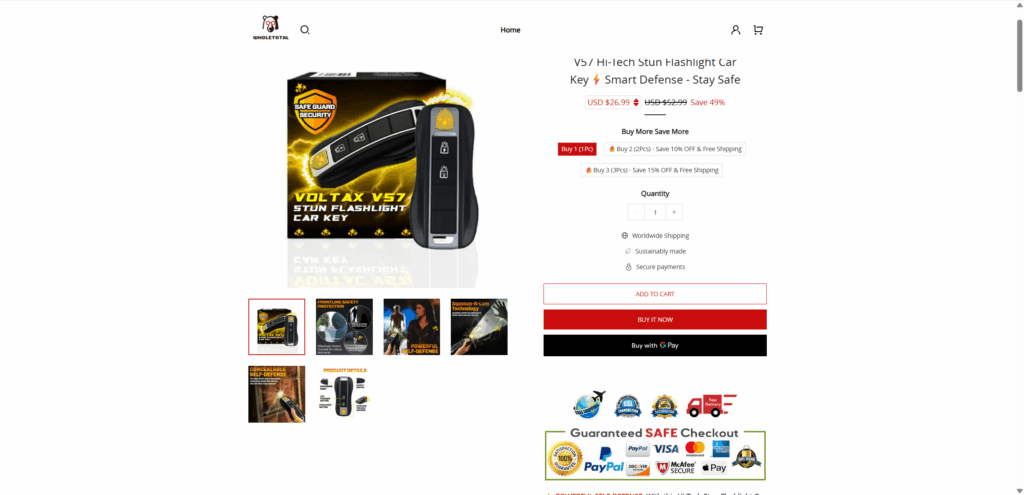
What is the Voltax V57 and Why People Are Suspicious
The Voltax V57 is advertised as a key-sized stun gun with a flashlight, disguised to look like a sleek car key. The product description claims it provides:
- 57,000,000 volts of open output
- A 150-lumen tactical flashlight
- Compact, lightweight design (0.19 lb)
- Rechargeable internal battery (lasting 30–45 days per charge)
- Effective self-defense against attackers or even aggressive dogs
On paper, it sounds like the perfect blend of power, convenience, and stealth. But once you start digging, several serious red flags appear.
Red Flag 1: Exaggerated Voltage Claims
The claim of 57 million volts is not only unrealistic—it’s scientifically impossible for a pocket-sized stun device. Real stun guns usually range from 50,000 to 1 million volts, and even those are powerful enough to incapacitate an attacker. A claim of 57 million volts is pure marketing hype designed to shock (literally and figuratively) buyers.
Red Flag 2: Misleading Marketing Language
The product pages use phrases like “Clinically Proven” and “100% Vegan”, which are completely irrelevant to an electronic stun device. These words are more at home in the skincare or supplement industry than in self-defense equipment. This shows the marketers are not focused on technical accuracy but instead on throwing around buzzwords that sound convincing.
Red Flag 3: Fake Reviews and Ratings
Websites selling the Voltax V57 often boast of 25,000+ five-star reviews, but only a handful of vague, overly positive testimonials are visible. Independent platforms like Trustpilot, Reddit, or consumer forums have little to no mention of this product. That’s a huge sign of fabricated ratings.
Red Flag 4: Suspicious E-Commerce Practices
- Prices constantly fluctuate (e.g., “70% OFF today only,” “49% OFF Mega Sale”) to create fake urgency.
- The product is sold for $26.99–$52.99, but similar stun flashlight devices appear on Alibaba and AliExpress for under $8–$12 wholesale.
- Websites selling it (like Wholetotal.com) are newly registered domains, which is common in short-term dropshipping scams.
Red Flag 5: Poor Customer Support
The only point of contact is usually a generic email address. No phone number, no live chat, and no physical address are listed. Once money is sent, many customers report difficulties reaching support or getting refunds.
How the Operation Works
The Voltax V57 stun flashlight operation follows the classic dropshipping operation model. Let’s break it down in detail:
Step 1: Sourcing Cheap Products
The actual product is a generic stun flashlight keychain, widely available on Alibaba for under $10 per unit. These devices are often low-quality, lacking safety certifications, and may not even function as advertised.
Step 2: Creating a Fake Premium Brand
Marketers rebrand the product as “Voltax V57,” give it a futuristic name, and build a slick website claiming it’s “Hi-Tech,” “Clinically Proven,” and “Smart Defense.” They use stock photos, doctored videos showing electric arcs, and testimonials to build credibility.
Step 3: Inflating the Specs
The specs are massively exaggerated to make the product look unbeatable:
- 57 million volts (impossible for the size and battery capacity).
- 150 lumens flashlight (real output is likely far lower).
- Claims of deterring threats instantly, even through “thick clothing.”
These numbers are designed to impress non-technical buyers, but they are not grounded in reality.
Step 4: Aggressive Marketing
- Ads run heavily on Facebook, Instagram, and TikTok targeting people worried about personal safety.
- They use fear-based marketing, showing women walking alone at night or people confronted by attackers.
- Discounts are everywhere: “50% off,” “Buy 2 save more,” “Only 3 left in stock.” These are classic urgency tactics.
Step 5: Misleading Reviews
The sites show glowing testimonials like “I feel safe every step now” from Amanda, New York or “This saved me from aggressive dogs” from Christine, Australia. These are generic, unverifiable, and often repeated across multiple scam product websites.
Step 6: Poor Customer Service and Refund Blockades
If the product arrives at all, it’s usually cheap, flimsy, and ineffective. Many buyers complain that it:
- Doesn’t deliver a real shock
- Has a weak flashlight
- Stops working after a few uses
When customers ask for refunds, they’re met with:
- Ignored emails
- Refund denials due to “hygiene and safety policies”
- Requests to ship the product back to China at the buyer’s expense
Step 7: Website Disappearance and Rebranding
Once enough complaints pile up, the site selling Voltax V57 often shuts down or rebrands under a new name. The same product then resurfaces as another “latest self-defense breakthrough,” repeating the cycle.
What To Do If You Have Fallen Victim to the Voltax V57 Scam
If you purchased the Voltax V57 and now realize it’s not what was promised, here are the steps you should take immediately:
1. Contact the Seller
- Send a refund request through the seller’s contact email.
- Document all correspondence, receipts, and screenshots of misleading claims.
2. File a Chargeback with Your Bank or Credit Card
- Contact your bank or credit card company.
- Explain that the product was misrepresented and sold under false advertising.
- Provide screenshots of the exaggerated voltage claims, misleading “clinically proven” language, and lack of real reviews.
3. Report the Scam Website
- In the US: File a complaint with the Federal Trade Commission (FTC).
- In the UK: Report to Action Fraud.
- In the EU: Contact your European Consumer Centre (ECC-Net).
- Report the website to domain registrars to flag it as fraudulent.
4. Share Your Experience
- Leave reviews on Trustpilot, Reddit, and Facebook groups.
- Warn others about your experience so fewer people fall for the same scheme.
5. Protect Yourself in the Future
To avoid similar scams:
- Check domain registration dates (new websites are riskier).
- Be wary of exaggerated specs and constant “70% off” sales.
- Cross-check products on Alibaba or Amazon to see their true value.
- Avoid sites with no phone number or physical business address.
6. Consider Safer Alternatives
If you want reliable self-defense tools, look into:
- Legally certified stun guns from established brands like Sabre or Vipertek.
- Personal alarms with proven effectiveness.
- Pepper spray (legal in many regions).
Always check your local laws before purchasing self-defense gadgets.
The Bottom Line
The Voltax V57 Stun Flashlight Car Key is marketed as a revolutionary safety device, but the reality tells a different story. Its voltage claims are fake, its reviews are fabricated, and its marketing is misleading.
What you’re really buying is a cheap generic gadget from Alibaba, rebranded with exaggerated promises and sold at inflated prices. Customer support is minimal, refunds are difficult, and the risk of wasting money is very high.
Verdict: Avoid the Voltax V57. If you’re serious about personal safety, invest in self-defense products from trusted, verified brands rather than falling for dropshipping gimmicks.

Join the discussion
0 commentsShare your experience or ask a question about this article.
Discussion
Start the conversation
Have a question or something useful to share? Add the first comment.