

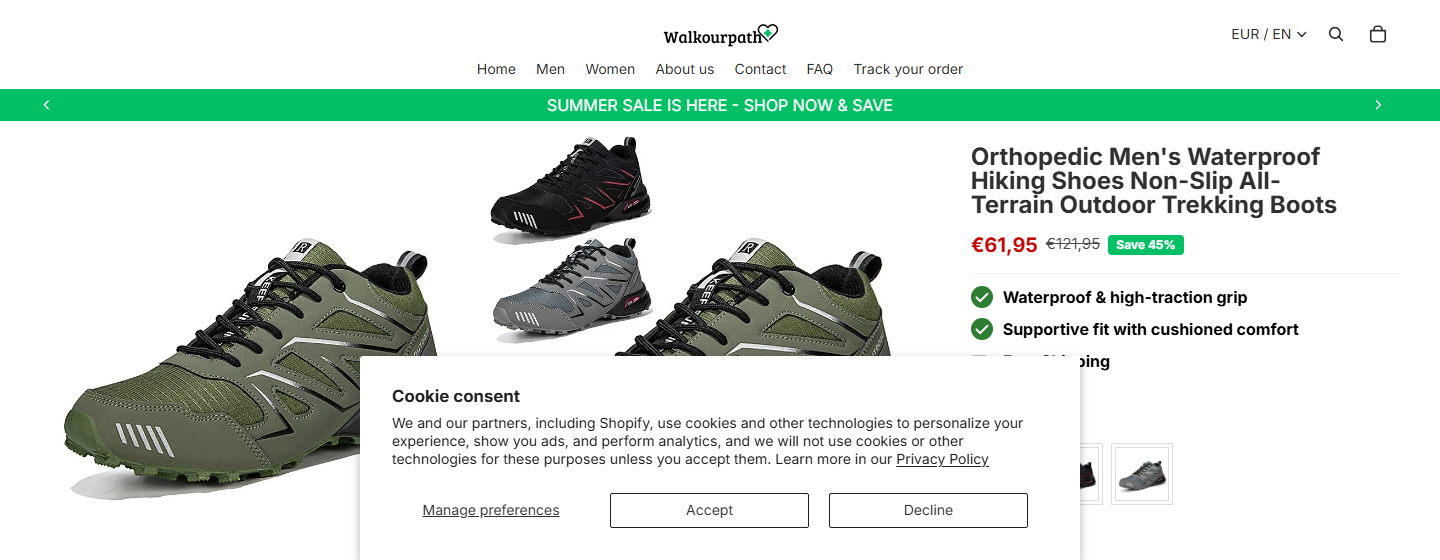
The shoes look sturdy, supportive, and heavily discounted. Product names use words such as “orthopedic,” “waterproof,” and “all-terrain,” while the store promotes a 60-day guarantee that seems to remove the risk.
But WalkOurPath shoes complaints tell a much less comfortable story, especially when buyers try to turn an unwanted order into a real refund.
One recent buyer reported ordering four pairs for $386.16. They said the materials, construction, fit, and comfort did not match expectations and asked for a refund on the day the package arrived.
According to the buyer’s saved correspondence, the responses moved through offers of 15%, 30%, 45%, and 60% store credit. A return was eventually discussed, but the proposed resolution was still store credit rather than money returned to the original card.
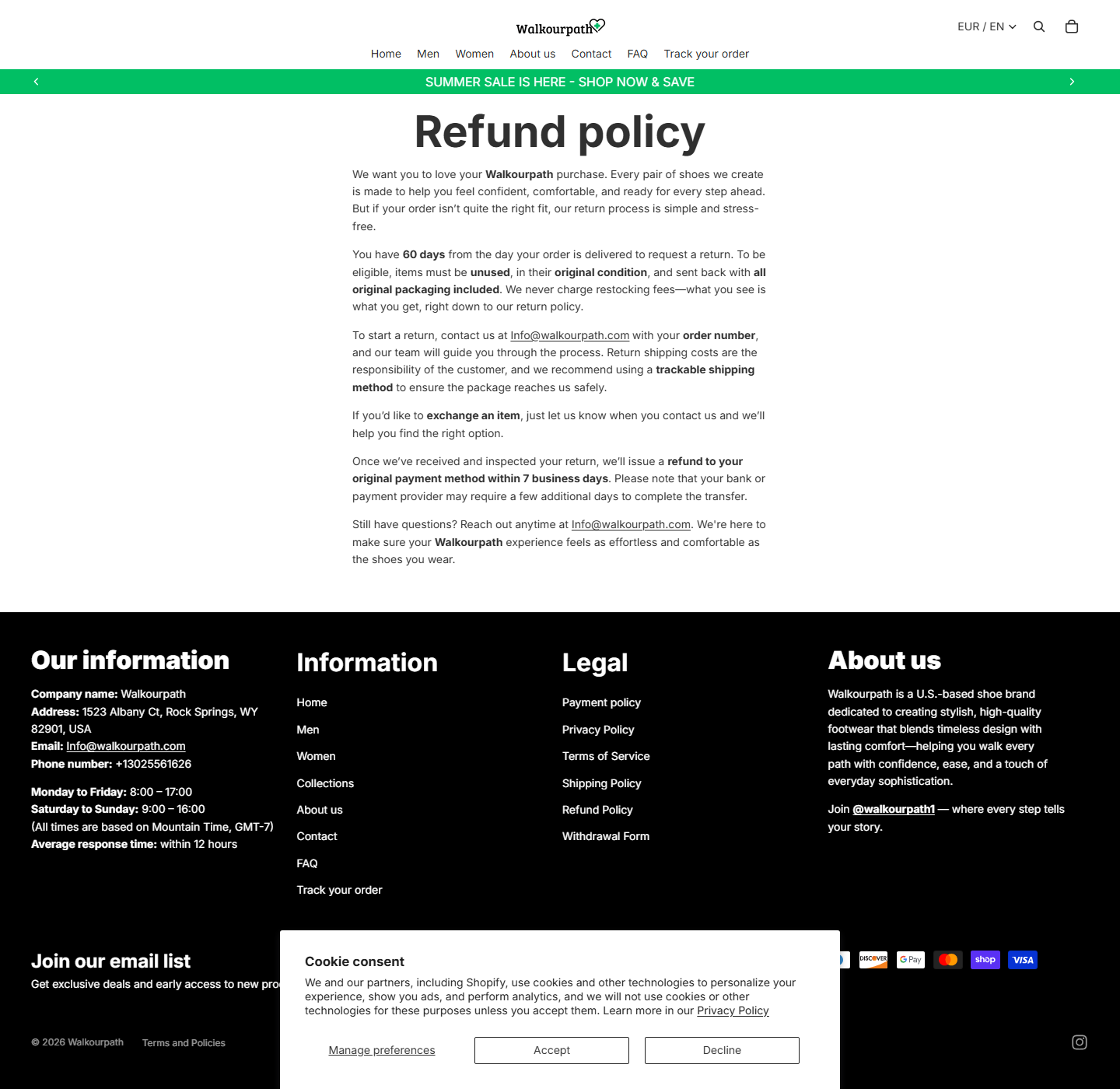
That account is an individual complaint, not a legal finding. Yet it raises a direct question because the refund policy reviewed on WalkOurPath says eligible refunds go to the original payment method after the return is received and inspected.
Overview
The sales page makes the purchase feel unusually safe
WalkOurPath presents a large catalog of discounted footwear with benefit-heavy names. The language suggests practical comfort and performance, and the guarantee gives buyers a reason to overlook uncertainty about fit, materials, or the company behind the storefront.
Shoes are difficult to judge from photographs. A polished product page cannot prove cushioning, sizing consistency, sole durability, waterproofing, or whether the item is appropriate for a medical condition. Those questions only become real after delivery.
The refund experience is where the risk becomes visible
The complaint pattern is not simply “I disliked the shoes.” Buyers describe being steered toward partial store credit, larger store-credit offers, or costly international returns. That can trap the customer inside the same store they are trying to leave.
A percentage of store credit is not equivalent to a refund. It requires another purchase, may carry conditions, and leaves the original charge in place. If the policy promises money back to the original payment method, support should explain clearly why a different remedy is being proposed.
The written policy and reported practice need to match
The refund page reviewed says returns are accepted within 60 days, customers pay return shipping, and approved refunds are issued to the original payment method. It also describes the process as simple and stress-free.
Before buying, compare that promise with the practical details:
- Is the return destination disclosed before checkout?
- Is a refund to the original payment method clearly available?
- Who pays tracked international postage?
- Are “orthopedic” claims supported by specific design or medical evidence?
- Does customer support provide a return authorization promptly?
What Buyers Report About WalkOurPath Shoes
The most important recent report came from a customer who said four pairs were ordered and rejected immediately after inspection. The buyer documented the package, labels, products, and support emails before disputing the charge.
The striking detail is the escalating sequence of store-credit offers. Each increase can make the customer feel they are negotiating toward a fair outcome, while the central question remains unanswered: will the merchant return the money to the payment method used?
Other public review complaints describe sizing problems, lightweight or plastic-feeling materials, and return instructions involving China. Those statements are customer allegations. They should not be treated as proof that every order has the same quality or that every buyer is denied a refund.
However, repeated reports about the same friction point are relevant. A store can deliver an item and still create substantial consumer risk if its refund route is expensive, unclear, or materially different from what a reasonable customer understood before purchase.
Does “Orthopedic” Mean the Shoes Are Medically Approved?
No universal approval is created by putting “orthopedic” in a product title. The word can describe a design intention, but it does not automatically mean a podiatrist evaluated the shoe, a regulator approved a medical claim, or the product is suitable for your condition.
Real footwear needs specific, testable information: heel-to-toe drop, width options, arch structure, removable insoles, materials, weight, outsole grip, and sizing measurements. Broad claims about pain relief or support are less useful without those details.
If you have diabetes, neuropathy, serious foot pain, recent surgery, or circulation problems, do not rely on an advertisement alone. Poor fit can cause pressure points, blisters, falls, or delayed detection of injury. Ask a qualified clinician what features you actually need.
A large discount also says nothing about medical value. The crossed-out price may be a marketing reference rather than a price at which substantial sales occurred. Judge the delivered product and the written terms, not the apparent size of the deal.
How the WalkOurPath Refund Trap Works
Step 1: Benefit-heavy ads create urgency
The buyer sees attractive shoes framed as comfortable, supportive, waterproof, or suitable for difficult terrain. A steep markdown and limited-time language reduce the amount of time spent checking the seller.
The advertisement may reach people already dealing with foot pain. That audience is more likely to focus on relief and less likely to investigate return logistics before ordering.
Step 2: The guarantee lowers resistance
A 60-day guarantee sounds like a safety net. Buyers reasonably expect that if the shoes do not fit or match the description, they can send them back and receive money to the original payment method.
The guarantee is only as useful as the instructions, destination, cost, and remedy behind it. A time window alone does not make a return practical.
Step 3: The delivered product disappoints
Reported problems include fit, comfort, materials, or construction. Footwear can vary, so a complaint about one pair cannot establish the quality of every product. It does establish why a functioning refund process matters.
Photograph the shoes before wearing them outdoors. Include soles, labels, packaging, size markings, defects, and any difference from the listing. This protects you if support later argues that the item was used or altered.
Step 4: Support proposes store credit first
Instead of immediately supplying a return authorization and address, support may offer a small credit. The amount can rise after the buyer refuses, creating the impression that continued negotiation is the normal process.
Store credit may suit someone who wants another product. It should not be presented as identical to a cash refund, and the buyer should not be pressured to accept it if the written policy provides another remedy.
Step 5: The return destination changes the economics
A low-priced shoe may become uneconomical to return if tracked international shipping costs $35, $40, or more. The buyer may also face customs forms, long transit times, and uncertainty about whether the warehouse will acknowledge receipt.
The location of a return warehouse should be disclosed clearly before purchase when it materially affects the guarantee. A US-facing storefront or contact address does not necessarily mean returns stay in the US.
Step 6: The deadline keeps running
Back-and-forth offers can consume days inside the return window. If support delays giving instructions, the customer should keep requesting them in writing and state the original cancellation date.
Do not allow negotiations to run past card-dispute deadlines. Ask the issuer about its exact time limit while you are still communicating with the merchant.
Step 7: The buyer must choose between loss and more store exposure
The customer may accept store credit, pay expensive return postage, keep an unwanted item, or dispute the charge. None is the frictionless money-back experience suggested by a reassuring guarantee.
This is why the refund process deserves as much scrutiny as the product page. The risk is not just what arrives. It is whether the customer can exit the transaction on the terms advertised.
Company, Address, and Fulfillment Checks
The brand name is not enough to identify the legal seller
WalkOurPath is the storefront name, but buyers should also look for the legal merchant on checkout pages, receipts, card statements, terms, and return instructions. Those names should connect clearly enough that a customer knows who accepted the payment.
A brand can use payment processors and fulfillment partners without doing anything improper. The problem is opacity. If the receipt, policy, support signature, and statement show different names, ask for a written explanation before shipping a return.
The published contact details do not explain the return route
The contact information reviewed listed an address in Rock Springs, Wyoming, and a phone number using a Delaware area code. That mismatch does not prove fraud. Companies can use remote support and registered addresses.
It does mean the listed contact page should not be assumed to be the warehouse that receives returns. Obtain the exact return address and authorization in writing before paying postage.
Support appears to be the central complaint
The recent buyer said support answered, but the answers focused on progressively larger store-credit offers. Responsive email alone is not enough. A useful support team should apply the published policy consistently and provide clear instructions.
Keep the complete thread, including headers and timestamps. If a representative promises a refund, ask them to specify the amount, destination, deadline, and payment method.
The product supply chain is not clearly traceable from the listing
A product title and polished photographs do not identify the factory, importer, quality controls, or exact model sold elsewhere. Similar-looking footwear can come from many suppliers and differ in materials or construction.
Country of origin alone is not a quality verdict. What matters is traceability: manufacturer, materials, model number, care information, accurate sizing, and a seller that stands behind the delivered item.
The Policy Language Buyers Should Save
The reviewed refund policy is important because it says approved refunds go to the original payment method. Take a dated screenshot before ordering. Website terms can change, and the version visible during the sale may matter in a dispute.
Also save the product page, order summary, shipping promise, and guarantee language. Do not rely on a social ad remaining available. Ads can be edited or removed, and product pages can be renamed.
Read the exceptions. Hygiene rules, final-sale designations, damage claims, return authorization requirements, and customer-paid shipping can change eligibility. If an exception was not disclosed until after payment, document when and where it first appeared.
The Federal Trade Commission advises online shoppers to review refund, return, and shipping terms and to keep transaction records. Paying by credit card usually provides stronger dispute tools than wire transfers, gift cards, or cryptocurrency.
Warning Signs Before You Buy Shoes From a Social Ad
- The product name makes broad pain-relief or orthopedic claims without measurements.
- The “sale” appears permanent or nearly every product is deeply discounted.
- The company identity is difficult to connect to the checkout merchant.
- The return country or warehouse is not disclosed before payment.
- The guarantee highlights the number of days but hides postage costs.
- Reviews repeatedly mention store credit when buyers requested refunds.
- Product photos appear on many unrelated storefronts under different names.
None of these signs alone proves a scam. Together, they increase the risk that the buying experience will not match the sales pitch. Search the domain name plus “refund,” “return address,” and “complaints,” then read the lowest-rated reports for recurring details.
What to Do if You Have Fallen Victim to This Scam
- Send a clear written cancellation or refund request. State the order number, items, delivery date, reason, and the remedy you want. Quote the policy that was visible when you ordered and request a return authorization and address.
- Do not accept store credit by accident. If you want money returned to the original card, say so plainly. Ask whether accepting a partial credit would waive the rest of your claim before agreeing.
- Photograph everything. Record the shoes, soles, labels, size markings, defects, packaging, mailing label, and unopened items. Save the listing, guarantee, refund policy, receipt, and full support thread.
- Contact your card issuer before deadlines expire. Explain the advertised terms, delivered condition, requested return, and merchant response. Follow the issuer’s process and provide evidence without exaggerating what happened.
- Do not ship to an unverified address. Obtain written instructions and use tracked postage. Photograph the sealed parcel and label, keep the receipt, and monitor delivery. Compare the shipping cost with the disputed amount.
- Check the device used for checkout. If the payment page redirected unexpectedly, downloaded a file, or triggered suspicious pop-ups, run a full Malwarebytes scan. This checks for common unwanted software or credential-stealing threats beyond the refund dispute.
- Block repeat scam advertising. AdGuard can reduce exposure to malicious ad networks and known scam pages. It cannot judge shoe quality or recover payment, but it can help prevent follow-up ads from pulling you into another rotating storefront.
- Report accurately and avoid recovery offers. Submit evidence to the FTC, your local consumer agency, the advertising platform, and the card issuer. Ignore anyone promising a guaranteed refund for an upfront fee.
Frequently Asked Questions
Is WalkOurPath definitely a scam?
The evidence reviewed supports serious caution about the refund experience and reported product quality, but individual complaints are not a court judgment. The clearest issue is the gap buyers describe between the guarantee and the remedy offered.
Does WalkOurPath promise refunds to the original payment method?
The refund policy reviewed stated that approved refunds are returned to the original payment method after receipt and inspection. Buyers should save the version displayed at the time of purchase because policies can change.
Why would support offer increasing store credit?
Store credit keeps the value inside the shop and can cost the merchant less than a refund. It may be acceptable to some customers, but it is not the same as reversing the original charge.
Should I return the shoes overseas?
Only after receiving verified written instructions and understanding the cost, tracking, customs requirements, and refund terms. Ask your card issuer how an expensive overseas return affects a dispute before shipping.
Are the shoes really orthopedic?
The label alone does not establish medical approval or suitability. Look for measurable design details and consult a qualified clinician if you need footwear for a diagnosed condition.
Can I dispute the charge if I received the order?
Receiving a package does not automatically eliminate dispute rights. Eligibility depends on the card network, local law, advertised description, return effort, and evidence. Contact the issuer promptly and describe the facts accurately.
The Bottom Line
WalkOurPath shoes complaints are most concerning when the promised safety net turns into a ladder of store-credit offers and a potentially expensive return. A discount is not valuable if you cannot exit a disappointing purchase.
Save the policy before paying, verify the return destination, use a credit card, and document the product immediately after delivery. If support will not follow the written terms, move quickly to a formal dispute rather than negotiating until the deadline passes.








