

A barking dog can turn an ordinary evening into a stressful negotiation. WoofAway promises a small, fast answer that appears easier than weeks of training.
The device itself is simple. The questions begin when its broad promises, bundle selection, policies, and real-world limitations are examined together.
Overview
WoofAway is a real type of device, not a proven instant solution
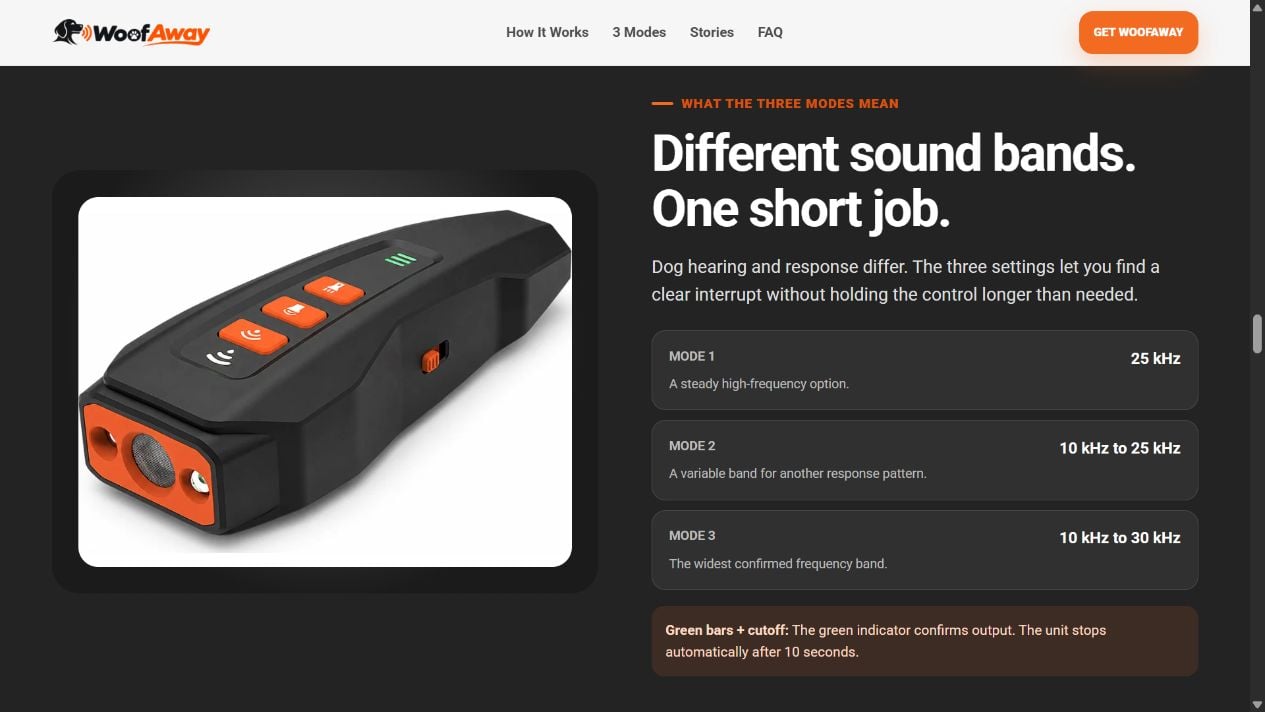
WoofAway is marketed as a handheld ultrasonic dog trainer with three modes, USB-C charging, and a claimed working distance between one and ten meters.
Ultrasonic trainers are not imaginary technology. They emit high-frequency sound that many dogs can hear, even when the sound is faint or inaudible to people.
That does not mean every dog will respond. Age, hearing, distance, distraction, fear, temperament, and prior exposure can substantially change the result.
The advertising presents confidence that the evidence cannot guarantee
The sales page uses phrases such as “100% humane,” “vet-approved,” and “works in three days.” It also displays a 4.8 rating and dramatic testimonials.
Those statements are presented by the seller, not by an independent testing body. We found no accessible clinical trial proving the advertised outcome for every dog.
The page itself acknowledges important exclusions. It says the device is unsuitable for deaf dogs and provides age and weight guidance that narrows the audience.
The checkout deserves as much attention as the gadget
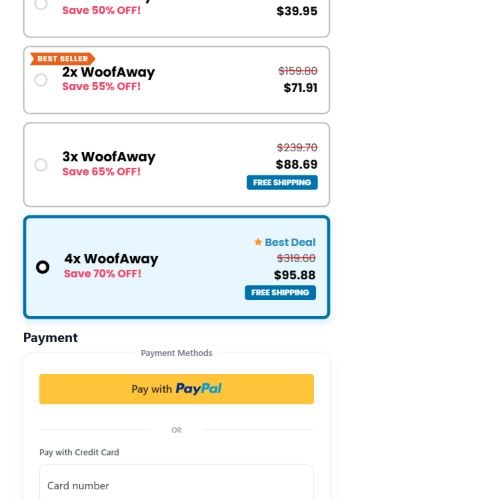
Four purchase options were available during our review. The checkout displayed one, two, three, and four-unit packages with different per-device prices.
The four-unit package, priced at $95.88 before later charges, was selected by default. A one-unit option at $39.95 remained available.
An optional extended-protection offer appeared separately. We did not find an automatic refill subscription in the checkout path that we examined.
- WoofAway belongs to an established category of ultrasonic training devices.
- The device cannot promise the same reaction from every dog.
- The strongest performance claims come from the seller’s own funnel.
- The four-unit bundle was selected by default during our checkout review.
- Shipping and taxes were not included in the first displayed package price.
- The policies identify Straight Commerce Inc. as the operator.
- Return costs and conditions may reduce the value of any refund.
Is WoofAway a Scam?
WoofAway should not be described as a nonexistent product. The offer shows a physical handheld device, specifications, package choices, and an active checkout.
We also found no evidence in the reviewed checkout that one purchase automatically created a recurring monthly subscription.
The stronger concern is how an ordinary, variable training aid is presented. The funnel makes broad promises that could sound much more certain than reality.
A dog may pause, become startled, ignore the sound, or associate it with the wrong event. None of those possibilities fit neatly inside a dramatic advertisement.
The default four-pack creates another concern. A distracted buyer can assume the highlighted choice is the basic offer and order more units than intended.
Quantity defaults are visible before payment, but visibility does not make them buyer-friendly. The shopper must actively inspect the package selector before proceeding.
The company trail also spans several names. WoofAway pages use Spark-Tek policy infrastructure, while published terms identify Straight Commerce Inc. as the operator.
That structure is not proof of fraud. It does make it important to save the checkout, merchant name, and policy pages before paying.
That uncertainty matters more because the device’s usefulness depends heavily on one animal’s individual response.
Our conclusion is a strong caution about claims and checkout design, not a claim that every order is fraudulent or every device is useless.
What Ultrasonic Dog Trainers Actually Do
Dogs generally hear higher frequencies than humans. An ultrasonic device uses that difference to introduce a sound intended to interrupt unwanted behavior.
The sound does not explain what the dog should do instead. At most, it creates an interruption that must be paired with clear, consistent training.
A startled pause can look like instant obedience in a short video. Long-term behavior change requires repetition, timing, appropriate rewards, and attention to the cause.
Barking may come from boredom, fear, pain, territorial behavior, separation distress, excitement, or learned habits. One tool cannot address every cause responsibly.
The American Veterinary Society of Animal Behavior recommends reward-based training methods. Its guidance warns that aversive methods can affect welfare and the human-animal relationship.
Ultrasonic interruption is commonly treated as positive punishment because an unpleasant stimulus follows a behavior. That classification matters when evaluating “100% humane” marketing.
Aversive does not automatically mean physically injurious. It means the method works by adding something the animal wants to avoid.
Some dogs may show anxiety, avoidance, confusion, or no response. Nearby animals can also hear the signal even when they are not the intended target.
Owners should stop if a dog appears distressed. Persistent aggression, panic, sudden behavior changes, or compulsive barking should be discussed with a qualified professional.
How the WoofAway Sales Funnel Works
Step 1: A frustrating behavior becomes an urgent problem
The advertisement starts with barking, jumping, chasing, or poor recall. These situations feel embarrassing and exhausting, especially when neighbors are already complaining.
That emotional pressure makes a quick handheld answer attractive. The viewer is invited to imagine quiet control without arranging classes or changing daily routines.
The ad rarely has time to discuss medical causes, fear, exercise, environment, or the dog’s individual learning history.
Step 2: A dramatic demonstration makes the response look universal
A dog stops when the button is pressed. The timing implies that the device produced an immediate, reliable correction.
Short demonstrations cannot show failed attempts, repeated conditioning, off-camera cues, editing, or what happened after filming.
A visible pause is also not proof that the underlying behavior improved safely. It may show surprise rather than learning.
Step 3: Strong labels replace independent evidence
The page calls the tool humane, effective, and veterinarian approved. These concise labels are easier to remember than limitations hidden farther down the funnel.
We did not find a named veterinary organization certifying the exact device. A generic approval phrase should not be mistaken for an independent endorsement.
Ratings and testimonials displayed inside a seller-controlled page also require context. They are not equivalent to verified purchases collected by an unaffiliated retailer.
Step 4: Compatibility limits appear after the headline promise
The FAQ says WoofAway is not suitable for dogs with hearing impairment. It also gives age and weight guidance that excludes some animals.
Distance, barriers, environmental noise, and a dog’s attention can further affect performance. Those practical variables receive less emphasis than the successful demonstrations.
A shopper should evaluate the limitations before price, not after becoming committed to the promised result.
Step 5: A larger bundle is highlighted at checkout
The reviewed checkout offered one unit for $39.95, two for $71.91, three for $88.69, and four for $95.88.
The four-unit package was preselected. Its lower unit price can feel economical, although many households need only one device.
Customers must verify the active package, item count, delivery charge, tax, and total before entering payment information.
The page also offered extended protection for $23.96. That option appeared unchecked during our review, but every buyer should confirm its status.
Step 6: Refund expectations meet the policy conditions
Direct-response funnels emphasize reassurance during the sale. The practical refund experience depends on written rules, authorization requirements, product condition, and return destination.
Shared Spark-Tek policies place responsibility on the customer to follow the return process. Shipping and handling charges may not be recoverable.
A low-cost imported-style gadget can become uneconomical to return when tracked postage, packaging, and administrative conditions are added.
Customer-review platforms contain complaints about support and cancellation experiences involving Spark-Tek offers. Those reports are allegations, not proof of every buyer’s outcome.
Red Flags Worth Checking Before You Order
- A promise that appears to work for nearly every dog within a fixed period
- “Vet-approved” language without a named veterinarian or certifying organization
- Testimonials that cannot be independently connected to verified purchases
- A multi-unit package selected before the shopper makes a deliberate choice
- Shipping and taxes shown only after the initial package decision
- Different brand, policy, operator, support, and statement names
- Return conditions that can make a small purchase expensive to send back
One warning sign rarely settles the question. Several signs together show whether the seller expects an informed decision or relies on momentum.
Take screenshots of each stage. A saved package selector can resolve a later dispute about the quantity that appeared before payment.
Company, Address, and Fulfillment Checks
The brand name is not the legal seller
“WoofAway” identifies the offer. The terms connected to the funnel identify Straight Commerce Inc. as the business operating the broader sales infrastructure.
Search every name appearing in the footer, receipt, terms, privacy policy, and card statement. They may not match the product label.
The contact address does not establish a dedicated headquarters
Spark-Tek pages use 100 Church Street, 8th Floor, New York, NY 10007. That address alone does not prove a WoofAway office or manufacturing site.
Corporate mail, administration, fulfillment, and returns can occur at different locations. Never send a package to a contact address without written authorization.
Shared support can complicate a product-specific problem
The same Spark-Tek contact infrastructure appears across unrelated consumer offers. Shared support is common, but it can obscure who controls a specific order.
Ask the representative to repeat the product, quantity, order number, refund deadline, and authorized destination in writing.
The domain is newer than the confidence of the claims
Registration records show get-woofaway.com was created in September 2025. A newer domain is not proof of wrongdoing, but it limits the available operating history.
Longstanding-sounding statistics should therefore be treated cautiously unless the seller explains their source and how the figures were verified.
How to Evaluate WoofAway Before Paying
- Ask why the dog is barking. Rule out pain, fear, inadequate exercise, separation distress, and environmental triggers before choosing an interruption tool.
- Consult an appropriate professional. A veterinarian or qualified reward-based trainer can identify causes that a product advertisement cannot diagnose.
- Read the device limits. Check hearing, age, weight, distance, charging, weather resistance, and the seller’s exclusions.
- Compare ordinary alternatives. Similar ultrasonic devices are widely available through retailers with clearer reviews and simpler return desks.
- Select the quantity deliberately. Do not assume the highlighted package contains one unit. Read the active label and total.
- Inspect every optional add-on. Confirm whether extended protection, priority processing, or another service is selected.
- Save the policies. Keep screenshots or PDFs showing the refund window, product-condition requirements, and seller identity.
- Use a protected payment method. A credit card usually offers better dispute options than a transfer, debit payment, or payment application.
What to Do if You Have Fallen Victim to This Scam
- Preserve the complete order trail. Save the advertisement, checkout, quantity selector, confirmation, receipt, policies, tracking, packaging, and every support message.
- Contact support in writing immediately. State the order number, exact requested remedy, and a reasonable response deadline. Keep the sent message.
- Do not mail a return blindly. Request a return authorization and written destination. Use tracked shipping only after the company confirms acceptance.
- Challenge an incorrect quantity promptly. Explain which package you intended to buy and include the saved checkout evidence.
- Contact the card issuer. Dispute unauthorized, duplicated, materially misrepresented, or undelivered charges within the issuer’s deadline.
- Watch the statement. We found no subscription in the reviewed checkout, but monitoring catches duplicate charges, add-ons, or unfamiliar descriptors.
- Report deceptive advertising. Notify the advertising platform and the appropriate consumer-protection agency with screenshots and transaction details.
- Protect the device used for purchase. Run Malwarebytes if you downloaded files or installed anything, and use AdGuard to reduce malicious redirects.
Frequently Asked Questions
Does WoofAway really exist?
We found an active product funnel and checkout for a physical ultrasonic dog trainer. That is different from proving its advertised results are universal.
Is WoofAway guaranteed to stop barking?
No. Dogs respond differently, and barking has many causes. Hearing, fear, training history, distance, and environment can change the outcome.
Is WoofAway completely humane?
That seller claim is too absolute. Ultrasonic interruption is aversive for some dogs and can create distress, confusion, or avoidance.
Does WoofAway create a monthly subscription?
We did not find an automatic subscription in the checkout reviewed. Buyers should still read the final order summary and monitor later statements.
Why did the checkout show four devices?
The four-unit package was selected by default during our review. Buyers could choose smaller packages, including one device for $39.95.
Can I return WoofAway if it does not work?
Return eligibility depends on the written policy, authorization, timing, condition, and destination. Ask for written instructions before mailing anything.
The Bottom Line
WoofAway is an ultrasonic training gadget sold through a polished direct-response funnel. The product category is real, but the advertised certainty is not.
Its strongest warning signs are sweeping behavioral promises, seller-controlled proof, shared multi-brand infrastructure, and a four-unit package selected by default.
We found no recurring subscription in the reviewed checkout. The more immediate risk is buying too many devices or expecting results the seller cannot guarantee.
Understand the dog’s behavior first, choose the quantity yourself, save every policy, and use a payment method that leaves a clear dispute path.








