


An offer for a Zara PR package lands in your feed. The brand is familiar, the reward is generous, and applying looks easy.
Zartest.online has circulated with that pitch. Before handing over your details, take a closer look at what the invitation actually asks you to complete.
Overview
The reviewer invitation changes into compulsory reward deals
The Zartest.online scam borrows Zara’s identity to promote a $750 PR package. The accessible related page calls itself Zara Product Reviewer.
Its main instruction is to complete five recommended deals. The page supplies no product-testing brief, named organizer, package contents, or fulfillment rules.
That is the central switch: an apparent fashion-review opportunity leads toward outside offers, while the party responsible for the promised package remains unidentified.
Do not register or buy deals through this pitch. It provides a route into a promotion, not the arrangements you would need for a genuine reviewer assignment.
The complete landing page leaves out basic accountability
The current zartest.webflow.io page contains one action link. It leads to an affiliate-style tracking address on rewarrdsgiant.com.
There are no terms, privacy, or contact links on that page to identify the organizer or explain how it handles information.
The practical omissions are specific:
- No company or campaign representative accepts responsibility for the package.
- No instructions explain which Zara products would be reviewed or how feedback would be used.
- No delivery schedule or process for a missing package is supplied.
- No complete conditions explain what the five compulsory deals require.
The prominent branding and TikTok-style graphic fill the space where those answers should be.
What the current and historical evidence covers
Updated Nov 2026: The original .online address redirected to an access-denied subdomain during checking. The related Webflow page still displays the package-and-deals promotion.
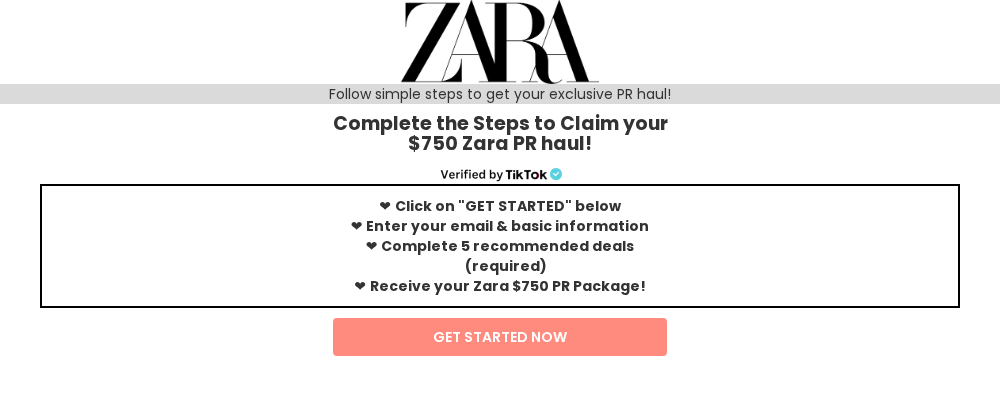
The lead image shows the current Webflow page. The historical comparison uses the image retained with the April 2025 report, whose original capture date and address are unknown.
The current outbound application route returned a renderer error. That prevented checking its later offer conditions, operator identity, and fulfillment process.
The April 2025 Image Shows the Earlier Version of the Pitch
An image preserved with the April 2025 version of this report shows the earlier pitch. It includes a Zara logo and instructions for claiming the package.
The image opens by referring to visitors coming from TikTok, then describes a Zara PR haul. Its sequence includes a short survey and a real email address.
Next comes a compulsory range of four to five recommended deals, followed by the promise of a $750 Zara package as a gift.
The current page shortens the first instructions and fixes the requirement at five deals. The attractive package remains the reason for completing those offers.
These are concrete similarities in the promise and conditions. They do not establish common ownership or a current redirect from .online to Webflow.
What changed and what stayed
| Feature | Image retained with the April 2025 report | Current Webflow page |
|---|---|---|
| Advertised reward | A Zara PR package valued at $750 | A Zara PR haul valued at $750 |
| Initial requirements | A short survey and a real email address | Email and basic information |
| Required offers | Four to five recommended deals | Five recommended deals |
| Main button | A claim button | A button to get started |
| Legal navigation | Privacy and terms labels are visible | No privacy, terms, or contact links in the complete saved page |
The historical image preserves visible labels, not the contents or functioning destinations of those old legal links. The current page can be inspected directly.
Our separate Zartest.Webflow.io report covers that hosted address. This article follows the Zartest.online invitation and the continuing package-and-deals pitch.
How the Zartest.online Scam Works
Step 1: Zara branding gives the invitation an immediate identity
The current page places a large Zara logo above the package promise. The browser title identifies a product-reviewer opportunity before the visitor reaches the conditions.
That presentation matters because PR normally suggests receiving something from a brand for publicity or feedback. It draws attention toward the clothes and away from the signup destination.
The page then presents a $750 value as the benefit of completing its instructions. There is no selection brief describing experience, clothing preferences, review deadlines, or deliverables.
The broader Zara reviewer-scam report examines this recurring hook: a familiar retailer supplies the appeal while another website runs the invitation.
Step 2: The invitation asks for contact information before explaining the organizer
The page directs visitors to enter an email address and basic information. It does not contain an application form on that landing page.
Instead, the single button sends the visitor away to start the next part. That separates the reassuring branded introduction from the service receiving the application.
An email address is more than a way to notify a selected reviewer. It can also become the contact used for signup confirmations and later offer messages.
Before sending it, you should know which organization receives it and where to find that organization’s privacy terms. This landing page supplies neither through its navigation.
Step 3: Five compulsory deals become the condition for the package
The requirement is explicit: “Complete 5 recommended deals.” It is presented as compulsory rather than an optional set of fashion recommendations.
The activity being requested is completing offers. Nothing in the page explains testing a garment, submitting a review, or receiving a particular item to evaluate.
This is why the reviewer label is misleading. The visitor’s task has changed from reviewing Zara products to satisfying another promotion’s conditions.
A deal may involve different commitments depending on its provider. Read any actual enrollment before accepting it, including price, renewal terms, cancellation, and eligibility.
The cost calculation belongs to those commitments, not the $750 headline. Spending time or money on one offer doesn’t settle what the remaining ones would require.
Step 4: The button passes the visitor into an identified tracking route
The destination is spelled rewarrdsgiant.com, with a double r in the middle. Do not confuse it with a similarly named reward service.
Its linked path is aff_c. The saved URL contains offer_id=488, aff_id=2953, and source=zz.
Those fields identify an offer and attribution route. They do not document a completed commission payment, the amount earned, or a Zara shipment.
For a visitor, the important change is who controls the next page. You are leaving the branded package introduction for an outside destination with its own process.
If you later need to identify a signup, keep that destination and its receipt. The Zara logo on the first page won’t identify the merchant on your statement.
Step 5: The page never identifies who must deliver the package
The page never names the party that would select the clothing, send it, or answer a missing-package complaint. It also supplies no campaign contact link.
That leaves the visitor carrying the obligations while the organizer leaves its own obligation unexplained. There is nowhere on the landing page to check a fulfillment rule.
If you receive a confirmation after following an offer, identify what it confirms. It may concern an outside enrollment rather than the package that attracted you.
Do not complete more offers to solve that accountability gap. Stop and address any actual signup or charge through the provider responsible for it.
The Missing Legal Links Matter Before the First Signup
The current page is short, so this isn’t a matter of overlooking a long policy. Its full saved HTML contains the promotional instructions and one outbound button.
There is no linked organizer statement setting out the package conditions, no contact route for this campaign, and no privacy notice describing the requested information.
Those omissions affect three separate decisions. You cannot identify who receives your application, who controls any reward process, or who owes the promised package.
A privacy policy should tell you about the relevant operator’s data practices. A policy reached later on another website may describe that different service instead.
Similarly, an outside merchant’s cancellation rules apply to its enrollment. They do not automatically explain how the first page’s Zara package would be delivered.
Keep those records separate if you have already continued. You may need to cancel a real service even though the original reviewer invitation was misleading.
The Zijtest.com reviewer report documents another Zara-themed invitation. Compare the actual requirements and receiving addresses rather than relying on a familiar-sounding name.
The Verification Graphic Adds Reassurance Without Answers
A small graphic near the package claim reads “Verified by TikTok.” It is an ordinary image embedded in the page, not a linked approval record.
The mark adds apparent outside authority beside the offer, while leaving the organizer, package contents, and fulfillment conditions unidentified.
That is its role in the presentation: reassurance arrives before the visitor is sent toward the compulsory deals. It doesn’t supply the missing campaign information.
You can report the advertisement or account through the platform where you encountered it. Keep the actual account identifier rather than reporting only the borrowed Zara name.
Where to Check a Real Zara Order or Opportunity
Open Zara’s official help center yourself and use the contact options for your market. Ask about the exact website and offer.
Provide the promotion’s address and the package claim. That gives customer service something specific to assess without you submitting an application to the promoter.
Zara’s online-purchase guide describes selecting items, completing payment, and receiving an order confirmation. A reward-deal signup is a separate transaction.
If you placed a genuine Zara order as well, keep its order number and messages apart from the promotion. Otherwise, a real delivery can complicate the wrong complaint.
For a reviewer arrangement, establish the product, organizer, expected work, delivery, and conditions before agreeing. The invitation should explain what each side is responsible for.
The same approach helps with other fashion brands. Our Shein reviewer-scam coverage discusses similar invitations, without establishing a shared operator for every promotion.
What to Do if You Have Fallen Victim to This Scam
- Stop completing offers to chase the package. Don’t pay an extra release, delivery, or verification fee merely because another message says your application is nearly finished.
Keep the original invitation before blocking its sender. You may need it to explain why you joined an unrelated service.
- List what you actually supplied. Separate an email address from a password, card number, identity document, or payment approval.
That list prevents unnecessary panic and helps you choose the right response. Giving an email address alone doesn’t mean someone knows your email password.
- Check each signup confirmation individually. Identify the provider, purchased service, price, trial deadline, and any renewal interval that applies to your own enrollment.
Don’t leave an unwanted trial running while waiting for a package. Use the provider’s genuine cancellation route and retain confirmation.
- Contact your issuer about an unexplained or deceptive charge. Use your banking app or the established number on your card, and explain what you authorized.
Ask about a dispute and preventing further charges. A payment you approved after a misleading promise differs from a transaction you never approved.
- Replace exposed passwords through the real accounts. If you entered a password already used elsewhere, change it on those genuine services and review account security.
Start with your email if its credentials were exposed. It may receive reset messages for other accounts you use.
- Save the offer and the transaction trail privately. Keep the page address, message, package claim, signup receipts, cancellation requests, and payment references.
Avoid posting your full address, card information, or identity documents in a public warning. A redacted example is enough when alerting friends.
- Report the misleading promotion where you found it. Include the actual account or advertisement, not only the Zara name appearing in its artwork.
The FTC’s guidance after a scam explains contacting payment providers, protecting exposed accounts, and reporting fraud.
- Be wary of a second person offering guaranteed recovery. Don’t pay another stranger to obtain the package, cancel every subscription, or retrieve an earlier payment.
Work with the service you actually joined and your payment provider. Retain their case references so later follow-up stays connected to the original problem.
If You Only Opened the Reviewer Page
Opening this promotion doesn’t, by itself, establish a malware infection. The documented page asks visitors to follow a reward route; it doesn’t identify a specific installed threat.
If you only viewed it, close it and decline further requests. If you granted notifications, remove that site’s permission through your browser settings.
A file downloading is different from an application being installed. Don’t open an unfamiliar download to investigate it, and don’t approve permissions requested by the promoter.
If you installed software or granted access, get trusted help appropriate to that device. Explain what you installed; don’t use a repair service advertised by the same promotion.
Frequently Asked Questions
What is Zartest.online asking visitors to do?
Its related page uses a Zara reviewer pitch to direct people toward five required deals through an outside tracking link. No product-testing assignment is explained.
Is the $750 Zara package guaranteed?
The page promises the package without identifying an organizer or supplying fulfillment rules. Do not register or purchase offers on that basis.
Did the earlier version require four or five deals?
The image retained with the April 2025 report shows four to five compulsory deals. The accessible Webflow page specifies five.
Is Zartest.online still working?
The original address returned a redirect and access denial during checking. The related Webflow promotion remained accessible; the two observations should be kept separate.
What do the identifiers in the button URL mean?
They mark an offer and attribution route. They are not a Zara order number, proof of payment, or a record of package delivery.
What if I already paid for one of the offers?
Identify the actual merchant, save its terms and receipt, cancel unwanted enrollment, and contact your payment provider about the transaction. Don’t pay again to recover it.
The Bottom Line
Do not register or buy reward deals through the Zartest.online Zara-package pitch. It uses a reviewer promise to drive compulsory offers while leaving the organizer and fulfillment terms unidentified.
If you already responded, cancel unwanted enrollment, contact your provider about concerning charges, and secure exposed credentials. Keep the invitation and receipts instead of chasing another package unlock.

Reviews & discussion
0 commentsShare a firsthand experience, or ask a question.
Community reviews
zartest.online
Moderated reader experiences, not an editorial verdict.
Start the conversation
Have a question or something useful to share? Add the first comment.