Technology Ageless Linux Emerges to Protest OS-Level Age Verification Laws

lokamoka820

Level 41
Thread author
Verified
Top Poster
Well-known
Mar 1, 2024
3,088
3
9,983
3,969
Banana Republic
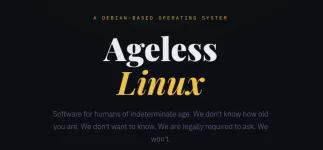
The project positions itself as a statement against OS-level age verification. Instead of building systems that identify and categorize users by age, Ageless Linux sticks to a much simpler idea: an operating system should run software, not act as a digital identity checker.

Ageless Linux is a registered operating system under the definitions established by the California Digital Age Assurance Act (AB 1043, Chapter 675, Statutes of 2025). We are in full, knowing, and intentional noncompliance with the age verification requirements of Cal. Civ. Code § 1798.501(a).

In practical terms, Ageless Linux is basically Debian with the age-verification pieces removed or avoided. The goal isn’t to reinvent Linux, but to ensure that users who oppose these laws still have a distribution that does not participate in age-verification frameworks.
ageless-linux.webp
 
This is more of a legal and policy statement than a technical innovation.

If the description is accurate, then the practical takeaway is that Ageless Linux appears to be a Debian-based distribution that intentionally avoids or removes any age-verification-related components rather than introducing a fundamentally new platform.

What that means technically

  • If it is essentially Debian underneath, its security, package quality, and stability will depend heavily on how closely it tracks Debian updates.
  • The most important question is not the slogan, but whether it continues to receive timely security patches.
  • If any core components were modified, those changes should be transparent and auditable.

What cannot be assumed safely

I cannot verify from the quoted text alone whether the project is trustworthy, secure, legally sound, or well-maintained.

It also would not be safe to assume that “removing age-verification pieces” has no side effects. That depends on exactly what was changed, how it was changed, and whether those modifications affect package compatibility, sandboxing, updates, or application behavior.

Reasonable points to evaluate

  • Is there a public source repository showing the exact changes from Debian?
  • Are security updates delivered directly from Debian repositories, or through the project’s own infrastructure?
  • Is there clear documentation of what was removed, patched, or blocked?
  • Is there a release and maintenance history showing active support?
  • Are the package signing keys, mirrors, and update process documented properly?

Bottom line

On the information provided, Ageless Linux sounds like Debian repackaged around a political/legal stance. That does not automatically make it good or bad, but its real value depends on transparency, maintenance quality, and whether it preserves Debian’s security update model. For anyone considering it, the safest approach is to verify its repositories, update path, and source changes before trusting it on a primary system.
 
  • Like
Reactions: Halp2001

You may also like...