


Hey guys,
Optical computing has been a pipe dream for the computer industry since the 1970's. And ever since I was a kid, I have always dreamed of someday building my own optical computer. Even if someone could build the hardware, they would still have to build the operating system, apps, developer tools, and all of the infrastructure required to make it useful as a general-purpose computer.
But that does not mean we cannot build a specialized optical computation device for AI inference and similar workloads / applications.
Over the last several years, several startups have tried to build photonic CPUs or general-purpose optical processors. From what I can tell, most either pivot toward optical interconnects between GPUs (which is needed as well), or they eventually run into the same wall everyone else does: trying to make an optical version of a traditional CPU is probably the wrong approach.
Personally, I think building a general-purpose photonic CPU is a fool’s errand, at least for now. I also think we should not assume optical computing needs to follow the same path as electrical silicon. Just because traditional CPUs benefited from extreme miniaturization does not necessarily mean optical computation devices should be scaled down the same way. In some cases, larger optical paths, emitters, detectors, fibers, lenses, or direct-contact optical elements may actually be more reliable, easier to manufacture, and better suited for clean signal separation.
That is the basic idea behind Analog Cognition.
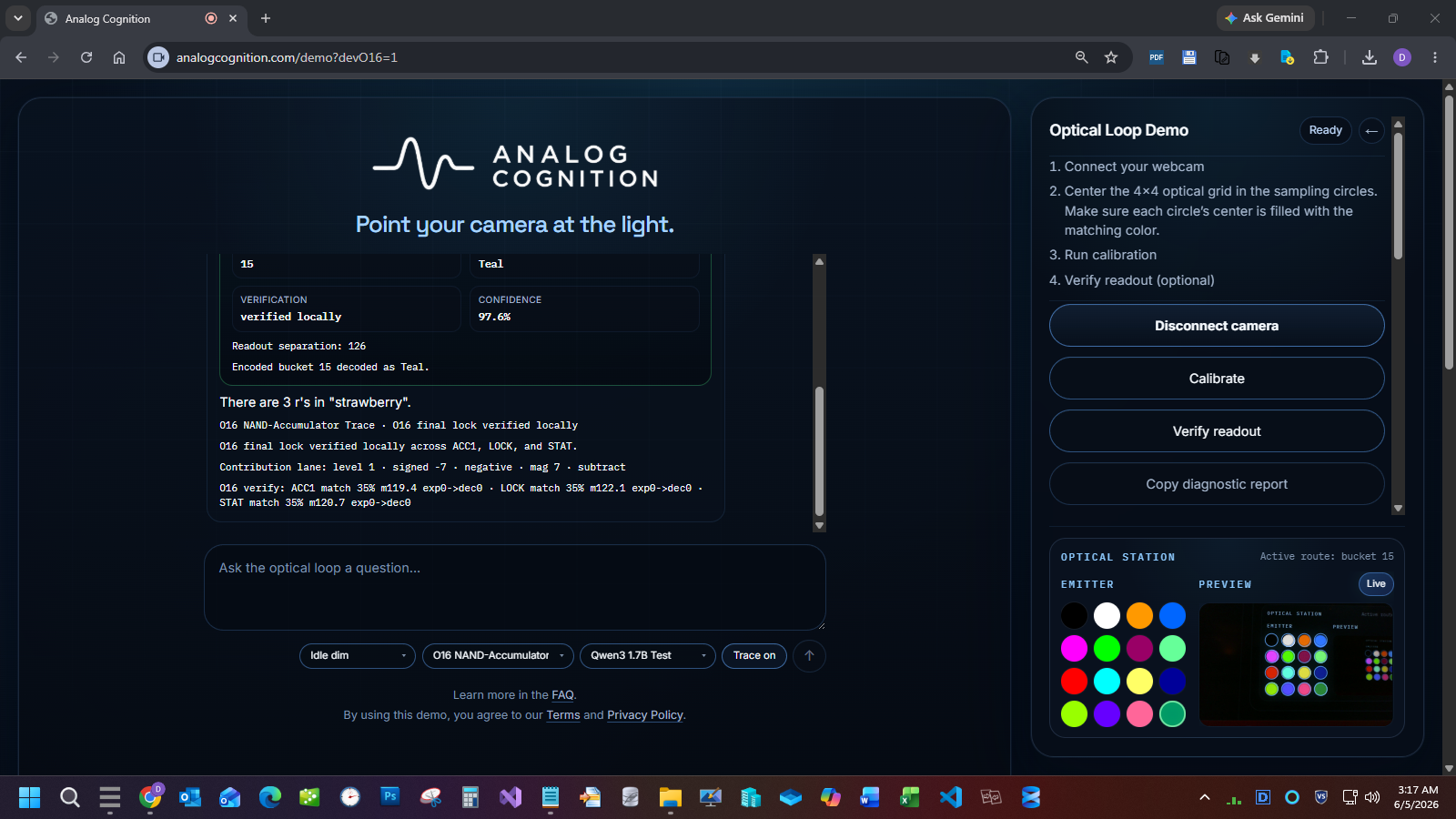
It is an early optical computation workbench that uses a monitor/webcam loop to represent, read, decode, and verify selected encoded optical computation states. In other words, it is a real camera-in-the-loop optical readout demo, but intentionally slow and experimental.
The long-term idea is much bigger: purpose-built optical hardware using LED or laser emitter arrays, photodiode / sensor detector arrays, multi-level optical weight encoding, accumulator-style computation, threshold verification, redundancy, and eventually direct-coupled optical paths.
You can try it here:
 www.analogcognition.com
There is a lot more detail in the FAQ:
www.analogcognition.com
If you guys have a usb webcam, please take it for a spin and let me know what you think.
The most useful feedback would be:
* Does the site explain the idea clearly?
* Does calibration work with your camera/browser setup?
* Does anything sound like it is overclaiming?
* Does the demo make sense after you read the FAQ?
* If calibration fails, what camera/browser/resolution are you using?
Again, this is very early. Think of it as a research workbench / proof of concept, not a finished product. But I think the core idea is extremely interesting, and I wanted to share it with you guys first before posting it anywhere else.
Thank you guys!
Dan
Optical computing has been a pipe dream for the computer industry since the 1970's. And ever since I was a kid, I have always dreamed of someday building my own optical computer. Even if someone could build the hardware, they would still have to build the operating system, apps, developer tools, and all of the infrastructure required to make it useful as a general-purpose computer.
But that does not mean we cannot build a specialized optical computation device for AI inference and similar workloads / applications.
Over the last several years, several startups have tried to build photonic CPUs or general-purpose optical processors. From what I can tell, most either pivot toward optical interconnects between GPUs (which is needed as well), or they eventually run into the same wall everyone else does: trying to make an optical version of a traditional CPU is probably the wrong approach.
Personally, I think building a general-purpose photonic CPU is a fool’s errand, at least for now. I also think we should not assume optical computing needs to follow the same path as electrical silicon. Just because traditional CPUs benefited from extreme miniaturization does not necessarily mean optical computation devices should be scaled down the same way. In some cases, larger optical paths, emitters, detectors, fibers, lenses, or direct-contact optical elements may actually be more reliable, easier to manufacture, and better suited for clean signal separation.
That is the basic idea behind Analog Cognition.
It is an early optical computation workbench that uses a monitor/webcam loop to represent, read, decode, and verify selected encoded optical computation states. In other words, it is a real camera-in-the-loop optical readout demo, but intentionally slow and experimental.
The long-term idea is much bigger: purpose-built optical hardware using LED or laser emitter arrays, photodiode / sensor detector arrays, multi-level optical weight encoding, accumulator-style computation, threshold verification, redundancy, and eventually direct-coupled optical paths.
You can try it here:
Analog Cognition
There is a lot more detail in the FAQ:
Analog Cognition
If you guys have a usb webcam, please take it for a spin and let me know what you think.
The most useful feedback would be:
* Does the site explain the idea clearly?
* Does calibration work with your camera/browser setup?
* Does anything sound like it is overclaiming?
* Does the demo make sense after you read the FAQ?
* If calibration fails, what camera/browser/resolution are you using?
Again, this is very early. Think of it as a research workbench / proof of concept, not a finished product. But I think the core idea is extremely interesting, and I wanted to share it with you guys first before posting it anywhere else.
Thank you guys!
Dan


 .
.


 **The one‑sentence takeaway**
 **The core idea in plain English**
 **Why this matters**
 **How a single cell works (super simple version)**
  **How many cells form a fabric**
 **Example: Cybersecurity**
 **Why this is different from AI chips or CPUs**
 **What this enables**
 **The kid‑level analogy**
 **1. Is there anything else like this?**
  **Closest Neighbor #2: Photonic / Optical Accelerators**
  **Closest Neighbor #3: Analog / Mixed‑Signal Correlators**
  **Closest Neighbor #4: Event‑Stream Processing Software**
  **Closest Neighbor #5: Reservoir Computing / Liquid State Machines**
  **Conclusion: There is no direct equivalent.**
  **2. How transformative is this idea?**
  **Transformative Aspect #1: It moves logic into physics**
  **3. So how big could this be?**


