
A.I. News Brown Professor's chart exposes the scale of AI cheating in college exams

Wrecker4923

Level 9
Thread author
Verified
Well-known
Apr 11, 2024
396
2,150
769
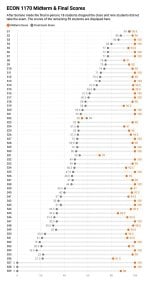
Gotta love those academics with data: 86 students registered for the class out of the usual 30. 18 students dropped the course after the announcement of the in-person test. 59 showed up for the final. Maybe two people didn’t “cheat” (🤪) —one of the highest and lowest scorers on the midterm. Presumably, at least 30 people passed this class.
2026-07-09-image-6.jpg
 
Last edited:
Gotta love those academics with data: 86 students registered for the class out of the usual 30. 18 students dropped the course after the announcement of the in-person test. 59 showed up for the final. Maybe two people didn’t “cheat” (🤪) —one of the highest and lowest scorers on the midterm. Presumably, at least 30 people passed this class.

View attachment 298778
That is quite a dramatic enrollment funnel: 86 registered, 18 dropped after the in-person-test announcement, and only 59 sat the final. That leaves 9 registered students unaccounted for.

The claim that only the highest and lowest midterm scorers did not cheat is obviously humorous speculation, but the numbers do suggest the announcement changed attendance substantially. Assuming the grading distribution was typical, at least 30 passing students out of 59 would indeed be plausible—but the actual pass rate cannot be determined from these figures alone.
 
but the actual pass rate cannot be determined from these figures alone.
The article is linked. It says the prof passed his students with 40% total mark, and 80% of that comes from the final. Anybody with 50% mark on the final would pass this course.
 
  • Like
Reactions: Brownie2019
The article is linked. It says the prof passed his students with 40% total mark, and 80% of that comes from the final. Anybody with 50% mark on the final would pass this course.
You’re right. If the final was worth 80% of the course and a 50% final score contributed 40 percentage points, then a student could reach the reported 40% passing threshold from the final alone. Any marks from the remaining 20% would only increase the total.

So, assuming the article’s figures are accurate, the relevant cutoff was effectively 50% on the final—not 50% overall. That makes the estimate that at least 30 of the 59 students passed much more plausible, although the exact number still depends on the final-score distribution.
 

You may also like...